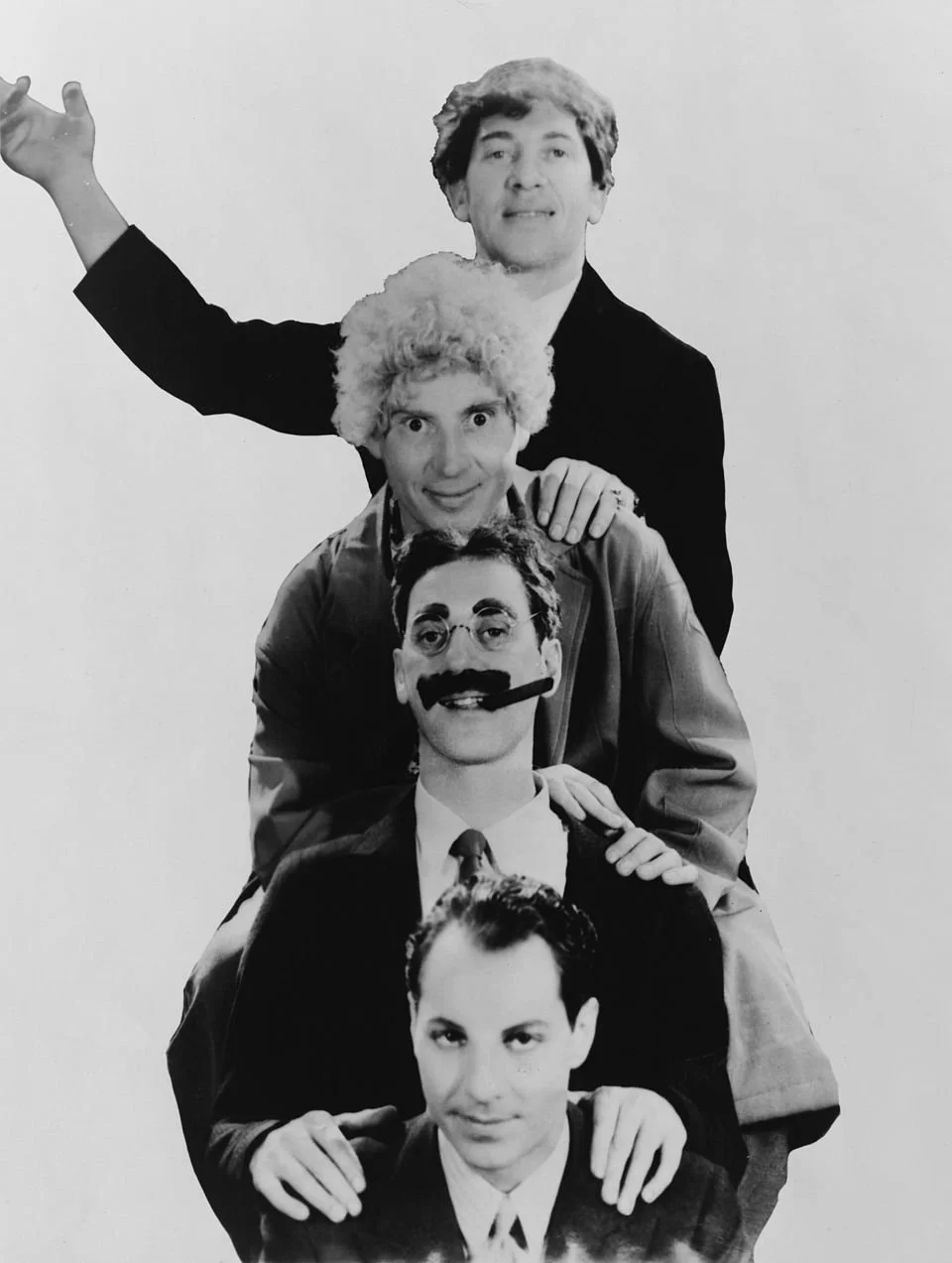
When picturing Hollywood’s first comedic legends, it’s impossible not to include the Marx Brothers. Between the pantomiming, sticky-fingered, musical genius Harpo, piano-playing Italian conman Chico, motormouthed Groucho, or perpetual straight-man Zeppo, this quartet set a new standard for incredible creative talent. That influence lives on today throughout the world…namely in the infamous costume glasses based on Groucho’s signature bushy eyebrows and painted-on mustache.

Andrew Nickerson explains.

The Marx Brothers. Top to bottom: Chico, Harpo, Groucho and Zeppo.

Given how crazy they got on-screen, it shouldn’t be any surprise that their off-screen behavior could get just as insane. However, they hit a new zenith (even by their standards) with an infamous incident during their early days at MGM, one which many would think so over-the-top it’d be impossible. Instead, it’s the definition of truth being stranger than fiction, and it’s time more people knew about it. For the record, this is sourced from the famed documentary Remarks on Marx, as well as a famous 1961 interview with Groucho on The Hy Gardner Show, both of which are quite fascinating.


The Beginning

In the 1930s, the Marx Brothers worked at Paramount Pictures, where they’d had great success with their first four films. Sadly, their fifth, Duck Soup (ironically now called their best work by the American Film Institute), flopped. Worse, they lost their contract due to a money dispute, and many were convinced they were finished; moreover, Zeppo stopped performing, and Groucho even considered leaving too.

Thankfully, they were saved by an unlikely champion: Irving Thalberg at MGM Studios, which was Hollywood’s biggest movie maker at the time. Thalberg, in turn, was a legend himself: he’d become an executive producer at age 30, hence his nickname “The Boy Wonder of MGM”. Furthermore, as Groucho said, “Thalberg, like Sinatra…he was the most feared man of any producer at any Hollywood studio. And people weren’t afraid of Thalberg because he wasn’t a nice guy or anything. He was so powerful because he was so talented…even Mayer (MGM Executive Louis Mayer) was afraid of him.” Apparently, Thalberg knew the brothers through Chico because they played Bridge together, and they’d become very close. So, when the brothers lost their contract at Paramount, Thalberg convinced them to sign on at MGM. After agreeing, he told the brothers to come by his office the next morning at 11 o’clock, and they’d have an initial story conference.


Setting the scene

To understand what happened next requires a little background. Thalberg was working on three projects at that time. He had one director/producer in one room, another such in a second room, and finally the brothers, who were waiting outside his office. Basically, he spent the day running between these locations, having very important meetings each time. However, in the process, he also left the brothers dangling: 11:30 passed, then noon, then 1 p.m. (which is when the brothers left for an hour to eat lunch), and so on. Ultimately, Thalberg’s assistant contacted the brothers at 5 p.m., told them he was sorry he’d been so busy, and they should try to meet again at the same time tomorrow.

Naturally, this didn’t go over well, and it registered even harder the next day, when Thalberg made them wait again. However, around 2 p.m., they got into his office, which not only was enormous, plus had a massive fireplace on the side. At this point, Groucho said, “Look, Mr. Thalberg, we starred in two plays on Broadway, we’ve done five pictures at Paramount. We’re considered very good comedians. So, if you ask us to show up for a story conference at midnight, we’ll be here at midnight. But when you ask us to show up at 11, we want you to see us at 11 or there’s no deal with you at all.” He completely stunned Thalberg. No one ever spoke to him like that because they were all so afraid of him. Thankfully, he took it in stride and made a concession: from then on, when he scheduled a meeting, he’d see them right away. However, they’d start talking about a project, but then, after around twenty minutes, he’d say, “I’ve got to go talk to someone for a few minutes, I’ll be back”…and he’d be gone for three hours. Thus, now they were waiting inside his office. However, it backfired again: the third or fourth time Thalberg did this, the brothers took his file cabinets and stacked them against the two doors to his office so he couldn’t get in—and wouldn’t let him in until 5 p.m. Thankfully, he laughed about it because, as Groucho said, “Now he respected us.”


The Grand Finale

Yet, this was only the prelude to the brothers’ shining moment of glory. The next time he left them like that, they called the cafeteria and had them send up eight baked potatoes. They then lit a roaring fire in the office’s fireplace and took off all their clothes. Thus, when Thalberg came back, there the brothers were, sitting around the fireplace in the buff, toasting the potatoes on the fireplace spits; they even offered one to Thalberg, who ate it. After that, as Groucho said, “He loved us, because no one ever cracked a joke around him because they were all so afraid of him.”

Tragically, their partnership would only last two films (A Night at the Opera and A Day at the Races) before Thalberg died from pneumonia, but they’d go on down in history as the brothers’ highest grossing work. Moreover, it cemented the brothers’ legacy, gave Thalberg a truly novel experience…and Hollywood gained one of its greatest backstories.


Did you find that piece interesting? If so, join us for free by clicking here.

Posted
AuthorHistory Is Now Magazine

Hedy Lamarr may not be as well-known an actress as Greta Garbo or Marilyn Monroe, but she made a more important contribution to society beyond her acting career.  Lamarr had an acting career in Europe, which led her to the area of invention. She then moved to the USA, where she continued her acting career. There she collaborated with another person on an invention that would make a significant contribution to military and electronic technology. Hedy Lamarr was a lesser-known actress but a co-pioneer in the field of modern electronics communications.

Daniel Boustead explains.

Hedy Lamarr for the film Ziegfeld Girl in 1941. Available here.

Hedy Lamarr was born Hedwig Kiesler in Vienna, Austria, on November 9, 1914, to assimilated Jewish parents.[1]  Hedy’s  mother had converted to Roman Catholicism. Her  mother was a concert pianist who encouraged her to pursue the arts. Lamarr’s acting and interest in inventions started then. It was after taking acting classes that Hedy appeared in the Austrian-German film Money on the Street in 1930. In 1933, she played Empress Elisabeth of Austria in the stage play Sissy in Vienna, earning praise and accolades from the critics.

In August 1933, Hedy married Friedrich “Fritz” Mandl, a wealthy industrialist and Austrian arms manufacturer (1). Hedy converted to Fritz’s Roman Catholic faith.  Fritz, because of his business dealings, associated with Europe’s fascist movements, which included Nazi Germany and Fascist Italy.

Mandel supplied ammunition to Fascist Italy and was friends with that country’s leader, Benito Mussolini, who visited for a dinner party (1). It was during these dinner parties that business discussions came up.  Mandl decided to show off his wife, Hedy, by having her sit in on these business dinner meetings.[2] A frequent topic of conversation that came up at Mandl’s meetings was how Mandl’s torpedoes would often completely miss their targets.

What Hedy learned in these business dinner meetings was that the militaries of the time wanted a way to guide torpedoes through the water(2). Although radio control would have helped the torpedoes’ guidance of the day, they could easily be jammed. Fritz Mandl’s Berlin-based munitions factory also dealt with aircraft control systems and the jamming of radio-controlled systems.[3] In the hundreds of dinners and meetings that Hedy attended with her husband Mandl, she learned about radio-jamming and radio-hopping. Hedy, in these various social excursions, learned a lot about the tensions in interwar Europe, and she gained knowledge of arms manufacturing and weaponry (1). These meetings would have a significant impact on the history of electronics and military weapons.


Leaving Austria

In 1937, Hedy was deeply unhappy with her marriage to Fritz Mandl and was unable to pursue her acting career in Austria (1). She left the country for London, United Kingdom, that same year.  She also left Austria because she was an Anti-Nazi of Jewish descent (3). It was there that she met with Louis B. Mayer, the co-founder of Metro-Goldwyn-Mayer (MGM) Studios (1). From London, she boarded the ship SS Normandie for New York. When she arrived in the USA, Hedy changed her name from Hedwig Kiesler to Hedy Lamarr in honor of the silent film actress Barbara La Marr. In 1938, Hedy Lamarr had her breakthrough Hollywood role in the film Algiers. Her biggest film hit was Samson and Delilah in 1949.

Hedy Lamarr’s impact in the field of electronics and military weapons was a result of the U-Boat war against the Allies (1). On September 17, 1940, the SS City of Benares was transporting 90 evacuee children from the United Kingdom to Canada. It was sunk by a German U-Boat. The vast majority of the children and adult passengers died in the attack. Hedy Lamarr was motivated to support the Allied cause because of this incident.

In 1940, Hedy met avant-garde composer George Antheil at a Hollywood dinner party (1). George Antheil was also her neighbor (3).  It was after striking up a friendship with Antheil that they began working on her idea for a remote-controlled torpedo because of the previously mentioned sinking (1). Hedy came up with the idea of using radio-frequency hopping to reduce the risk of detection or jamming for radio-controlled torpedoes (3). Although the concept of radio control for torpedoes was nothing new, the idea of frequency hopping was). Lamarr would use radio broadcasting over an apparently random series of radio frequencies and then switched from frequency to frequency at split-second intervals. This resulted in the radio signals being able to avoid being jammed. The radio receiver was to be synchronized with the transmitter so that the two could jump frequencies together. If both the radio transmitter and the radio receiver were hopping in sync, the message could be transmitted clearly. However, if the opposing force tried to intercept the radio message, it would only hear random noise. The theory of frequency hopping was Hedy’s contribution to the guidance of the new torpedo.


Invention

George Antheil’s contribution to the torpedo was to develop a device inside of it (3). This device had the role of paper, with punched-in holes that allowed both radios in the torpedo to be controlled by the same pattern of holes on the paper.

Hedy Lamarr and George Antheil worked on this idea for several months, and then in December, 1940 sent the description of the device to the National Inventors Council (3). The chairman of the organization was Charles Kettering, who was also the Research Director of General Motors. Kettering suggested that they consult the Electrical Engineering Department at the California Institute of Technology to help refine and perfect their concept.  On June 10, 1941, Lamarr and Antheil filed for a patent application for their invention (1). Hedy Lamarr filed the patent under her married name at the time, Hedy Kiesler Markey. On August 11, 1942, the invention received US patent No. 2,292,387 (1). The U.S. Patent was also referred to as No. 2,292,387A (5). The patent was listed under the title “Secret Communications System”, and it mentioned that a high altitude observation aircraft could steer the torpedo from above (3). Hedy and George sold the patent rights to the U.S. Navy. However, the U.S. Navy said they could not use the device because it was too large to fit into a torpedo. Hedy and George never profited from the device during their lifetime.[4] The concept of frequency hopping largely disappeared after World War II ended.

In 1957, Sylvania Electronics adapted the Antheil and Lamarr patent by using transistors in their device (3). In 1959, the original Lamarr and Antheil Patent expired, including Hedy’s right to the patent.[5]  In that same year, George Antheil died (1). The new device was used on ships that were used to blockade Cuba during the 1962 Cuban Missile Crisis (3). The frequency-hopping spread-spectrum device known by the acronym BLADES was installed on the Mount McKinley, the flagship of the U.S. Navy’s amphibious forces during the Cuban Missile Crisis.[6]  The BLADES device on the Mount McKinley was not tested during the Cuban Missile Crisis due to a radio silence order. The American military also used the concept of frequency hopping in the development of “sonobuoys,” which were used to detect enemy submarines (1). In addition, by the time of the  Cuban Missile Crisis, American military ships had torpedoes which were controlled by frequency-hopping systems.

In 1997, Antheil and Lamarr were jointly honored with the Electronic Frontier Foundation’s Pioneer Award (1). Hedy Lamarr’s son, Anthony, accepted the 1997 award on her behalf and played a message during the ceremony.[7] In the tape-recorded message, Hedy stated: “In acknowledgement of your honoring me, I hope you feel as well as I feel good about it, and it was not done in vain. Thank You”.[8]    The ceremony was held on the evening of March 12, 1997, at the Electronic Frontier Foundation conference in Burlingame, California, outside of San Francisco (7).  Lamarr and Antheil received the Sixth Annual Pioneer Award at the Electronic Frontier Foundation conference.

Hedy Lamarr passed away on January 19, 2000 in Casselberry, Florida at the age of 85 (1).


Legacy

Today, Antheil-Lamarr’s concept is called “Spread Spectrum,” and more than 1,000 Spread Spectrum patents refer back to the Lamarr-Antheil patent (3). Spread Spectrum is now the basis for wireless communications such as WiFi and Bluetooth. These technologies allow devices to operate in the same radio spectrum without interfering with each other’s signals. “Spread spectrum” is also a foundational technology used in military communications technologies, as well as in GPS and phone networks (1).

Hedy Lamarr’s acting career in the entertainment industry did not produce the level of fame that her contemporaries did.  She would escape the clutches of Nazi-occupied Europe and continue her acting career in the USA.  Her collaboration with George Antheil revolutionized the world of electronic communications. Hedy Lamarr was not an “A-list” actress, but, she and George Antheil left a lasting legacy in modern military communications and the modern electronic and digital world.


The site has been offering a wide variety of high-quality, free history content since 2012. If you’d like to say ‘thank you’ and help us with site running costs, please consider donating here.


References

Butler, Alun. “Heady Lamarr, Movie Star and Inventor of Torpedo-control”: Naval Historical Review, (June, 1999), 1-2. Naval Historical Society of Australia, https://navyhistory.au/hedy-lamarr-movie-star-and-inventor-of-torpedo-control/.

IEEE  Standards Association. .”Actress/Inventor Hedy Lamarr-and How Far Wireless Communications Has  Come”. June 23rd, 2023. Accessed  March 18th, 2026, https://standards.ieee.org/beyond-standards/hedy-lamarr/.

Lansberg, Erica. “Hedy Lamarr’s WWII Invention Helped Shape Modern Tech”. The National WWII Museum New Orleans, April 23rd, 2025, https://www.nationalww2museum.org/war/articles/hedy-lamarrs-wwii-invention-helped-shape-modern-tech.

National Inventors Hall of Fame. “Hedy Lamarr: Frequency Hopping Communications System”. 2016. Accessed March 18th, 2026. https://www.invent.org/inductees/hedy-lamarr.

Rhodes, Richard, Hedy’s Folly: The Life and Breakthrough Inventions of Hedy Lamarr: The Most Beautiful Women in the World. New York, New York: Vintage Books: A Division of Random House, Inc., 2011.

Wolf, William, U.S. Aerial Armament in World War II: The Ultimate Look: Air-launched Rockets, Mines, Torpedoes, Guided Missiles, and Secret Weapons. 3 vols. Atglen, Pennsylvania: Schiffer Military History of Schiffer Publishing Ltd, 2010.


[1] Lansberg, Erica. “Hedy Lamarr’s WWII Invention Helped Shape Modern Tech”. The National WWII Museum New Orleans, April 23rd, 2025, https://www.nationalww2museum.org/war/articles/hedy-lamarrs-wwii-invention-helped-shape-modern-tech .

[2] Butler, Alun. “Heady Lamarr, Movie Star and Inventor of Torpedo-control”: Naval Historical Review, (June, 1999), 1-2.  Naval Historical Society of Australia, https://navyhistory.au/hedy-lamarr-movie-star-and-inventor-of-torpedo-control/ .

[3] Wolf, William,  U.S. Aerial Armament in World War II: The Ultimate Look: Air-launched Rockets, Mines, Torpedoes, Guided Missiles, and Secret Weapons. 3 vols. Atglen, Pennsylvania: Schiffer Military History of Schiffer Publishing Ltd, 2010. 105.

[4] National Inventors Hall of Fame. “Hedy Lamarr: Frequency Hopping Communications System”. 2016. Accessed March 18th, 2026. https://www.invent.org/inductees/hedy-lamarr .

[5] IEEE  Standards Association. .”Actress/Inventor Hedy Lamarr-and How Far Wireless Communications Has  Come”.  June 23rd, 2023. Accessed  March 18th, 2026, https://standards.ieee.org/beyond-standards/hedy-lamarr/ .

[6] Rhodes, Richard, Hedy’s Folly: The Life and Breakthrough Inventions of Hedy Lamarr: The Most Beautiful Women in the World. New York, New York: Vintage Books: A Division of Random House, Inc., 2011. 200.

[7] Lansberg, Erica. “Hedy Lamarr’s WWII Invention Helped Shape Modern Tech”. The National WWII Museum New Orleans, April 23rd, 2025, https://www.nationalww2museum.org/war/articles/hedy-lamarrs-wwii-invention-helped-shape-modern-tech.; Rhodes, Richard, Hedy’s Folly: The Life and Breakthrough Inventions of Hedy Lamarr: The Most Beautiful Women in the World. New York, New York: Vintage Books: A Division of Random House, Inc., 2011. 214.

[8] Rhodes, Richard, Hedy’s Folly: The Life and Breakthrough Inventions of Hedy Lamarr: The Most Beautiful Women in the World. New York, New York: Vintage Books: A Division of Random House, Inc., 2011. 214.

Posted
AuthorHistory Is Now Magazine

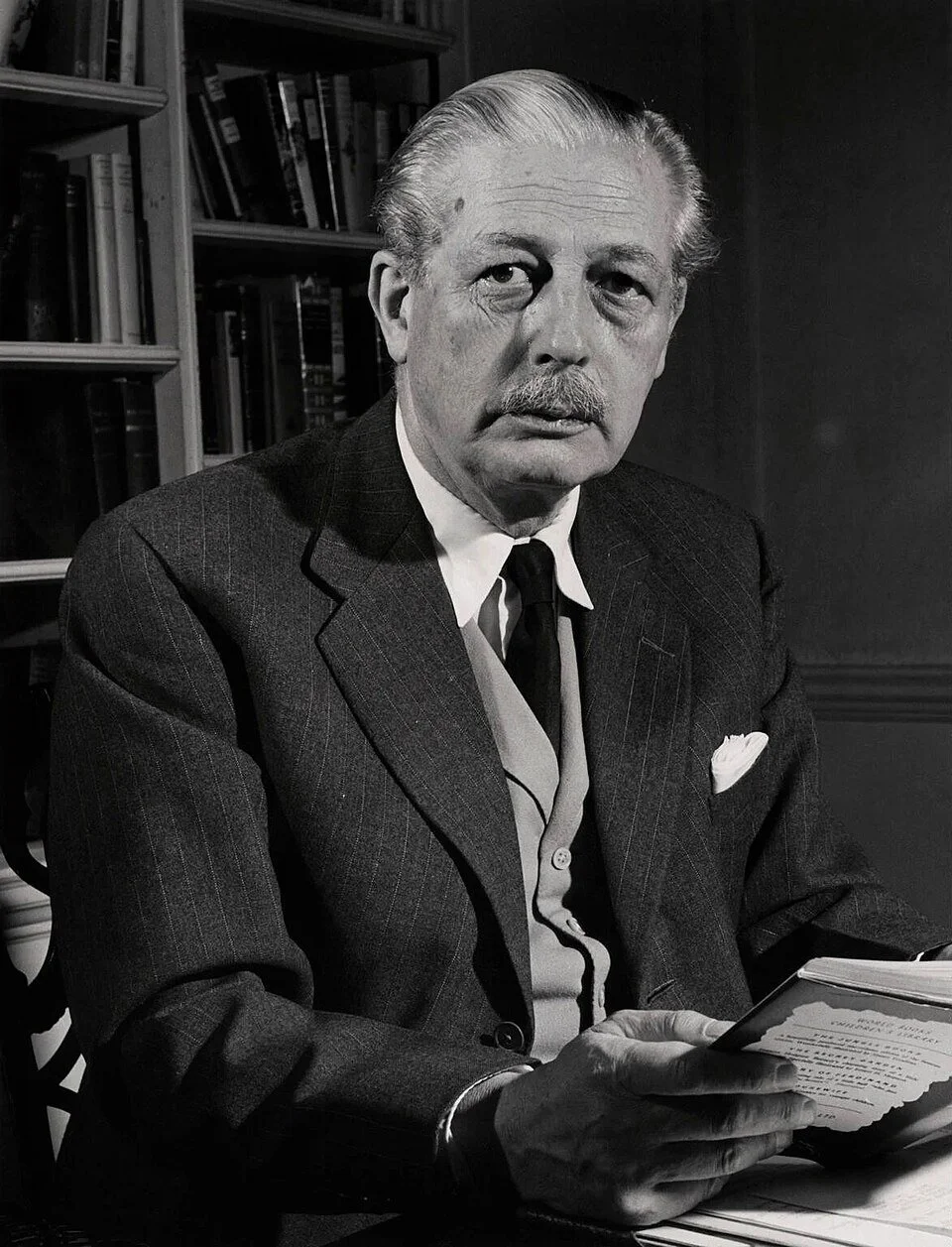
In 1957, the then British Prime Minister Harold Macmillan famously asserted that “most of our people have never had it so good;” an oft-quoted claim that very much captured the spirit of the times. In the twenty years or so following the end of the Second World War, the average Briton witnessed a substantial growth in their real earnings, which went up by an estimated 50% from 1951 to 1964, and would continue to climb until the end of the 1960s.

Vittorio Trevitt looks at Britain’s affluent society.

British Prime Minister Harold Macmillan in 1959.

The post-war boom in Britain translated into a steady rise in consumer expenditure and widespread penetration of leisurely items such as record players, transistor radios, and TV sets. Although consumer products could not always be acquired or purchased outright, with facilities like hire purchase and mail order catalogues enabling buyers to spread the cost over a period of time, this was definitely something new. For the first time, most Britons came to acquire a level of spending power high enough to obtain a wide range of home comforts; something that ordinary people in previous decades could only dream of. To some extent, it was a sign that the hardships and sacrifices of the war years had given way to a happier, brighter tomorrow.

Britons came to have more time for recreation, helped by an extension of paid leave and reductions in working hours for an increasing percentage of the workforce, with more people embracing the opportunity to take holidays outside their home environment; whether on camping sites or on overseas excursions. Although a visit to the seaside was the most common form of holiday, as it had been for years, more and more people went abroad for their holidays; the number taking this opportunity going up sevenfold during the Fifties and Sixties and the amount spent on such trips more than tripling. Greater wealth also meant that there was greater propensity for households to save, with savings as a percentage of disposable income rising more than twofold over the course of those two decades. Aware of this trend, the government introduced in 1956 a novel savings scheme known as Premium Bonds.  More than four in ten Britons would come to own bonds of their own, which was a development arguably attributable to holders being offered the chance to win cash prizes; a popular incentive for purchasing these bonds.


Signs of affluence

Much of the new consumerism was embraced by teenagers, whose personal wealth enabled them to spend their spare cash on items like fashion, personal transport, and records (with 85.5 million LPs sold alone in 1963) and at meeting places like coffee bars, cafés and dance halls, with 5 million people attending the latter weekly by the early Sixties; a 40% increase since 1951. As a sign of the changing times, an increasing proportion participated in sporting activities once solely the preserve of the elite, such as mountain climbing and skiing. Children tasted the fruits of growing consumer prosperity, with yearly expenditure on average children for entertainment reaching just over an estimated (in contemporary money) £415 by 1956, with toys making up a third of this sum. Women were also beneficiaries of the consumer boom, with their daily lives made easier by the spread of appliances like fridges, washing machines and vacuum cleaners, while people in general devoted more time to the comfort and appearance of their residence, such as through gardening and decorating. One symbol of affluence, the automobile, also came within the reach of an increasing number of homes. At the start of the Fifties, less than a fifth of households had a car, but by 1970 the majority had at least one.

The new prosperity was supported by government policy, as exemplified by cuts in taxation, the liberalisation of credit, and (symbolically for a nation that had lived with it for so long) the abolition of rationing. In addition, more opportunities became available for workers to switch to more preferable occupations, while both price rises and the rate of joblessness were kept to a minimum; adding to a sense of general wellbeing. The more prosperous economic climate led to a decline in the reliance on traditional forms of credit like ‘tick’ by corner shops and transactions with pawnshops; institutions that had previously flourished during the Nineteenth Century. In a diary extract from April 1969, the (then) social security minister Richard Crossman reflected on the spread of mass prosperity since the Forties, arguing that Britain had transformed itself “into a place where the majority are well off and the minority are poor.”


Global trend

Britain’s rise to mass affluence was not unique, however. It was, in fact, part of a wider global trend. Across the developed world, nations like Norway, France, and Germany witnessed considerable increases in personal incomes, which was accompanied (like the UK) by a growth in the percentage of households equipped with consumer durables. Developing nations like Venezuela witnessed a growth in the size of their consumerist middle classes, while the far-eastern states of Singapore, South Korea, Taiwan and Hong Kong experienced a period of strong economic growth that would earn them the moniker of the “Asian Tigers.” Similar to South Korea’s authoritarian neighbour North Korea and most contemporary African nations like Comoros and the Central African Republic, these four states at mid-century lagged far behind their Western counterparts in terms of social and economic development. But by the end of the Nineties high growth rates, supported by investments in education and industrial development, culminated in a huge improvement in the quality of life of ordinary people, who obtained a degree of material affluence comparable to that long enjoyed by most of their counterparts in the British Isles.

Despite these positive trends, poverty (like today), remained a tragic reality for many. One only needs to see the pictures of slum housing during the Fifties and Sixties, together with stories of low earnings and households lacking the money to afford essentials like new clothes (such as children’s shoes), adequate heating and a good diet, to be aware of this. In 1966, it was estimated that nearly one in five of all householders lived (as noted by one journal) “below any current definition of subsistence.” Also, at the time of Macmillan’s statement, it was hard to describe most Britons as having attained affluence by then, given the fact that earnings for the majority of people did not enable participation in the fruits of what was described as the “Affluent Society.” Regional inequalities (which had long been a negative feature of the British economy) continued to persist, with some parts of the country benefiting more from post-war prosperity than others. Britain also fell behind several Western European nations in terms of individual income growth, with the purchasing power of wages in the European Economic Community (the predecessor of the EU) rising by 35% more than the UK from 1958 to 1969.

It is also worth remembering that living standards today are generally higher. The ownership of televisions and central heating is now practically universal, whereas at the dawn of the Seventies the former was mostly rented by those who had one while the latter was still a luxury, with most households relying on other means at different times of the day like coal fires, paraffin heaters, hot water bottles and multiple blankets to stay warm. Households have also come to enjoy a multitude of new gadgets for education, health and entertainment, including video games, personal computers, and mobile apps, while streaming services have provided people with a far greater choice of programming than ever before. Similarly, the telephone, an item that comes in many forms today, was something that only existed in a minority of homesduring the Sixties, with most people using public phone boxes for making calls.


Conclusion

None of this negates, however, the tremendous rise in living standards following the return of peace in Europe. By the end of the Sixties, most Britons had attained an affluent lifestyle; one that has only continued to improve to the present day with the accumulation of new and better items and overseas travel now the norm rather than the exception as had been the case for the average Briton growing up in the two decades after VE Day. While post-war affluence remained out of reach for millions of Britons, it nevertheless became a positive reality for most. At a time when many are concerned about the current state of the economy, the emergence of the post-war affluent society is a period of British history worth celebrating and remembering.


The site has been offering a wide variety of high-quality, free history content since 2012. If you’d like to say ‘thank you’ and help us with site running costs, please consider donating here.

The South Atlantic’s Bouvet Island doesn’t have deadly snakes, un-contacted tribes, the risk of radiation poisoning or past human wartime horrors. It’s story is frozen in the harsh climate that envelopes the island and some of its greatest mysteries lost in the dangerous weather conditions and even blizzards of the Sub-Antarctic. Not only does no one live there — it’s likely that no one could.

Michael Thomas Leibrandt explains.

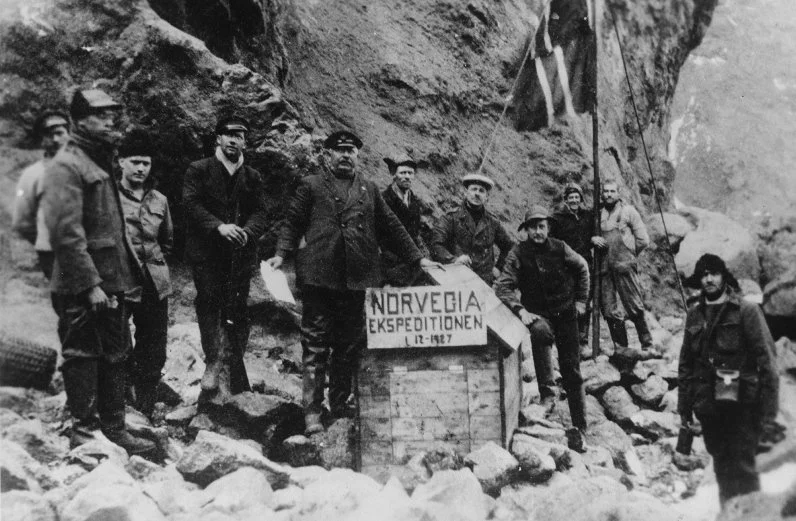
Norweigans on Bouvet Island in 1927.

Bouvet — formed as a Sub-Antarctic volcanic island — is one of the most remote, uninhabited island on earth. It lies nearly 1,100 miles from Queen Maud Land in Antarctica and some nearly 1,600 miles southwest of South Africa. Over 90% of the island itself is covered by glaciers and a volcano that is estimated to have last erupted in 2000 BCE. Its tallest peak is Olavtoppen at over 2,500 feet and the island’s only demarcation point is Nyroysa — on the Northwest Coast.

Humans first recorded discovery of the island was on New Year’s Day, 1739 — when two French vessels trying to validate the presence of a large southern continent (Antarctica) spotted Bouvet. Jean-Baptiste Charles Bouvet de Lozier would make two crucial mistakes in this discovery. First — he did not map the location of the island correctly and also did not sail around it to validate that it was indeed an island. Explorers like James Cook led expeditions to find the island but could not.

It would be nearly forty years later when Captain James Lindsay aboard the Whaler Swan and accompanied by anothership called Otter found the island in 1808. Benjamin Morrell aboard the Wasp claimed to have landed on the island and hunted seal — but his physical description of the geography has left some speculation about the validity of his claim. 

Between 1822 and 1895 — a number of vessels attempted to visit the island — but most could not land due to the geography. In December 1825,  a British exploration team landed on the island and claimed it for the Crown. The island was named Liverpool and a second island some fifty miles north was also identified. 

Thompson island was also confirmed by an expedition in 1893; however, from 1898  no one else saw the island. Maps continued to show Thompson Island until 1943 — and in 1967 it was hypothesized that the island ceased to exist during a volcanic explosion. Either way — it has never been seen since.

In 1927 — on an expedition supported including financially by Lars Christensen — the first Norvegia Expedition landed on the island with Harald Horntvedt in charge. After a flag was placed and a hut erected,  Norway claimed the island in January of 1928. This led to diplomatic issues with the United Kingdom who finally withdrew their claim in 1929. Norway launched subsequent expeditions, and protected all of the seals on the island and in 1971,  the island was made a protected nature reserve. 

In 1964,  a strange discovery was made. The British vessel HMS Protector landed a survey team on the island. In a small lagoon, the team found an unoccupied lifeboat and barrels. After a brief search, no other signs of human life were found and the discovery has remained a mystery. In September 1979, the US Vela Hotel Satelite 6911 recorded a double-flash in the area between Bouvet Island and the Prince Edward Islands. This  has been theorized to most likely be a joint nuclear testing operation between Israel and South Africa.

Major General Sir Nils Olav III (Edinburgh Zoo’s King Penguin) is also known as Baron of the Bouvet Islands. The island is also the setting for the 1989 film, Alien vs. Predator. Bouvet Island — a place that most will only be able read about — sits with its fog and howling winds as one of the most uninhabited, unreachable, unlivable, remotest places on earth.

Oh and that lifeboat discovered in 1964? Without explanation by 1966,  it had disappeared as well — and has been shrouded in mystery ever since.


Michael Thomas Leibrandt lives and works in Abington Township, PA.

Aviatrix Mary Jayne Gold came from a prominent Chicago family. Under the Gestapo’s nose in Marseilles, she helped save thousands from Hitler’s concentration camps, all while carrying out a brazen l’affaire de guerre with a cutthroat French-American commando. In part 3, we look at how she waged war against Hitler’s Reich. Timothy M. Gay explains.

Part 1 is here and part 2 is here.

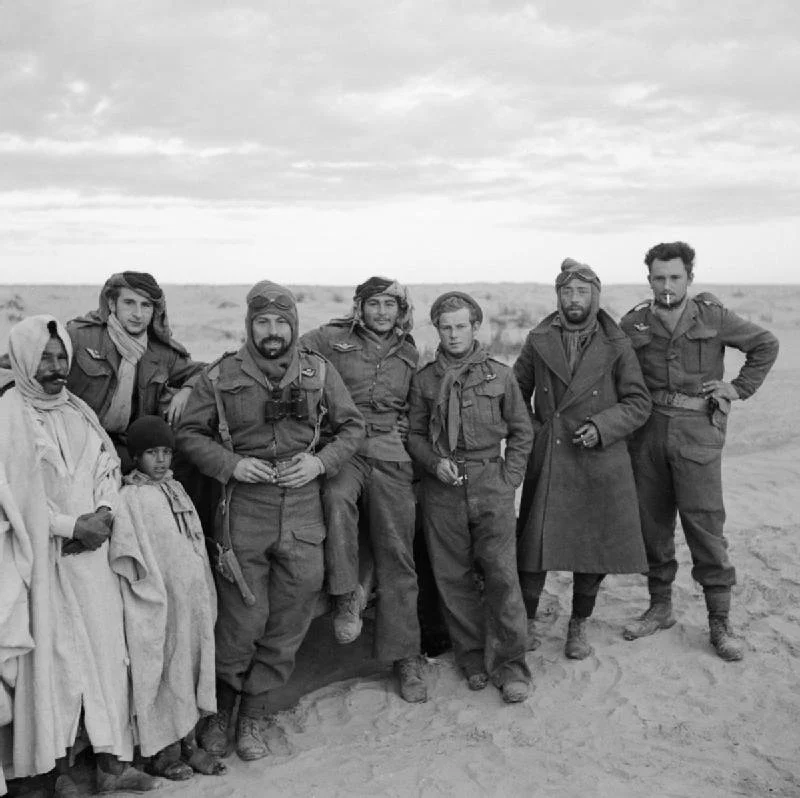
The SAS French Second Squadron in Tunisia, 1943.

Once war broke out in 1939, Mary Jayne Gold donated her plane to the French air force and never saw it again. In the spring of 1940, with Hitler’s blitzkrieg closing in on Paris, Gold was forced to abandon her posh lodgement on the Avenue Foch to join the exodus of panicked refugees heading south by rail, foot, and automobile. En route to Marseilles, she and her dachshund Dagobert were entrusted with the care of the toddler son of close friends.

While fleeing south, Mary Jayne bumped into Miriam Davenport, an American sculptor and painter soon to be hired by Fry to work on emergency relief activities. Davenport recognized that Gold and her deep pockets could be of immense value to the Fry operation. Soon after her arrival in Marseilles, Gold joined Davenport in helping Fry hector Vichy officials and collude with Resistance heads.

Davenport and Gold that August were also conspiring to help three handsome ex-French Foreign Legionnaires whom Miriam had befriended while waiting in line at the U.S. consulate.

Two of the soldiers were onetime American journalists who had enlisted in the Legion to experience a grand adventure and help beat back Hitler and Mussolini. That adventure had included being pummeled by the Nazis in Norway and watching the nightmare repeat itself a few weeks later in France.

The third ex-Legionnaire was the leathery-faced Raymond Couraud, who had lied about his age (he was only 16 when he signed up) to avoid being rubbed out by his rivals in the French mob. Four years later, Couraud had earned a reputation as a kick-ass infantryman, winning plaudits in both Norway and France. Vichy wanted Couraud fighting for the pro-Nazi side; Couraud wanted nothing to do with them.

*

Under Marseilles’ azure sky, the four young Americans and their French-American friend became inseparable, finding plenty of ways to make mischief despite the war. They pretended to ignore the gendarmes tailing them as they bounced from bistro to café and back again.

“It’s a shame there’s a war on, otherwise we’d be having a hell of a time,” they would snigger while quaffing wine and beer at the Pelikan Bar, which had a breathtaking view of the Mediterranean. With Gold paying the freight, there was no shortage of Burgundy, or Rouge Rhône, or frothy brew served in a foot-high flute affectionately known as a “Formidable.”

After midnight, the gang would repair to Gold’s suite at the Continental, where the radio – if the knobs were finetuned just so – could reel in the forbidden BBC and its nightly wrap-up of war news. Britain in those perilous days was hanging by a thread. Each time the wireless crackled, they feared it meant Hitler had launched the cross-Channel assault that would finish off the Brits. Every day that passed without a German invasion brought a sliver of hope that Britain might survive.

The fivesome caused quite a stir as they bustled through the alleyways of Le Vieux-Port, two American femmes, one tiny, one tall, escorted by the three exiles from the FFL. They would babble in French one minute, English the next.

Couraud may have suffered from paranoia (among other mental illnesses), but that didn’t mean that Marseilles’ cops weren’t spying on him and his pals. As Vichy suspected, the ex-Legionnaires and their American enablers were indeed plotting ways to escape the South of France so they could rejoin the Allied fight.

The women were helping them run the traps on buying (or stealing) a boat and sailing it to British-held Gibraltar, or hopping a freighter anchored in Marseilles harbor, or hiking southwest under the cover of darkness and sneaking through a gap in the Pyrenees Mountains into neutral Spain.

Feigning nonchalance, the five of them combed Marseilles’ bookstores and novelty shops for nautical and topographical charts. They hid the maps in Gold’s suite. Sipping Scotch, they would pore over potential escape routes while huddled in front of the radio in those post-midnight BBC sessions.

Without Gold’s cash and bravado – not to mention Couraud’s dodgy connections to the Marseilles underworld – Fry’s Centre Américain de Secours (American Relief Center) would not have been nearly as effective. Gold’s rental of Villa Air-Bel, a decrepit château on a farm outside Marseilles, provided food and shelter to scores of transients and gave Fry a home base to foil Vichy henchmen – at least for a time. In many ways, Couraud and Gold became the “real Rick and Ilsa,” star-crossed lovers caught in a maelstrom but remaining devoted to the Allied cause.

Couraud never stopped being a thug and a gigolo, but he served with distinction in Britain’s two leading cloak-and-dagger outfits: the ultra-secret Special Operations Executive (SOE) and the highly irregular (and misnamed) Special Air Service (SAS). In both capacities, he was repeatedly sent behind Axis lines as a spy, a Resistance partner, and a liberator of Allied prisoners-of-war.

Despite earning commendations at every turn, he was expelled from both units for insubordination. Worse, at war’s end he was court-martialed for dereliction of duty and an abhorrent breach of conduct. The charge was eventually lessened but the episode remains a stain on his record.

  *

Raymond William Jacques Couraud, a.k.a. “Captain Jack William Raymond Lee,” was a Zelig-like hero in the underground war against the Nazis. Couraud-Lee and his thick-rimmed specs popped up all over the European and Mediterranean Theaters – usually with a Sten gun and a string of grenades strapped across his shoulders.

Wounded three times, he survived scores of bloody skirmishes on two continents with Wehrmacht and Regio Esercitoregulars, not to mention Gestapo henchmen, Vichy mercenaries, hostile guerillas, and black-market thugs.

Twice captured and imprisoned, he endured beatings at the hands of Fascist policemen in both the South of France and Spain. Five years and two dozen harrowing missions later, he was among the first Allied soldiers to enter Paris in the throes of liberation. After the war, he was not only awarded a number of the United Kingdom’s highest military honors, but King George VI personally conferred on him the British Defence Medal.

Yet Couraud was so lippy and irascible that he was tailed by military gumshoes almost everywhere he went while stationed in England. To this day, Couraud stirs ambivalence among the scholars who study Allied special operations. None question his élan, but some view him as a poseur, others as a grandstander – and a crook and playboy to boot. Couraud’s military personnel file at the British National Archives is full of innuendo about reckless behavior.

His story reads like something concocted in Hollywood, a surreal combination of Sergeant York, Audie Murphy, and Casablanca, plus a healthy dose of Scarface. The son of a wayward Broadway showgirl and a ne’er-do-well French dairyman turned arms merchant, Couraud was deserted by his parents and left to be raised by his paternal grandparents (and eventually, his father’s brother) in a small village in France’s Aquitaine province.

In his early teens, Couraud moved to New York City to live with his mother, Broadway showgirl Flora Lea Bowen. But the boy apparently quarreled with her and her theater-producer husband and was sent packing back to Surgeres. His mother’s rejection left the youngster with emotional scars that lasted a lifetime.

While still in early adolescence he ran away to the Riviera. He soon joined a gang of organized crime ruffians and began smuggling hookers and contraband across the Mediterranean to North Africa. Couraud incensed the Corsican mafia by starting a rival prostitution ring in Cairo; before long, there was a price on the teenager’s head.

To elude his mobster enemies, he lied about his age and joined the French Foreign Legion. Couraud spent two-plus years digging latrines and patrolling restless French colonies in North Africa and the Near East.  

In May of ‘40, after Hitler unleashed his stormtroopers against France and the Low Countries, Couraud and other Legionnaires were rushed back from Norway and thrown against the blitzkrieg north of Marseilles. The overwhelmed French army quickly collapsed; Couraud, hellbent on not being conscripted by Vichy, deserted the FFL and went into hiding in Marseilles.

With Gold’s help, he escaped to Spain, where he was arrested and confined. After gaining his release, he made his way to Gibraltar and eventually to England, where he joined Britain’s Special Operations Executive. He went on a number of early SOE missions to buoy French Resistance cells but got into hot water thanks to his intemperate attitude.

Lord Louis Mountebatten, a senior officer in the Royal Navy, invited Couraud to participate in the March ’42 raid on the Nazis’ naval repair base at Saint-Nazaire on the French Atlantic coast. Couraud, the only Frenchman on the mission, was wounded in both legs and dragged onto a retreating British ship. He spent months recovering in a Falmouth hospital.

  *

By January of ’43, SOE had tired of Couraud, transferring him to the newly formed 62nd Commando unit, which was soon folded into the Second Regiment of Colonel David Stirling’s Special Air Service (SAS) Regiment.            

SAS’s mission was to make life miserable, by any means necessary, for enemy combatants, which at that point in the war meant the Mediterranean Theater. Its Second Regiment was a small-scale raiding force that spent the next 14 months bushwhacking Axis soldiers from Sardinia to Tunisia.

Sometimes, Couraud and his SAS men parachuted behind Axis lines; at other times they flummoxed the enemy by using jeeps or attacking from the sea via rafts launched from submarines.  SAS’s target was often an enemy airstrip or naval port; other missions blew up rail tracks or big fuel depots.

SAS was so successful that it soon tripled in size. A new French SAS Second Squadron was formed, with Captain Lee/Couraud in command and other former Legionnaires assigned to key capacities. On at least 17 occasions, Couraud and his men were dispatched behind enemy lines.

In May of 1943, Couraud took advantage of the Churchill Act and became a U.K. citizen, albeit situated 1,300 miles from Piccadilly. Four months later, his Second Squadron provided crucial reconnaissance in Operation SLAPSTICK, the British Eighth Army’s assault on Taranto. Attacking in jeeps that had been deposited on a nearby beach, Couraud and his men blew up roads, bridges, and airdromes, liberating hundreds of Allied prisoners and stealing tons of supplies.

During a night-time amphibious raid on Italy’s Adriatic coast in mid-September, enemy artillery destroyed Couraud’s landing craft, killing several commandos. Couraud was wounded in both shoulders and hospitalized, but only for a few days. Two weeks later, he helped lead a stunning assault on Camp 59, a POW compound outside Termoli. Scores of Allied officers were freed, sparing them from the Axis machine gun squads stalking the Italian countryside. 

In early October, Couraud’s commandos ambushed a German convoy near Chieti, then shielded the leading edge of General Bernard Montgomery’s host as it approached the River Sangro. Amid these audacious missions, Couraud hatched a plan to steal gold bullion from the Bank of Italy branch in Chieti. Fortunately for the Allies, Couraud’s crooked scheme was rebuffed by an SAS superior.

In late winter 1944, most of the Second Squadron was ordered back to the U.K. to prepare for special ops missions related to the cross-Channel invasion. When Churchill, Montgomery, and the Allied high command approved the formation of an elite squad to be deployed against Field Marshall Erwin Rommel, the head of German forces in Normandy, the SAS put Couraud in charge.

Couraud headed a seven-man unit that spent weeks training in Scotland and England for what became Operation GAFF, a hush-hush maneuver to kidnap or kill Rommel in the aftermath of the invasion.

Like many of the war’s covert operations, GAFF got its title from Churchill; the Prime Minister loved to give his favorite special ops colorful codenames. A “gaff” is an outsized hook; in Churchill’s youth, it was also the term for the backstage vaudeville device used to abruptly remove an unpopular entertainer.

For most of the next half-century, GAFF remained a closely guarded secret. It wasn’t fully divulged until decades after the war when long-suppressed SAS intelligence files were released by the British National Archives.

It’s clear from the files that GAFF’s hoped-for object was to capture Rommel alive and bring him back to Britain. Not only would kidnapping Rommel provide the Allies with a propaganda coup, but his presence would have served a larger purpose. Allied intelligence may well have hoped that Rommel could be positioned as the leader of a “new” Germany in the event of Hitler’s demise. Rommel was a beloved figure in the Fatherland; he was perhaps the one German general who could have persuaded his countrymen to lay down their arms.

British and American intelligence had known for months that Wehrmacht officers (among them Rommel’s chief of staff, General Hans von Spiedel), together with civilian members of the German Resistance, were plotting to kill Hitler. Couraud’s team was scheduled to drop not far from Chateau La Roche Guyon along the Seine, the site of Rommel’s headquarters, on July 18, 1944, two days before the attempt on Hitler’s life was carried out at Wolf’s Lair in East Prussia.

Bad weather, however, appears to have delayed GAFF’s jump-off for a week, although chronological accounts of the mission differ. By one reckoning, some 72 hours after parachuting into a wooded area north of Orleans, Couraud and his men learned from Resistance sources that Rommel had been severely wounded on July 17 by a British fighter plane that had strafed his staff car. By late July, Rommel was back in Germany, recovering in a hospital and awaiting Der Fuhrer’sinevitable revenge, which came that fall in a visit from the Gestapo. The field marshal who once exercised “hypnotic” control over Hitler was forced to swallow a cyanide capsule for his complicity in the assassination plot. 

Once Allied intelligence confirmed that Rommel had been removed from France, GAFF was scrubbed, which is puzzling. If GAFF’s goal was to remove the enemy commander in Normandy, why not pursue Rommel’s successor, Field Marshal Gunther von Kluge? Von Kluge was from a distinguished Prussian family and had, like Rommel, been awarded an Iron Cross in the Great War. His 1940 exploits in Poland and France were almost as admired as Rommel’s legerdemain in North Africa. Surely, kidnapping or killing von Kluge would have represented a significant feat for the Allies. The high command’s decision not to go after von Kluge suggests that a different agenda had been in the offing.

Couraud and his men put their time behind enemy lines to destructive use. They ambushed two trains and seven trucks and harassed German units scrambling to contain General Omar Bradley’s Operation COBRA, the Allied breakout from hedgerow country. Captain Lee also led a wild nighttime assault on a German intelligence and police command post at Mantes-la-Jolie that inflicted a dozen fatalities, paved the way for Canadian troops to capture the village, and yielded a cache of important papers on German troop deployments in northern France.

Wearing a pilfered uniform, Couraud disguised himself as a gendarme and maneuvered on foot through enemy lines to Pontchartrain, reaching General George S. Patton’s U.S. Third Army on August 12. After sharing information seized at Mantes-la-Jolie, Couraud stayed with the Third Army for several days, plotting with local Resistance leaders and providing Patton’s staff with intelligence on German strongholds.

He then pulled the stunt that eventually got him court-martialed. Without obtaining permission, he helped Alfred Kraus, the son-in-law of a prominent British socialite and a double agent with ominously close ties to the Gestapo, escape from France to England. The day after Couraud and Kraus’ plane arrived in the U.K. amid much teeth-gnashing from British intelligence, Couraud was ordered back to France to help spearhead SAS’ Operations WALLACE and HARDY, a series of ballsy hit-and-run raids – plus one pitched battle at Chȃtillon – that hobbled the retreating Wehrmacht.

Under the overall command of famed SAS Colonel Roy Farran, the men and their machine gun-mounted jeeps crash-landed into northern France. Farran split the group in two. Couraud’s contingent wreaked havoc around Orleans; Farran’s team spread chaos 120 miles west near Rennes. Between them, they wrecked two dozen enemy staff cars and three dozen trucks, half-tracks, and troop carriers, destroyed tens of thousands of barrels of petrol, derailed a passel of trains, and inflicted more than 500 casualties.

Farran’s group eventually met up with Couraud’s near the village of Langres, 200 miles southeast of Paris, from which they launched one lethal raid after another. Couraud was held in such high esteem by his fellow Frenchmen that in late August he was given an exalted position in the liberation of Paris, near the tip of the French armored advance. He wrote to Mary Jayne that he found her old apartment on the Avenue Foch, went inside, and spent time reminiscing about their romance as La Libération raged outside. Following his court-martial that fall, he was dismissed from the British Army, whereupon he joined the French Army General Staff.

After the war, Couraud continued his martial (and often malicious) ways, running guns in some of the world’s hotter spots, advising the French army as it struggled to quell uprisings in Algeria and other colonies, and serving as military consigliere to a rajah on the Indian subcontinent.

At some point, he separated from Katherine Davies, his well-connected British wife, to marry a Frenchwoman named Hélène Louise Nancy Debono. She was the surgeon who had patched him up after he was wounded in the Termoli raid. Alas, it does not appear that Couraud obtained a divorce before his second nuptials, so “bigamist” can be added to the disquieting credentials in his bio.

After fathering two sons with Debono, he apparently left her late in life to return to Davies. He spent his twilight years with Davies, shuttling between Surgeres, his family’s ancestral village in the southwest of France, and Cornwall in the southwest of England. One of his sons, also named Raymond Couraud, is a World War II historian of note who’s written extensively about D-Day. Couraud junior now describes his father as a man of mystery, a schemer who deliberately built layers of intrigue and deceit around almost everything he did in life.

Couraud died in 1977, 35 years after being dragged off the Nazis’ Saint-Nazaire naval base with wounds to both legs. He is buried in a small cemetery in Vouhé, not far from his hometown. His gravestone lauds his bravery as a soldier and his loving heart.

The only book written about Couraud was done by an Italian historian named Silvio Tasselli. His Captain Lee, which focuses on the Mediterranean exploits of the SAS French Second Squadron, was privately published and has sold only a handful of copies in the U.S. and Britain. A French historian has written an account of the SAS’s Second Squadron that’s also difficult to find. Moreover, most SAS histories, including Ben McIntyre’s popular Rogue Heroes, do not give Couraud-Lee his due.

Although Killer’s role in the Marseilles Resistance was highlighted in memoirs written by Gold, Davenport, and Fry, and acknowledged in more recent accounts of the Fry cell’s heroics, Couraud remains an enigmatic and divisive figure.

After the war, Couraud and Gold had reunions in the South of France and Quebec, but it’s not known if the romance was rekindled – or if Couraud owned up to the fact that he was married, perhaps twice over. A French filmmaker has tried to turn Gold’s memoir, Crossroads Marseilles 1940, into a film, but to date the project has not gotten off the ground. Gold’s book, edited at Doubleday by Jacqueline Kennedy Onassis, proved far more popular in France than the U.S. A 2023 Netflix series called Transatlantic was loosely based on Mary Jayne’s story, but it eliminated the Davenport character and distorted the Couraud character.

After the war, Davenport ended up accompanying her college professor husband to Iowa, where she taught French and art. Couraud, for his part, could never get out of his own shadow. He was jailed at least twice after the war, for stealing jewels and art. In the postwar years, Mary Jayne bought a chalet in the South of France with a garden that looked like a Cezanne watercolor. She spent most her time there with occasional trips to New York and Chicago.

Gold told interviewers late in life that the nefarious “Killer” was the only man she ever truly loved. Their coupling was anaffaire de guerre, a yen for danger and passion that animated her entire life. Her father would have approved.


Did you find that piece interesting? If so, join us for free by clicking here.


About the Author

Timothy M. Gay is the author of two critically acclaimed books on World War II: Assignment to Hell: The War Against Nazi Germany with Correspondents Walter Cronkite, Andy Rooney, A.J. Liebling, Homer Bigart, and Hal Boyle(NAL/Penguin, 2012) and Savage Will: The Daring Escape of Americans Trapped Behind Nazi Lines (NAL/Penguin, 2013). Tom Brokaw called Assignment to Hell, which was nominated for a Pulitzer, a Bancroft, and an American Book Award, “a book every modern journalist – and citizen – should read.” Historian Marcus Brotherton wrote that Savage Will was “powerful, intriguing, well-researched, and fierce.”

Gay’s lengthy article on the citizen response to the Nazi U-boat threat in U.S. waters early in WWII was featured in a pandemic-inspired special issue of American Heritage called “America in Crisis.”

He has been featured on PBS’ “History Detectives” and contributed on-camera and off- to two documentaries – one on Walter Cronkite’s coverage of the Kennedy assassination, the other on Lyndon Johnson’s legacy on civil rights – which have appeared in Britain and the U.S.

His latest book is RORY LAND, a biography of golf superstar Rory McIlroy. It looks at McIlroy’s life through the prism of Ireland’s sectarian Troubles that devastated both sides of his family. 


Endnotes

“Some bastard weaseled on him!” and the other references to the circumstances surrounding Couraud’s arrest comes from Gold’s memoir, Crossroads Marseilles 1940, pp. 124-140.

Information on Varian Fry’s Scarlet Pimpernel operation comes from Crossroads, other books on the Marseilles-based rescue efforts, including A Hero of Our Own, Villa Air-Bel, and A Quiet American: The Secret War of Varian Fry, and Miriam Davenport’s unpublished memoir, An Unsentimental Education, housed online at the Chambon Foundation.

The account of Gold’s visit to the Marseilles jail where Couraud was being held comes from Crossroads, pp. 132-140.

The information on Mary Jayne Gold’s background comes from a variety of sources, including the early chapters of Crossroads, Oh, You Must Not Peek Under My Sunbonnet, Gold’s unpublished memoir housed (in part) online at the Chambon Foundation, and the obituaries that appeared in the New York Times and other news outlets upon Ms. Gold’s passing in October 1997.

Information on Gold’s Percival Vega Gull monoplane comes from the “This Day in Aviation” website, September 4, 2020.

Information on the ancestral background of the Gold family comes from Who’s Who in Chicago, provided online by Chicago History.

The Chicago Daily Tribune articles on the Egbert Gold-“Mother” Lyons scandal in May of 1901 and again in January 1914, were provided online by Chicago History.

Edgar Lee Masters’ free-verse poem Spoon River Anthology and Carl Sandburg’s poem Chicago can be found online via the Poetry Foundation.

The information on Ms. Gold’s aviation exploits can be found in the early chapters of Crossroads and her obituaries. The contemporaneous Chicago Daily Tribune regularly reported on her races.

Information on the French Foreign Legion experiences of Couraud and his American mates comes from Crossroads, Silvio Tasselli’s Captain Lee (“Captain Lee” was Couraud’s British Army pseudonym), and various online Special Operations Executive and Special Air Service resources, plus declassified files at the British National Archives at Kew Gardens, London.

The stories about the Gold-Davenport-Couraud experiences in Marseilles come from Crossroads and the ladies’ unpublished memoirs housed at the Chambon Foundation.

Information on Villa Air-Bel comes from Villa Air-Bel, Crossroads, and the other books about the Fry operation.

Information on Couraud’s war heroics comes from Crossroads, Captain Lee, various online SOE and SAS sources, and declassified files at Kew Gardens.

Information on Gold and Couraud’s postwar friendship comes from Crossroads and Villa Air-Bel.

Posted
AuthorHistory Is Now Magazine

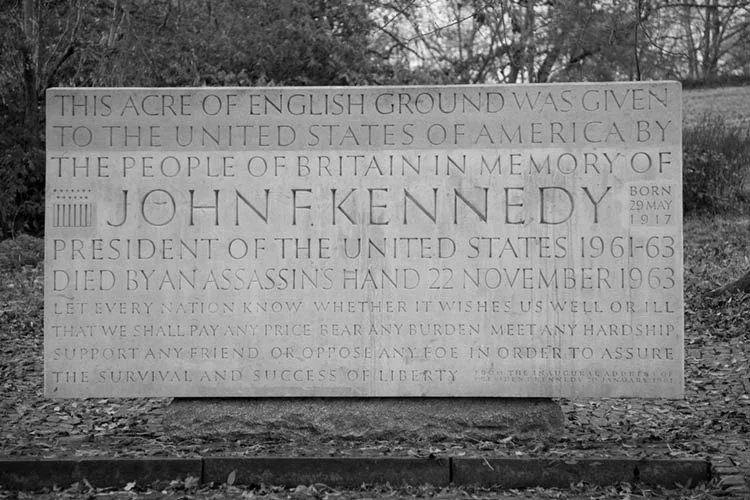
In the quiet area of Runnymede in England, there is a small piece of land that is not quite England. In fact, if you venture onto it, then you are walking on American soil.

Steve Prout explains in this short piece about the area.

The John F. Kennedy Memorial at Runnymede. Source: Wyrdlight.com, available here.

Runnymede is a quiet town that is situated on the famous River Thames. In this town in 1215, King John signed the Magna Carta which curtailed the power of the English monarchy. Going forward 750 years, it was the site of another major event. In 1965, Queen Elizabeth II  gifted one-acre of Runnymede to the USA. This is the only land overseas that the U.S. has gained without purchase or forceful acquisition.

The gesture was born out of two intentions. One was the commemoration of John F Kennedy following his assassination two years earlier. The monument that sits there is dedicated to him, his ideals and the cause he pursued for freedom. The other was a symbol of the British-US “special relationship”, at a time when the two countries faced a very real threat as the Cold War rivalry escalated in various forms and various locations.

The 1960s, despite its prosperity and its liberating culture, had its darker tones. Not all the world enjoyed these freedoms. The Berlin Wall was erected in 1961 further dividing the east and the west and solidifying those ideological differences. Numerous proxy wars were being fought around the globe, such as in Vietnam and various former European colonies in Africa. There was also unrest in Latin America as the Cuban Missile Crisis warmed up the Cold War close to the U.S. itself.


The site

The memorial’s creator was Alan Collina and it is made of Portland stone. Its inscription is from John Kennedy’s 1961 inaugural address and sits at the top of a short climb of fifty steps, representing the 50 US states. The design was inspired by John Bunyan’s The Pilgrim’s Progress, which alludes to life as being akin to a journey. In this case, perhaps it was the symbolism of the journey of the U.S.-UK relationship at a time when they both shared common values -  but this is just the author’s interpretation. The site also promotes the scholarships of UK students wishing to study.

The site, although technically on British sovereign soil, is still regarded as belonging to the U.S. by nature of its gifting by a British monarch. This acre of land is not fenced or policed by border guards as would be expected of most national frontiers. It is maintained quietly by the British National Trust but remains in essence American soil. So, if anyone would like to visit U.S. territory in the UK without being troubled by the bureaucracy of visa applications, the long flights, and the frosty US customs officers, then an opportunity presents itself there in quiet Runnymede.

The Americans may not realise this, and many may have forgotten, but they possess yet another piece of overseas territory in a land that was once their colonial rulers. Here, amid a history that includes the Alaskan purchase from Russia in 1867 and gains from the American Spanish War of 1898, there sits an acre of land that is not only a commemoration to one of their Presidents but also a symbol of the struggle for freedom and the spirit of shared values.  Perhaps the current leaders of both countries should revisit this site to reaffirm this partly estranged relationship.


The site has been offering a wide variety of high-quality, free history content since 2012. If you’d like to say ‘thank you’ and help us with site running costs, please consider donating here.

Posted
AuthorHistory Is Now Magazine

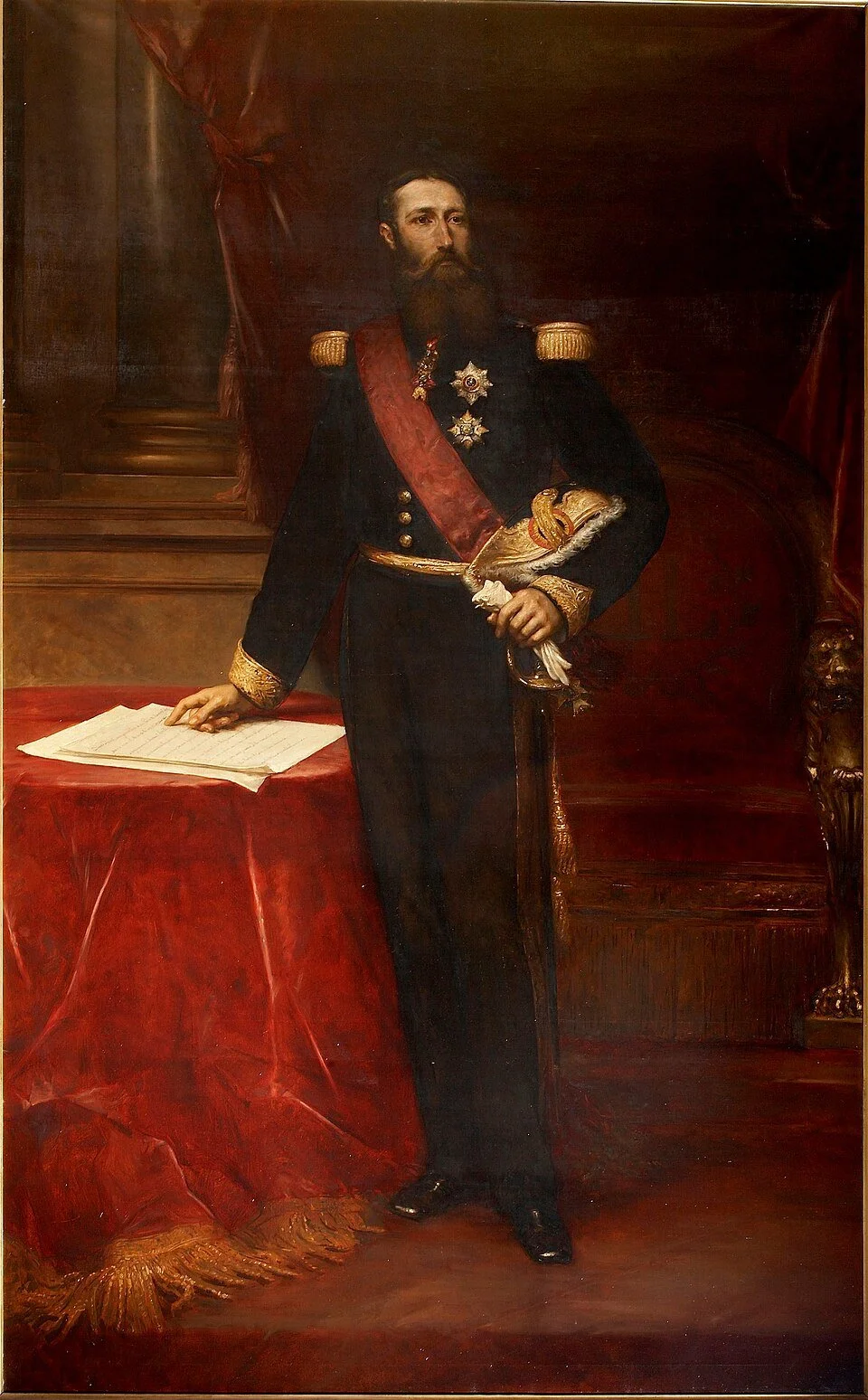
The year is 1909. A 75-year-old King Leopold appears calm despite the dreary circumstances and his physical distress. He peacefully welcomed his untimely end. In his final moments he was surrounded by his loyal staff and several members of his family, except his two daughters Princess Louise and Stephanie. After his passing on December 17, 1909 his funeral followed in quick concession, though he wished for it to be a private affair this was ignored and the state provided a formal public display for their dead King. His funeral was met with a public outcry of boos and jeers. This begs the question: who was King Leopold, and how did his actions impact both his private and public life?

Sophie Riley explains.

King Leopold II of Belgium by Louis Gallait.

International Brutality

King Leopold’s interest in the Congo started in the mid 1870s after he reviewed a report by Henry Morton Stanley in which he detailed his exploration of the region and he noted how it had access to uncharted natural resources.

Leopold’s seizure of the Congo began in 1876, when he hosted the Brussels Geographic Conference where he publicly established the International African Association. This was the first step in his humanitarian and scientific campaign in the Congo.

He then moved to active exploration of the area. This involved sending Henry Stanley to the Congo where his mission was to establish over 27 principal stations along the Congo River. These stations would act as signals to the local population and his rival European powers that this was his territory. In addition to this he was also instructed to secure the land rights from the Congolese chiefs through cloth and trinket treaties. Stanley would collect more than 450 treaties from the locals in exchange for cloth, alcohol, and local trinkets. In response the chiefs would place an x on the dotted line of a treaty they could not read and ultimately swore over their land and their states’ sovereignty.  What appeared to be diplomacy revealed itself as deception.

The impact of these treaties would hit the Congolese in several stages. Firstly, in the 1880s some would realize the deception as local chiefs who resisted the Belgians or did not sign the treaties were either replaced or killed. Secondly, Leopold issued a tax decree in which he would claim all the occupied land and its resources as state property. This meant that the villagers were branded as thieves for harvesting their own resources.    

The next phase of Leopold’s plan was to receive recognition for his control of the Congo on the world stage. This recognition would be received through deception; he would use the rising tensions between Britain, Germany, and France to his own end. He went to each country individually and convinced each one that the Congo should remain under neutral Belgium’s control instead of risking it falling into the hands of their rival.  

In addition to this he replaced the International association of the Congo with his own political body to govern the territories that Stanley had acquired a few years earlier.

This chapter in Congo’s independence would close when King Leopold declared himself as the sovereign king of the free Congo state in 1885. Over the next few decades the Congolese would revolt and resist the ongoing takeover of their nation by the Belgians - this would result in millions of Congolese deaths through torture, famine and violence. The Congolese would unfortunately not receive full independence until 1960.


Leopold’s Legacy

King Leopold left behind a legacy that was complex and tainted with human suffering and bloodshed. The brutality of his rule in the Congo was so extreme that it drew international condemnation from other European colonists in 1908.  His actions have been described by historians as callous, ruthless, and the almost unrestrained pursuit of power and wealth, raising enduring questions about moral responsibility and imperialist madness.  

Nevertheless, historians and Belgian records have highlighted areas where King Leopold positively impacted the modernization and economic expansion of Belgium during his 44-year reign.  Early in his rule he earned the nickname the builder King for his focus on the urban identity and public health of Belgium.  One of his first initiatives involved engineering a plan to cover the heavily polluted Senne River in 1867, to help stop the spread of cholera. In 1873, he commissioned the Royal Green houses in Laeken which helped advance botanical studies, and in 1880, he oversaw the creation of Cinquantenaire park to celebrate Belgium’s 50th anniversary as an independent state.   

As his reign progressed Leopold shifted his focus towards public education and the economic expansion of Belgium. During this time his government established a state funded school system, and oversaw the modernization and expansion of Antwerp’s docks, transforming the city’s docks into the world’s first commercial port. By the end of this period, Belgium had expanded significantly in both economic strength and national infrastructure, while political reforms extended universal suffrage to all men.

In the last years of his reign, Leopold’s focus shifted towards social reform and the question of his legacy. His last decade saw the introduction of laws that would change the daily lives of his citizens. Child labor for children under the age of 12 was abolished, and the restrictive worker’s booklet which had restricted their mobility was removed. However, these reforms were met by more controversial measures, including the introduction of compulsory military service where one son per family would have to serve 15 months in the army.    

Despite what he did in the Congo, Leopold’s reputation within Belgium remained largely intact. It would take over 90 years for the Belgians to shift their perspective. The catalyst for change started in 1999 when Adam Hochschild wrote a book entitled King Leopold’s Ghost. His book was met with high acclaim due to its in-depth view on Leopold’s colonial atrocities in the Congo. While being widely acclaimed, the book reopened old wounds within Belgian society, particularly for the older conservative generation who still believed that Leopold was an ambitious hero.

In contrast the younger generations alongside many institutions began to question the narrative of their past, and this led to the gradual removal of statues of their former king.  

This reckoning reached a turning point in 2020, amid global protests against racism in response to the murder of US citizen George Floyd. In Belgium, statues of King Leopold were either defaced or spray painted red with the words assassin or I cannot breathe. While none were officially destroyed, this would eventually lead to some statues being placed into museum storage. Due to the public’s tenacity, the Prime Minister at the time, Charles Michel, would apologize for the kidnapping of mixed-race children during the 1940s and 1950s. However, no formal apology has been made towards the Congolese people for the atrocities committed under Leopold’s rule, with the Belgian state offering admissions of regret rather than full acknowledgement.  It is within the tension between remembrance and reckoning that Leopold’s legacy must ultimately be understood.  


Final Thoughts

In the end, the story of King Leopold II resists a simple verdict. He was a ruler who reshaped Belgium’s cities, economy, and institutions, yet he also presided over one of the most brutal colonial regimes in modern European history. These two legacies do not cancel each other out but they do exist side by side, forcing us to confront the uncomfortable reality that progress and suffering are often intertwined.  

Leopold’s life and legacy reveals as much about the present as it does the past.  The conversation surrounding his actions has shifted from admiration to scrutiny, from silence to debate.


The site has been offering a wide variety of high-quality, free history content since 2012. If you’d like to say ‘thank you’ and help us with site running costs, please consider donating here.

Since 1917, following the Revolution that swept through Russia, the country’s Imperial family, the Romanovs, had been placed under house arrest and then exiled to Siberia. By July 1918 they were residing in the Ural town of Ekaterinburg, in a building called the Ipatiev House, where they were well guarded by Soviet soldiers. Early on the morning of July 17, Tsar Nicholas, his wife Alexandra, and their five children, Olga, Tatiana, Maria, Anastasia and Alexei, along with four members of their staff, were brutally murdered in the basement. Their bodies were roughly disposed of in the nearby forest and a veil of secrecy fell across their fates.

The Soviets admitted to killing the Tsar, but remained close lipped about what had happened to the rest of his family. Almost immediately rumours began to circulate that at least one of the children had escaped. Claimants soon appeared, the most common ‘survivor’ was the then seventeen-year-old Anastasia, the youngest Romanov daughter.

Erin Bienvenu explains.

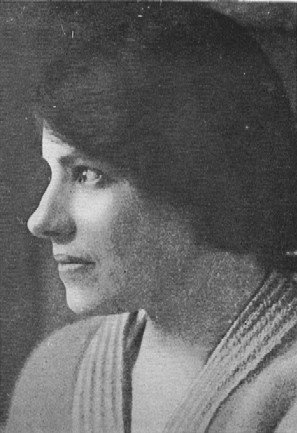
Anna Anderson in 1922.

Miss Unknown

On February 27 1920, a young woman tried to commit suicide by jumping from a bridge in Berlin. She was taken by a policeman to a hospital, but when she refused to give any details, she was admitted as Fräulein Unbekannt (Miss Unknown). She was then admitted to a mental hospital, and remained there for the next two years, speaking little, and spending much of her time in bed.

She did make one friend, fellow patient Clara Peuthert, who became convinced that Miss Unknown was in fact Grand Duchess Tatiana. When Clara was released, she went in search of people who could confirm her suspicions. There was a large Russian emigre population living in Berlin, members of the aristocracy and upper classes who had managed to escape the Revolution. A friend of the Tsarina, Zinaida Tolstoy, went to visit Miss Unknown and confirmed that she was Grand Duchess Tatiana. The Tsarina’s former lady-in-waiting, Sophie Buxhoeveden however was adamant that she was not the Grand Duchess, upon seeing the patient she exclaimed, “She’s too short for Tatiana,” and left. Miss Unknown would go onto say, “I did not say I was Tatiana.” Clara wasn’t willing to drop her story, and so if Miss Unknown was too short to be Tatiana, then she must be the shortest of the Romanov girls, Anastasia. Miss Unknown continued to speak little, and neither confirmed or denied these claims.

Interest in her story began to grow and she was released from the asylum to live with Baron Arthur von Kleist and his wife, Maria, also exiles from Russia.

It was whilst staying with the von Kleists that something of a story began to form, the young woman allegedly claimed she was Grand Duchess Anastasia, but wanted to be called Anna. She said she had been rescued the night of her family’s murder by one of the soldiers, Alexander Tschaikovsky. He took her to Romania where they married and had a son, Alexei. When Tschaikovsky was killed Anna came to Berlin, leaving her son in a Romanian orphanage.


Royal Visitors


Over the next several years Anna was in and out of numerous hospitals and met numerous members of the Russian enclave living in Berlin, though she was usually uncommunicative, and frequently hid beneath her bed clothes. Anastasia’s Aunt, Irene, met with Anna and claimed she was a fraud. This did not detract her growing number of supporters. Anna was in poor health and was often seriously ill, at one time with tuberculosis. She was painfully thin and had lost most of her teeth, her frail appearance no doubt helped to trick some of her visitors.

Anna certainly knew a lot about the Romanov’s and their extended circle, but this was probably from being coached by emigres, extensive reading, and in some cases, pure luck.

Eventually three people who had known Anastasia well paid Anna a visit. Pierre Gilliard, the Grand Duchesses French tutor, his wife, Shura, who had been Anastasia’s nursemaid, and the Grand Duchess Olga, the Tsars sister and Anastasia’s godmother.

Anna’s emaciated appearance and lack of conversation made identification difficult, and both Olga and the Gilliard’s expressed sympathy for the young woman. Anna’s supporters latched onto this sympathy as proof that they recognised her, but Olga was convinced that Anna was not her beloved niece, and the Gilliard’s agreed.  

In the coming years Anna resided with several benefactors, but usually fell out with them. She had a prickly personality, was argumentative and could be cruel.  Anna’s supporters excused most of Anna’s bad behaviour as a result of trauma and amnesia.  They frequently commended her Royal bearing and haughty nature, somewhat ironically because Anastasia was often said to be the least ‘royal’ of her siblings, she was not known for her deportment or elegance.


Franziska or Anastasia?

Meanwhile Anastasia’s maternal uncle, the Grand Duke of Hesse, had hired a private investigator to establish Anna’s true identity. The detective claimed that Anna was really a Polish factory worker by the name of Franziska Schanzkowska. Further attempts to establish this proved as contradictory as the attempts to prove Anna was Anastasia. She met with Franziska’s brother, but he was noncommittal as to her identity.

Then Anna met Tatiana and Gleb Botkin, the children of court physician Evgeny Botkin, who had been murdered with the Imperial family. They had known Anastasia as children and were utterly convinced that Anna was the Grand Duchess. Gleb in particular became her most vocal supporter and arranged for her to travel to America in 1928. Here she was registered in a hotel under the name Anna Anderson.

Gleb wanted Anna to inherit what was left of the Romanov fortune, and accused legitimate family members of denying Anna so that they could claim the legacy. The scattered members of the Romanov family, and their extended European relatives, some who had known Anastasia, and some who had not, remained bitterly divided over Anna’s true identity.

Anna remained in America until 1931 when her increasingly erratic behaviour led to her being admitted to an asylum back in Germany.

Eventually Anna was put into her own home by supporters, and was visited again by members of the Schanzkowska family. Franziska’s brothers, Valerian and Felix, and her sisters, Gertrude and Maria, met with Anna in 1938. The brothers denied she was their sister, but Gertrude was adamant she was.


Going to Court

Confusion continued to reign, Anastasia’s English teacher, Charles Sydney Gibbes, stated that Anna was a fraud, but her mother’s close friend, Lili Dehn, believed she was Anastasia.

Over the following years her story continued to divide people, and eventually made its way to court, where a lengthy legal battle ensued. In an attempt to prove, or disprove, her identity she was subjected to hand writing tests, language tests, and her face and body were intently studied for any likeness to Anastasia. Particular attention was paid to her ears, which were said by some to bear a close resemblance to the missing Grand Duchess. As usual Anna was not forthcoming during interviews, and it was difficult to establish just what languages she knew. It seemed she wasn’t fluent in any, though she claimed she refused to speak Russian due to the trauma. Anastasia had spoken Russian, English, French and German, the latter two not as well as the first. Eventually the court case was thrown out, her identity could not be conclusively proved.

Anna was then living in squalor with innumerable cats who were euthanised due to their poor condition. Following this she returned to America and married Jack Manahan, an eccentric history teacher who was a friend of Gleb Botkin’s, and was eighteen years her junior. Jack was equally as unconventional as Anna and their home was soon overrun by poorly cared for cats and dogs, neighbours frequently complained about the smell coming from the house, and its wildly unkempt garden. Over time Anna’s stories had grown increasingly muddled and contradictory, it could not be said that she was a reliable witness, but still people believed her and supported her

In 1979 Anna was admitted to hospital for an operation that would remove a blockage in her lower intestine. A sample was kept by the hospital for their records, which would later be the key that unlocked the secrets of her identity.


The Truth is Revealed

Anna died in 1984, asserting right to the end of her life that she was the Grand Duchess Anastasia.  In the decade that followed the remains of five of the Romanov’s were discovered in a forest near Ekaterinburg. DNA testing confirmed their identities. The bodies of Alexei, and either Maria or Anastasia, remained unaccounted for until they too were found in 2007.

The advancement of DNA testing also made it possibly to establish the truth about Anna. The piece of her intestine that had been removed during surgery was tested against the DNA of the Tsar and Tsarina. The DNA was not a match. Anna Anderson was no relation of the Romanovs; she was not Anastasia.

Her DNA however did match that of Karl Maucher, the grandson of Gertrude Schanzkowska, the sister of Franziska.

Franziska’s family remembered that their sister had always had aspirations above her station, she was an avid reader who had cultivated a refined air and wanted to be an actress. She was engaged to a German man who was killed during the First World War, and had then been involved in an accident at the factory where she worked. She had accidentally dropped a grenade which killed a foreman, following this her mental health deteriorated. Her family last heard from her shortly before Anna’s suicide attempt in Berlin.

As to why the Schanzkowsa’s never definitively identified her, it is possible that Anna convinced them that her life was better than it would have been as a Schanzkowsa, and they were happy to allow her this bit of make believe.


Anna’s motives remain unknown, did she really come to believe she was Anastasia? Was she easily led, or a cunning deceiver?

It seems the answer lies somewhere in the middle, it is likely Anna did not come up with the idea of ‘playing’ Anastasia herself. When her resemblance was suggested to her by others, it seems she simply went along with the ruse. It allowed her to live a fairy-tale, and to socialise with the rich and famous, opportunities that would never have been available to a poor factory worker. It’s also likely that due to her poor mental health she was able to convince herself that she was Anastasia. She seemed to believe her own lies wholeheartedly.

In a tale stranger than fiction, a Polish factory worker had somehow managed to convince half the world that she was in fact a Russian Grand Duchess.


The site has been offering a wide variety of high-quality, free history content since 2012. If you’d like to say ‘thank you’ and help us with site running costs, please consider donating here.


References

King, Greg & Wilson, Penny (2003), The Fate of the Romanovs. New Jersey: John Wiley & Sons

Klier, John & Mingay, Helen (1995), The Quest for Anastasia: Solving the Mystery of the Lost Romanovs. London: Smith Gryphon

Welch, Frances (2007), A Romanov Fantasy. New York: W. W. Norton & Company

Posted
AuthorHistory Is Now Magazine

The dynastic struggle that would later erupt into the Wars of the Roses did not emerge suddenly in the mid–fifteenth century. Its roots lay decades earlier in the complicated aftermath of the reign of Edward III, one of England's most powerful medieval kings. When Edward died in 1377 after a reign of fifty years, he left behind a formidable legacy of military victories and royal prestige. Yet beneath the apparent strength of the monarchy lay a dangerous problem: a tangled web of royal descendants whose competing claims to the throne would gradually destabilize the kingdom. The seeds of civil war had already been planted within the royal family itself, and over the following generations, those seeds would steadily grow into one of the most destructive internal conflicts in English history.

Terry Bailey explains.

An 15th century depiction of Edward III of England. From the Bruges Garter Book made by William Bruges (1375–1450), first Garter King of Arms, British Library, Stowe 594 ff. 7v.

Edward III had fathered several sons who survived into adulthood, each of whom founded powerful branches of the royal lineage. In the medieval system of dynastic succession, such an abundance of heirs could appear to strengthen a monarchy, yet it could just as easily generate rival claims. The king's eldest son, Edward the Black Prince, was widely admired as one of the greatest military commanders of his age. During the early campaigns of the Hundred Years' War against France, the Black Prince gained fame for his leadership and battlefield skill, particularly in victories such as the Battle of Poitiers. He appeared destined to succeed his father and continue England's military dominance on the continent. Fate, however, intervened. The Black Prince died in 1376 after a long illness, a year before Edward III himself passed away.

The death of the heir apparent created an immediate problem of succession. The Black Prince left behind only one legitimate son, the young Richard II. When Edward III died the following year, the crown therefore passed not to an experienced adult prince but to a ten-year-old boy. Although medieval monarchies were accustomed to child rulers, such circumstances almost always created opportunities for political rivalries to flourish. A king who was too young to rule independently depended upon advisers and regents, and those who surrounded him inevitably competed for influence.

The early years of Richard II's reign were therefore dominated by powerful relatives and leading nobles who sought to guide royal policy. Among the most influential figures was John of Gaunt, Duke of Lancaster, Edward III's third surviving son. Gaunt possessed enormous wealth, extensive estates, and vast political influence throughout the kingdom. The lands and titles associated with the Duchy of Lancaster gave him resources that rivalled those of the crown itself. As a result, the Lancastrian branch of the royal family emerged as one of the most powerful political forces in England.

Another of Edward III's surviving sons was Edmund of Langley, Duke of York. Though less politically dominant than his brother John of Gaunt, Edmund's descendants would later form the basis of the Yorkist claim to the throne. At the time, however, these various branches of the royal family coexisted uneasily within the aristocratic structure of England. The stability of the realm depended heavily on the king's ability to balance the interests of these powerful houses. A strong monarch could maintain harmony; a weak one risked allowing rivalry to flourish.

Richard II struggled to command the authority necessary to maintain such a balance. Although he displayed intelligence and a sense of royal dignity, he often proved politically inflexible and suspicious of the great magnates whose support he required. His reign became increasingly characterized by factionalism and mistrust. Early in his rule England experienced a major social upheaval in the form of the Peasants' Revolt of 1381. This uprising, one of the most dramatic popular revolts in medieval Europe, was fueled by widespread resentment over taxation and economic hardship in the aftermath of the Black Death.

The revolt brought thousands of rebels marching toward London, demanding relief from oppressive taxes and the abolition of certain feudal obligations. Though still a boy, Richard II confronted the rebels personally in an attempt to defuse the crisis. The revolt was eventually suppressed, but the event left a lasting impression on the young king and revealed how fragile social and political stability could be during times of economic strain. England's ruling elite became increasingly aware that the kingdom faced internal pressures that could erupt unexpectedly.

As Richard matured, his style of governance became more assertive and increasingly controversial. Determined to strengthen royal authority, he relied heavily on a small circle of trusted favorites while punishing opponents with severity. This approach alienated many influential nobles who believed their traditional rights and privileges were being ignored. Over time, the king's court became associated with factional intrigue and personal rivalries rather than broad political consensus.

One of the most significant figures drawn into this growing conflict was Henry Bolingbroke, the son of John of Gaunt. Bolingbroke was a capable and respected nobleman who had cultivated strong support among England's aristocracy. In 1398 he became embroiled in a dispute with another prominent lord, leading Richard II to intervene by exiling both men from the kingdom. The situation worsened dramatically the following year when John of Gaunt died. Instead of allowing Bolingbroke to inherit the vast Lancastrian estates, Richard confiscated them for the crown.

This decision proved to be a fatal miscalculation. By denying Bolingbroke his inheritance, Richard effectively transformed a political rival into a determined enemy.

In 1399 Bolingbroke returned to England while Richard was campaigning in Ireland. Initially, he claimed that his goal was simply to recover his rightful lands, yet discontent with the king's rule had become widespread among the nobility. As Bolingbroke advanced through the country, support for his cause rapidly grew.

The political situation quickly escalated into a full-scale revolution. Richard II found himself abandoned by many of his supporters and was eventually captured. Forced to abdicate the throne, he was imprisoned and later died under mysterious circumstances. Bolingbroke then claimed the crown and was crowned as Henry IV, inaugurating the Lancastrian dynasty.

The deposition of Richard II marked a profound turning point in English constitutional history. For centuries the legitimacy of kingship had been based on hereditary succession. By removing the reigning monarch and replacing him with another claimant, the nobility had demonstrated that the crown could be transferred through political force. Although Henry IV justified his claim by emphasizing his descent from Edward III, his hereditary right was not the strongest available within the royal family.

Indeed, another line of descent from Edward III provided the foundation for a potentially stronger claim. Through the descendants of the king's second surviving son, Lionel of Antwerp, later Yorkist supporters could argue that their lineage represented the senior branch of the royal family. Although this issue did not immediately provoke conflict, it created an unresolved question of legitimacy that would later resurface with dramatic consequences.

Henry IV's reign was therefore far from secure. Throughout his rule, he faced rebellions, conspiracies, and political instability. Noble families who had supported his rise to power expected rewards and influence, while others remained loyal to the memory of Richard II. Maintaining authority required constant vigilance and careful political management. Though the Lancastrian dynasty survived these early challenges, it did so in an atmosphere of uncertainty.

The broader political climate of the early fifteenth century further complicated the situation. England remained deeply involved in the long and costly Hundred Years' War against France. Maintaining armies overseas and defending English territories required vast financial resources. Heavy taxation placed increasing strain on the population, while military setbacks undermined confidence in royal leadership.

For a brief moment, however, the Lancastrian monarchy appeared to regain its prestige. Henry IV's son, Henry V, proved to be a charismatic and formidable warrior king. His dramatic victory at the Battle of Agincourt in 1415 revived English fortunes and restored a sense of national pride. Henry's campaigns in France brought new territorial gains and renewed confidence in the Lancastrian regime.

Yet this revival proved short-lived. Henry V died unexpectedly in 1422 at the height of his success, leaving the throne to his infant son, Henry VI. Once again England faced the political complications of a child king. A prolonged minority government placed power in the hands of competing factions among the nobility, each seeking influence over the young monarch.

As Henry VI grew to adulthood, it became increasingly clear that he lacked the political strength and military ability of his father and grandfather. Gentle and deeply religious by nature, he struggled to command authority over the powerful nobles who dominated English politics. At the same time, England's position in France began to collapse. During the final phases of the Hundred Years' War, French forces gradually recaptured most of the territories England had once controlled.

The loss of these lands dealt a severe blow to the prestige of the monarchy. Military failure abroad undermined confidence in royal leadership at home. Many noble families who had once profited from warfare in France found their opportunities disappearing, while the financial burden of past campaigns continued to weigh heavily on the kingdom. Discontent within the aristocracy steadily increased.

Within this unstable environment, alternative claims to the throne began to attract greater attention. Among the most prominent figures was Richard, Duke of York. Through his descent from multiple lines of Edward III's family, York possessed a powerful hereditary claim that rivalled—and in some interpretations exceeded—that of the Lancastrian kings. Combined with his considerable wealth and influence, this lineage placed him at the center of a growing political opposition.

By the mid-fifteenth century, England had become a kingdom strained by weak kingship, economic hardship, and unresolved questions of dynastic legitimacy. The precedent set by the overthrow of Richard II had demonstrated that a king could be removed if powerful nobles united against him. Meanwhile, the decline of English fortunes in France eroded the authority of the Lancastrian dynasty.

Thus the conditions for civil war were already firmly in place. What began as a complicated issue of royal inheritance gradually evolved into a bitter political rivalry between two powerful branches of the royal family. The Houses of Lancaster and York, later symbolized by their rival red and white roses, would soon plunge England into a prolonged struggle for control of the throne. In the decades ahead, battles, betrayals, and shifting alliances would reshape the English monarchy and leave an enduring mark on the nation's history.

Therefore, the Wars of the Roses were not the product of sudden ambition or isolated acts of rebellion, but the culmination of long-developing structural weaknesses within the English monarchy. The reign of Edward III, for all its outward strength and prestige, had unintentionally created a dynastic landscape crowded with competing lines of succession. This abundance of royal heirs, which might have ensured continuity under a strong ruler, instead became a source of instability when authority faltered. The premature deaths of key figures and the repeated accession of child kings—most notably Richard II and later Henry VI—further weakened the crown's ability to manage powerful nobles whose ambitions increasingly outpaced their loyalty.

The deposition of Richard II by Henry IV proved to be a decisive constitutional rupture. In overturning the principle of unquestioned hereditary succession, it introduced a dangerous precedent: that kingship could be claimed and justified through force as much as by lineage. From that moment onward, legitimacy became contested ground, open to interpretation and, crucially, to challenge. The rival claims descending from Lionel of Antwerp and John of Gaunt lingered unresolved, quietly hardening into ideological fault lines within the nobility.

Compounding these dynastic tensions were the broader pressures bearing down on the kingdom. The economic aftershocks of the Black Death, the social volatility exposed by the Peasants' Revolt, and the immense financial strain of the Hundred Years' War all contributed to a climate of uncertainty and discontent. Military decline in France, particularly during the reign of Henry VI, eroded confidence in Lancastrian rule, while simultaneously depriving the nobility of the wealth and purpose that foreign campaigns had once provided.

By the mid-fifteenth century, England stood on a knife-edge. The monarchy, no longer an unassailable institution, depended heavily on the fragile balance of noble support. Into this volatile environment stepped Richard, Duke of York, whose formidable lineage and political influence offered a credible alternative to Lancastrian authority. What had begun as a question of inheritance had evolved into a struggle for power, legitimacy, and survival between two rival houses.

Thus, the outbreak of the Wars of the Roses was less an abrupt descent into chaos than the inevitable consequence of decades of accumulating tension. Dynastic ambiguity, political miscalculation, and social strain converged to produce a conflict that would engulf the English nobility and redefine the monarchy itself. In this sense, the wars were not merely fought over the crown—they were born from the very foundations upon which that crown had come to rest.


The site has been offering a wide variety of high-quality, free history content since 2012. If you’d like to say ‘thank you’ and help us with site running costs, please consider donating here.

Aviatrix Mary Jayne Gold came from a prominent Chicago family. Under the Gestapo’s nose in Marseilles, she helped save thousands from Hitler’s concentration camps, all while carrying out a brazen l’affaire de guerre with a cutthroat French-American commando. Timothy M. Gay explains.

French prisoners of war under German guard in 1940. Source: Bundesarchiv, Bild 121-0404 / CC-BY-SA 3.0, available here.

No Hollywood mogul worth his salt would ever have greenlighted a script based on the life of Mary Jayne Gold. “Way over the top!” Jack Warner or Harry Cohn would have scrawled on the title page. “Audiences will never buy it!”

Except it was all very real – and very little of it needed embellishing.

She was an impossibly rich and fetching femme fatale, the daughter of one of Chicago’s leading industrialists. She didhave a mansion and a yacht (both called “Marigold”) named in her honor. She did become a famed aviatrix in an era when female pilots attracted flashbulbs and headlines. She was the prewar toast of London and Paris, an intimate of lords and ladies who followed the sun to St. Tropez and the snow to St. Moritz. She did leave in her wake a trail of champagne bottles and broken hearts. She did bribe a French judge to spring her illicit lover from jail. She did play deadly cat-and-mouse with Vichy and the Gestapo and help thousands of people escape Hitler’s concentration camps.

Surely, she’s the only refugee liberator honored by the U.S. Holocaust Memorial Museum who grew up summering in an architectural marvel along the shores of Lake Michigan; who raced her own plane – a sleek Percival Vega Gull, the “Sports Car of the Skies” – at air shows across the North America and Europe; who consorted with mobsters in the French Riviera and once described herself as a “gangster’s moll”; who helped bankroll one of the war’s most effective evacuee operations; who sheltered some of the 20th century’s most celebrated surrealists; who was mistaken more than once for a high-priced hooker; who used her feminine wiles (twice!) to seduce a Vichy prison commandant, gaining favorable treatment for Resistance detainees; and whose provocative (in every sense) memoir late in life was edited by none other than Jacqueline Kennedy Onassis, a fellow Francophile who enjoyed tales of a life richly lived.

“Fuugg-about it!” Sam Goldwyn would have barked. “No one will ever believe it!”


        *

How did Mary Jayne Gold ever find the moxie to lead a life that – let’s face it – turned a little tawdry at times? A lot of it had to come from her old man, one of the most ambitious and – let’s face it again – dissolute industrial pioneers in Chicago history. Maybe when your fabulously wealthy father is forced to skip town to avoid being prosecuted in a steamy sex scandal it steels you for whatever life throws your way.  

*

Egbert Habberton Gold (1868-1928) was rich the day he arrived in Chicago, but he got a lot richer in a hurry. The Golds were Old New England, a family that emigrated from East Anglia’s Bury St. Edmunds in the years before 1650 and quickly made themselves pillars of Cornwall, Connecticut, society, becoming benefactors of the Congregationalist Church and, two generations later, of Yale College.

Egbert’s ancestors had a yen for engineering. His father, Mary Jayne’s paternal grandfather, patented in the 1850s the forerunner to the cast-iron “mattress” radiator. The Gold radiator became the method of heating residential and commercial buildings for much of the next century, earning the family a huge fortune.

Its burgeoning reputation as a railroad hub lured Egbert Gold to Chicago in the 1890s. Following in his father’s footsteps, he soon devised a reliable method of using steam vapor to heat passenger rail cars. Gold’s breakthrough revolutionized wintertime train travel; virtually overnight, it became safer and more comfortable. 

Yet again, the Golds had struck, well, gold. Egbert eventually established the offices of the Gold Car Heating Company (later the Vapor Car Heating Co., Inc.) in the “Chicago Style” Railway Exchange Building bordering Grant Park. In 1904, he beat back a competitor by contesting a patent case all the way to the U.S. Supreme Court, winning an intellectual property precedent that’s still studied today. At roughly the same time, he began acquiring large and lucrative chunks of Chicago real estate.

He also acquired a level of infamy that might have caused his Congregationalist forebears to roll over in their graves. In the spring of 1901, the police began investigating reports of a 17-year-old woman being kept against her will in what the Chicago Daily Tribune called a “disorderly house” at 348 West Madison.

It was, all euphemisms aside, a brothel run by a madame named Mary “Mother” Lyons. Lyons’ apparent modus operandi was to snag unsuspecting young women to work as maids, then, once under roof, bully them into providing services of a more horizontal nature.

The teenaged Jeanette Johnston was one of Lyons’ hostages. “Mother’s” debasement of Jennie was abetted, police said, by a mystery man whom Johnston knew only as “Bert Brown.”

Brown, the cops told the press, was a pseudonym for one Egbert H. Gold, then 33 and married to the former Margaret Jayne Dickey. Brown/Gold was, it sounds like, a steady customer of Lyons’ bordello. He apparently took a fancy to young Jennie, ignoring her pleas to escape confinement, plying her with alcohol, and conspiring with Lyons to keep her under lock and key.

When Jennie somehow escaped and told her chilling story to a local minister (ironically of the Congregationalist faith), the preacher called the cops. Soon Chicagoans were waking up to headlines like, “TELL SECRETS OF ‘MOTHER’ LYONS: ATTORNEYS’ QUESTIONS POINT TO EGBERT H. GOLD AS ‘BERT BROWN.’”

Acting sub-rosa, Gold hired Chicago attorneys Kickham Scanlan and Edgar Lee Masters (perhaps Gold’s unsavory behavior encouraged Masters, a decade later, to publish Spoon River Anthology, his celebrated free-verse skewering of Midwestern “virtues”} to provide legal services for Lyons. Scanlan and Masters did their job: “Mother” got off easy, slapped with just a one-year sentence, with time off for good behavior.

Gold, meanwhile, had stayed elusive during Lyons’ trial, skulking off to a secret flat on Ellis Avenue, then decamping for Davenport, St. Louis, and Omaha, always keeping one step ahead of the subpoena server. On the day Lyons copped her plea, Gold fled to New York City, where he stayed incognito until the heat cooled.

Eventually, he returned to Chicago and his tony lifestyle, which by then included memberships at the South Shore and Exmoor country clubs, a side-stage box at Crosby’s Opera House, a luxurious yacht, and a summer home to die for on the eastern shore of Lake Michigan. The boat and vacation place were both named “Marigold” in honor of his wife and infant daughter.

The sordid episode with “Mother” and Jennie might have been forgotten if Gold had just paid Masters and Scanlan the $2,000 (the rough equivalent today of $63,000) he owed them. Their dispute erupted in 1914, the year poet Carl Sandburg wrote his paean to Chicago, not realizing that the line, “They tell me you are wicked and I believe them, for I have seen your painted women under the gas lamps,” was all too accurate in the case of one of the city’s business titans.

The public punches flew fast and furious. In mid-bout, Gold issued a defiant – and disingenuous – statement.

“The matter is hardly worth discussion,” Gold fumed. “It is simply a case of an attempt to hold me up for money which I refuse to pay. I did have some business with Attorney Masters nine or ten years ago, but he was paid every cent he was entitled to at that time. The matter was not in connection with any place of questionable repute. I do not know this woman Mary Lyons, referred to by Attorney Masters. Neither do I know Jeanette Johnston, or whatever her name might be. Long ago, when the first attempts were made to secure money from me, I turned the matter over to my attorneys.”

A settlement was eventually reached; the matter again died down but was no doubt the subject of much gossip around town. Over the years, the Golds, now the parents of two boys plus Mary Jayne, stayed quiet in the Chicago papers, eliciting only the occasional article about Mrs. Gold’s gardening triumphs, or their real estate purchases, or their patronage of the arts. Egbert Gold died of natural causes in 1928, when his daughter and oldest child was 19.

It wasn’t until Mary Jayne got her pilot’s license after she graduated from an Italian boarding school and began flying her two-seat monoplane at air shows across North America and Europe that the name Gold found itself back in the headlines. If press accounts were accurate, the other seat in Mary Jayne’s plane was often occupied by a dashing beau du jour or some member of European royalty. Her life took an abrupt turn after the German army invaded Poland.


Did you find that piece interesting? If so, join us for free by clicking here.


About the Author

Timothy M. Gay is the author of two critically acclaimed books on World War II: Assignment to Hell: The War Against Nazi Germany with Correspondents Walter Cronkite, Andy Rooney, A.J. Liebling, Homer Bigart, and Hal Boyle(NAL/Penguin, 2012) and Savage Will: The Daring Escape of Americans Trapped Behind Nazi Lines (NAL/Penguin, 2013). Tom Brokaw called Assignment to Hell, which was nominated for a Pulitzer, a Bancroft, and an American Book Award, “a book every modern journalist – and citizen – should read.” Historian Marcus Brotherton wrote that Savage Will was “powerful, intriguing, well-researched, and fierce.”

Gay’s lengthy article on the citizen response to the Nazi U-boat threat in U.S. waters early in WWII was featured in a pandemic-inspired special issue of American Heritage called “America in Crisis.”

He has been featured on PBS’ “History Detectives” and contributed on-camera and off- to two documentaries – one on Walter Cronkite’s coverage of the Kennedy assassination, the other on Lyndon Johnson’s legacy on civil rights – which have appeared in Britain and the U.S.

His latest book is RORY LAND, a biography of golf superstar Rory McIlroy. It looks at McIlroy’s life through the prism of Ireland’s sectarian Troubles that devastated both sides of his family.

Posted
AuthorHistory Is Now Magazine