
In the dramatic and dangerous world of the Tudor court, few figures appear as restrained and enigmatic as Jane Seymour. Where Anne Boleyn had dazzled with wit, ambition, and controversy, Jane emerged as a figure of silence, modesty, and traditional femininity. Yet beneath this calm exterior lay a woman whose brief reign would alter the future of England more profoundly than many queens who sat upon the throne for far longer. Jane Seymour's significance did not arise from political brilliance or religious revolution, but from the simple and immense fact that she succeeded where Henry's previous marriages had failed: she gave the king a legitimate male heir. In doing so, she secured her place forever within the turbulent history of the Tudor dynasty.
Terry Bailey explains.
Read part 1 on King Henry VIII here, part 2 on Catherine of Aragon here, and part 3 on Anne Boleyn here.
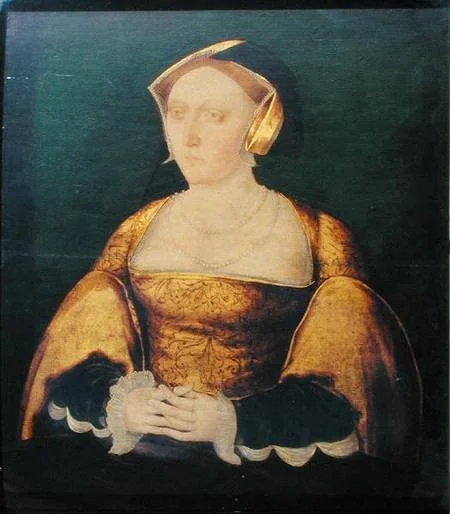
Jane Seymour. Attribution: Hans Holbein workshop, available here.
Jane was born around 1508 into the ambitious but comparatively restrained Seymour family of Wiltshire. Unlike Anne Boleyn, whose years at the sophisticated courts of the Low Countries and France had shaped her into a cosmopolitan and intellectually confident woman, Jane's upbringing was more traditional and conservative. She was educated primarily in the domestic accomplishments expected of noblewomen in Tudor England: household management, embroidery, music, and religious devotion. She lacked Anne's sharp political instincts and dazzling conversational abilities, yet in the climate that followed Anne's downfall, these very qualities became advantages. Henry VIII had grown exhausted by conflict, public controversy, and the relentless political storms surrounding his second marriage. Jane appeared to offer something entirely different, peace, obedience, and stability.
The contrast between Jane and Anne was carefully cultivated both by Henry and by those at court eager to distance themselves from the fallen queen. Anne had become associated in the minds of many English subjects with upheaval: the break from Rome, the destruction of old certainties, and factional court politics. Jane, by comparison, dressed conservatively, behaved modestly, and projected humility. She rarely intervened openly in matters of state and deliberately avoided the intellectual flamboyance that had characterized Anne's queenship. Yet this quieter image should not obscure the reality that Jane was still operating within one of the most dangerous political environments in Europe. Tudor queenship was inseparable from power, and every royal marriage carried immense political implications.
Henry's courtship of Jane began while Anne Boleyn's position was already collapsing. By early 1536, the king's frustrations with Anne had deepened due to miscarriages, political tensions, and his growing infatuation with Jane herself. Jane reportedly refused to become Henry's mistress, presenting herself instead as a virtuous woman who would surrender only through marriage. Whether this reflected genuine personal morality or calculated political wisdom remains debated by historians, but the effect upon Henry was significant. At a time when the king increasingly viewed women through the lens of loyalty and obedience, Jane embodied the idealized image of feminine submission that he now desired.
The speed with which events unfolded revealed both Henry's ruthlessness and the precarious nature of queenship in Tudor England. Anne Boleyn was executed in May 1536 on charges of adultery, incest, and treason, accusations many historians regard as politically motivated or exaggerated. Astonishingly, Henry became formally engaged to Jane Seymour the day after Anne's execution and married her less than two weeks later. The rapid transition from one queen to another shocked foreign ambassadors and demonstrated how completely personal desire, dynastic anxiety, and political authority had merged within Henry's monarchy.
As queen, Jane Seymour consciously attempted to heal the divisions that had fractured both the royal family and the kingdom itself. One of her most important acts was seeking reconciliation between Henry and his eldest daughter, Mary I of England. Mary had been declared illegitimate following Henry's divorce from Catherine of Aragon and had endured years of humiliation and political isolation under Anne Boleyn's ascendancy. Jane treated Mary with kindness and encouraged Henry to restore relations with his daughter. Though Mary was not fully restored to legitimacy, the gradual thaw in relations marked an important moment in the rebuilding of the Tudor family.
Jane's queenship unfolded during a period of continuing religious tension. England remained deeply divided by Henry's break with the authority of the papacy. Although Henry had rejected Rome and established himself as Supreme Head of the Church of England, the religious identity of the kingdom remained uncertain. Jane herself appears to have retained conservative Catholic sympathies. She reportedly interceded with Henry on behalf of participants in the Pilgrimage of Grace, the major northern rebellion against religious reforms and the dissolution of monasteries in 1536. Henry reacted furiously, warning Jane not to meddle in political affairs by reminding her of the fate of previous queens who had overstepped their boundaries. The incident revealed the narrow limits placed upon female authority in Tudor England. A queen might influence the king privately, but direct intervention in matters of policy remained dangerous territory.
This tension between gender and power forms one of the defining themes of Henry VIII's marriages. Queens were expected to embody obedience and fertility while simultaneously serving as dynastic instruments and political symbols. Their value depended heavily upon their ability to produce sons, maintain alliances, and avoid threatening male authority. Jane Seymour succeeded largely because she appeared to understand these unwritten rules better than her predecessor. Yet even her apparent conformity reflected the harsh constraints placed upon women at the Tudor court, where failure could mean exile, disgrace, or death.
The defining moment of Jane Seymour's life came in October 1537 when, after a difficult labor lasting several days, she gave birth to a healthy son at Hampton Court Palace: the future Edward VI of England. Across England, church bells rang in celebration. Henry VIII, after nearly three decades of anxiety, disappointment, and political turmoil, finally possessed the legitimate male heir he had long desired. The birth transformed Jane's status immediately. More than any previous queen, she had fulfilled the essential dynastic duty expected of a Tudor consort.
The importance of Edward's birth cannot be overstated. Henry's obsessive pursuit of a male heir had reshaped England politically, religiously, and socially. His desperation had led to the rejection of papal authority, the establishment of the Church of England, the dissolution of monasteries, and the concentration of royal power on an unprecedented scale. Jane Seymour's success therefore appeared almost providential to contemporaries. To many observers, she became the embodiment of ideal queenship precisely because she delivered the son that justified, in Henry's mind, the sacrifices and upheavals of the previous years.
Yet triumph quickly turned to tragedy. Jane Seymour fell gravely ill shortly after childbirth, likely suffering from puerperal fever, a common and often fatal infection following delivery in the pre-modern world. On the 24th of October 1537, less than two weeks after Edward's birth, she died at the age of approximately twenty-eight. Her death plunged Henry into genuine grief. Unlike his reactions to several of his later wives, the king appears to have mourned Jane deeply and sincerely. He withdrew from public life for a period and wore black for months afterward. Significantly, Henry chose to be buried beside Jane after his own death in 1547, suggesting that he regarded her as his "true" wife — the queen who had given him the son and dynastic security he had pursued for so long.
Jane Seymour's posthumous reputation benefited enormously from her early death. Because she died before political tensions or personal conflicts could damage her standing with Henry, she remained frozen in royal memory as the virtuous and successful queen. Unlike Catherine of Aragon, she did not endure rejection; unlike Anne Boleyn, she did not suffer destruction; unlike later wives, she was not associated with scandal, disappointment, or political embarrassment. Death preserved her image at its most idealized moment.
Her legacy, however, extends beyond her role as mother to Edward VI. Jane's queenship illustrated the increasingly transactional nature of monarchy in Tudor England, where marriage functioned simultaneously as a personal relationship, political institution, and religious battleground. Through her, one can observe the evolution of Henry VIIIhimself. The young Renaissance prince who had once pursued romance and glory had become a hardened ruler shaped by suspicion, dynastic fear, and the burden of absolute authority. Jane represented not passion but reassurance, a retreat into the comforting image of traditional queenship after the chaos unleashed by Anne Boleyn's rise and fall.
The long-term consequences of Jane Seymour's brief reign would reverberate far beyond her lifetime. Edward VI inherited the throne as a child in 1547 and presided, through his regents, over the acceleration of Protestant reform in England. Ironically, the male heir whose birth had seemed to stabilize the Tudor dynasty would rule for only six years before dying young, plunging the succession once again into crisis. Yet without Jane Seymour, the entire trajectory of English history might have unfolded differently. The Tudor succession, the religious identity of England, and the future of the monarchy itself were all shaped by the short life of the quiet queen who succeeded where others had failed.
In the broader story of Henry VIII and his six wives, Jane Seymour occupies a uniquely paradoxical position. She was perhaps the least politically flamboyant of Henry's queens, yet arguably the most consequential. Her reign lacked the dramatic confrontations associated with Catherine of Aragon or Anne Boleyn, but her impact upon the Tudor dynastyproved immense. In a court where women were judged by their usefulness to male power, Jane Seymour achieved the highest success possible and paid for it with her life, through a possible post-pregnancy-based illness.
In conclusion, Jane Seymour's story remains one of the most revealing and tragic episodes within the history of the Tudor monarchy. Although her queenship was short, its consequences shaped the political and religious future of England for generations. In many ways, Jane embodied the ideal Tudor queen as Henry VIII understood it: obedient, modest, fertile, and loyal to both husband and dynasty. Yet the very qualities that elevated her in Henry's eyes also expose the harsh realities faced by women at the Tudor court, where a queen's security depended almost entirely upon her ability to satisfy dynastic expectations. Jane achieved what Catherine of Aragon and Anne Boleyn could not by producing a legitimate male heir, but the cost of that success was ultimately her own life.
Her brief reign also highlights the deeply fragile nature of power in Henry VIII's England. Beneath the ceremonies, splendor, and outward stability of monarchy lay a court governed by fear, faction, and the constant pressure of succession. Jane's careful caution, her avoidance of open political confrontation, and her deliberate presentation as a traditional and virtuous consort were not simply reflections of personality, but survival strategies within a system that could swiftly destroy even the most powerful individuals. The memory of Anne Boleyn's execution lingered over Jane's queenship, serving as a constant reminder of the dangers surrounding royal favor and female influence.
At the same time, Jane Seymour's life reveals the deeply personal dimension of Tudor politics. Henry VIII's marriages were never merely private relationships; they shaped the religious identity, political structure, and dynastic future of the kingdom itself. Through Jane's successful delivery of Edward VI, the king finally secured the succession he had pursued with obsessive determination for decades. Yet history would ultimately reveal the bitter irony of this triumph. Edward's short reign failed to bring lasting stability, and the Tudor succession crises continued after his death, leading eventually to the reigns of Mary I and Elizabeth I, whose legacies would eclipse even that of the long-desired male heir.
Jane's enduring reputation owes much to the fact that her life ended before disappointment, scandal, or political conflict could tarnish her image. She became immortalized as Henry's "perfect" queen largely because she died at the height of her success. In death, she was transformed into a symbol of peace and dynastic fulfilment, preserved forever in contrast to the dramatic rises and catastrophic falls that characterized so many of Henry's other marriages. Yet reducing Jane merely to the role of obedient wife or mother of Edward VI risks overlooking the broader significance of her place in history. Her queenship reflects the expectations placed upon women in Renaissance monarchy, the limitations of female authority, and the dangerous intersection of gender, politics, religion, and dynastic ambition in sixteenth-century England.
Ultimately, Jane Seymour occupies a uniquely important position in the story of the Tudors. She neither transformed England through ideology nor dominated the political stage through force of personality, yet her influence upon the course of English history was immense. Quiet where others were confrontational, cautious where others were ambitious, Jane nevertheless altered the destiny of the Tudor dynasty more decisively than almost any queen consort before or after her. Her life serves as both a testament to the immense power of queenship and a reminder of its terrible human cost in the age of Henry VIII.
Read more about Anne Boleyn here.