The story of Catherine of Aragon unfolds as one of the most compelling intersections of personal conviction and political consequence in Tudor history. Born into the formidable courts of Spain, the youngest daughter of Ferdinand II of Aragon and Isabella I of Castile, Catherine was raised at the heart of a newly unified and deeply Catholic kingdom. Her parents had completed the Reconquista and positioned Spain as a dominant European power, and from them Catherine inherited a worldview in which monarchy was divinely sanctioned and duty to God inseparable from duty to the crown. Exceptionally well educated for a woman of her time, she studied theology, languages, and classical literature, cultivating both intellect and piety. These qualities would later define her queenship, but they would also place her on a collision course with the shifting ambitions of her second husband.
Terry Bailey explains.
Read part 1 on King Henry VIII here.
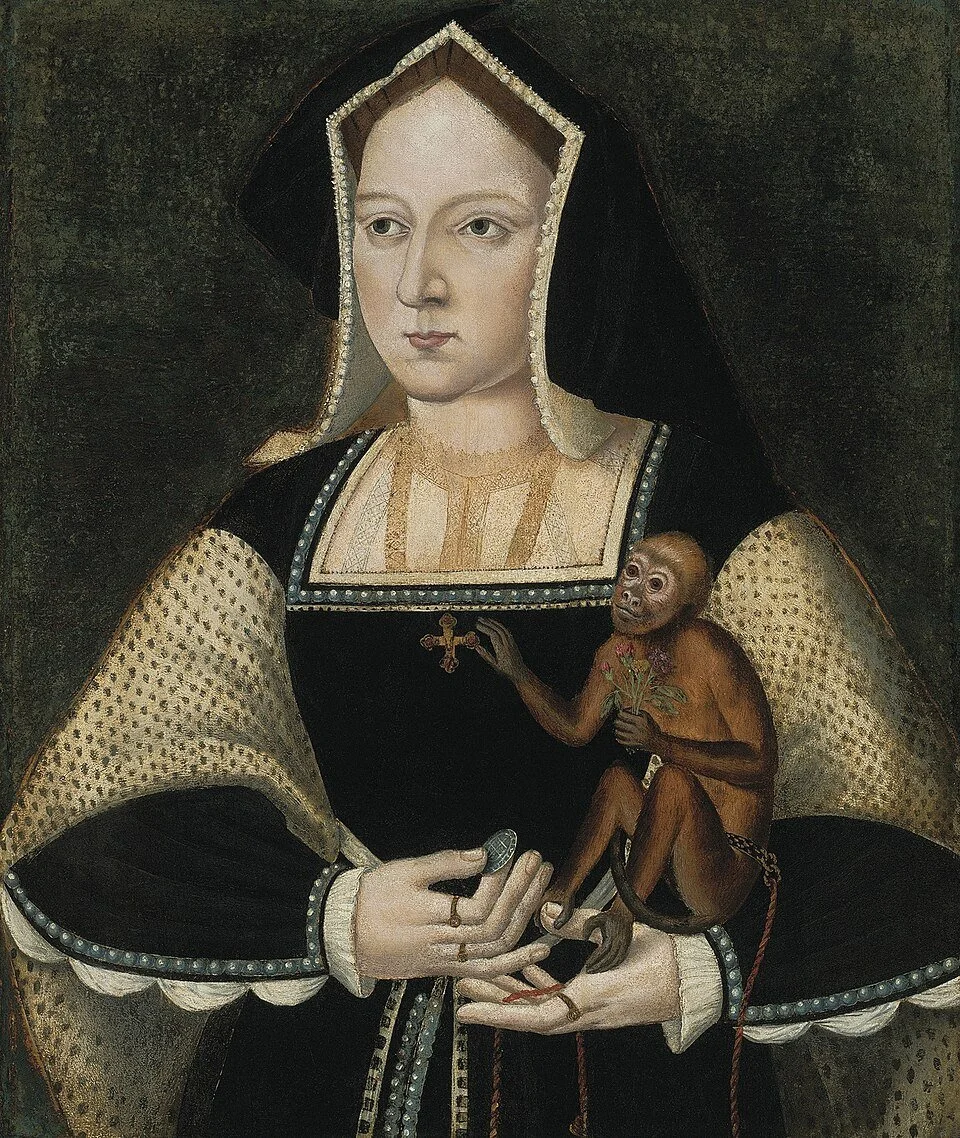
Catherine of Aragon.
Her journey to England began as a diplomatic mission. In 1501, she married Arthur Tudor, heir to the English throne, in a union designed to cement an alliance between two powerful Catholic monarchies. Yet the promise of that alliance was cut short when Arthur died just months after their wedding. Catherine, still a teenager, found herself stranded in a foreign land, her future uncertain and her status diminished. For several years she lived in a kind of political limbo, her fate tied to ongoing negotiations between England and Spain. Ultimately, a solution was reached that would have far-reaching consequences: she would marry Arthur's younger brother, the future Henry VIII.
When Henry ascended the throne in 1509 and married Catherine soon after, their union appeared to embody harmony between personal affection and political necessity. Contemporary accounts suggest that Henry admired Catherine deeply, valuing her intelligence and sharing in her religious devotion. She, in turn, embraced her role with seriousness and grace, quickly becoming a respected queen. During Henry's absence on campaign in France, Catherine served as regent, demonstrating political acumen and leadership. Her oversight coincided with England's victory at the Battle of Flodden, a moment that reinforced her capability and strengthened her standing at court. For a time, theirs was a partnership that seemed to fulfill the ideals of Tudor monarchy: stable, devout, and effective.
Yet beneath this stability lay an issue that would grow into a national crisis. Catherine's repeated pregnancies ended in heartbreak, with miscarriages, stillbirths, and infant deaths undermining the couple's hopes for a male heir. Only one child, Mary I of England, survived into adulthood. In Tudor England, the absence of a male successor was not simply a personal tragedy but a political threat. Memories of the Wars of the Roses lingered, and the fear of dynastic instability haunted the court. As the years passed and Catherine's chances of bearing a son diminished, Henry's concern turned to urgency, and eventually to obsession.
It was in this atmosphere that the "Great Matter" emerged, transforming a private marital difficulty into a defining episode of English history. Henry became convinced that his marriage to Catherine was invalid in the eyes of God, citing a biblical prohibition against marrying a brother's widow. Whether this conviction stemmed from genuine religious anxiety, political calculation, or his growing desire to marry Anne Boleyn remains a subject of historical debate. What is certain is that Henry sought an annulment from the Pope, expecting compliance from a Church that had long been intertwined with European monarchies.
Catherine's response altered the course of events in profound ways. She refused to accept the annulment, maintaining that her marriage to Arthur had never been consummated and that her union with Henry was therefore lawful. Her stance was not merely defensive but principled, rooted in her deep religious conviction and her understanding of her role as queen. In a dramatic moment before a papal court in England, she appealed directly to Henry, kneeling before him and asserting the validity of their marriage. It was a powerful display of dignity and resolve, one that captured public sympathy and underscored the moral weight of her position.
In the context of Tudor England, Catherine's resistance was extraordinary. As a queen, she was expected to be obedient and accommodating, yet she navigated the limited avenues of female power with remarkable skill. She leveraged her reputation for piety, her status as a foreign princess, and her support among the English people to challenge the king's will. Her defiance highlights one of the central tensions of the period: the constrained yet potent role of women within a patriarchal system. Catherine could not command armies or legislate, but her moral authority proved formidable.
The failure to secure papal approval for the annulment pushed Henry toward a radical solution. Frustrated by delays and political complications—particularly the influence of Catherine's nephew, the Holy Roman Emperor—Henry began to assert greater control over the English Church. This process culminated in the break with Rome and the establishment of the Church of England, a transformation that would reshape the religious landscape of the nation. While Henry's motives were complex, Catherine's refusal to yield was a critical catalyst. In this sense, her personal stand became a turning point in the history of European Christianity.
For Henry, the episode marked a significant evolution in character. The king who had once been celebrated as a defender of the Catholic faith began to redefine his authority, placing himself at the head of both state and church. This shift not only resolved his immediate marital dilemma but also expanded the power of the monarchy in unprecedented ways. It set a precedent for future rulers and altered the relationship between the crown and religion for generations to come.
Catherine's final years were marked by isolation and hardship. Stripped of her title as queen and separated from her daughter, she was relegated to a diminished status, yet she never relinquished her claim to be Henry's rightful wife. Her correspondence reveals a woman of unwavering faith and resilience, committed to her principles despite personal suffering. Even in decline, she maintained the dignity that had defined her life, earning the respect and admiration of many who witnessed her ordeal.
Her legacy is both deeply personal and broadly political. Catherine of Aragon represents the ideal of queenship rooted in duty, faith, and integrity, yet her story also illustrates the limitations imposed on women in positions of power. At the same time, her resistance played a pivotal role in one of the most significant religious transformations in English history. Through her, power, gender, politics, and religion intertwine in a narrative that is as consequential as it is compelling.
Catherine's story casts a long shadow. It sets the stage for the rise of Anne Boleyn and the further evolution of Henry's reign, while also foreshadowing the enduring impact of his decisions on the English monarchy. In Catherine, we can see not only a queen of duty, but a figure whose steadfastness helped to reshape a nation, proving that even within the constraints of her time, conviction ultimately altered the course of history.
Catherine of Aragon's life closes not with the triumph of her cause, but with the quiet endurance of a woman who refused to separate conscience from identity. In the end, she lost her crown, her position at court, and the companionship of her daughter, yet she preserved something far more enduring: the integrity of her beliefs. Where Henry sought resolution through power, Catherine remained anchored in principle, embodying a form of resistance that did not rely on force, but on moral certainty. This contrast between authority and conviction lies at the heart of her story and explains why her legacy has outlived the political settlement that displaced her.
Her significance extends well beyond the personal tragedy of a discarded queen. Catherine's refusal to concede forced a reckoning that exposed the fragile balance between monarchy and the Church, revealing how deeply intertwined faith and governance had become in early modern Europe. By standing firm, she inadvertently compelled Henry to pursue a course that would permanently alter England's religious identity. The English Reformation, often framed as the will of a determined king, cannot be fully understood without acknowledging the immovable figure of Catherine at its center, her resistance transforming what might have been a quiet annulment into a seismic historical rupture.
At the same time, her story offers a powerful lens through which to examine the nature of female agency in a rigidly patriarchal society. Catherine did not wield conventional power, yet she influenced events at the highest level of statecraft. Her authority was expressed through intellect, piety, and an unyielding sense of duty, tools that allowed her to challenge a king without ever stepping outside the boundaries of her role. In doing so, she redefined what strength could look like in a queen, leaving behind a model of leadership grounded not in dominance, but in steadfastness.
There is also an enduring poignancy in the personal cost of her stand. Catherine's later years, marked by separation and declining health, reflect the human consequences of political transformation. Yet even in isolation, she remained resolute, never acknowledging the legitimacy of the annulment or Henry's subsequent marriage. This unwavering position ensured that, in the eyes of many contemporaries, she remained the true queen of England until her death. It is a testament to her character that, despite her fall from power, she retained the loyalty and sympathy of the people an intangible but powerful form of victory.
Ultimately, Catherine of Aragon's story is not simply one of loss, but of influence. She stands as a pivotal figure whose personal convictions intersected with and helped to shape one of the most transformative periods in English history. Her life illuminates the complexities of power, the limits imposed by gender, and the profound impact of individual resolve within larger historical forces. As Henry VIII moves forward to new marriages and further upheaval, it does so in the shadow of Catherine's example, a reminder that even in defeat, steadfast conviction can leave an indelible mark on the course of history.
Now read part 3 on Anne Boleyn here.
Read more on Catherine of Aragon here: Who had the better case in the divorce with Henry?