
Before November 18, 1883, noon in New York was not noon in Philadelphia. Not noon in Pittsburgh. Not noon in Chicago. Each city kept its own time, measured against the position of the sun directly overhead that town, that day. This was not a flaw. It was how time had always worked. Here, Ali Mujtaba Zaidi looks at the change.
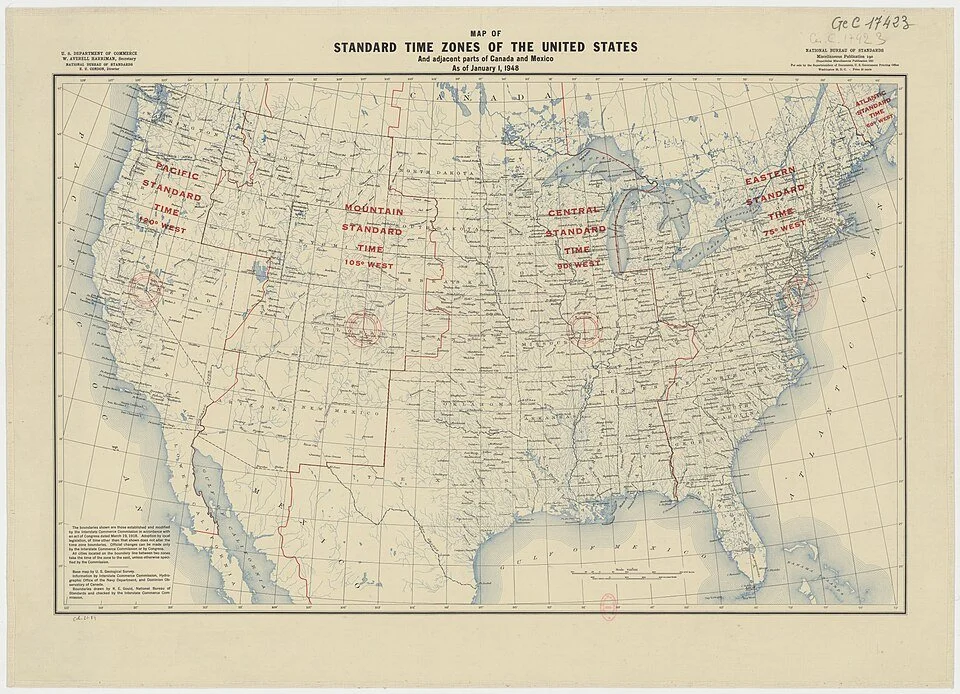
A 1948 map of standard time zones of the United States.
In the US in 1883, the different times in different cites made railroads dangerous.
A passenger leaving Boston in the 1870s carried a watch set to Boston time. At Providence, the station clock showed something slightly different. At New Haven, different again. By the time the train reached New York, a traveler paying close attention had passed through four or five quietly disagreeing versions of the same afternoon. Most people found this mildly irritating. Railroad schedulers found it a genuine operational nightmare.
Conductors often carried small handwritten conversion tables in their breast pockets, noting the difference between their company's internal clock and whichever local time the next station was running on. A few minutes here. Eight minutes there. It sounds trivial. On a single-track line with two trains moving toward each other from opposite ends, it was not trivial at all.
The Fragmentation Problem
By the early 1870s, the United States had somewhere between 50 and 80 separate railroad time standards running simultaneously. Some estimates go higher, depending on how you count regional variations and company-specific practices. No authoritative single number exists. What does exist is a picture of fragmentation serious enough that the Railroad Gazette, which tracked industry operations closely, was publishing regular complaints about it through the 1870s.
The safety concern was specific. Single-track railroads, which described most American rail infrastructure at the time, required trains traveling opposite directions to pass at designated sidings. That coordination depended entirely on agreed timing. If a stationmaster in one town and a stationmaster forty miles away were working from clocks even three or four minutes apart, the margin for error on a high-speed approach shrank considerably.
Collision records from the period are difficult to analyze cleanly. Mechanical failures, poor track conditions, and miscommunication caused most accidents, and historians are rightly cautious about attributing too many disasters to timing alone. But the rail industry itself identified clocking inconsistencies as a contributing factor in enough incidents that by the late 1870s, reform was no longer a theoretical debate. It was an economic and safety priority.
The resistance to solving it was partly political, partly institutional. Each railroad company had built its own internal timekeeping standard, often based on the solar time of its headquarters city. Adopting a rival company's time standard felt, to many managers, like a concession. Who sets the reference clock was also a question about whose city, whose meridian, whose commercial center stood at the center of the network.
The Man With the Proposal
William Frederick Allen did not invent the idea of time zones. Several astronomers and geographers had proposed versions of the concept through the 1860s and 1870s, including the Canadian engineer Sandford Fleming, whose advocacy for global standardized time ran through the same decade. What Allen did was take a workable version of the idea and spend years making it acceptable to the people who actually controlled American rail operations.
Allen was secretary of the General Time Convention, a body representing the major American railroad companies. His position was essentially that of a technical administrator and industry diplomat. He had access to the people whose agreement he needed. He also understood the practical constraints well enough to design a proposal that asked rail operators to give up as little as possible while gaining the coordination they needed.
The compromise he eventually brought to the table divided the continental United States into four time zones, each one hour apart, pegged to specific meridians. Eastern, Central, Mountain, Pacific. The boundaries were drawn to follow existing railroad operating regions as closely as practical, which meant they were not perfectly aligned with longitude in every case. They still aren't.
Some city newspapers resisted. Detroit refused to adopt standard time for years. A handful of municipalities held out on principle, arguing that the federal government had not actually mandated anything, which was technically true. Congress had not passed a law. No executive order had been issued. The railroads, as a private industry consortium, had simply decided on the change and implemented it. The rest of the country followed because the railroad schedule was now the most authoritative clock in most people's lives. If your town clock didn't match the station clock, you would miss your train.
November 18, 1883
At noon Eastern Standard Time on November 18, 1883, railroad station clocks across the country were adjusted. Telegraph operators, who were also the communication backbone of rail operations, had coordinated the synchronization. Some stations had to move their clocks forward. Some had to move them back. In a few cities, the adjustment was significant enough that the same afternoon briefly contained two noons, one solar and one standard, about sixteen minutes apart in some cases.
Chicago's adjustment was memorable enough to get newspaper coverage. The city's clocks were moved back nine minutes and thirty-two seconds to align with the new Central time standard. A reporter for the Chicago Tribune noted that two separate stroke-of-noon signals came from different city clocks that day, and that pedestrians near the Board of Trade briefly stopped to figure out which one to trust.
Most people simply reset their watches and continued with their afternoon.
The federal government took another 35 years to formally recognize what the railroads had created. The Standard Time Act of 1918 made the four-zone system law, largely because the First World War had made coordinating national logistics across incompatible regional times an obvious liability. For those 35 years between 1883 and 1918, standard time in the United States was a corporate convention, not a legal one. Society had adopted it, practically and almost entirely, because it was more convenient than the alternative.
What This Actually Changed
The railroad companies were not trying to reshape how Americans experienced their days. They were not, as some later commentators have suggested, attempting to impose industrial discipline on an agrarian population attached to solar rhythms. That interpretation is not entirely wrong, but it reverses the causation. The companies were trying to stop trainsfrom crashing into each other. The larger social consequences came afterward and were largely unplanned.
Once synchronized time existed as infrastructure, other institutions built on top of it. Factory shift schedules became easier to coordinate between sites. Banks in different cities could agree on a common closing hour. Telegraph servicesthat operated nationally needed a single temporal reference for message timestamps. Each of these adaptations reinforced the standard, made defection from it more costly, and gradually turned a railroad scheduling solution into something that felt like a natural feature of reality.
This is how most large infrastructure changes actually settle into a society. Not through a single dramatic moment of adoption, but through accumulated dependency, each new use case making the underlying standard harder to dislodge.
The Inheritance
The time zone structure that Allen's 1883 compromise created has been modified at the edges many times since. International conferences in the late 19th and early 20th centuries extended the logic globally. Individual countries have shifted zones for political reasons. A handful of places use half-hour or quarter-hour offsets that fit awkwardly inside the original framework. China officially observes a single time zone across a landmass that geographically spans five.
But the basic architecture is the same. The world runs on a grid of standardized longitudinal bands, each offset from a reference meridian by a fixed number of hours, the direct descendant of what four railroad companies and one patient industry secretary agreed to in the autumn of 1883.
Standard time, which most people now experience as an unalterable fact of the physical world, is younger than the telephone. The telephone was patented in 1876. Standard time came seven years later. People alive in 1883 had spent their entire lives in a world where every town kept its own time as a matter of course, where the question "what time is it here?" had a genuinely local answer, and where the idea of a single synchronized clock across an entire continent would have seemed either visionary or absurd, depending on who you asked.
That the change happened within a single generation, driven by the operational needs of one industry, and was absorbed so completely that most people today can't name its origin date, says something worth thinking about. Not about railroads specifically. About how quietly the structures that organize daily life get built, and how invisible they become once they work.
Did you find that piece interesting? If so, sign-up with us and get a free book by clicking here.
References
Allen, William F. History of the Adoption of Standard Time. American Railway Association, 1884.
Bartky, Ian R. Selling the True Time: Nineteenth-Century Timekeeping in America. Stanford University Press, 2000.
O'Malley, Michael. Keeping Watch: A History of American Time. Viking, 1990.
Prerau, David. Seize the Daylight: The Curious and Contentious Story of Daylight Saving Time. Thunder's Mouth Press, 2005.
The Historical Insights, Why Time Zones Were Created in 1883: https://thehistoricalinsights.page/2026/04/why-time-zones-were-created-1883.html
About the Author: Ali Mujtuba Zaidi is a civil engineering scholar at Jamia Millia Islamia and the lead researcher for The Historical Insights, an independent publication focused on forgotten logistics, historical infrastructure, and systems history.