The 19th and the early 20th century were characterized by the major powers of Europe possessing massive, worldwide colonial empires. Often, when people think of colonial powers, popular imagery depicts the British Empire, one of the largest in history, or the French Empire. But as many empires rise and dominate, many more are short-lived but equally as impactful, with one such being the colonial empire of Germany from 1871, when the nation was unified, to the 1stWorld War.
Harrison West explains.
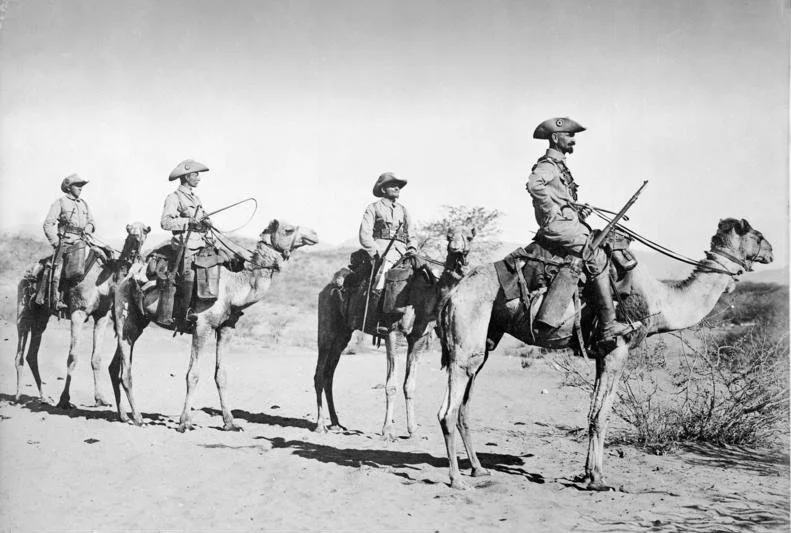
Four German soldiers in a camel patrol in German South West Africa. Attribution: Bundesarchiv, Bild 105-DSWA0095 / Walther Dobbertin / CC-BY-SA 3.0, available here.
The German Empire
Germany lies at the center of Europe, rich in culture and dense history going back to Neolithic settlers thousands of years ago. At the turn of the 20th century, Germany was a constitutional monarchy under the leadership of Kaiser Wilhelm II, with Chancellor Theobald von Bethmann Hollweg leading the executive, and the parliament (the Reichstag), having limited power. The state capital was Berlin, with cities like Hamburg, Dresden, Cologne and more being large hubs of industry. By 1914, the German Empire was the largest economic power in all of Europe, ahead of nations like Britain in world trade, and becoming a dominant player in the global export of steel and electrical equipment. The empire was one of Europe’s fastest-growing nations, with major population increases, urbanization, and being a leader in the manufacturing of chemicals, pharmaceuticals, and electrical engineering. On the downside, industrial workers faced restricted political rights, leading many to support socialist parties. And internationally, a system of alliances had isolated the country, with poor relations with France, Russia and Britain, but it did have allies in the form of Austria-Hungary, and Germany was pursuing global expansion to secure national prestige, economic resources, and geopolitical power. Another reason was to rival that of the British and the French. Officially proclaimed in the 1880s, by 1914, the German Colonial Empire spanned from the rainforests of Cameroon to the small islands, like Samoa and the Marshalls, deep in the Pacific Ocean.
Colonial administration of the colonies was through either direct decrees from the Kaiser, or, if not imperial, cases could be issued by the Colonial Office, and then the Reichstag could issue laws regarding Germans. Colonial organization and self-governance depending on the influence of the colony.
African Colonies
Kamerun
Kamerun was a protectorate in central Africa, under the leadership of Governor Karl Ebermaier; its territory spans over modern-day Cameroon, Nigeria, Chad, the Central African Republic, Gabon and Congo. The protectorate was first established in August 1884 after German explorers signed a treaty with local chiefs in the region during the scramble for Africa. Over time, the colonial capital shifted three times, with Jaunde (present-day Yaoundé) serving as the capital by 1914. The colony’s main exports were rubber, palm oil, palm kernels, cocoa, and bananas, produced through cash-crop plantations that relied on forced and harsh labor. The infrastructure of the colony comprised two major railways, which the colony relied heavily on as road construction was minimal, and ports such as Duala, with the colonial population being 4.645 million by 1912. Military-wise, there was the Schutztruppe (protection troops), which comprised 1,855 men—mostly Africans soldiers led by German officers—and 1,530 armed police. Inside the colony, German was the official language, but Basaa, Beti, Duala, and other local languages were common. Many local communities fiercely protected their sovereignty, leading to various forms of resistance against the Germans.
Togoland
Togoland was a protectorate in West Africa, at the time under the leadership of Duke Adolf Friedrich of Mecklenburg, from 1912 until August 1914, when Hans Georg von Doering became acting governor. This colony spans modern-day Ghana and Togo, with this colony first being established in the same year as Kamerun, by the same method, during the scramble for Africa. Similar to Kamerun, the colonial capital also shifted three times over the course of its history, with Lomé being the capital since 1897, and considered one of the prettiest cities in West Africa at the time. This colony mainly exported similar goods as Kamerun, but also cotton and coffee, with efforts to make Togoland a cotton-producing hub, but it failed to meet Germany’s needs, and the plantations for these goods were also cash crops manned by forced laborers. Regarding infrastructure, Tongoland possessed three major railway lines connecting Lomé to the colony’s interior, with the capital also being the principal port. The population of the colony was estimated to have numbered roughly 920,000, with the official language being German, but local languages like Ewe, Kotokoli and Kabye were also common, and other European languages such as French and English were used as a trade language. A small police force numbering 1,500 by 1914 was stationed to protect the colony, with this force mainly comprising Africans and very few Germans. Life in the colony varied with traditional structures, beliefs, and practices remaining central to the lives of many, with some local resistance rising to combat the harsh colonial treatment of the Germans.
German East Africa
German East Africa that spans over what is now the modern-day African nations of Tanzania, Kenya, Burundi and Rwanda. By 1914, the colony was under the leadership of Governor Heinrich Schnee, with the colonial capital being the city of Dar es Salaam in present-day Tanzania. The colony was established in 1885 during the scramble for Africa via treaties with local chiefs and sending warships to cement claims against the Sultan of Zanzibar. The main exports of this colony include Sisal, which was the largest source of income for plantations, coffee, rubber and other agricultural products like hides and oil seeds. The majority of these goods were sold to places like Britain and Australia, with only some being shipped back to the German homeland. The main backbone for transportation in the colony was railways, with two main lines, one connecting the capital to the coast, whilst the other connected the ports to the highlands. Roads were present, but mainly used for administrative needs, rather than for the general public. The population of the colony was around 7.7 million, with German being the official language, but many local languages, like Arabic, Swahili and Kirundi, were also commonly spoken. For defense, the Schutztruppe numbered 14,700 men in strength, with 3,000 of them being Europeans. Similar to Togoland, life here was a mixture of traditional, native practices and culture, and brutal German colonial control that prioritized the establishment of cash crops.
German South West Africa
German South West Africa (modern-day Namibia) was the final German colony on the African continent for their overseas colonial empire. The Germans had a presence there as early as 1883, leading to the establishment of a protectorate the next year to prevent British encroachment. By 1914, the governor of the colony was Theodor Seitz, with the colonial capital being Windhuk. The main exports of this colony were diamonds, copper, hides and produce coming from cattle. The transport for this was done by railways, the backbone of transportation infrastructure in the German colonies in Africa, as we have seen, with these rails connecting the interior to ports along the coast. The total population of the colony by 1914 was around as much as 200,000, with the majority being native Africans, and the official language was German, with local languages like Afrikaans and Khoekhoegowab also being commonly spoken. Life in this colony varied, with the indigenous people facing dispossession, forced labor, and genocide, which even led to a genocide in 1904 after an uprising against German authorities. Meanwhile, for German settlers, life was mixed, with settlers celebrating traditional German holidays, including beer and bratwurst culture, but life was often harsh, forcing many to take up many trades. By 1914, the colonial defenses comprised 3,000 soldiers of the Schutztruppe and 6,000 reservists.
Pacific & Asian Colonies
German New Guinea
Moving beyond the lands of Africa, we have the vast Pacific islands, starting with German New Guinea. The Germans claimed the territory in 1884, partly to challenge British interests in the Pacific, and it was originally administered by the New Guinea Company until 1899, when the state took over control. This territory included the northeastern part of the island (Kaiser-Wilhelmsland), the Bismarck Archipelago, the islands of Buka and Bougainville in the northern parts of the Solomon Islands chain, Palau, the Caroline Islands, Nauru, the Mariana Islands & the Marshall Islands. Regarding the land beyond New Guinea, the Solomons & Bismarck’s, those were bought from the Spanish in the late 1800s. By 1914, the colony was under the administration of Eduard Haber, with the colonial capital being Simpsonhafen (present-day Rabaul) on the island of New Pomerania (New Britain). The main export commodities of this colony were copra, rubber and other products grown in plantations, along with minerals like copper and phosphates. Infrastructure varied tremendously throughout the islands, with a main focus on maritime transportation to trading ports along the coast, but due to the tropical and mountainous environment of New Guinea, road infrastructure was very limited.
By 1914, the population of the colony numbered around 600,000, with the majority being native people, and a fraction being Asian or European, with the official language being German, but Papuan and Austronesian languages were also common in the vast islands. Life amongst the colony varied, with the Germans heavily enforcing plantation expansion, forcing local inhabitants into labor, with coastal and island settlements experiencing some development, European presence remained limited, especially in the interior of New Guinea. German New Guinea itself was defended by a light force of 240 Melanesian Polizeitruppe and 61 German officers, all cantered around protecting Simpsonhafen.
German Samoa
German Samoa was the farthest extent of the German colonial empire, comprising modern-day Samoa; it was nearly double the distance from Germany itself compared to German South West Africa (Namibia). This territory was acquired at the turn of the century, after a civil war saw the Samoan islands divided up between the Germans and the Americans (the British were initially interested but withdrew). By 1914, the colonial capital was Apia on Upolu Island, with the protectorate being under the leadership of Erich Schultz-Ewerth. Similar to New Guinea, the main export was coconut products coming from plantations, with cocoa and rubber also being cultivated and exported as well. German Samoa was considered one of the most well-developed German colonies in the Pacific, allowing the colony to become nearly self-sufficient, with the Telefunken Railway connecting the capital's harbor to Mount Vaea and some roads. By 1914, the population was estimated to be just over 40,000, the large majority of those being Samoans, with German being the official language, but native Samoan was also widely spoken. The Germans co-operated with local chiefs, with the Germans respecting Samoan customs and culture, although they banned activities like gambling. For colonial defense, the islands had an extremely small force of 50 ceremonial guardsmen and an equally small volunteer force.
Kiautschou Bay Leased Territory
The final possession of the German colonial empire was a leased territory in eastern China, established following a military occupation of parts of the Shandong province around the port of Tsingtau (Qingdao), and the signing of a treaty with the Qing securing a 99-year lease for a naval coaling station and economic exploitation in 1898. By 1914, the leased territory was under the administration of Vice Admiral Alfred Meyer-Waldeck, with the capital being the port of Tsingtau. The main export goods of this territory were mostly agricultural products like soy and sesame, but beyond that, coal was also exported widely as well.
Being a vital port for the Germans in the region, the territory’s deep-water port was well built, with a smaller harbor for commercial shipping also being present, a shipyard and dry docks. As well as the Tsingtao-Jinan railway line, which linked the deep-water harbor to the interior of the Shandong province, and lastly, paved and wide streets that are often compared to those in German cities. By 1914, the population was around 200,000, the large majority being Chinese, whilst only a handful of Germans. Life and culture in this territory were characterized by the mixing of Bavarian-style buildings and Western-style services, with Chinese culture, customs and language, similar to the situation in Samoa, even serving as a safe haven for those trying to escape the Boxer Rebellion in 1911. In defense of the territory was the German Navy (Kaiserliche Marine) East Asia Squadron with a few ships and a small garrison force.
The End of Germany’s Empire
Now, to answer the question, what happened to them? And to summarize, when World War 1 began, each one of the German overseas territories and protectorates found themselves occupied by the Entente. Germany’s African colonies were conquered by the British and the French (with Belgian assistance), the Kiautschou Bay Leased Territory was besieged and occupied by the Japanese until the 20s when it was returned to China, Samoa surrendered quickly to New Zealand, Australia occupied German New Guinea, and the Pacific Islands went to Japan as a mandate. The signing of the Treaty of Versailles marked the official end of the German Empire.
With the benefit of hindsight, Germany's attempt at colonialism was poorly handled. Despite holding vast territories across the globe, colonies were managed to benefit a tiny minority of German settlers, while indigenous populations were treated as subordinate. Colonial rule relied on forced labor, was poorly managed, and colonies were not economically successful, providing low returns and often requiring significant state funding for infrastructure and military control.
Interested in European colonialism? Now read about France’s role in Algeria here.
Sources
1. Michael Stuermer, 2013, THE GERMAN EMPIRE 1871 - 1919, book
2. James Hawes, 2018, The Shortest History of Germany, book
3. Helmut Walser Smith, 2020, Germany A Nation in Its Time: Before, During, and After Nationalism, book