The War of the Breton Succession or the Breton War of Succession (1341–1365) was a war over the succession of the Dukes of Brittany, north-western France, that lasted for over twenty years. The war was a major conflict in the long Hundred Years’ War, which drove both France and England into a fight for survival and a contest for supremacy in Western Europe. Talia Bega explains - and here looks at the rise of the English.
Part 1 on the origins of the war is here.
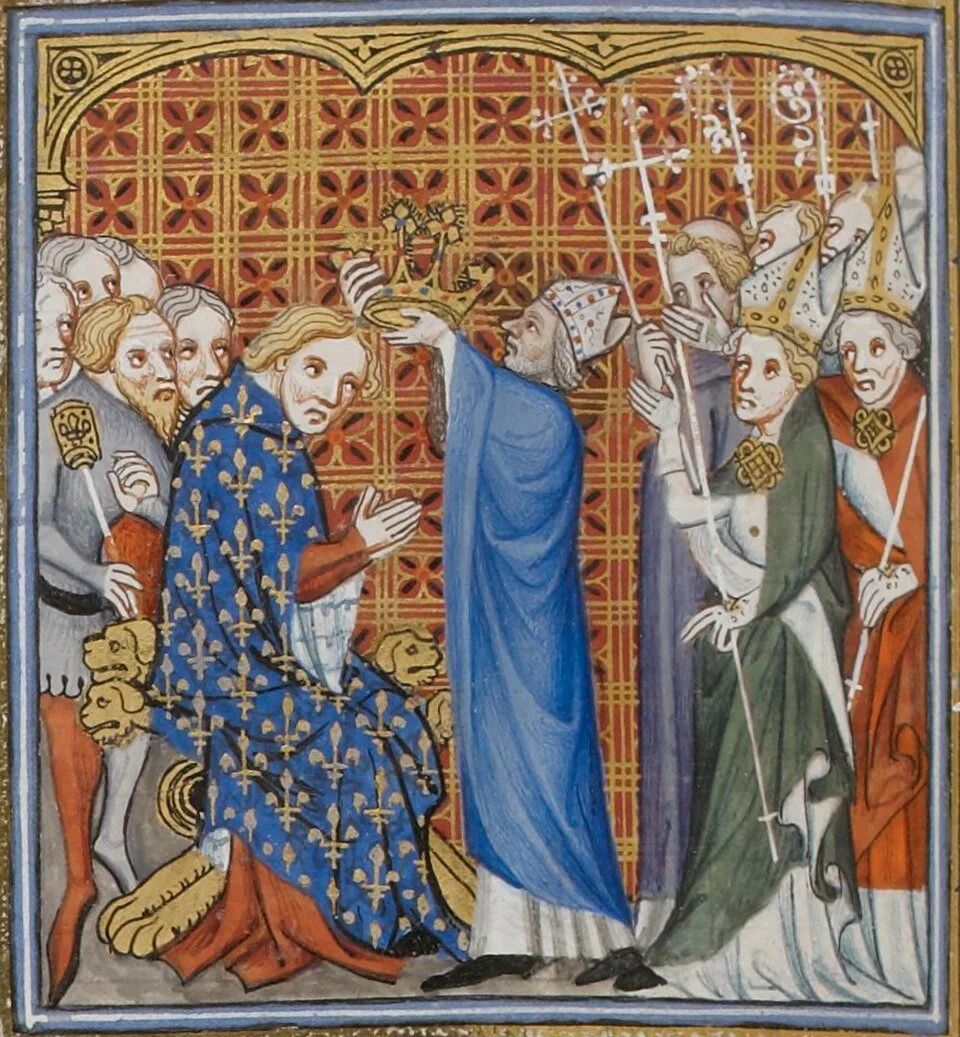
A depiction of the coronation of Philip VI of France.
1341, the Year that Changed Everything
The Hundred Years’ War (1337–1453) was waged by Edward III of England, who pressed his claim to the throne of France after the death of his uncle Charles IV in 1328, the last direct Capetian. The English fought to recover and expand the territories their Angevin predecessors had held in France in the twelfth century. The war brought bloody campaigns on multiple fronts and devastated large parts of the French countryside. However, it was not just about the French throne; it also intersected with internal conflicts in France. In 1341, John III, Duke of Brittany (1286–1341), died, leaving a crisis over who would succeed him. This was not just a problem of succession but a source of wider chaos, especially for France and England during the Hundred Years’ War.
The dukes of Brittany were important in French politics, serving as a basis for stability in the French realm. After John's death, there was widespread anxiety over who should become the next duke. Two candidates emerged, each backed by one of the rival kingdoms. On the French side stood Charles of Blois, who had married the late duke’s niece, Joan of Penthièvre. Joan was the daughter of the late duke’s younger full brother, Guy, Count of Penthièvre, making him one of the most plausible heirs. But this was not the only option. Whenever a dispute opened up in France, the English were rarely far away. The English backed John of Montfort, the late duke’s younger half-brother, born of their father Arthur II’s second marriage to Yolande de Dreux. Both sides knew where their candidate stood; what remained was to see whose claim could prevail.
A Truce that Turns the Tide
France and England were at peace with the Truce of Espléchin, which had been signed in 1340 and ran until the summer of 1341. The truce followed the failed English siege of Tournai, after which Pope Benedict XII asked Edward’s mother-in-law, Jeanne of Valois (who was also Philip VI’s sister), to mediate. The English would not attack France for nine months over the period. It was soon overtaken by events in the Breton War of Succession.
The treaty allowed both sides to gather numerous troops and to rethink a new plan, especially as France faced a challenge from its own people to an increase in debt after constant battles with the English. After the death of the Duke of Brittany, the violation of the treaty occurred as the English came to support John of Montfort. However, at the time, many of the nobility supported Charles, causing a wide division. Even though John had arguably the stronger legal claim, the French king, Philip VI, preferred Charles, who was well known and well-connected among the French aristocracy. John saw that the matter would not resolve itself in his favor, and he made other plans. Encouraged by his wife, he moved on the capital of the duchy, Nantes, after the funeral of the late duke, and took control of the treasury.
John’s aim was to seize as much of the duchy as possible and force the king of France to confirm him as duke. He pressed on to Rennes and took it without serious opposition. Still, his position had weaknesses: much of his support came from the lower classes and the towns, while most of the nobility continued to favor Charles. By the end of 1341, much of eastern Brittany was in John’s hands, bringing him closer to the ducal title. He also had the backing of Edward III, who pursued his own claim to the French throne. With Edward behind John and Philip behind Charles, any prospect of a negotiated settlement was vanishingly small.
A Spark of a New War
In September 1341, the French Court of Peers at Conflans, summoned by Philip VI, ruled in favor of Charles, with John of Montfort called as a witness. On September 7, Charles was formally recognized as the new duke. As Charles took up his duchy, he faced military pressure from several directions, and the situation in Brittany remained volatile. Philip also wanted to absorb the duchy into the French royal domain as a province, although the terms of the recent truce restricted what he could do openly. Edward, for his part, was furious that events were running against him and decided to resume the war. He saw Brittany as a useful foothold for English forces, and a Montfort duke would strengthen the English position in France.
Aware of the growing English threat, Charles secured the king’s help and a force of more than 7,000 troops was dispatched to defend the duchy against any invasion or siege. It was led by the future king of France, John, Duke of Normandy. Montfort saw the large army approach and rallied whatever fighters he could muster. Heavily outnumbered, his forces were defeated, and the French took Champtoceaux. John had no choice but to retreat to Nantes, where he soon surrendered to the duke of Normandy after a long blockade during which the French broke into the town. Philip had John escorted back to Paris and once again pressed him to drop his claim. What Philip did not know was that John’s wife was already working to bring English forces across the Channel and widen the war.
The west of Brittany still held out for the Montfort cause, but with John captive, time was running short. This was not only a struggle for power, but also a contest of wills between two powerful realms. John’s wife, Joanna of Flanders, fought hard to keep her husband’s claim alive. So too did Charles’ wife, Joan of Penthièvre — a rivalry that gave the conflict its other name, the War of the Two Joans. These events have rarely received the attention they deserve, yet they reveal how local successions could feed into the larger Anglo-French struggle, with the outcome only settled more than twenty years later.
A reminder that Part 1 on the origins of the war is here.
References
GRAHAM-GOERING, E. (2021). Princely power in late medieval France: Jeanne de Penthievre and the war for Brittany. CAMBRIDGE UNIV PRESS.
Sumption, J. (1991). The Hundred Years War. University of Pennsylvania Press.