A century after Napoleon's death, thousands of Boer prisoners unexpectedly transformed life on one of Britain's most remote possessions. Richard Clements explains. Richard Clements explains.
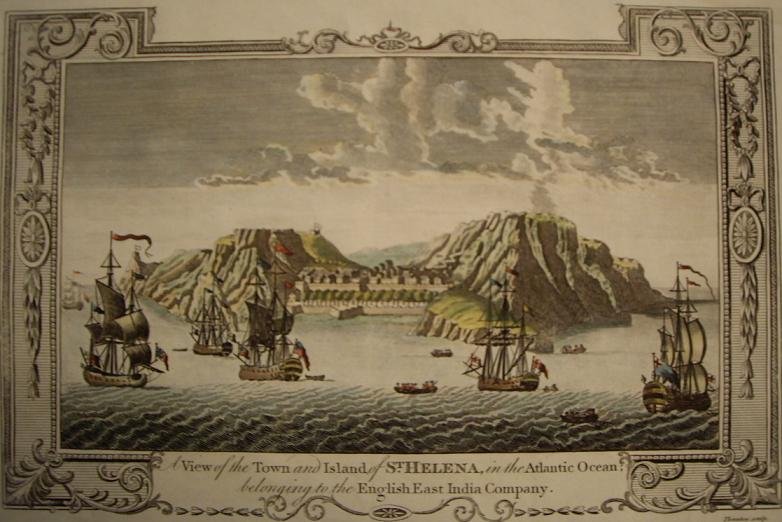
A view of St Helena, circa 1790. Thornton, engraver, published by A. Hogg. Source: Public domain, available here.
In April 1900, St Helena found itself entering another unexpected chapter in its long and unusual history.
Nearly eighty years had passed since Napoleon Bonaparte had died on the island, yet once again ships were approaching Jamestown carrying defeated enemies of Britain. This time they were not emperors and marshals, but exhausted Boer prisoners captured during the war in South Africa.
Governor Robert Armitage Sterndale seems to have understood that emotions might easily run high. Before the prisoners arrived, he urged the islanders to show restraint and courtesy. Whatever side they had fought on, these men had gone to war for what they believed was their country's cause.
On 11 April 1900, the first contingent of 514 prisoners came ashore. By the end of the war, somewhere between 5,500 and 6,000 Boer prisoners had passed through St Helena. The effect on the island was immediate. Suddenly, a small community found itself sharing the island with thousands of unexpected newcomers.
Another Prison Island
Britain's military authorities had never expected to care for so many captives. As the war dragged on, prisoner camps in South Africa became increasingly overcrowded and vulnerable. Men were sent across the Empire to places including Bermuda, India, and Ceylon.
St Helena offered an obvious solution.
The same remoteness that had once confined Napoleon now appealed to officials faced with a very different problem. Surrounded by thousands of miles of ocean, the island seemed secure enough to hold thousands of prisoners.
Among the first arrivals was General Piet Cronjé, whose surrender at Paardeberg had shocked the Boer republics. Punch magazine later imagined the defeated commander saluting Napoleon's ghost with the words, "Same enemy, Sire! Same result!"
Lord Roberts allowed Cronjé's wife Hester to accompany her husband, and the couple were accommodated at Kent Cottage near Half Tree Hollow rather than in the camp itself. According to later accounts, the general insisted that proper respect should be shown to his rank and was even provided with a mounted guard made up of members of the St Helena Volunteers.
A Canvas City
Most of the prisoners were marched to Deadwood Plain, a windswept plateau overlooking the sea and not far from Longwood, where Napoleon had spent his final years.
Arthur Montefiore Bryce later described Deadwood Camp as a "canvas city."
Rows of tents spread across the open ground. Contemporary accounts suggest that each tent might contain as many as twelve men. Before long, the camp became overcrowded and permission was granted for prisoners to construct their own shelters using whatever materials they could find.
Paraffin tins, scraps of timber, bamboo, and cloth all found new uses.
The prisoners gave their growing settlement a nickname.
Blikkiesdorp.
Tin Town.
As more transports arrived, a second camp was established at Broadbottom. There, another improvised settlement emerged. The men called it Lappiesdorp, or Rag Town. Differences between Transvaalers and Orange Free Staters, together with simple overcrowding, encouraged the separation.
Later still, another division appeared. Men willing to swear allegiance to the British Crown found themselves deeply unpopular with those who remained committed to the republican cause. Deadwood No. 2 became known officially as Peace Camp, though not everyone used that name. Depending on whom one asked, it was also remembered as Jam Camp or Judas Camp.
Life Behind the Wire
The pages of Kamp Kruimels, the camp newspaper, suggest that life was not entirely given over to monotony.
Christmas brought decorated halls, church services, and parcels sent from Europe. More than 1,400 gifts arrived from supporters overseas. Rugby and cricket attracted enthusiastic followings, and arguments over sport seem to have been as common then as they are now.
Small businesses sprang up throughout the camp. Advertisements appeared for bakeries, confectioners, painters, engravers, and walking-stick makers. There were cafés, a brewery, and a surprising range of craftsmen.
Deadwood had begun to resemble something more than a prison camp.
As evening approached, singing could often be heard across the plain. There were choirs, brass bands, and string groups, and more than one visitor remarked upon the sound of hymns drifting over the tents.
Among the prisoners listening to those voices was Erich Mayer, a German-born volunteer who had joined the Boer cause. After the war, he became one of South Africa's most respected artists. His sketches preserved scenes from St Helena long after the camps themselves had vanished.
Sports also helped pass the time. Contemporary reports describe cricket, football, athletic meetings, and concerts. Reuters dispatches noted competitions lasting several days, while visitors remembered camp life as surprisingly active.
Many prisoners sought work, not simply for the money but to relieve the boredom of confinement.
Tensions and Escape
Life on St Helena was generally peaceful, but it was not without difficulties.
Persistent troublemakers occasionally found themselves confined in High Knoll Fort overlooking Jamestown. Serious incidents remained rare. One prisoner was shot and killed by a sentry in early 1901 following repeated attacks on guards with stones and other missiles. A military inquiry followed.
Escape attempts provided rather more colorful episodes.
One of the most famous involved Hans Eloff, a relative of President Paul Kruger. Together with several companions, he seized an old fishing boat at Sandy Bay and attempted to persuade local fishermen to help.
The escape soon descended into something close to farce.
Floorboards were ripped up in an effort to fashion paddles and money was offered to the fishermen, but the islanders stood firm. By the following morning, the would-be fugitives had been returned to custody.
Other schemes fared no better. One prisoner attempted to hide inside a crate marked "Boer Curios." Another pair stole a small water boat named Phoebe, only to be recaptured soon afterward.
For most prisoners, the surrounding ocean proved a more effective barrier than any fence.
The Island Changes
The Boers altered life on St Helena in ways few people had anticipated.
Local farmers benefited from increased demand for produce. Vegetables, eggs, cheese, and other goods commanded higher prices. Some prisoners entered the service of farmers and tradesmen, while others worked on roads and wharf improvements.
Governor Sterndale's administration employed groups of prisoners on public works. Reuters reports observed that many actively sought employment simply to break the routine of camp life.
The changes were not entirely beneficial. Fuel prices rose and heavy wagon traffic damaged roads. Yet many islanders later looked back on the period as an unexpected economic boost.
Relations between prisoners and residents appear to have been remarkably good. Before departing, German prisoners expressed their gratitude to the people of St Helena for the kindness shown to them during what they called the gloomy days of captivity.
For a small island community, the experience had been extraordinary.
Those Who Stayed
Most of the prisoners eventually returned to South Africa.
Not all of them did.
Some married local women and chose to remain on the island permanently.
Charles John Smith had been captured at Elandslaagte in 1899 and transported to St Helena with his brother Alfred. When repatriation finally came, Charles made a decision that surprised many others.
He stayed.
Known locally as "Boer Smith," he ran a bakery and became one of Jamestown's best-known characters. People who knew him later remembered a talkative man who delighted in telling stories and slipping back into old-fashioned Afrikaans whenever South Africans happened to appear.
He died in 1958 and was buried in St Paul's churchyard.
Members of his family remain part of St Helena life today.
A Cemetery on the Hillside
Not everyone lived to see the end of the war.
During 1902, enteric fever spread through the camps and deaths began to mount. By the time the prisoners departed, 180 men had been buried on the island.
According to several later accounts, Anglican authorities declined to use Anglican burial grounds and the Baptist community provided land at Knollcombes. There a cemetery was established on a steep hillside in the island's interior.
In 1913, the government of South Africa sent two granite obelisks listing the names and ages of the dead. The youngest was sixteen. The oldest sixty-one.
Today, little remains of Deadwood or Broadbottom beyond markers, photographs, and memories. The winds still sweep across the same hills, and the cemetery at Knollcombes remains quiet.
Yet traces of those years survive in family names, museum collections, and stories that have become part of St Helena's own history.
Long after the tents vanished, the Boer years never entirely left the island.
Now read about Napoleon’s secret plan to escape to America here – rather than St Helena
Further Reading
Alana Bailey, "Boer Graves on St Helena."
A. J. Nathan, "Boer Prisoners of War on the Island of St Helena," Military History Journal, Vol. 11, No. 3/4 (1999).
Arthur Montefiore Bryce, "Life in Camp at St Helena," Temple Bar.
Ben Viljoen, My Reminiscences of the Anglo-Boer War.
British Newspaper Archive.
E. L. Jackson, St Helena.
Philip Gosse, St Helena, 1502–1938.
Deadwood Camp Gedenksboek and surviving issues of Kamp Kruimels and De Krijgsgevangene.
St Helena Guardian (1900–1902).
St Helena Island Info.