The War of the Breton Succession, or Breton War of Succession (1341–1365), was a war over the succession to the dukes of Brittany, in north-western France, that lasted for over twenty years. The war was a major conflict in the long Hundred Years’ War, which drove both France and England into a fight for survival and a contest for supremacy in Western Europe. Talia Bega explains — and looks at how the English continued to win as the war concluded.
Part 1 on the origins of the war is here, and part 2 on the rise of the English is here, and part 3 on the rise of the English here, and part 4 on French Struggles Against the English at Crécy here, and part 5 on how the English kept winning (until they didn’t) here.
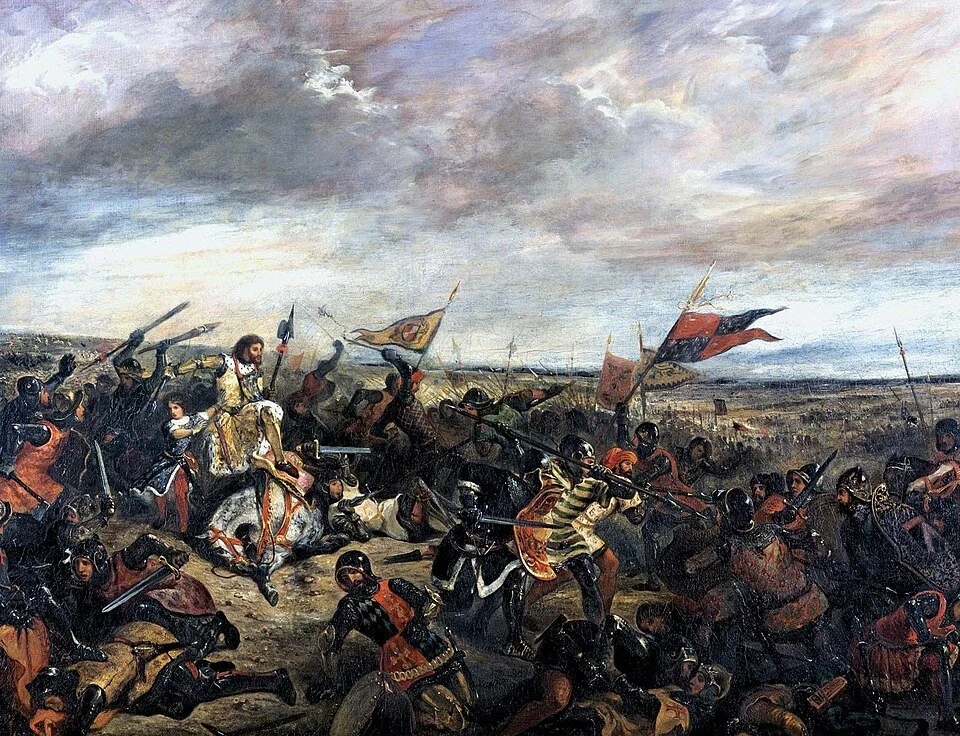
Battle of Poitiers by Eugène Delacroix. Source: Public domain, available here.
The Final Years: Poitiers
When John, the Duke of Montfort, died in 1345, his English supporters thought it was over, but, this was not the case. His son, John of Montfort, continued his father’s cause once he came of age. Meanwhile, Charles of Blois had been captured by the English at the Battle of La Roche-Derrien back in 1347 and spent the next nine years as a prisoner in England, only returning to Brittany after his ransom and release in 1356. During his long captivity, the Montfortist cause steadily gained ground in the duchy.
At about the same time, Edward III and his son, the Black Prince, were planning a much larger campaign to conquer France, known as a chevauchée, a mounted raid meant to destroy everything in its path. This campaign culminated in a turning point of the Hundred Years’ War: the Battle of Poitiers, fought in 1356. The Black Prince, leading a large force of Gascons and Englishmen, marched deep into central France on a destructive raid. John II had inherited a monarchy already weakened by his father’s disastrous campaigns a decade earlier.
The Black Prince's campaign continued through Poitou and the Loire valley in late August, with the Prince burning everything in his path. John saw a chance to stop the invading force before it could cross the Loire, until he realized his own fate was on the line against the powerful prince. On September 18, both sides still could not reach a deal as John was determined to seek glory on the battlefield. The Prince wanted a passage through Gascony and a deal for his men, but nothing was agreed upon.
A day later, tragedy struck for France: although their army of some 14,000-16,000 men heavily outnumbered the roughly 6,000-strong English force, the powerful English longbow carried the day once again. The battle saw two full-scale French charges; the English staged an initial withdrawal before launching a striking counterattack from behind. The French suffered heavy casualties, and worse was still to come. A few more attacks occurred, and the fourth proved decisive as the Prince's men struck unexpectedly from the rear. Amid the chaos, the king and his sons were surrounded and John was taken prisoner. John was captured, a stark low point as many of his men lay dead. All of the king's men were split up and lost on the battlefield, uncertain of what would come next.
The French resisted until the English were victorious one more time. Thousands of men were taken as prisoners, which was embarrassing for the French. Still, many French soldiers went into hiding, knowing they had to flee the battlefield. When John was held captive, France fell into chaos as rebellions spread, with the king of Navarre attempting to seize power. His son Charles had to sit and watch his realm fall apart as his father lay in the hands of power. John was treated quite well with various receptions and feasts as an honored guest.
Two important treaties were signed, which included the First Treaty of London in 1358 to end the war and to give up the claim to the French throne. Two years later, the Treaty of Bretigny was signed, asking for more lands for the English and increasing the king's ransom. This is debatable, however, given how far French debts grew. After his release, France needed stabilization, especially given the losses and setbacks of the Black Prince’s campaign.
Less is known about Charles’s whereabouts during this period, though he was occupied with defending his lands from English incursions.
Over for Charles
When John turned 22 in 1362, he was sent back to France to claim his father’s destiny to become the next duke of Brittany. John tried his best to keep the peace and even proposed a treaty, but Charles refused, unwilling to split his land between the two of them. One crucial figure who aided Charles was Bertrand du Guesclin, a powerful commander nicknamed the Black Dog, who would later help France reconquer its lost territory. In 1363, he helped Charles mount a campaign against John, meeting with considerable success.
In 1364, Auray was an important spot that both sides wanted to hold; John, despite Charles’s forces being strengthened by Guesclin’s support, set his sights on it for his stronghold. The campaign opened in September, with fighting beginning on the river beside the town. Charles saw the men from a distance and, on September 29, ordered an attack on John's forces. Charles was killed in the fighting, and Guesclin was forced to surrender to John and taken into custody. A year later, the Treaty of Guérande was signed, recognizing John IV as the duke of Brittany, and committed Brittany to neutrality between England and France going forward. This established a male-only line of succession for Brittany, while allowing Joan of Penthièvre to retain the viscounty of Limoges along with a pension of 10,000 livres annually. John, in turn, remained notably loyal to the new king, Charles V, a stance that helped consolidate French authority in the region.
Guesclin was released shortly after his capture and continued his campaigns in France. John, as the new duke, ruled with support from both sides but still faced continuing tension as some English barons pushed for greater control. He also declared himself a vassal to France, which shocked the English. And, indeed, over the decades the French would become more powerful
Lessons and legacy
This conflict offers a few clear lessons. First, the French simply fought at the wrong time; had they been at their peak, as they were a century before, the outcome might have been different. Second, Edward held the advantage in strategy, building on naval victories and his claim to the French throne. Many have also pointed to poor French planning — an overabundance of men paired with weak communication — as a contributing factor. Finally, the dispute over lineage, and how rival claims could be pressed, explains how the civil war dragged on for so long.
This war is often overshadowed by the broader Hundred Years’ War, yet it offers a valuable window into Edward III’s wider strategy. It also highlights the influence of women in this period, as the two Joans became deeply involved amid growing women's power in the Late Middle Ages. These women showed real grit, operating within a system that afforded women little formal power to support their husbands’ claims. This war illustrates much of France's broader struggles, offering a simple lesson: France was, for a time, on the wrong side of fortune.
References
GRAHAM-GOERING, E. (2021). Princely power in late medieval France: Jeanne de Penthievre and the war for Brittany. CAMBRIDGE UNIV PRESS.
Sumption, J. (1991). The Hundred Years' War. University of Pennsylvania Press.