In 1951 Che Guevara was still known as Ernesto Guevara de la Serna. To his friends and family, he was a restless young man, still undecided about his life's direction, who constantly craved adventure and excitement. At this point, he was a medical student with a considerable number of examinations to complete, but he decided instead to travel the length of South America. In this period, we see the transition from Ernesto the restless student and man of letters to the man who would become Che.
Steve Prout explains.
You can read part 1 on Che’s early years here.
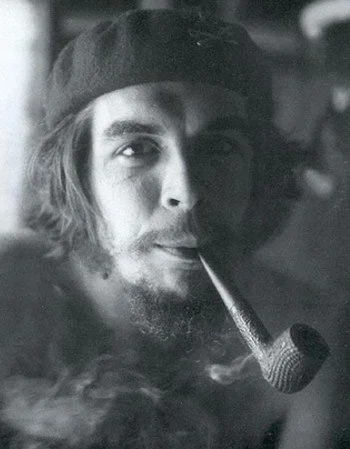
Che Guevara in Caballete de Casas, Cuba, 1958. Source: Museo Che Guevara, Public domain, available here.
The Motorcycle Diaries
This first journey began in January 1952 with his trusted friend Alberto Granado and temperamental motorcycle “La Poderosa II.” The two left Argentina for a tortuous adventure around his home continent recorded in the infamous book “The Motorcycle Diaries.” This first journey was very much two friends on a backpacking tour surviving on their wits and lack of money. To go into finite detail will offer no valuable insights as far as the focus of this article is concerned. The reader will be best served going straight to the actual book for more detail. Instead, we pick up after Ernesto’s return from his first trip and his plans changed once again. In the second of these articles, this will follow Che Guevara's life up until his involvement in the successful Cuban Revolution in 1959.
To summarize the first trip the two comrades began in January and February of 1952 working their way through Argentina before they spent the next two months in Chile. The duo then moved through Peru in March of that year before visiting Colombia and Venezuela in the summer months of June and July 1952. The trip finished with a visit to Miami before returning to Buenos Aires. There, Ernesto planned to finish his professional studies.
Introducing Doctor Guevara
In July 1952, Ernesto returned to Buenos Aires. This time it was to finish his medical studies, to which he applied himself in earnest, passing thirteen of his medical exams in November and December 1952. Allegedly according to his father beforehand, Ernesto succumbed to infection after experimenting on human remains required by his studies. Stubbornness had won the day and that same resolve would be applied to later life. One more exam remained in 1953, and he then officially became Dr Ernesto Guevara. He told his father by telephone the good news before then telling them to their dismay that he was going to embark on further travelling. This second trip would change his life. Che Guevara’s story now gathers pace.
Back on the Road, 1953
In July 1953, he set out on his second journey. This time his journey again began in Argentina with his friend Carlos Ferrer, crossing part into Chilean territory and then into Bolivia. At first his journalling and its content was reminiscent of his first trip with the usual privations of his travels such as the limitations caused by his asthma, mechanical breakdowns, and border issues. Eventually in 1953 he reached Central America. The tail end of this journey sent him to Guatemala and then ultimately Mexico, where he had his fateful meeting with Fidel Castro.
Guatemala, 1954
Everything in Ernesto's life would change with his stay in Guatemala. Ernesto had travelled through the region at a tense time. Guatemala, or rather the administration headed by the nation's leader Jacobo Arbenz (1951–1954), had its fair share of problems with the USA and its neighbors. The President had introduced some sweeping reforms in the country during the “Ten Year Guatemalan Revolution” from 1944 to 1954. The reforms improved the lives of over half a million people and the agrarian reforms improved the lot of the agricultural community. The policy of Arbenz’s reforms was for the government to seize idle and uncultivated land and redistribute it to its people. This was a policy that a growing Marxist like young Ernesto would approve of. Ernesto became a staunch supporter of Arbenz in his time in Guatemala.
This did not sit well with the USA and corporations resident in that country such as the United Fruit Company. Those corporations lobbied President Eisenhower and the hawkish John Foster Dulles, Secretary of State to remove Arbenz via the CIA and military action. At the same time, the two US statesmen also feared the growth or strong influence of communism in Guatemala and feared for the financial stakes they had made. They could not let Arbenz continue or allow his ideas to spread throughout the rest of South America.
Ernesto, although intending to travel and fund himself through casual work within the medical profession, found himself caught up in the political furor, which he did not find unpleasant. He was keen to fight on the side of Arbenz and joined an armed militia organized by a communist group. Once the bombing began, he tried to organize this group to perform a number of supporting roles such as guarding the capital and arms negotiations to other resistance. It was all in vain and temporary; after expressing frustration with the lack of action in the group, he abandoned this idea and returned to his medical duties. Following the coup, he again volunteered to fight, but Arbenz took refuge in the Mexican embassy, and his control of his country was lost. All foreign supporters were urgently advised by him to leave Guatemala. Due to their support and involvement with Arbenz, Ernesto had now been targeted by the authorities. However, Ernesto showed no signs of being perturbed by these dangers at all.
In his letters to his mother, he confessed that being around the chaos made him feel a “little ashamed for having as much fun as a monkey” and that had felt “a magic sensation of inviolability” that led him to “lick his lips in pleasure.” This was now a man who had acquired an addiction to adrenaline and danger. His growing penchant for adventure had now been raised to higher and more dangerous levels.
Ernesto met Hilda Gadea, a Peruvian woman whom he later married in the late summer of 1955 in Mexico. Hilda was also a political activist before she met Ernesto, and her work had led her to be expelled from Peru in 1948. This did not help her during her time in Guatemala: swept up in the political turmoil alongside Ernesto, she was incarcerated in a Guatemalan prison on multiple occasions, gaining release each time only after hunger striking. The two seemed very intellectual and politically compatible, but the marriage had underlying issues that would later surface. Ernesto, it has been suggested, initially courted her as she was convenient to him on many levels such as financial support, a useful contact, a roof over his head and more so for “transactional motives” (Che’s actual words from his memoirs cannot be used here).
Meanwhile President Arbenz fled his country and was replaced by a US/Honduran-backed government headed by Castillo Armas. The new President was clamping down on any suspected communist sympathizers and supporters of its former leader. The couple therefore had to leave Guatemala amid the bombings, invasions and the new government clampdowns and headed for Mexico. The couple would both leave and arrive in Mexico separately.
In 1954, Ernesto was still nothing more than a “young Argentine vagabond who just happened to have a medical degree scrabbling for work in a foreign country.” He had acquired a taste for danger, and all that seemed to be needed now was a cause and a leader to cross his path.
Mexico and Fidel Castro, 1955
Even as late as 1955, Ernesto still had his heart set on his travels. His letters home still talked of travelling to Europe and India specifically, which were no doubt genuine, and he could change his mind at “the drop of the proverbial hat.” In a letter to his mother in November 1954, he wrote that he is “desperate to travel around Europe” and in that same letter “as for the United States I have not lost an ounce of hostility.” In explaining how he would still like to visit New York he adds “I’ll leave just as anti-Yankee as when I arrive”. His experiences in Guatemala had clearly affected him as he makes other political observations.
His views on Mexico were interesting. In a letter written in March 1955, shortly after he arrived, it is clear that his anti-Americanism followed him. He blames the upheavals going on in the country as being US instigated when he said, “Mexico has been completely handed over to the Americans.” He adds that the “FBI is much more dangerous than the Mexican police, here they act as they please and arrest anyone without a pretext.” In the meantime, his letters home talked of the struggles of finding work and political commentary.
In reality, much more was going on under the surface. Ernesto pretended in his letters to be pursuing an academic career and falsely claimed to be working on various research projects and pursuing professorships in various educational establishments. His letters up to July 1956 were those of a man with continued wanderlust, various bouts of casual jobbing, and thoughts of establishing a medical career. In truth he was preparing himself for Fidel Castro’s planned invasion and coup of Cuba. In his letter to his mother on 6th July 1956 from Miguel Schultz Prison, which he described as his “delightful mansion,” he admitted “I’ve spent much time stumbling around looking for my truth, having finding my way, and with a draught to perpetuate me, I feel I have closed the cycle”. He refers to his decision to join the cause and support Fidel Castro.
Ernesto in that letter of 6th July 1956 makes further admissions from Miguel Schultz Prison, in which he stated “over the past few months I have maintained the cover of saying I had a job as a professor, whereas in fact I have been dedicating myself to the physical training who must one day set foot again in Cuba”. Che mentions in that same letter Fidel Castro’s arrest, which implicated Ernesto himself thus ending up in prison. He further reveals, “I see my future tied to the Cuban Revolution.” So how did the two men meet and bond?
Ernesto's initial attempts at establishing contact with Castro were tentative, but he eventually met him through mutual associates. At first, on these occasions, Ernesto sat in silence and at a distance, offering little, as if he were in awe of Castro or intimidated by Castro’s overwhelming personality. It was in fact Hilda who asked Castro the bold questions about his exile. Ernesto at this point was far from the future right-hand man of the movement, but he realized that if he were going to make a mark on this world and make a name for himself, he would need Fidel Castro and to be part of his plans for the Cuban revolution.
The beginnings of a revolutionary
Ernesto committed himself wholeheartedly to the cause with a new zeal. His marriage became secondary to his new efforts. He applied strict daily discipline to his diet and gymnasium work. He also conditioned his mind with economic works, Mao and Soviet texts and regularly attended secret meetings of the Mexican Communist Party to discuss the situation in Latin America. All this was in preparation for Fidel’s Cuban assault plans. All this had to be clandestine as the FBI, CIA and Mexican authorities were always fast to swoop down on any communist activity. The danger no doubt appealed to the adventure-seeking Ernesto.
These efforts came to the attention of Castro, who rebuked his small group of forty fellow revolutionaries for not displaying the same zeal as Ernesto. Eventually his colleagues warmed to him and his disciplinarian ways, earning him a leadership title within the small ranks but that would take time, a lot of time. Ernesto immediately sought a remote and safe location to further develop training which he did successfully. He acquired a ranch in Chalco in Mexico. As he left to join his comrades there, he warned Hilda that he might not return.
Ernesto was still to be properly accepted by Castro’s group. He was still seen by this exclusive group as an interloper or a foreigner who had no business in Cuban affairs, much less organize them. He was seen as a scruffy oddball, too self-righteous and altogether disagreeable. Some commented on his lack of hygiene, in particular washing, but instead Ernesto was trying to condition himself and his colleagues for the harsh conditions of guerrilla warfare that would take place once they arrived in Cuba. In one incident, a member refused to obey Ernesto's orders, and a court martial was instigated by Castro in his support for the man who had now been named by his colleagues as Che (Ernesto will now be referred to as Che).
Che carried on his routines with his characteristic discipline while Fidel Castro left to intensify funding and arms supplies from sympathizers in Cuba and the USA, but he was seized by the authorities in July 1956 and the whole operation looked as if it were about to be derailed... Hilda and other members were detained and charged with plotting a coup and assassination of Batista. Che was ordered by Castro to volunteer his arrest. The whole event made the national news in Mexico. Che was now coming to public prominence as a new article reported on a certain “Dr Guevara as an active member of the Instituto Intercambio Cultural Mexicano-Ruso” who was “the principal link between the Cuban plotters and certain communist organizations.” These were serious charges and accusations, and Che was now facing the full legal and political backlash in the glare of the world’s media. He was no longer the vagabond in the background. Castro’s contacts had to arrange legal defense and representation and with that came media attention. Che then admitted his involvement with the Cuban revolutionary movement to his parents in the letter of 6th July (as detailed above). Guevara was interrogated several times as the authorities were now concerned over Che’s communist connections.
It gave his family cause for concern, rightfully so, but in a letter to his mother, who expressed worry, he simply replied “I am all the contrary of a Christ. I fight for the things I believe in, with all the weapons at my disposal and try to leave the other men dead…” he went on in a veiled rebuke of his mother’s natural concern “what terrifies me is your lack of comprehension in all of this and your advice about moderation, egotism, etc.”. It appears she had struck a nerve, but Ernesto, now Che, was fully focused.
Whilst incarcerated, Che did not acquit himself well with Castro. Che spoke too openly, carelessly, and too freely on Marxist theories and intentions that he held to his interrogators. He shared loudly his Marxist views on Latin America and the need for armed revolutionary struggle. Castro was furious with this unwanted attention and needless risk that could jeopardize his operation. He had previously denied publicly any association with communist movements and now this was being undermined by Che Guevara. Che's outspokenness was rumored to be a source of quiet frustration for Castro.
Meanwhile, Che started a series of hunger strikes whilst incarcerated. He was one of the last two of Castro’s group to be released. After his release, Che, along with Castro’s group of revolutionaries, went underground in Mexico to continue planning their assault on Cuba and Batista.
Cuba, Guerrilla Warfare and Revolution
The plans did not go well at first. The small band of men had to move around Mexico in a clandestine manner, out of view of the Mexican authorities, US and Cuban agents. Che had effectively left the marital home, warning Hilda again that he might not return. The next time the couple would meet was in 1959 after achieving victory in Cuba where Che would admit an affair and seek a divorce.
Meanwhile Castro had to overcome many financial and logistical problems while the team trained themselves. He needed money for a boat; he needed arms and more committed men. He only had forty at this time. After secretive visits to the USA, he secured $50,000, a boat and forty more men. He would eventually assault Cuba with an initial force of eighty-two men. The landings needed to be coordinated with planned uprisings in Cuba.
In November 1956, with the odds stacked against them, Castro, Che and the rest of the eighty-two men embarked for Cuba. Of those men, only twenty-two remained after most were killed almost immediately in the early stage of the assault, which was going unfavorably for Castro and favorably for Batista. The rebels sought refuge in the mountains.
Morale was low, and while they took stock and sought refuge in the Sierra Maestra mountains under miserable conditions, Che took a different approach to winning over hearts and minds. This is where his intellect was of better use than his weakened physical situation aggravated by asthma and mosquito infection. His next actions secured his promotion and elevation in the ranks. During his time in the mountains, he lived among the poor subsistence farmers. The living conditions were very grim for everyone: there were no schools, no electricity, minimal access to healthcare, and many of the adults were illiterate. Che suggested an alternative but longer path to win over the population: a strategy of “competence, diplomacy and patience".
Che set up infrastructure to serve the needs of the local population and the guerrillas. He set up factories to make grenades, built ovens to bake bread, and organized schools to teach illiterate campesinos to read and write. Alongside this makeshift community, he established health clinics, workshops to teach military tactics, and a newspaper to disseminate information. Che was promoted by Castro to the rank of Comandante of a second army column. Che would acquit himself well in the battles that were to come.
Che the Comandante
Although in combat conditions, Che was never far from his intellectual pursuits. It was something he demanded of his men. An educated guerrilla force was more effective than an illiterate one. He expected higher standards of everyone, which was certainly a trait he displayed consistently in his many roles. He was also known for his ruthlessness and had no compunction in executing traitors, a matter that is still hotly debated by historians today as to whether he was a tyrant or not.
Castro on Comandante Guevara
Castro described Guevara as intelligent, daring, and an exemplary leader who "had great moral authority over his troops” but also a man who took too many risks that bordered on a "tendency toward foolhardiness". The two in public always appeared united, but Che had attracted Castro's disapproval many times, and this would not be the last. We will assess in the final article whether Castro saw him in the post-revolutionary period as a liability.
Che and Guerrilla Warfare
Che took part in a number of battles in the two years up to victory. Not all the battles Che participated in will be recounted, but one in particular stands out. In July 1958, Guevara played a critical role in the Battle of Las Mercedes. His column halted an attacking force of 1,500 men called up by Batista's General Cantillo, whose mission was to surround and destroy Castro's forces. It involved a series of hit-and-run tactics that some military experts praise as evidence of Che's ingenuity. It was a tactic he utilized successfully multiple times. It became an essential part of his book Guerrilla Warfare, published in 1961.
The war was approaching its end. In December 1958, one of the final battles required Che to take the Las Villas province, dividing the island and its opposing forces. Using his guerrilla tactics, he soon took control of the area except the capital, Santa Clara, which required a new approach, as Che was outnumbered by government forces ten to one. He was successful in taking the capital.
On 2nd January 1959, Che entered Havana to take control of the capital. Castro followed some days afterward. This would be the last occasion Che would be successful in combat or in any theatre he became involved in. Castro had won the war, Batista fled, and Che had now achieved iconic status.
Conclusion
In 1959, Che was in the spotlight on the international stage. He had also fallen for Aleida March, a fellow revolutionary he had fought alongside, and was divorced from Hilda soon after. He was now firmly ensconced in a number of government roles to settle Cuba's internal affairs and help complete its revolution. This, however, was not enough. He wanted a stage to himself. His ideas and dreams had grown.
The next article will finish on the post-revolutionary life, a critique of Che's character, his ideas, successes and failures.
What do you think of Che Guevara? Let us know below.
Now listen to our podcast on Fidel Castro here.
Sources
I Embrace You with All My Revolutionary Fervour – Ernesto Che Guevara – Collected letters 1947-1967 – Penguin Modern Classics
The Motorcycle Diaries – Che Guevara – 1995 -Fourth Estate Paper Backs
Che Guevara – A Revolutionary Life – Jon Lee Anderson – Penguin – 1997
Back on the Road – A Journey into Central America - Che Guevara – 2000 – Vintage Uk
Guerrilla Warfare – Che Guevara – 1961 – Souvenir Press