
He was not supposed to be remembered this way. Caleb Bradham was a pharmacist, trained for local steadiness rather than worldwide success, a man expected to move plainly through small-town commerce in late–19th-century North Carolina. However something in him bent toward experiment—toward mixtures, margins, and the uncertain chemistry of public taste, perhaps without fully knowing where it would lead.
Brian D’Ambrosio explains.
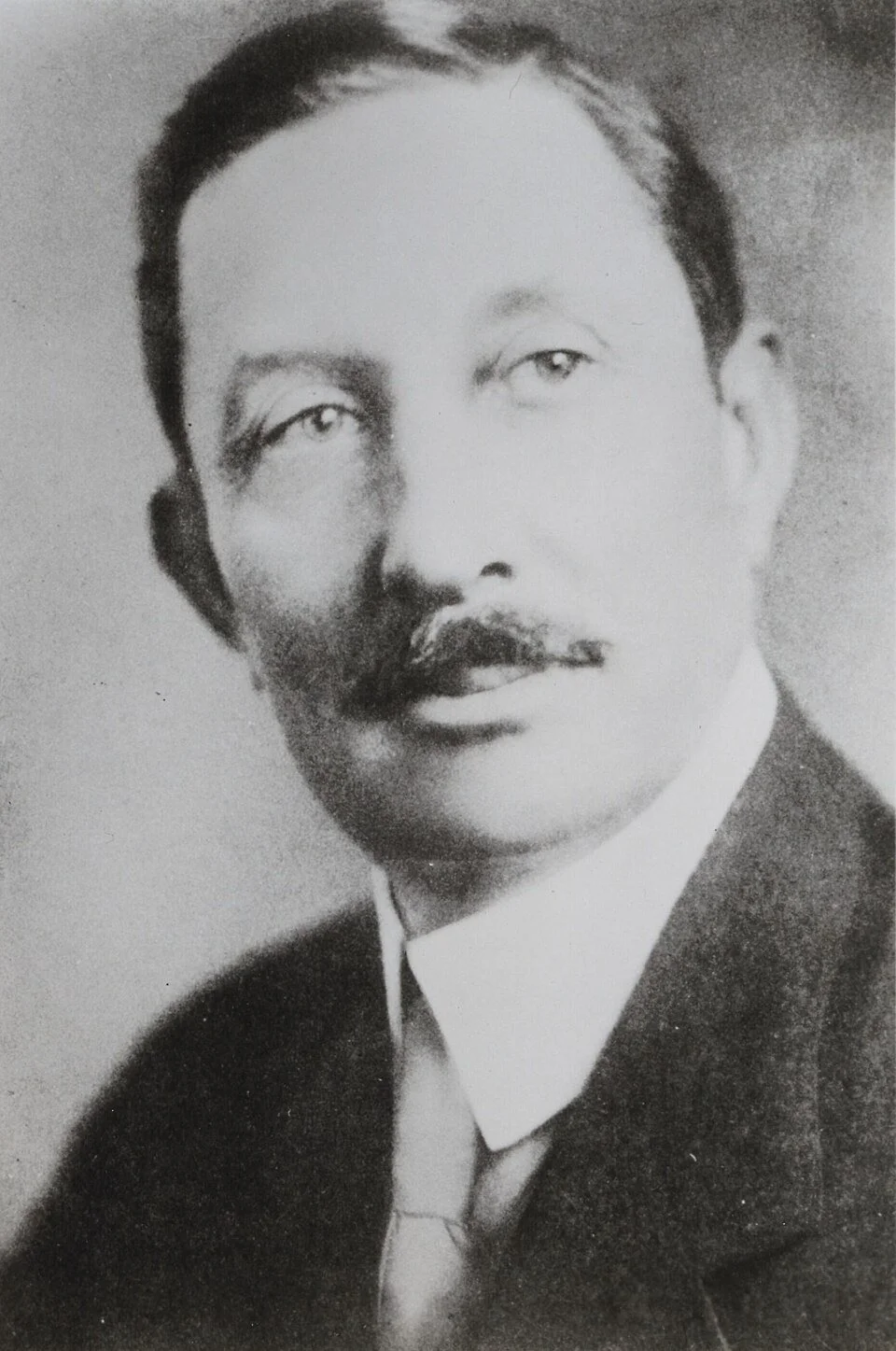
Caleb Davis Bradham.
Son of businessman George Washington Bradham, Caleb Bradham was born in 1867 in Chinquapin, North Carolina, and later attended the University of North Carolina at Chapel Hill, where he studied science and prepared for a medical career he would ultimately not complete. Financial strain, in particular his father’s bankruptcy, forced his return home, where he taught school briefly before turning fully to pharmacy. In New Bern, he opened a drugstore that would become the unlikely laboratory for one of America’s most enduring consumer brands.
Like many pharmacists of his era, Bradham presided over more than prescriptions. The soda fountain was central to his trade—a place where medicine, refreshment, and commerce blurred. Carbonated drinks were often promoted in zany, quasi-medical terms, and the line between remedy and recreation remained deliberately thin.
In 1893, he began developing a beverage of sugar, kola nut extract, vanilla, and oils. He sold it as “Brad’s Drink,” a local fountain offering marketed as a digestive aid and mild restorative. It was part of a broader late-19th-century trend in which pharmacists created proprietary tonics that straddled therapeutic and commercial categories.
By 1898, Bradham renamed the drink Pepsi-Cola. The name drew from “dyspepsia,” meaning indigestion, and aligned with the growing popularity of cola-based beverages flavored with kola nut derivatives. It was a name built for both familiarity and aspiration—clinical in origin, commercial in effect.
Pepsi-Cola Company
He incorporated the Pepsi-Cola Company in 1902 and secured the trademark shortly thereafter. Production expanded through syrup distribution and a licensing system in which independent bottlers produced and sold the drink under contract. The model enabled rapid geographic spread but limited centralized control.
By the 1910s, Pepsi-Cola had reached much of the United States through regional bottlers. It remained uneven in consistency and branding, but it was no longer confined to New Bern.
Its chief competitor, Coca-Cola, expanded during the same period through a more tightly managed national structure. The difference between the two companies was organizational rather than conceptual: Coca-Cola emphasized uniformity; Pepsi relied on distributed growth through independent operators. Indeed, that structural divide would shape their rivalry far more than product formulation.
During the First World War, sugar prices rose sharply and became increasingly volatile. Bradham purchased large quantities in anticipation of continued increases. When wartime demand ended, however, sugar prices fell rapidly, leaving his inventory overvalued. Bradham had bought heavily at the peak, and with Pepsi still selling for a nickel a bottle, he couldn’t raise prices enough to recover the loss. What had seemed like a calculated bet turned into a crushing miscalculation, one he couldn’t outrun. The resulting financial strain contributed to the company’s bankruptcy in 1923.
Pepsi-Cola’s assets were liquidated and reorganized through bankruptcy proceedings. The brand name survived, though the original company structure did not.
Bradham returned to his pharmacy in New Bern. He did not attempt to rebuild the company or reenter large-scale business. He continued working as a pharmacist until his death in 1934.
Pepsi-Cola name
The Pepsi-Cola name, however, continued under new ownership. During the 1930s and 1940s, the brand was restructured and expanded, eventually emerging as a direct national competitor to Coca-Cola. Post–Second World War advertising, expanding bottling networks, and standardized marketing systems transformed Pepsi into a mass-market national product. By 1961, the company shortened its name to Pepsi, reflecting a more streamlined corporate identity and modernized branding strategy, perhaps signaling a more modern commercial language as well.
Bradham did not live to see that transformation, but the framework of it had already been set in motion: a product built for replication, a system dependent on distribution, and a name simple enough to travel beyond its origin.
What he created was not permanence but continuity. A formula, a label, and a habit that moved through markets long after its originator stepped away from the business.
The result is straightforward: Bradham did not build an empire that lasted intact, but he did create something that outlived its first structure and continued under new hands, in new forms, under a name that, indeed, never disappeared.
Brian D'Ambrosio is the author of Montana Eccentrics, New Mexico Eccentrics, and Italian-Americana: Explorers, Entertainers, and Eccentrics. Available here: Amazon US | Amazon UK
Sources
North Carolina pedia: https://www.ncpedia.org/biography/bradham-caleb-davis
North Carolina History Project: https://northcarolinahistory.org/encyclopedia/caleb-bradham-1867-1934/
Brittanica, miscellaneous pages