
The South Atlantic’s Bouvet Island doesn’t have deadly snakes, un-contacted tribes, the risk of radiation poisoning or past human wartime horrors. It’s story is frozen in the harsh climate that envelopes the island and some of its greatest mysteries lost in the dangerous weather conditions and even blizzards of the Sub-Antarctic. Not only does no one live there — it’s likely that no one could.
Michael Thomas Leibrandt explains.
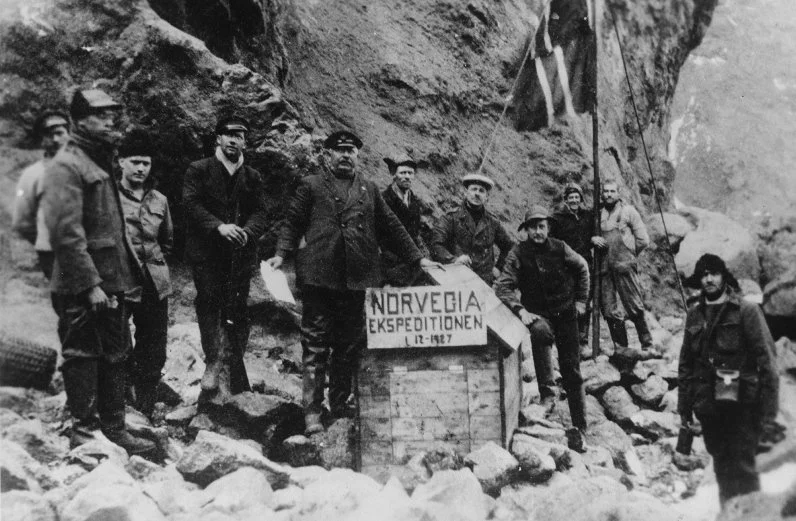
Norweigans on Bouvet Island in 1927.
Bouvet — formed as a Sub-Antarctic volcanic island — is one of the most remote, uninhabited island on earth. It lies nearly 1,100 miles from Queen Maud Land in Antarctica and some nearly 1,600 miles southwest of South Africa. Over 90% of the island itself is covered by glaciers and a volcano that is estimated to have last erupted in 2000 BCE. Its tallest peak is Olavtoppen at over 2,500 feet and the island’s only demarcation point is Nyroysa — on the Northwest Coast.
Humans first recorded discovery of the island was on New Year’s Day, 1739 — when two French vessels trying to validate the presence of a large southern continent (Antarctica) spotted Bouvet. Jean-Baptiste Charles Bouvet de Lozier would make two crucial mistakes in this discovery. First — he did not map the location of the island correctly and also did not sail around it to validate that it was indeed an island. Explorers like James Cook led expeditions to find the island but could not.
It would be nearly forty years later when Captain James Lindsay aboard the Whaler Swan and accompanied by anothership called Otter found the island in 1808. Benjamin Morrell aboard the Wasp claimed to have landed on the island and hunted seal — but his physical description of the geography has left some speculation about the validity of his claim.
Between 1822 and 1895 — a number of vessels attempted to visit the island — but most could not land due to the geography. In December 1825, a British exploration team landed on the island and claimed it for the Crown. The island was named Liverpool and a second island some fifty miles north was also identified.
Thompson island was also confirmed by an expedition in 1893; however, from 1898 no one else saw the island. Maps continued to show Thompson Island until 1943 — and in 1967 it was hypothesized that the island ceased to exist during a volcanic explosion. Either way — it has never been seen since.
In 1927 — on an expedition supported including financially by Lars Christensen — the first Norvegia Expedition landed on the island with Harald Horntvedt in charge. After a flag was placed and a hut erected, Norway claimed the island in January of 1928. This led to diplomatic issues with the United Kingdom who finally withdrew their claim in 1929. Norway launched subsequent expeditions, and protected all of the seals on the island and in 1971, the island was made a protected nature reserve.
In 1964, a strange discovery was made. The British vessel HMS Protector landed a survey team on the island. In a small lagoon, the team found an unoccupied lifeboat and barrels. After a brief search, no other signs of human life were found and the discovery has remained a mystery. In September 1979, the US Vela Hotel Satelite 6911 recorded a double-flash in the area between Bouvet Island and the Prince Edward Islands. This has been theorized to most likely be a joint nuclear testing operation between Israel and South Africa.
Major General Sir Nils Olav III (Edinburgh Zoo’s King Penguin) is also known as Baron of the Bouvet Islands. The island is also the setting for the 1989 film, Alien vs. Predator. Bouvet Island — a place that most will only be able read about — sits with its fog and howling winds as one of the most uninhabited, unreachable, unlivable, remotest places on earth.
Oh and that lifeboat discovered in 1964? Without explanation by 1966, it had disappeared as well — and has been shrouded in mystery ever since.
Michael Thomas Leibrandt lives and works in Abington Township, PA.