In the quiet area of Runnymede in England, there is a small piece of land that is not quite England. In fact, if you venture onto it, then you are walking on American soil.
Steve Prout explains in this short piece about the area.
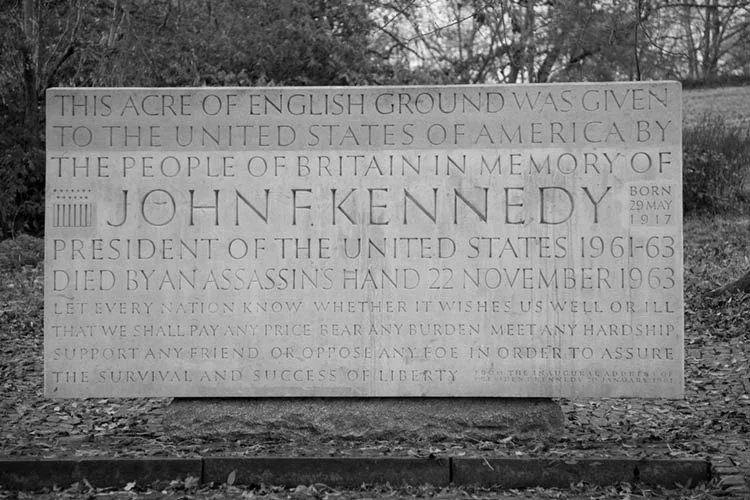
The John F. Kennedy Memorial at Runnymede. Source: Wyrdlight.com, available here.
Runnymede is a quiet town that is situated on the famous River Thames. In this town in 1215, King John signed the Magna Carta which curtailed the power of the English monarchy. Going forward 750 years, it was the site of another major event. In 1965, Queen Elizabeth II gifted one-acre of Runnymede to the USA. This is the only land overseas that the U.S. has gained without purchase or forceful acquisition.
The gesture was born out of two intentions. One was the commemoration of John F Kennedy following his assassination two years earlier. The monument that sits there is dedicated to him, his ideals and the cause he pursued for freedom. The other was a symbol of the British-US “special relationship”, at a time when the two countries faced a very real threat as the Cold War rivalry escalated in various forms and various locations.
The 1960s, despite its prosperity and its liberating culture, had its darker tones. Not all the world enjoyed these freedoms. The Berlin Wall was erected in 1961 further dividing the east and the west and solidifying those ideological differences. Numerous proxy wars were being fought around the globe, such as in Vietnam and various former European colonies in Africa. There was also unrest in Latin America as the Cuban Missile Crisis warmed up the Cold War close to the U.S. itself.
The site
The memorial’s creator was Alan Collina and it is made of Portland stone. Its inscription is from John Kennedy’s 1961 inaugural address and sits at the top of a short climb of fifty steps, representing the 50 US states. The design was inspired by John Bunyan’s The Pilgrim’s Progress, which alludes to life as being akin to a journey. In this case, perhaps it was the symbolism of the journey of the U.S.-UK relationship at a time when they both shared common values - but this is just the author’s interpretation. The site also promotes the scholarships of UK students wishing to study.
The site, although technically on British sovereign soil, is still regarded as belonging to the U.S. by nature of its gifting by a British monarch. This acre of land is not fenced or policed by border guards as would be expected of most national frontiers. It is maintained quietly by the British National Trust but remains in essence American soil. So, if anyone would like to visit U.S. territory in the UK without being troubled by the bureaucracy of visa applications, the long flights, and the frosty US customs officers, then an opportunity presents itself there in quiet Runnymede.
The Americans may not realise this, and many may have forgotten, but they possess yet another piece of overseas territory in a land that was once their colonial rulers. Here, amid a history that includes the Alaskan purchase from Russia in 1867 and gains from the American Spanish War of 1898, there sits an acre of land that is not only a commemoration to one of their Presidents but also a symbol of the struggle for freedom and the spirit of shared values. Perhaps the current leaders of both countries should revisit this site to reaffirm this partly estranged relationship.
The site has been offering a wide variety of high-quality, free history content since 2012. If you’d like to say ‘thank you’ and help us with site running costs, please consider donating here.