Aviatrix Mary Jayne Gold came from a prominent Chicago family. Under the Gestapo’s nose in Marseilles, she helped save thousands from Hitler’s concentration camps, all while carrying out a brazen l’affaire de guerre with a cutthroat French-American commando. Timothy M. Gay explains.
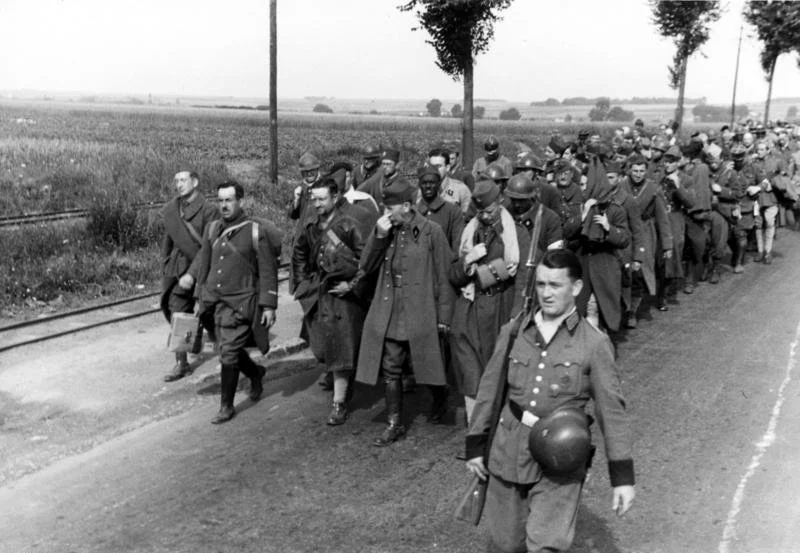
French prisoners of war under German guard in 1940. Source: Bundesarchiv, Bild 121-0404 / CC-BY-SA 3.0, available here.
No Hollywood mogul worth his salt would ever have greenlighted a script based on the life of Mary Jayne Gold. “Way over the top!” Jack Warner or Harry Cohn would have scrawled on the title page. “Audiences will never buy it!”
Except it was all very real – and very little of it needed embellishing.
She was an impossibly rich and fetching femme fatale, the daughter of one of Chicago’s leading industrialists. She didhave a mansion and a yacht (both called “Marigold”) named in her honor. She did become a famed aviatrix in an era when female pilots attracted flashbulbs and headlines. She was the prewar toast of London and Paris, an intimate of lords and ladies who followed the sun to St. Tropez and the snow to St. Moritz. She did leave in her wake a trail of champagne bottles and broken hearts. She did bribe a French judge to spring her illicit lover from jail. She did play deadly cat-and-mouse with Vichy and the Gestapo and help thousands of people escape Hitler’s concentration camps.
Surely, she’s the only refugee liberator honored by the U.S. Holocaust Memorial Museum who grew up summering in an architectural marvel along the shores of Lake Michigan; who raced her own plane – a sleek Percival Vega Gull, the “Sports Car of the Skies” – at air shows across the North America and Europe; who consorted with mobsters in the French Riviera and once described herself as a “gangster’s moll”; who helped bankroll one of the war’s most effective evacuee operations; who sheltered some of the 20th century’s most celebrated surrealists; who was mistaken more than once for a high-priced hooker; who used her feminine wiles (twice!) to seduce a Vichy prison commandant, gaining favorable treatment for Resistance detainees; and whose provocative (in every sense) memoir late in life was edited by none other than Jacqueline Kennedy Onassis, a fellow Francophile who enjoyed tales of a life richly lived.
“Fuugg-about it!” Sam Goldwyn would have barked. “No one will ever believe it!”
*
How did Mary Jayne Gold ever find the moxie to lead a life that – let’s face it – turned a little tawdry at times? A lot of it had to come from her old man, one of the most ambitious and – let’s face it again – dissolute industrial pioneers in Chicago history. Maybe when your fabulously wealthy father is forced to skip town to avoid being prosecuted in a steamy sex scandal it steels you for whatever life throws your way.
*
Egbert Habberton Gold (1868-1928) was rich the day he arrived in Chicago, but he got a lot richer in a hurry. The Golds were Old New England, a family that emigrated from East Anglia’s Bury St. Edmunds in the years before 1650 and quickly made themselves pillars of Cornwall, Connecticut, society, becoming benefactors of the Congregationalist Church and, two generations later, of Yale College.
Egbert’s ancestors had a yen for engineering. His father, Mary Jayne’s paternal grandfather, patented in the 1850s the forerunner to the cast-iron “mattress” radiator. The Gold radiator became the method of heating residential and commercial buildings for much of the next century, earning the family a huge fortune.
Its burgeoning reputation as a railroad hub lured Egbert Gold to Chicago in the 1890s. Following in his father’s footsteps, he soon devised a reliable method of using steam vapor to heat passenger rail cars. Gold’s breakthrough revolutionized wintertime train travel; virtually overnight, it became safer and more comfortable.
Yet again, the Golds had struck, well, gold. Egbert eventually established the offices of the Gold Car Heating Company (later the Vapor Car Heating Co., Inc.) in the “Chicago Style” Railway Exchange Building bordering Grant Park. In 1904, he beat back a competitor by contesting a patent case all the way to the U.S. Supreme Court, winning an intellectual property precedent that’s still studied today. At roughly the same time, he began acquiring large and lucrative chunks of Chicago real estate.
He also acquired a level of infamy that might have caused his Congregationalist forebears to roll over in their graves. In the spring of 1901, the police began investigating reports of a 17-year-old woman being kept against her will in what the Chicago Daily Tribune called a “disorderly house” at 348 West Madison.
It was, all euphemisms aside, a brothel run by a madame named Mary “Mother” Lyons. Lyons’ apparent modus operandi was to snag unsuspecting young women to work as maids, then, once under roof, bully them into providing services of a more horizontal nature.
The teenaged Jeanette Johnston was one of Lyons’ hostages. “Mother’s” debasement of Jennie was abetted, police said, by a mystery man whom Johnston knew only as “Bert Brown.”
Brown, the cops told the press, was a pseudonym for one Egbert H. Gold, then 33 and married to the former Margaret Jayne Dickey. Brown/Gold was, it sounds like, a steady customer of Lyons’ bordello. He apparently took a fancy to young Jennie, ignoring her pleas to escape confinement, plying her with alcohol, and conspiring with Lyons to keep her under lock and key.
When Jennie somehow escaped and told her chilling story to a local minister (ironically of the Congregationalist faith), the preacher called the cops. Soon Chicagoans were waking up to headlines like, “TELL SECRETS OF ‘MOTHER’ LYONS: ATTORNEYS’ QUESTIONS POINT TO EGBERT H. GOLD AS ‘BERT BROWN.’”
Acting sub-rosa, Gold hired Chicago attorneys Kickham Scanlan and Edgar Lee Masters (perhaps Gold’s unsavory behavior encouraged Masters, a decade later, to publish Spoon River Anthology, his celebrated free-verse skewering of Midwestern “virtues”} to provide legal services for Lyons. Scanlan and Masters did their job: “Mother” got off easy, slapped with just a one-year sentence, with time off for good behavior.
Gold, meanwhile, had stayed elusive during Lyons’ trial, skulking off to a secret flat on Ellis Avenue, then decamping for Davenport, St. Louis, and Omaha, always keeping one step ahead of the subpoena server. On the day Lyons copped her plea, Gold fled to New York City, where he stayed incognito until the heat cooled.
Eventually, he returned to Chicago and his tony lifestyle, which by then included memberships at the South Shore and Exmoor country clubs, a side-stage box at Crosby’s Opera House, a luxurious yacht, and a summer home to die for on the eastern shore of Lake Michigan. The boat and vacation place were both named “Marigold” in honor of his wife and infant daughter.
The sordid episode with “Mother” and Jennie might have been forgotten if Gold had just paid Masters and Scanlan the $2,000 (the rough equivalent today of $63,000) he owed them. Their dispute erupted in 1914, the year poet Carl Sandburg wrote his paean to Chicago, not realizing that the line, “They tell me you are wicked and I believe them, for I have seen your painted women under the gas lamps,” was all too accurate in the case of one of the city’s business titans.
The public punches flew fast and furious. In mid-bout, Gold issued a defiant – and disingenuous – statement.
“The matter is hardly worth discussion,” Gold fumed. “It is simply a case of an attempt to hold me up for money which I refuse to pay. I did have some business with Attorney Masters nine or ten years ago, but he was paid every cent he was entitled to at that time. The matter was not in connection with any place of questionable repute. I do not know this woman Mary Lyons, referred to by Attorney Masters. Neither do I know Jeanette Johnston, or whatever her name might be. Long ago, when the first attempts were made to secure money from me, I turned the matter over to my attorneys.”
A settlement was eventually reached; the matter again died down but was no doubt the subject of much gossip around town. Over the years, the Golds, now the parents of two boys plus Mary Jayne, stayed quiet in the Chicago papers, eliciting only the occasional article about Mrs. Gold’s gardening triumphs, or their real estate purchases, or their patronage of the arts. Egbert Gold died of natural causes in 1928, when his daughter and oldest child was 19.
It wasn’t until Mary Jayne got her pilot’s license after she graduated from an Italian boarding school and began flying her two-seat monoplane at air shows across North America and Europe that the name Gold found itself back in the headlines. If press accounts were accurate, the other seat in Mary Jayne’s plane was often occupied by a dashing beau du jour or some member of European royalty. Her life took an abrupt turn after the German army invaded Poland.
Did you find that piece interesting? If so, join us for free by clicking here.
About the Author
Timothy M. Gay is the author of two critically acclaimed books on World War II: Assignment to Hell: The War Against Nazi Germany with Correspondents Walter Cronkite, Andy Rooney, A.J. Liebling, Homer Bigart, and Hal Boyle(NAL/Penguin, 2012) and Savage Will: The Daring Escape of Americans Trapped Behind Nazi Lines (NAL/Penguin, 2013). Tom Brokaw called Assignment to Hell, which was nominated for a Pulitzer, a Bancroft, and an American Book Award, “a book every modern journalist – and citizen – should read.” Historian Marcus Brotherton wrote that Savage Will was “powerful, intriguing, well-researched, and fierce.”
Gay’s lengthy article on the citizen response to the Nazi U-boat threat in U.S. waters early in WWII was featured in a pandemic-inspired special issue of American Heritage called “America in Crisis.”
He has been featured on PBS’ “History Detectives” and contributed on-camera and off- to two documentaries – one on Walter Cronkite’s coverage of the Kennedy assassination, the other on Lyndon Johnson’s legacy on civil rights – which have appeared in Britain and the U.S.
His latest book is RORY LAND, a biography of golf superstar Rory McIlroy. It looks at McIlroy’s life through the prism of Ireland’s sectarian Troubles that devastated both sides of his family.