Perhaps the most fascinating Civil War general to Jeb Smith is Nathan Bedford Forest. Many think he is not just the best cavalry general of the American Civil War but among the greatest to ever live. He acquired more confirmed kills in war than any America has ever achieved. No general as high a rank as Forrest killed as many men since the medieval period. He had 29 horses shot from under him and said, “I ended the war a horse up.” He was one of the most feared individuals of the war and was said to be a “Superhuman warrior.” One friend who knew him before the war said he looked unrecognizable in battle. His face and eyes would change.
A natural military genius, Forrest rose from the rank of private to lieutenant general. His willingness to mix personally in combat led to him receiving multiple wounds doctors feared would be fatal, all of which he survived. The famed Civil War author Shelby Foote opined that the Civil War produced two geniuses: Abraham Lincoln and Nathan Bedford Forrest.
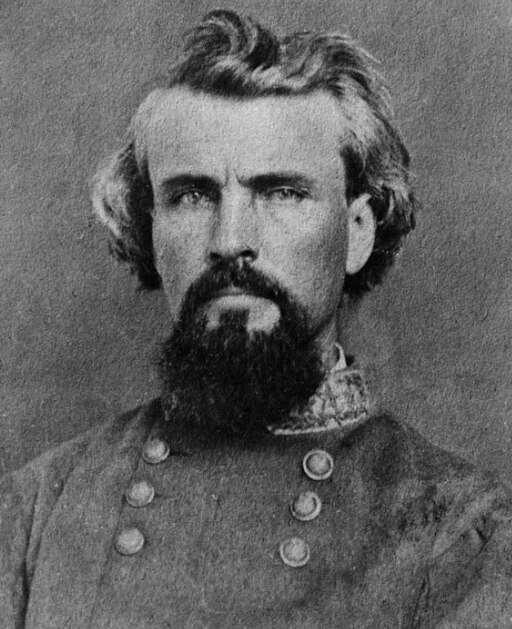
Nathan Bedford Forrest.
Pre-war
Born into poverty in Tennessee, Forrest received little formal education and no military training. By 1860, he owned two plantations, traded extensively in slaves, and was one of the wealthiest men in Memphis. He was tall, muscular, and powerful even for his size. An adamant believer in states’ rights and secession, the war was not the first violence he engaged in. Before it even began, he had killed several people.
In 1845, in Mississippi, his uncle was killed in a street fight; in retaliation, Forrest then killed two of his uncle’s murderers with a pistol and wounded two more with a knife someone in the crowd threw to him. There are unconfirmed reports that he killed others on two more occasions, including being severely wounded himself during one such engagement and recovering from what had seemed mortal wounds, as he would do more than once later in his career.
The Civil War
Forrest survived and was involved in some truly miraculous combat situations and multiple brushes with death, earning him an immense reputation as a warrior. When the war began, Forrest raised his own regiment, paid for their equipment, and advertised for recruits in Memphis, writing, “Come on, boys, if you want a heap of fun and to kill some Yankees.” Forrest had no trouble gaining men, as his reputation for toughness, aggression, and bravery had already spread widely. The general once told his men, “I have never, on the field of battle, sent you where I was unwilling to go myself.” And he quickly proved his fearlessness and tactical skill to them.
Early on in the war, Forrest led a cavalry charge against a Union line and single-handedly engaged multiple troops despite receiving wounds. A similar situation occurred later in the war when Forrest was mounted on his horse and attacked by four federals at once, receiving horrific wounds to his head and arm. He was able to retaliate and kill one of his ambushers, stating later, “No damn man kills me and lives.” Yet the situation became even worse for him as three more federals came shooting and stabbing at him. He was now surrounded, and on top of that, his horse was then shot [would eventually prove mortal], but riding on his injured horse, Forrest then jumped a wagon that was blocking his retreat. Thirty paces down the road, he was attacked by yet another federal with a saber. Forrest ended his attacker's life soon after.
In another instance, as the Confederates were chasing retraining federals, Forest found he outpaced his men and was surrounded by dozens of retreating federals; he was shot multiple times, and his horse was once more wounded mortally. But before his steed departed, and among a hail of bullets, he escaped, utilizing his revolver to cut a way clear.
In a dangerous and fortunate battle, where Forrest was riddled with 15 bullet holes in his uniform, and his horse fell dead after sustaining seven bullet wounds. Later that day, he had another horse die from under him. Soon after, he received what doctors initially believed to be yet another mortal wound during a confrontation with a subordinate. However, he would heal and return to command.
Forrest led by example. He would not order his men to do anything he would not do. He often would do a mission when no volunteers would offer. He himself would go on dangerous scouting missions and once crossed a frozen river when none of his men would. In Six Armies in Tennessee, historian Steven E. Woodworth wrote that Forest “would fight anyone, anytime.” Perhaps that was no truer than when Forrest and his command were surprised and surrounded by federal forces. The general commanded his men to “charge em both ways,” and his men did, and many escaped. Forrest also stated, “Never stand and take a charge… charge them too.”
Battle Results
A gifted military genius...he was the prophet of mobile warfare. His campaigns [allegedly] studied by German proponents of the blitzkrieg...His operations are more reminiscent of a 20th century panzer leader, such as Heinz Guderian or Erwin Rommel, than of any commander of his age.
-Barry C Jacobsen The ten Best Generals of the Civil war
Likie Jackson, Forrest always attempted to “Get their first with the most,” and his fast cavalry, adaptability, strategy, ambushing tactics, and fearless leadership led to some remarkable results, especially while raiding. He would conduct swift but decisive assaults on the enemy, often utilizing a cavalry charge. In The Civil War, Bruce Catton wrote, “Forrest ... used his horsemen as a modern general would use motorized infantry. He liked horses because he liked fast movements.”
Forest sought to outflank his enemy and create chaos; he was vicious and efficient in attacking any weakness in his adversary’s defenses while also being unpredictable. Attacking the weak spot of the enemy mercilessly, Forest stated, “Get ’em skeered, and keep the skeer on ’em.” He would throw his entire force on the enemy, rarely keeping reserves. He led his men as a warrior of old; he did not hang back but showed courage, leading in charges. He was excited about warfare, observers saying he changed physical features and would “come alive.”
Forrest was one of the few Cavalry commanders who could consistently and successfully utilize the Cavalry charge in the Civil War. In part, because he kept somewhat of a bodyguard made up of about 100 of his best soldiers around him at all times, and would use this elite force to strike the enemy at the right place and time to turn the battle in his favor. Some of his remarkable lopsided battle results are as follows.
Due to the massive trouble Forrest was causing to Union supply lines, and his raiding ability and devastation he was causing on isolated units, General Sherman had had enough, and so decided to make no mistakes about it, to hunt Forest down with a vastly superior force, and take him out of the war. Sherman sent Samuel Sturgis, with a command of 3,300 cavalry and 5,000 infantry, along with 22 guns, to "bag" Forrest's command of 3,200 men. Instead, Forrest drove the Federals 58 miles, captured 19 of the guns, all the Federals' baggage and supplies, 200 wagons, 30 ambulances, 161 mules, 20 horses, took 2,000 prisoners, caused 300 killed, 400 wounded, and the destruction/disorganization of the more significant Union force. Confederate casualties were under 500.
One raid in Tennessee caused 3,500 federal casualties, eight artillery captured, 400 horses and mules, 100 wagons, 100 cattle, 3,000 arms stores, destroyed rail, six bridges, two locomotives, 50 freight cars, and captured/destroyed 50 blockhouses. During the raid, Forrest gained 1,000 men from recruitment and from men who had deserted Confederate general Joe Johnston army to join a commander who would fight, General Forrest. Forrest's losses were 300; he returned stronger than he left.
Of another raid, also in Tennessee, a federal newspaper wrote, “Forrest with less than 4,000 men has moved right through the 96th army corps, has passed within 9 miles of Memphis, carried off 100 wagons, 100 beef cattle 3,000 conscripts, innumerable stores, tore up railroad track, cut telephone wire, burned and sacked towns ran over picket lines. Again, with 1,800 in command, Forrest captured 150 federals, killed 25, wounded another 50, captured 200 horses, a few wagons, and 2 artillery, tore up the railroad, and captured rail cars. He rearmed his entire force with better-captured weapons than when they went into the raid. Forrest Lost 3 killed 5 wounded.
In one of his renowned assaults, with only 1,800 men, he captured 2,200 federals (not including killed and wounded), and he lost only 30 men, 150 wounded. In another battle, the Federal losses were 500 prisoners, 10 killed [ 230 soon after], 16 wagons, and three ambulances. Forrest lost only one killed and two wounded. Another time with just 300, Forrest led an attack on a depot. The results were 400 prisoners and the capture of 1,000 horses, 15 wagons, 600,000 rounds of ammo, 100,000 rations, clothes, etc., and $500,000 worth overall.
In a month-long campaign that destroyed rail, 2,500 federals were killed or taken as prisoners, and once more, his command came back stronger and better equipped than he left. During the four minor skirmishes, he lost 200 men but killed 350, captured 2,000 prisoners, and captured artillery and wagon. Forrest had to release prisoners on many occasions as he had too many to control, often larger than his own force. Forrest once had prisoners help move artillery wagons through rough roads to be set free.
In a particularly daring attack, Forrest charged his command up a hill against a force twice his size, supported by artillery. Remarkably victorious, he took 75 prisoners, recaptured 60 Confederate prisoners, and captured the artillery. These events were just a few of the kinds of lopsided victories and successes Forest achieved.
Deception
Forrest excelled at scouting, ambushing, and deception. He kept the enemy uncertain of his movements and could cross bridges or “impassable” streams when he was “trapped.” He could also be creative; he once used captured Union infantry drums to make his Cavalry force appear more numerous, thereby preventing an attack by the Union. He once used some of the older men in his command to dress as civilians and give false information to the upcoming federals on the whereabouts of his men. Another time he had his men wear captured federal uniforms to gain information from them. Once, while trying to convince a Union commander to surrender, he made his force of 4,500 appear to be 10,000 to the Federal commander, convincing the general to surrender his command. He did things like have his artillery brought up over and over in circles to appear like he had more guns than he did whilst negotiating with his adversary.
Feared by Many
Follow Forrest to the death if it costs 10,000 lives and breaks the treasury. There will never be peace in Tennessee till Forrest is dead.
-William T Sherman
Few, perhaps none would hesitate to call Forrest the most feared individual soiler of the war, the last man you would not to fight to the death against on the field of battle, but also The Civil War Trust's article on Forest reads, "the most feared commander of the war... no Union commander was able to effectively come to grips with Forrest's cavalry during the war." In 10 Best Generals in American History, Barry C Jacobsen referred to him as "Perhaps the most feared general in American history."
Because of Forrest's fighting ability, fearlessness, aggressiveness, unpredictable and lightning-fast raids and assaults, and great success, he became widely seen as the most feared commander on either side of the war. In one instance, an enthusiastic and confident federal cavalry command was prepared to attack the much smaller Confederate cavalry command. Upon receiving notice that it was, in fact, under the direction of General Forrest, the Union officer called off the attack despite the significant manpower advantage.
Where Does Forrest Rank in Civil War Generals?
Having him [Forrest] in an army was something like operating in concert with a band of formidable but unpredictable barbarians allies...could be an excellent cavalryman for practicality any purpose if he could be convinced to pursue his commanders wishes.
-Steven E Woodworth Six Armies in Tennessee the Chickamauga and Chattanooga Campaigns University of Nebraska press
If you were to rank Civil War soldiers just as fighting men, I think Forest would come out on top; if you were to rank the best cavalry commander, he could well be your first choice. Perhaps even If you were to rank generals with a division or less, he might come out on top. However, he was not always reliable enough to work as part of a larger command and perhaps not as great as others with larger groups of men and thus his impact was not as outstanding as a Grant, Jackson, or Lee. So, where does he rank? That, of course, would depend on personal opinion. He is widely regarded as the best Cavalry commander of the war and is usually ranked around 5th overall commander. He excelled in a limited area, such as a division or less, or when allowed to conduct raids. At this, he had no peers. However, he did not have the impact of generals in the regular army on the major battlefields.
Forrest was hard to control and did his own thing. He once threatened to kill Braxton Bragg, the army commander, and so was shipped to Mississippi. This, in part, made it so Forrest could not do what many thought should have been done: work on Sherman's supply during his invasion of Atlanta and turn him back like he did Grant in his first attempt on Vicksburg. Forrest stated in 1864 “There is no doubt we could soon wipe old Sherman off the face of the earth, John, if they'd give me enough men and you enough guns.”
In the end, Forrest is for me tough to gauge. Compared to other great generals of the war. I think with a division to command he would have been as feared as Stonewall, perhaps even more so. But he was more a berserker type general, one you are glad he is on your side and can achieve remarkable outcomes if you let him loose on the enemy, but perhaps not as versatile as a Stonewall Jackson or Robert E. Lee. I think someone like Grant had a larger influence on an entire army than Forest could achieve.
Jeb Smith is an author and speaker whose books include Defending Dixie's Land: What Every American Should Know About The South And The Civil War written under the pen name Isaac C. Bishop, Missing Monarchy: Correcting Misconceptions About The Middle Ages, Medieval Kingship, Democracy, And Liberty and he also authored Defending the Middle Ages: Little Known Truths About the Crusades, Inquisitions, Medieval Women, and More. Smith has written over 120 articles found in several publications.