Corporal Tibor Rubin stands as one of the most compelling figures of the Korean War, a man whose life traced a harrowing path from Nazi concentration camps to the frozen hills of Korea and, ultimately, to the highest decoration the United States can bestow for valor. His story is not merely one of battlefield gallantry. It is a narrative shaped by genocide, survival, gratitude, and a long-delayed reckoning with prejudice inside the very institution he served with unwavering devotion.
Terry Bailey explains.
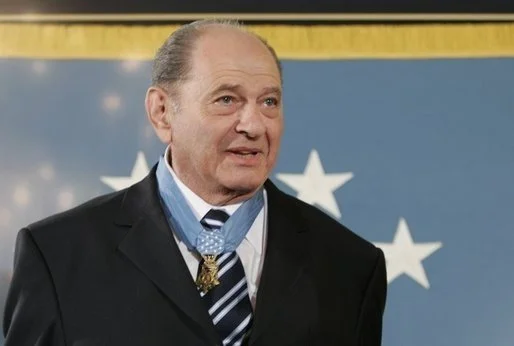
Tibor Rubin.
Rubin was born in 1929 in Pásztó, Hungary, into a Jewish family during a period when Europe was sliding toward catastrophe. His childhood was cut short by the rise of fascism and the spread of antisemitic laws that increasingly isolated and endangered Hungarian Jews.
Following the German occupation of Hungary, Rubin was deported to the infamous Mauthausen concentration camp in Austria. Still a teenager, he endured starvation, forced labor, brutality, and the ever-present specter of death. Thousands perished in the camp's granite quarries and barracks; Rubin survived through a combination of resilience, resourcefulness, and sheer will. When American forces liberated Mauthausen in 1945, Rubin later recalled being profoundly moved by the sight of U.S. soldiers—healthy, confident, and free. One American serviceman, he said, treated him with kindness and humanity at a moment when such gestures seemed almost unimaginable. That encounter left an indelible mark. Rubin resolved that if he ever made it to the United States, he would repay the nation that had rescued him from annihilation.
In 1948, he fulfilled that ambition. Arriving in America as an immigrant with limited English and little money, Rubin settled in New York and embraced his adopted homeland with fervor. When war broke out in Korea in June 1950, he saw an opportunity to honor his promise. He enlisted in the U.S. Army that same year, determined to serve the country he regarded as his liberator.
The Korean War erupted on the 25th of June 1950, when North Korean forces stormed across the 38th parallel in a surprise invasion of South Korea. The United States, acting under a United Nations mandate, rushed troops to defend the South. Early engagements were chaotic and costly. American and allied forces were driven into a shrinking defensive enclave known as the Pusan Perimeter. Only after General Douglas MacArthur launched the daring amphibious landing at Inchon did the tide temporarily turn. Yet by late 1950, the war shifted again as Chinese forces entered the conflict in massive numbers, launching brutal offensives that sent UN troops reeling southward through mountainous terrain and bitter winter cold.
It was during these desperate months that Rubin distinguished himself. In July 1950, near the Pusan Perimeter, his regiment came under intense North Korean assault. According to eyewitness accounts later included in his Medal of Honor citation, Rubin single-handedly manned a machine-gun position on a hill for twenty-four hours. Wave after wave of enemy soldiers attacked, but Rubin held his ground, inflicting heavy casualties and slowing the advance long enough for his unit to regroup and withdraw. His stand was not a dramatic flourish; it was a grim, grinding act of endurance, reminiscent of the tenacity that had sustained him in the camps of Europe.
Later that year, as Chinese forces surged into the war, Rubin again volunteered for a perilous task. During a chaotic withdrawal, he remained behind to cover his unit's retreat, engaging the enemy alone and allowing fellow soldiers to escape encirclement. His actions exemplified a pattern: whenever danger intensified, Rubin stepped forward rather than back. In November 1950, during fierce fighting, Rubin was captured by Chinese troops. What followed was more than two and a half years of imprisonment under appalling conditions. Food was scarce, sanitation was almost nonexistent, and medical care was minimal, with diseases that spread rapidly. Prisoners endured relentless indoctrination efforts and the psychological strain of uncertainty. Many perished from malnutrition and exposure.
For Rubin, however, captivity was tragically familiar terrain. Drawing on the survival instincts forged in Nazi camps, he refused to surrender to despair. He slipped out of the prison compound at night, risking execution if caught, to scavenge for food. He stole rice and other provisions from enemy supplies and distributed them among weaker prisoners. He nursed the sick, carried the infirm, and offered comfort to those on the brink of death. Fellow prisoners later testified that his efforts saved numerous lives. To them, Rubin was not simply a comrade but a lifeline.
When the armistice was signed in 1953 and prisoners were exchanged, Rubin returned home, gaunt but unbroken. Many of his fellow soldiers believed he would soon receive the Medal of Honor. Recommendations had been submitted during the war for his extraordinary actions in combat. Yet the award never came. Over time, it emerged that antisemitism on the part of a superior noncommissioned officer had obstructed or failed to process the necessary paperwork. In the climate of the early 1950s, such discrimination could quietly derail recognition without scrutiny. Decades later, a congressionally mandated review examined cases in which Jewish and Hispanic service members might have been denied awards due to prejudice. Rubin's case resurfaced as one of the most striking examples. Investigators confirmed that his heroism had been documented and recommended, but administrative bias had prevented proper consideration.
In 2005, more than half a century after his acts of valor, Tibor Rubin finally stood in the White House as President George W. Bush placed the Medal of Honor around his neck. The ceremony was both a personal triumph and a national acknowledgment of past injustice. The citation recognized not only his single-handed stand in combat but also his selfless courage as a prisoner of war. Rubin accepted the medal with characteristic humility. He often insisted that he had simply kept a promise—to repay America for his liberation.
In interviews, he deflected praise toward his fellow soldiers and reflected on the freedoms he cherished as an immigrant citizen. For him, the medal symbolized gratitude rather than vindication. In his postwar life, Rubin settled in California, married, and raised a family. He remained active in veterans' circles and frequently addressed schools and community groups. He spoke about resilience, about the value of liberty, and about the responsibility of memory. Having witnessed both the depths of totalitarian cruelty and the capacity for democratic self-correction, he embodied a bridge between two defining conflicts of the twentieth century.
When Tibor Rubin died in 2015, he left behind more than a record of battlefield heroism. His life formed a moral arc that stretched from the barbed wire of a concentration camp to the ceremonial dignity of the Medal of Honor. It is a story that links the Holocaust to the Korean War, illustrating how individual courage can shine even amid institutional failure. His long-delayed recognition serves as a reminder that while injustice may obscure valor for decades, truth has a stubborn endurance of its own—and, in time, can prevail.
In conclusion, Corporal Tibor Rubin represents something larger than a single act of heroism on a distant battlefield. His life is a study in moral continuity. The same resolve that sustained him in the shadow of Mauthausen concentration camp sustained him on the hills of Korea; the same gratitude he felt toward the soldiers who liberated him shaped the courage with which he defended their flag. He did not compartmentalize his past and present. Instead, he fused them into a singular commitment: to stand firm when others faltered, to give when others could not, and to endure when surrender might have seemed understandable.
His story also illuminates the complex character of the nation he chose as his own. The United States that freed him from Nazi tyranny later failed, through prejudice and neglect, to honor him promptly. Yet it was also a nation capable of confronting that failure, reopening old records, and correcting an injustice decades later. In that arc—from liberation to oversight to eventual recognition—lies the proof not only to Rubin's perseverance but to the imperfect, evolving promise of American democracy itself.
The medal placed around his neck in 2005 did more than acknowledge battlefield gallantry. It affirmed the lives he saved in frozen foxholes and prison compounds. It validated the testimony of fellow prisoners who survived because he shared stolen rice, shouldered burdens not his own, and refused to let despair claim another man. And it restored to the historical record the full measure of a soldier whose faith in his adopted country never wavered, even when its institutions faltered.
Ultimately, Rubin's journey from persecuted Hungarian Jewish youth to American war hero binds together two of the twentieth century's defining struggles: the fight against genocidal totalitarianism and the defense of fragile democratic allies during the Cold War. His life reminds us that courage is not born in a single moment of crisis but forged through repeated trials. It is a reminder that gratitude can be a powerful engine of service, that character, once tempered by suffering, can become an enduring force for good.
Remembering Tibor Rubin, it compels the seeing beyond medals and citations. It highlights a man who transformed unimaginable trauma into steadfast loyalty, who answered cruelty with compassion, and who met injustice not with bitterness but with continued devotion. His legacy endures not only in military archives or presidential ceremonies, but in the example he leaves behind: that even in the harshest landscapes of history, individual courage and conscience can prevail—and, in time, be recognized for what they truly are.
The site has been offering a wide variety of high-quality, free history content since 2012. If you’d like to say ‘thank you’ and help us with site running costs, please consider donating here.