In the Afternoon on October 1st 1946 a man dressed in a smart civilian suit stood awaiting his verdict in the Palace of Justice in Nuremberg. What will my verdict be? Guilty or not guilty? Life imprisonment or death by hanging? He pondered.
Who is this man? His name is Albert Speer he was formally known during the Nazi regime as Hitler’s Architect and later he became the Minister of Armaments prior to his arrest by the Allies in 1945.
Though Speer has been known to history by a string of titles there is one that stands out amongst the rest. This title is one that Speer created for himself which was the Nazi who said sorry.
Sophie Riley explains.
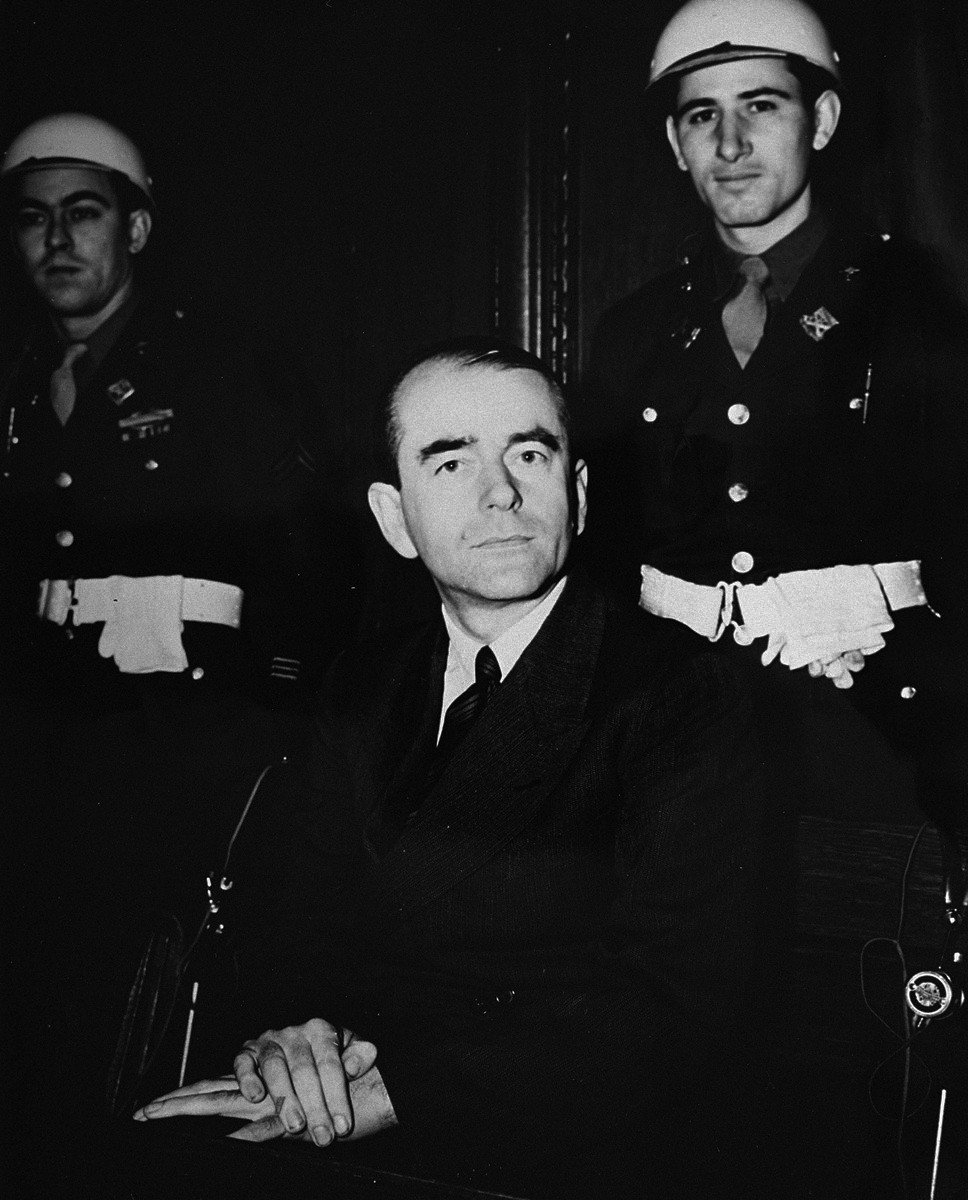
Albert Speer at the Nuremberg Trials.
Upbringing and Education
Albert Speer was born into an upper middle-class family in Manheim, Germany. However, despite the immense wealth he was born into Speer’s early years were far from idyllic. His early childhood lacked the love, support, and warmth he yearned for and this would haunt him in his later years when he went searching for this in all the wrong places.
Speer was the youngest child of three brothers who used to bully and beat him because of his perceived shy and sensitive nature. This emotional trauma that he suffered would be later argued by Historian Gita Sereny as a justification for his susceptibility to Adolf Hitler’s charismatic nature.
Speer’s academic life however would provide the structure that his home life lacked. His education prior to his architectural training was that of a classical nature. Speer would have a typical middle-class education that consisted of learning mathematics, science, Greek, Latin, conventional German literature, and sport. He would later describe this education as apolitical, traditional, and technical. During his early education Speer was exceptionally gifted in mathematics which he later wanted to pursue as a career despite his family’s legacy lying in the architectural field. This passion however would be cut short by his father who pushed Speer into the family business.
Speer’s journey as an architect would begin during the years of the Great Depression. In 1923 he began his training at the University of Karlsruhe in Manheim, this allowed him to study under the familiar shadow of the family trade. He would later transfer to two different universities to deepen his skills. One of them was the Technical University of Munich and the other was the Technical University in Charlottenburg, Berlin. During his time in Berlin, Speer would study under Heinrich Tessenow. Speer found that Tessenow’s philosophy of simple but disciplined architecture resonated with his own opinion. He would eventually become Tessenow’s assistant in 1927 and begin to teach classes alongside his post graduate work.
Rise to power
Speer was 25 years old when he first heard Hitler speak at a beer hall in Berlin. Though he was not initially drawn to the loud violent antisemitism he was swept up in the aesthetic of power. He would later describe that Hitler’s speech had a hypnotic quality to it that promised order in a chaotic Weimar Republic. This moment would push Speer to join the Nazi party in January 1931 where he became member number 474,481.
Speer’s breakout moment however would not occur until the Nuremberg rally in 1933. His talent would not be shown through a building but through setting a stage for the Fuhrer. When tasked with decorating for the rally Speer ignored the traditional route of using flags and instead, he used 130 anti-aircraft searchlights to create a Cathedral of Light much to the despair of Reich Marshal Hermann Goering.
This was the first time the Nazis used technology to create a spiritual experience. This moment proved to Hitler that Speer knew how to make the regime appear God like and untouchable. Following on from his success Hitler would officially appoint him the Commissioner for the Artistic and Technical Presentation of Party Rallies in 1933.
By late 1934, Speer’s rise to power had accelerated by his close companionship with Adolf Hitler. He was able to gain the Fuhrers ear through their mutual interests in art, architecture, and history. By discussing the idea that buildings in the new Germany should be constructed to mirror the empires of Rome and Greece this helped Speer play into Hitler’s vanity and fantasy for his Third Reich.
This close relationship and interconnecting dream led Speer to become the General Building Inspector for the Reich Capital. Within this new role he and Hitler planned to destroy large parts of Berlin and replace them with new structures for the future Germania. In addition to this new venture Speer was also given impossible deadlines by Hitler which included building the new Reich’s Chancellery in just nine months. Though Germania would never see the light of day the Reich’s chancellery was completed in time due to Speer employing thousands of workers to complete shifts around the clock.
The turning point for Speer came in February 1942 when the mister of armaments Fritz Todt died in a mysterious plane crash. In response to this Hitler quickly appointed Speer to this new position despite him having zero experience and knowledge in military logistics and mass production. This was the moment that Speer transitioned from Hitler’s architect to the man that would fuel the Nazi war machine.
However, this turning point from building monuments to managing a failing war machine began to cast a shadow on the once artistic harmony and friendship between Speer and Hitler. A growing friction that would lead to Speer’s fall from grace.
Fall from Grace
During Speer’s time as Armaments Minister, Germany’s production saw a massive but temporary rise due to his brutal exploitation of slave laborers from nearby concentration camps. The use of slave laborers, Speer would later argue, was due to the shortage of German workers as women were not allowed to work in the factories. Furthermore, Speer also cooperated closely with Fritz Sauckel to deploy millions of forced laborers, prisoners of war, and concentration camp inmates in his factories
In addition to this the rise was also due to Speer’s radical rationalization of the industry. He did this by breaking down bureaucratic barriers by creating the Central Planning Board. This gave him control over raw materials, production, and transportation. He also reduced the variety of weaponry, such as reducing anti-tank weapon types from twelve to one, to improve efficiency. This radicalization of the war industry would be dubbed the armaments miracle and it hit its maximum output in 1944.
This graceful period ended on the 19th March, 1945 when Hitler issued his Nero Decree. The Nero Decree, also known as the scorched earth policy, commanded the destruction of all German infrastructure—including transportation, communication, and industrial facilities—to prevent their use by Allied forces as the Nazi regime collapsed. This decree felt like a personal attack on Speer and in response he deliberately sabotaged Hitler’s plan by ordering the General and Gauleiters that he controlled to stop destroying Germany’s infrastructure. Though he knew the war was lost Speer wanted to preserves as much of Germany’s infrastructure for the post-war world.
Speer’s final conversation with Hitler would take place on the 23rd April 1945, when Speer visited the Fuhrer’s bunker for one last time. On approach Speer knew that he may not come out alive after he admitted to Hitler that he defied his Nero Decree. Speer also entered the bunker with another intention that day and that was to kill Hitler by releasing poison gas into the ventilation system. However, this claim was only mentioned during his trail at Nuremberg and has never been proven.
After entering the bunker Speer headed straight for Hitler’s Office where they had one last talk. The visit marked the definitive end of their long-standing partnership. Shortly after this cold farewell, Speer fled Berlin, leaving behind the ruins of the "armaments miracle" and the regime he had helped sustain.
The collapse of the Third Reich transformed Speer from a high-ranking minister into a high-value captive. His subsequent arrest in Flensburg by Allied forces shifted the arena of his struggle from the industrial factories of Germany to the interrogation rooms of the victors in Glucksberg Castle. During his interrogation in May 1945, Speer curated his ‘Good Nazi’ by admitting to openly criticizing and defying the regime, attempting to kill Hitler and the German war machines efficiency. However, he was careful to avoid and deny knowing about the holocaust in any capacity. During these periods of intense questioning Speer would also begin to defer blame to his deputy Fritz Sauckerl especially when he was questioned about the use of forced laborers in his factories.
These interrogations would serve as the prelude to the Nuremberg Trials, where Speer would face international judgment not only for his administrative efficiency but for the human cost of the brutal exploitation that had fueled it.
Nuremberg Trial
On November 20th, 1945, Albert Speer was indicted on four charges alongside 21 other high ranking Nazi party members. The following day he pleaded not guilty to all the counts against him.
Though he was indicted in November 1945, Speer would have to wait several more months before he could plead his case. Speer’s trail officially began on the 20th June, 1946, and unlike many of his other defendants he would acknowledge both the regimes and his individual responsibilities during the Second World War and the Holocaust.
The following day he was cross-examined by American Prosecutor Robert Jackson. During this Speer admits to disobeying Hitler’s Nero Degree as well as his collective guilt of the Nazi regime alongside his role within obtaining slave laborers.
Prior to his own trail Speer was able to watch his fellow colleagues arrogantly push the blame towards either Hitler or blamed their actions on just following orders. Speer was able to recognize what behavior would lead him straight to the hangman’s noose and he was determined to defy it at all costs. When he entered the dock on the 21st June, 1946, he had a game plan ready, he was prepared to escape death and, in its place, he created a new life and legacy for himself.
Speer would never fully admit to doing anything during his time as an architect or later as armaments minister, he was careful to admit to his personal responsibility and the collective responsibility of the Reich. When it came to topics such as the Holocaust, he would accept that it had happened and how harrowing it was to watch the camp footage; however he would never admit that he had direct knowledge about what was happening. In addition to the Holocaust, Speer would deny about his knowledge of the Auschwitz camp expansion though it was his ministry that approved the funds and materials to allow this.
Where he would deny involvement, he would also omit his presence from specific events such as the Posen speech in 1943. During the Posen speech Heinrich Himmler made it known that there was a genocide towards the Jews and how they were carrying it out. Though Speer would deny his attendance, during his trial a letter would later appear in 1971 that proved his presence. In addition to this Speer also denied his role in the forced resettlement of 75,000 Berlin Jews during his time as Hitler’s architect.
In contrast to his denials and omissions. Speer would admit enough information and apologize for his role to the point where the Allies would choose the punishment of jail time over a public hanging. Though it should be noted that Speer never said I am sorry or I apologize during his time at Nuremberg. What Speer did admit too, alongside his collective responsibility, was to using slave laborers from the camps - though he happily deferred the brutal recruitment of the laborers to his deputy Fritz Sauckerl.
In addition to this, Speer would claim that he attempted to kill Hitler in early 1945. According to Speer he had planned to assassinate the Fuhrer by introducing poison gas into the bunker’s ventilation system. This moment is one of several that historians still debate on whether this was feasible or was it a ploy by Speer to gain acceptance from the Allies. Another favorable point from the Allies would come from Speer’s defiance of Hitler’s Nero Decree. Speer admitted to sabotaging Hitler’s orders to preserve Germany's infrastructure for the post-war period.
Despite all this acceptance and denial, on 1st October, 1946, Albert Speer was sentenced to twenty years in Spandau prison, as the International Military Tribunal found him guilty on two out of four counts. He was found guilty of war crimes and crimes against humanity. His twenty years in prison allowed Speer to cultivate an image of the good Nazi, an image, and a legacy that historians would debate during his lifetime and long after his death on the 1st September, 1981.
Good Nazi Legacy – or a myth?
With his 20 years in prison, the next two decades in Spandau were consumed with preserving the legacy he created during his trail at Nuremberg. Speer had 20 years to masterfully curate his public rehabilitation. His long-term isolation granted him time to reflect on his previous life in the Third Reich. He began to meticulously curate two books that would be published later after his release. These narratives would allow him to further himself from the regime, so when he was eventually released in 1966, it was as if they convicted the wrong man of war crimes and crimes against humanity. Over 400 reporters would be waiting for him alongside Baldur Von Schirach, the West was besotted with Hitler’s former Architect now turned ‘good’.
Upon his release and until his untimely death in October 1946, Speer embarked on a new career as a reformed witness of the Nazi image. He was interviewed vigorously by the media for TV and radio segments, everyone wanted a piece of the man who took responsibility, showed sympathy, and maintained a remorseful persona both in his public and private life.
However, despite the public being charmed, there were sceptics who did not buy into the new and improved Speer. Evidence starting in the early 70’s and that is still being found to this day. destroys Speer’s image and legacy as the ‘Good Nazi’. In 2007 a letter written by Speer in 1971 to his friend Helene Jeanty included an admission that stated "There is no doubt—I was present as Himmler announced on October 6, 1943 that all Jews would be killed." This statement would signify for the majority that Speer had fabricated his life to escape the hangman’s noose.
In addition to this, historians and others have highlighted that as Armaments Minister it would have been impossible for Speer to be truly ignorant to what was happening in his factories whilst merely being a technocrat. Furthermore, historiographers such as Matthias Schmidt found that Speer's close aide Rudolf Wolters deleted incriminating passages from Speer’s official diary after the war. Those accounts regarded the deportation of Jews from Berlin and other occupied zones in Europe. In addition to this Richard Evans would argue that Speer's account in Inside the Third Reich—claiming he confessed to Hitler that he was sabotaging the scorched-earth policy—as pure invention. This then begs the question - did anyone know the real Albert Speer?
Final Thoughts
To conclude, Speer was a manipulative and coercive individual who weaponized his past to build a new future for himself. He spent the early years of his life being a victim of neglect and bullying. However, this victim would turn into a victor at Nuremberg a man who would convince most of the Western world with his remorseful and repentant attitude. In his later years he would draft memoirs that reflected his earlier buildings as an architect; they were full of botched truths that distracted many but not all from the misery that lay beneath.
However, as the dust settled, his façade as the good nazi began to crumble to nothing. Evidence would appear that would highlight at mass cover ups and private admissions by Speer himself. The armaments miracle that he had boasted about earlier was created from mass bloodshed and despair. The products were made by thousands upon thousands of slave laborers who he ‘employed’ and later deported at whim. Speer would escape the noose again as he died in London on September 1st 1981. History’s final verdict on Speer would be that he was not a misguided architect or an apolitical technocrat - he is really a man who had immense talent for evil. Ultimately, we must consider, did Speer truly spend his later life seeking redemption, or was he merely performing his final and greatest architectural feature —building a monument of lies to hide a graveyard?"
The site has been offering a wide variety of high-quality, free history content since 2012. If you’d like to say ‘thank you’ and help us with site running costs, please consider donating here.