Prohibition is very often associated with the criminal activities of the infamous Al Capone, his nemesis Eliot Ness, and numerous illegal speakeasies from the USA between 1920 and 1933 made memorable from numerous gangster films over the decades. Prohibition, after a fashion at least, was not just confined to North America. It did in fact reach Britain and established itself in a quieter way in some remote towns in Scotland. Kirkintilloch was one of those towns and famously stands out among many for having prohibition laws that continued late into the twentieth century.
Steve Prout explains.
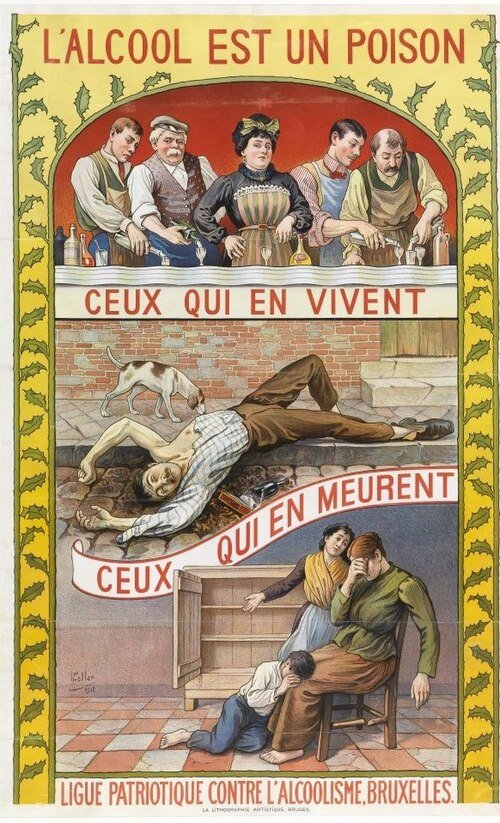
"L'Alcool est un Poison" from Belgium, 1910. This depiction contrasts "those who live from it" (those selling alcohol) with "those who die from it" (showing alcoholic and his family).
Kirkintilloch can be found eight miles from central Glasgow. The town started life as a Roman fort and led a quiet and largely quiet life until the industrial revolution brought the benefit of the textile industry to its inhabitants. Further expansion followed with the building of Forth and Fyfe canal in 1773 and later in 1836 with the railways. The town became an important transport center for iron, coal, and other industrial needs.
Kirkintilloch would have remained just another industrial town, but the town earned its notoriety for becoming what was known as a "dry town" which forbid the sale of alcohol on public premises from 1923 until 1967. Kirkintilloch was not alone and was one of many towns in Scotland that embraced prohibition. The ban on the sale of alcohol had long been demanded by both the Liberal Party and the Temperance movement, both of which had a strong influence in Scottish local town politics in the early part of the 20th century. It was a combination of the Temperance movement and the outbreak of the First World War that created “dry towns” which lasted long into the twentieth century and the infamous prohibition period of the United States.
The Temperance Movement and the Origins of “Dry Towns”
The origin of Scotland’s former dry towns began with the Temperance movement, a movement that led a moral crusade against alcohol consumption in the USA in the early 1800s. Its ideas were soon in Britain. The movement did not find it difficult to find supporters all over Britain but found strong and more lasting support in Scotland in the mid 1800s. The movement focused on the morally degrading effect that alcohol consumption had on society. One writer on the subject, Jack S Blocker, in his book Alcohol and Temperance in Modern History pays particular attention to the situation in Scotland. The book mentions a parliamentary report that contained alarming statistics concerning drink-related arrests between 1831 and 1851 in Scotland. It painted Glasow in a poor light. The report concluded that the situation was not helped by the ratio of drinking establishments per inhabitant. In Glasgow there was one licensed premises for every one-hundred and fifty inhabitants. As far as Temperance Movement was concerned this was all the proof needed to convince potential followers for assertive action.
The report boldly claimed that “Glasgow was three times more drunken than Edinburgh and five times more drunk than London.” He also noted that Scots “like the Irish and unlike the English and Welsh, ordinary people drank a great deal of whisky.” We cannot confirm the accuracy of the data, which no doubt had it flaws, nor do the unhelpful and outdated stereotypes help to substantiate these claims. However, whether true, false, or exaggerated the report caused enough alarm for the Temperance movement to fuel their crusade and so it grew and gathered momentum.
Kirkintilloch was not the only dry town in Scotland; others soon joined the moral cause after the passing of the later 1913 Temperance Act. At first the movement’s demands were limited to just banning the sale of “strong and ardent spirits” but soon those demands encapsulated the banning of all alcoholic drinks. Variants of the movement spread to other towns in Scotland such as Paisly, Kilsyth Wick, Lerwick, Greenock, Ayrshire, and Lanarkshire. In 1844 in Falkirk, the Scots Temperance League established itself in the community and promoted “the long pledge” of total abstinence from its members.
The Growth of Temperance
The first challenge the Temperance representatives had to overcome was encouraging the drinking population to surrender one of their few leisurely pastimes, especially those who grafted in the long hours and harsh working conditions of the time. It was no easy task, but the members found innovative ways. Various movements offered extremely attractive terms in return to leading a tee-total life and being part of the movement.
In return for a serious commitment to a clear oath or pledge, the member would receive support in various forms from this new community. In some variants of the movement, certain benefits were offered such as the entitlement to an early form of social welfare type insurance to draw on in times of need, representing an early example of a Co-operative or a micro social security system. This was certainly true of the Sons of the Temperance Society which formed in the 1850s. The oath was noticeably clear, and each faction had its own wording, but all had one clear and unified meaning. The Hope of Coatbridge Section of the Cadets of Temperance (1878-1925), for example, had their members recite the following vows:
“We the undersigned promise to abstain from all intoxicating drinks and discountenance the Causes -and practices of intemperance and to abstain from tobacco in all its forms.”
The risk of breaking these vows resulted in public condemnation, shaming, and exclusion.
In the towns where the Temperance ideas took hold the old-fashioned public house was replaced by other commercial ventures and for a time flourished. Alternative establishments such as Temperance hotels, coffee houses and tea rooms replaced these licensed premises. The social scene was changing in some areas. Over twenty such establishments replaced the public house is Glasgow in 1840 and the movement was gaining political approval.
Meanwhile these societies continued to lobby and win the approval of political influencers. One peer commented: “Without these societies we should be involved in such an ocean of intoxication, violence and sin as would make this country quite uninhabitable.” The lobbying proved to be fruitful, and the best example of the movement’s success came from their work with Forbes Mackenzie, a Conservative MP. MacKenzie also happened to be a temperance reformer himself, and he introduced a number of changes to support the movement. This became law within the Public Houses (Scotland) Bill in 1853. This act forced the closure of pubs in Scotland at 10pm on weekdays and forced closure on Sundays. Slowly but surely the consumption and supply of alcohol was being restricted, and, in some towns, further restriction was to come. Alcohol was not completely removed from people’s lives and momentum would be slow until the early part of the twentieth the century.
In 1906 the Liberal government passed legislation allowing communities to veto alcohol consumption and with that the Temperance Scotland Act was passed in 1913. Whether this alone would have been enough we will never know because the political and social landscape changed further as Britain entered World War One.
The Temperance movement was not wholly responsible for the creation of Scotland’s Dry Towns. The First World War and Government laws bought further tight restrictions on the sale of alcohol with the Defence of the Realm Act 1914. The purpose of these restrictions was to ensure a productive resourceful pool of industrial labor to service the war effort. Stricter controls on public house opening hours were enforced, the strength of beer brewed was diluted and additional taxes amounting to an extra penny were charged on each pint of beer. Naturally, this changed attitudes and habits. Helped by the patriotic fervor for the war effort, a lot of publicans chose to support the armaments industry and keep workers sober. They of course had little choice as their incentives from their trade had been curtailed. Examples of the landlord measures were to enforce the ‘No Treating’ rule between 1916 and 1919 that forbid the buying of rounds of drinks. Slowly but surely alcohol availability was diminishing but the temperance movement had not gone away and was far from finished. They in fact seized upon these gains at the end of the war.
The Temperance Movement took advantage of the 1913 act to continue and expand their cause once the war ended. The result was vast numbers of voters in the 1920 local elections opted for the abolition of alcohol sales. Towns such a Kirkintilloch became one of those dry towns as a result. This was given further backing when supporter Edwin Scrymgeour was elected as a Scottish Prohibitionist Party MP for the Dundee constituency. He remained an MP until 1931.
Other Variants of Temperance
There were many variants of these Temperance societies, one founded in the USA in 1851 was the Independent Order of Good Templars (born from a previous organization called the Sons of Temperance). After reaching Scotland, this society became the first Scottish lodge, established in Glasgow in 1869. One interesting facet about this variant was that it promoted equality of rights for women: an early forerunner of Universal Suffrage.
The movement demonstrated its sincerity by admitting women into their societies, thus placing them on an equal footing to men and encouraging them to be active board members. This was certainly the intention of Provost James Knox who was also the manager of Airdrie Savings Bank from 1848 to 1861 (he also held the position of Chief Templar in the early 1900s).
The End of the Dry Period
Dry towns soon and slowly relaxed their rules and departed away from the ways of Temperance. Some chapters and their establishments lasted until late in the twentieth century. Moods had changed and the world. A number of factors had brought about change. By the time of the Second World War attitudes had changed and become more relaxed. The Temperance ways were now seen as outdated and irrelevant. Even the government did not impose the same alcohol restrictions on alcohol consumption between 1939-1945 as it had during the First World War. It may have been too much to impose such restrictions on the population a second time. With that being said, some areas of Scotland did maintain their discipline until well after the end of the war. Kirkintilloch, for instance, finally abandoned its dryness in 1967.
In some cases, the remnants of the Temperance acts held on tenaciously a little longer. It took until 1976 for parliament to dismantle the legislation set out by Mackenzie from 1853, with some parts of Scotland - such as Kilmacolm - taking longer to embrace the new liberties. Kilmacolm finally acquired its own pub as late as 1998 when an old waiting room at the train station was converted into The Pullman. It was a memorable event and well attended by a thirsty crowd at the establishment’s grand opening after seventy dry years.
Did you find that piece interesting? If so, join us for free byclicking here