During the movement of settlers west across America, a number of bloody and violent encounters took place with Native Americans. Here Shubh Samant considers whether such actions can be considered genocide.
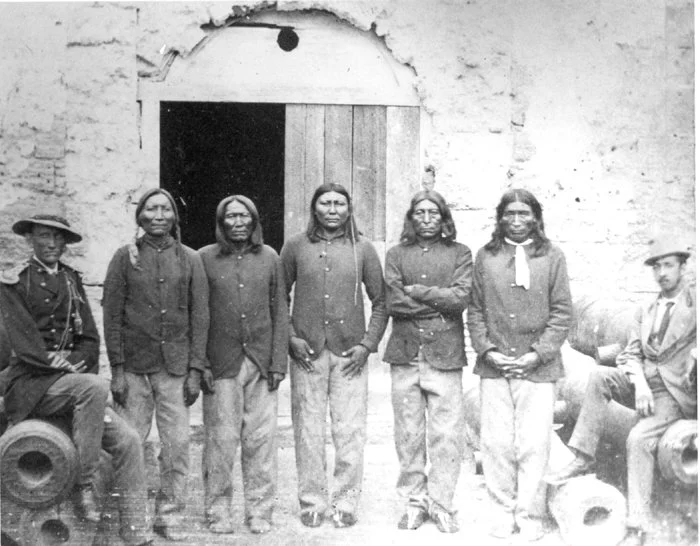
Native American prisoners from the Red River War. In Fort Marion, Florida in 1875.
The Indian Wars were a tragic and violent period in American history, filled with death, suffering, and forced displacements of many Native American people. However, according to the United Nations definition of genocide, which requires intent “to destroy, in whole or in part, a national, ethnical, racial, or religious group”, I would argue that the actions of the US government during these wars cannot be considered a genocide. While many military campaigns caused significant losses to Native communities, most evidence suggests that the government’s primary intent was territorial expansion and economic growth, rather than a complete destruction of the Native American people. This distinction between intent and outcome is crucial when analyzing historical atrocities. While the consequences of these wars were undeniably devastating, the legal classification of genocide hinges on deliberate, documented intent.
The Sand Creek Massacre in Colorado from the year 1864 CE is regarded as one of the most famous atrocities during the Indian Wars. On November 29, 1864, Colonel Chivington led militia forces in an attack on a peaceful camp of Cheyenne and Arapaho people, killing over 150 non-combatants. The brutality of this event, including the mutilation of bodies, fits a part of the UN definition - “killing members of the group.” However, to meet the legal threshold of genocide, such acts must be part of a wider, intentional policy aimed at the group’s destruction. This massacre was not ordered by the Federal government as part of a national anti-Native American movement, but was rather done by a small local force. The US Congress later condemned the attack themselves, calling it a ‘massacre’. Thus, while the event was undeniably horrific and anti-human, the absence of a federal order or coordination to intently eliminate the Cheyenne and Arapaho group weakens its classification as genocide under international law. The Sand Creek Massacre remains a haunting reminder of how local actions, driven by prejudice and fear, can result in catastrophic violence. It also highlights the importance of accountability, as Congress’s condemnation set a precedent for recognizing and denouncing such acts.
The Red River War was a series of US army campaigns against several Southern Plains tribes. The army destroyed villages, food supplies, and horses. Such acts could relate to another part of the UN definition - “inflicting conditions of life calculated to bring about physical destruction.” Yet, the destruction was strategically aimed at forcing surrender, not extermination. Rather, the purpose of these military actions was to force the Native tribes to surrender and relocate to reservations, not their extermination. Once these tribes relocated to the reservations, the government continued to provide them with ration supplies, in complete contrast to extermination, as defined in the UN definition. This provision of aid, however inadequate, suggests a policy of containment and assimilation rather than extermination.
It’s important to note that while these campaigns were tactically designed to break resistance, they also dismantled centuries-old ways of life. The loss of horses, food stores, and mobility had long-term cultural impacts that extended beyond physical survival.
Wounded Knee Massacre
The Indian Wars, just as violent and horrific they had been, ended in a similar tone. On December 29, 1890, the US 7th cavalry surrounded a Lakota camp near Wounded Knee Creek, and opened fire. This led to the deaths of roughly 300 Natives. Yet again, in contrast with the UN definition, this violence was not a result of an intentional plan to destroy the Lakotas. It rather erupted from a misunderstanding surrounding the Ghost Dance movement, which the soldiers misinterpreted as a rebellion. While the scale and indiscriminate killings can clearly be considered crimes against humanity, the lack of any documented intent by the US federal government to eliminate the Lakota as a group weakens the claim of genocide.
The Wounded Knee Massacre has since become a symbol of Native resistance and remembrance. Annual commemorations and historical reinterpretations continue to challenge the narrative of “misunderstanding,” urging deeper reflection on the militarization of fear and prejudice.
The UN definition emphasizes intent, a deliberate goal to destroy/exterminate a group. Although the US government engaged in destructive practices throughout the Indian Wars, there is little evidence that there was an official policy intending to annihilate Native Americans. Historical records and military correspondence show the goals were primarily land expansion and assimilation, not extermination. While these goals caused immense suffering and destruction, they differ from the genocidal intent defined by the UN.
This distinction has legal implications, but it doesn’t absolve the moral responsibility. The legacy of these wars continues to shape Native American communities today, from land rights battles to cultural preservation efforts.
Conclusion
In conclusion, while the Sand Creek Massacre, the Red River War, and the Wounded Knee Massacre were horribly violent/had terrible consequences, they do not fully meet the United Nations definition of genocide, which requires proven intent to destroy a group of people. The US government actions during the Indian Wars were driven more by expansionism, forced relocation, and assimilation than by a systematic/official effort to exterminate Native Americans as a race. Therefore, these actions can be considered as genocidal by effects, but not by the legal criteria.
Understanding this nuance is essential, not to diminish the suffering, but to accurately frame the historical record. As we continue to confront the past, we must also amplify Native voices, support reparative justice, and ensure that such tragedies are never repeated.
All quotations in this article have been taken from https://www.un.org/en/genocide-prevention/definition.
Article dedicated to Mr. Kopitar.