A century after Napoleon's death, thousands of Boer prisoners unexpectedly transformed life on one of Britain's most remote possessions. Richard Clements explains. Richard Clements explains.

A view of St Helena, circa 1790. Thornton, engraver, published by A. Hogg. Source: Public domain, available here.

In April 1900, St Helena found itself entering another unexpected chapter in its long and unusual history.

Nearly eighty years had passed since Napoleon Bonaparte had died on the island, yet once again ships were approaching Jamestown carrying defeated enemies of Britain. This time they were not emperors and marshals, but exhausted Boer prisoners captured during the war in South Africa.

Governor Robert Armitage Sterndale seems to have understood that emotions might easily run high. Before the prisoners arrived, he urged the islanders to show restraint and courtesy. Whatever side they had fought on, these men had gone to war for what they believed was their country's cause.

On 11 April 1900, the first contingent of 514 prisoners came ashore. By the end of the war, somewhere between 5,500 and 6,000 Boer prisoners had passed through St Helena. The effect on the island was immediate. Suddenly, a small community found itself sharing the island with thousands of unexpected newcomers.


Another Prison Island

Britain's military authorities had never expected to care for so many captives. As the war dragged on, prisoner camps in South Africa became increasingly overcrowded and vulnerable. Men were sent across the Empire to places including Bermuda, India, and Ceylon.

St Helena offered an obvious solution.

The same remoteness that had once confined Napoleon now appealed to officials faced with a very different problem. Surrounded by thousands of miles of ocean, the island seemed secure enough to hold thousands of prisoners.

Among the first arrivals was General Piet Cronjé, whose surrender at Paardeberg had shocked the Boer republics. Punch magazine later imagined the defeated commander saluting Napoleon's ghost with the words, "Same enemy, Sire! Same result!"

Lord Roberts allowed Cronjé's wife Hester to accompany her husband, and the couple were accommodated at Kent Cottage near Half Tree Hollow rather than in the camp itself. According to later accounts, the general insisted that proper respect should be shown to his rank and was even provided with a mounted guard made up of members of the St Helena Volunteers.


A Canvas City

Most of the prisoners were marched to Deadwood Plain, a windswept plateau overlooking the sea and not far from Longwood, where Napoleon had spent his final years.

Arthur Montefiore Bryce later described Deadwood Camp as a "canvas city."

Rows of tents spread across the open ground. Contemporary accounts suggest that each tent might contain as many as twelve men. Before long, the camp became overcrowded and permission was granted for prisoners to construct their own shelters using whatever materials they could find.

Paraffin tins, scraps of timber, bamboo, and cloth all found new uses.

The prisoners gave their growing settlement a nickname.

Blikkiesdorp.

Tin Town.

As more transports arrived, a second camp was established at Broadbottom. There, another improvised settlement emerged. The men called it Lappiesdorp, or Rag Town. Differences between Transvaalers and Orange Free Staters, together with simple overcrowding, encouraged the separation.

Later still, another division appeared. Men willing to swear allegiance to the British Crown found themselves deeply unpopular with those who remained committed to the republican cause. Deadwood No. 2 became known officially as Peace Camp, though not everyone used that name. Depending on whom one asked, it was also remembered as Jam Camp or Judas Camp.


Life Behind the Wire

The pages of Kamp Kruimels, the camp newspaper, suggest that life was not entirely given over to monotony.

Christmas brought decorated halls, church services, and parcels sent from Europe. More than 1,400 gifts arrived from supporters overseas. Rugby and cricket attracted enthusiastic followings, and arguments over sport seem to have been as common then as they are now.

Small businesses sprang up throughout the camp. Advertisements appeared for bakeries, confectioners, painters, engravers, and walking-stick makers. There were cafés, a brewery, and a surprising range of craftsmen.

Deadwood had begun to resemble something more than a prison camp.

As evening approached, singing could often be heard across the plain. There were choirs, brass bands, and string groups, and more than one visitor remarked upon the sound of hymns drifting over the tents.

Among the prisoners listening to those voices was Erich Mayer, a German-born volunteer who had joined the Boer cause. After the war, he became one of South Africa's most respected artists. His sketches preserved scenes from St Helena long after the camps themselves had vanished.

Sports also helped pass the time. Contemporary reports describe cricket, football, athletic meetings, and concerts. Reuters dispatches noted competitions lasting several days, while visitors remembered camp life as surprisingly active.

Many prisoners sought work, not simply for the money but to relieve the boredom of confinement.


Tensions and Escape

Life on St Helena was generally peaceful, but it was not without difficulties.

Persistent troublemakers occasionally found themselves confined in High Knoll Fort overlooking Jamestown. Serious incidents remained rare. One prisoner was shot and killed by a sentry in early 1901 following repeated attacks on guards with stones and other missiles. A military inquiry followed.

Escape attempts provided rather more colorful episodes.

One of the most famous involved Hans Eloff, a relative of President Paul Kruger. Together with several companions, he seized an old fishing boat at Sandy Bay and attempted to persuade local fishermen to help.

The escape soon descended into something close to farce.

Floorboards were ripped up in an effort to fashion paddles and money was offered to the fishermen, but the islanders stood firm. By the following morning, the would-be fugitives had been returned to custody.

Other schemes fared no better. One prisoner attempted to hide inside a crate marked "Boer Curios." Another pair stole a small water boat named Phoebe, only to be recaptured soon afterward.

For most prisoners, the surrounding ocean proved a more effective barrier than any fence.


The Island Changes

The Boers altered life on St Helena in ways few people had anticipated.

Local farmers benefited from increased demand for produce. Vegetables, eggs, cheese, and other goods commanded higher prices. Some prisoners entered the service of farmers and tradesmen, while others worked on roads and wharf improvements.

Governor Sterndale's administration employed groups of prisoners on public works. Reuters reports observed that many actively sought employment simply to break the routine of camp life.

The changes were not entirely beneficial. Fuel prices rose and heavy wagon traffic damaged roads. Yet many islanders later looked back on the period as an unexpected economic boost.

Relations between prisoners and residents appear to have been remarkably good. Before departing, German prisoners expressed their gratitude to the people of St Helena for the kindness shown to them during what they called the gloomy days of captivity.

For a small island community, the experience had been extraordinary.


Those Who Stayed

Most of the prisoners eventually returned to South Africa.

Not all of them did.

Some married local women and chose to remain on the island permanently.

Charles John Smith had been captured at Elandslaagte in 1899 and transported to St Helena with his brother Alfred. When repatriation finally came, Charles made a decision that surprised many others.

He stayed.

Known locally as "Boer Smith," he ran a bakery and became one of Jamestown's best-known characters. People who knew him later remembered a talkative man who delighted in telling stories and slipping back into old-fashioned Afrikaans whenever South Africans happened to appear.

He died in 1958 and was buried in St Paul's churchyard.

Members of his family remain part of St Helena life today.


A Cemetery on the Hillside

Not everyone lived to see the end of the war.

During 1902, enteric fever spread through the camps and deaths began to mount. By the time the prisoners departed, 180 men had been buried on the island.

According to several later accounts, Anglican authorities declined to use Anglican burial grounds and the Baptist community provided land at Knollcombes. There a cemetery was established on a steep hillside in the island's interior.

In 1913, the government of South Africa sent two granite obelisks listing the names and ages of the dead. The youngest was sixteen. The oldest sixty-one.

Today, little remains of Deadwood or Broadbottom beyond markers, photographs, and memories. The winds still sweep across the same hills, and the cemetery at Knollcombes remains quiet.

Yet traces of those years survive in family names, museum collections, and stories that have become part of St Helena's own history.

Long after the tents vanished, the Boer years never entirely left the island.


Now read about Napoleon’s secret plan to escape to America here – rather than St Helena


Further Reading

Alana Bailey, "Boer Graves on St Helena."

A. J. Nathan, "Boer Prisoners of War on the Island of St Helena," Military History Journal, Vol. 11, No. 3/4 (1999).

Arthur Montefiore Bryce, "Life in Camp at St Helena," Temple Bar.

Ben Viljoen, My Reminiscences of the Anglo-Boer War.

British Newspaper Archive.

E. L. Jackson, St Helena.

Philip Gosse, St Helena, 1502–1938.

Deadwood Camp Gedenksboek and surviving issues of Kamp Kruimels and De Krijgsgevangene.

St Helena Guardian (1900–1902).

St Helena Island Info.

A 26-year-old Union brigade commander risked being court-martialed when, without orders, he rushed his four regiments to the summit of an undefended hill at a crucial moment during the Battle of Gettysburg. The Harvard graduate’s valor may have saved the Army of the Potomac – but it cost him his life. Timothy M. Gay explains – in part 1 of 2.

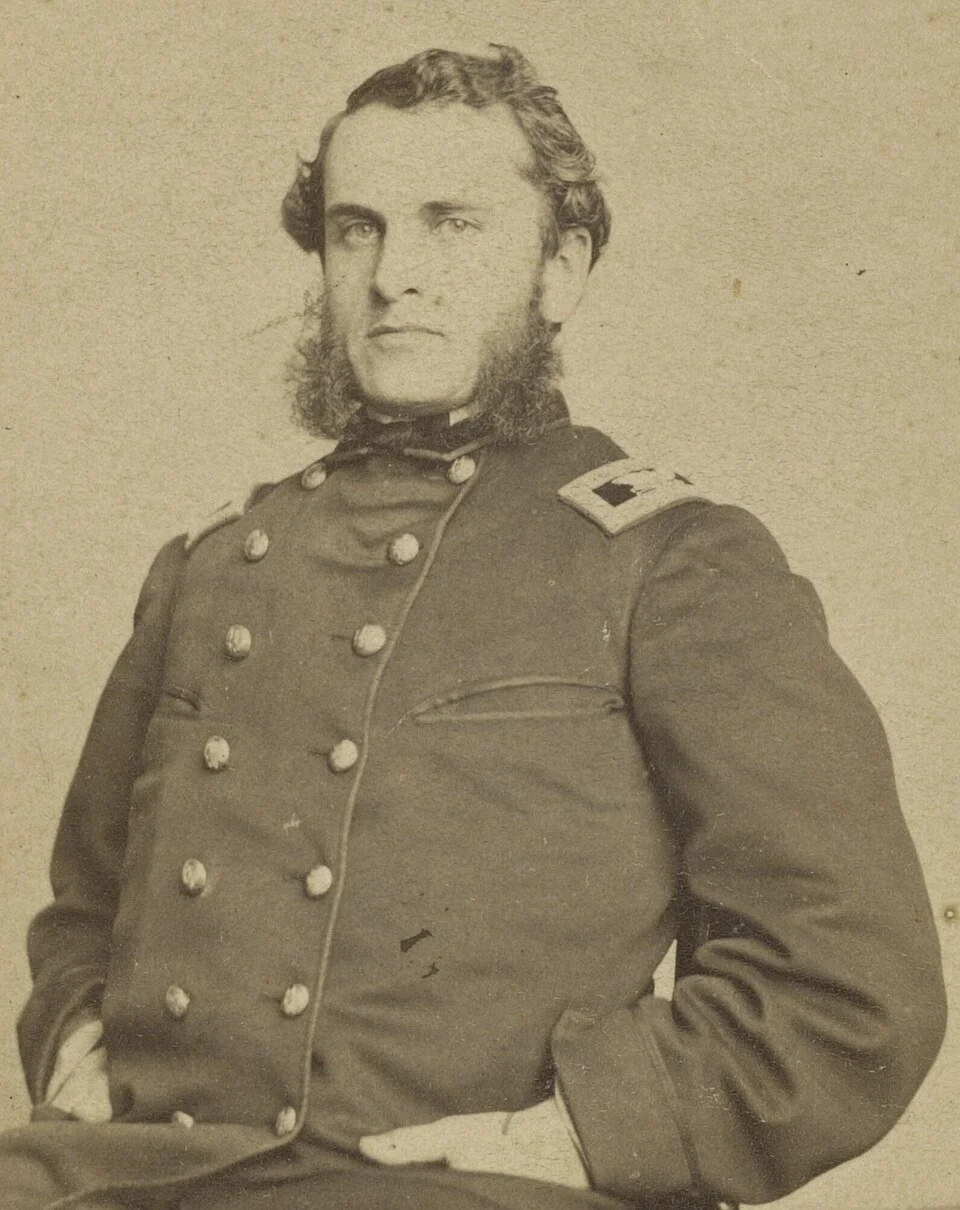
Colonel Strong Vincent. Source: Public domain, Library of Congress, available here.

The bugle blare ordering the men to break camp that steamy Wednesday evening could not have come at a worse moment. Having not eaten a restful meal in days, the 1,300 soldiers of the Third Brigade, First Division, Fifth Corps of the Army of the Potomac had just settled down to supper when the dreaded “Assembly!” call came screeching through their campground.  

Now the infantrymen weren’t just ravenous, they were spitting mad. No doubt muttering curses while gulping a last bite of salted beef, they doused their fires, struck their tents, grabbed their equipment, and scrambled into formation. A dozen miles off, they could hear sporadic cannon fire. At first the noise was muffled, like distant thunderclaps from the summer storms that stalked them on their grueling trek north from Virginia. But as the Fifth Corps’ ten brigades – nine infantry, one artillery – hustled west, kicking up clouds of dust in what was already searing heat, the sounds grew sharper and more ominous.

General George Sykes, who had taken command of the corps just days before when President Lincoln elevated Major General George Meade to overall head of the Army of the Potomac, pushed his men past the brink of exhaustion. By the middle of the night, one Fifth Corps soldier recalled, “all human endurance was on the verge of utter collapse.”

Private Oliver Willcox Norton, a former northwestern Pennsylvania schoolteacher, was lucky. As a bugler, color bearer, and orderly, Norton was given a horse to keep abreast of the Third Brigade’s commanding officer. But almost every other enlisted man in the corps that night was struggling to stay upright, dragging one foot in front of the other.

Squinting their eyes in the purplish predawn, the men could make out a pair of hills to their left, a slight ridge dead ahead, and a mound to their right. They knew that beyond that high ground, a fierce battle was raging outside a crossroads called Gettysburg. It was now Thursday, July 2, 1863.

Third Brigade veterans had no illusions about the cataclysm that awaited them. At Gaines’ Mill in June of 1862, mired in the swamplands of Virginia’s Chickahominy River, they were caught in an ambush, losing close to half their men. Eight weeks later at Second Bull Run, many of them were forced to make a reckless charge into Confederate General Stonewall Jackson’s entrenched line; again, they suffered horrific losses. Four months removed from the Manassas debacle, under withering fire at Fredericksburg, elements of the Third crept as far up Marey’s Heights as any Federal unit. In frigid weather, they spent the better part of two days hunkered down within a stone’s throw of the Rebel front, trying to drown out the cries of wounded comrades. When their mates expired, as Michael Shaara described in The Killer Angels, they used the dead bodies as macabre shields against enemy fire.

Halfway through another year, their new brigade leader was predicting that a decisive clash was on the horizon. “We move tomorrow for the Pennsylvania border,” he had written two days earlier to his 25-year-old bride. Seven months pregnant with their first and only child, Elizabeth Carter Vincent was at their home some 330 miles northwest in Erie, Pennsylvania. Like her husband, “Lizzie” was a graceful equestrian. Acquaintances marveled at what a handsome couple they made while riding in tandem. Lizzie was also an accomplished scholar in an age when few women received formal educations; she was fluent in four languages and a devotee of religious art.

“A general battle must ensue soon,” the colonel penned in what proved to be his final letter to his wife. “[The enemy’s] fate is sealed.”

Lizzie’s husband did not suffer fools gladly. He knew his stern visage and burly frame were intimidating – and learned to use them to full effect. Thick-necked and barrel-chested, he had powerful arms, deep-set eyes, and a pair of bristly side whiskers that matched a flinty temper. As a youngster, he had won more than his share of fistfights and wrestling bouts.

It wasn’t just the Army of Northern Virginia whose fate was sealed in the early summer of 1863. At noontime on July 1stas the brigade crossed into his native commonwealth, the colonel ordered that the tattered colors of the Pennsylvania regiment under his aegis – the 83rd Infantry, the outfit that two years earlier he had helped organize – be unfurled, including a banner with its designated corps insignia, a crimson Maltese Cross. The cross symbolized the Fifth Corps’ devotion to God in eradicating evil; in the Union Army’s troop identification system, the color red meant it belonged to the corps’ First Division.

With the 83rd’s flags fluttering, the colonel rode through the brigade, directing his men to give three cheers for the Keystone State. “Hip, hip, hooray, Pennsylvania!” they hollered three times, happy to be north of the Mason-Dixon Line for the first time in more than a year. As dusk descended and the brigade neared its campsite outside Hanover, the colonel again ordered that the 83rd’s colors be uncased, but this time with a drum corps providing ceremonial pomp.

Once the sun disappeared that evening, Private Norton in all likelihood serenaded the men with “Taps,” the mournful end-of-day bugle call he had cowritten a year earlier with General Dan Butterfield. Butterfield, a veteran Fifth Corps officer, was now serving as General Meade’s chief of staff.

Norton and his old cohorts in the 83rd Pennsylvania were an eclectic mix. They hailed from different parts of the commonwealth, but mainly from Erie and its neighboring counties: Warren, Crawford, Venango, and Mercer. Before the war, Norton had taught school in Girard, a farm village southwest of Erie. Besides teachers and farmers, the 83rdincluded boatsmen, blacksmiths, bricklayers, barmen, carpenters, wagon drivers, railroaders, store clerks, shop owners, a few foundry workers, and a smattering of immigrants from Ireland and Germany – plus one notable second-generation Scottish-American. They fought with such ferocity in so many battles that at war’s end it was determined that only one regiment in the entire Union Army – the Fifth New Hampshire – had suffered a higher casualty rate.

They were proud to be called “Mud Turtles,” after an episode early in the war when one of its charges stuck a small Confederate flag onto a turtle's flipper and let it waddle around in the muck, to the cackling amusement of men from other units.

But none of the Mud Turtles were cackling as their colors were being presented at sunset on the outskirts of Hanover. To the martial thump of drums, Colonel Strong Vincent, the Third Brigade’s brand-new commander and the former head of the 83rd, removed his hat, bowed his head, turned to his adjutant, a lieutenant of Scottish descent from Meadville in Crawford County named John M. Clark, and uttered: “What death more glorious can any man desire than to die on the soil of old Pennsylvania fighting for that flag?”

 *

What death more glorious?” It’s such a poignant phrase that authors James H. Nevins and William B. Styple used it as the title of their 1997 book about the unflinching young man who sacrificed his life for something beautiful and profound: the preservation of the American Republic.

Did the 26-year-old Strong Vincent, a Harvard graduate and scion of one of Erie’s most prominent families, truly wax thatpoetic the evening before being mortally wounded? Well, none of us were there, so it’s impossible to know.

We know this much, however: amid all its bloody fratricide, the mid-19th century was an intensely romantic age. As filmmaker Ken Burns lovingly captured in his series The Civil War, combatants and non-combatants alike – from Abraham Lincoln to the spouse of the lowliest private – tended to emote in lyrical terms, often citing biblical passages and classic verse.

Indeed, a National Park Service essay on the Battle of Gettysburg suggests that Vincent’s “glorious death” prophesy may have been inspired by poet Thomas Babington Macaulay. The Englishman’s epic 1842 work, known informally as Horatius at the Gate, saluted the Roman martyr’s courage in defeating the invading Etruscans in 509 BC. During Vincent’s schoolboy days at the private Erie Academy, Horatius was surely assigned as must-memorize literature:

Then out spake brave Horatius,

The Captain of the Gate:

“To every man upon this earth

Death cometh soon or late.

And how can man die better

Than facing fearful odds,

For the ashes of his fathers,

And the temples of his gods.”


Still, the enlisted man who ascribed the death musing to Vincent – his orderly Norton who, a half-century later, wrote a pair of memoirs that had a lasting effect on Civil War scholarship – was doubtless eager to trumpet his dead boss’s heroics. The “Taps” cocomposer may have exercised some literary license. Perhaps Vincent’s actual words that evening were a bit more prosaic.

But there was nothing prosaic about Vincent’s gallantry the next night astride Little Round Top. Colonel Joshua Lawrence Chamberlain and his 20th Maine Regiment – heralded by Shaara, Burns, a host of other chroniclers, and not incidentally, the publicity-and-legacy-seeking future governor, Chamberlain himself – are justly revered for their twilight stand on Little Round Top’s southwestern slope. Too often overlooked, however, is the brigade commander who, with Minié and cannon balls shrieking through the air and thousands of wild-eyed enemy infantrymen clambering up the hill, brilliantly positioned the 20th Maine, the 83rd Pennsylvania, and his two other regiments, the 44th New York and the 16th Michigan. Despite his Horatius-like role in repelling the attackers, Vincent got nary a mention in Professor James McPherson’s Battle Cry of Freedom, the much-admired book that cracked the bestseller lists.

Amid the pandemonium that night, Vincent had the presence of mind to tell Chamberlain that his 360 Mainers now represented the extreme left flank of the Army of the Potomac. Any retreat whatsoever, Vincent admonished, could spell catastrophe.

“You understand?! You are to hold this ground at all costs!” Vincent yelled into Chamberlain’s ear as the bedlam below grew louder. Then the Pennsylvanian raced off to rally the rest of his troops.

Within minutes, the Rebels were threatening to swamp the right side of the Third Brigade’s line; they were as close to Vincent’s position as he had gotten to theirs at Fredericksburg. He leapt atop a boulder, brandishing the riding crop that Lizzie had given him as a keepsake, bleating, “Don’t yield an inch, men! Don’t yield an inch!”

Seconds later, he keeled over, shot through the hip and groin.

*

It would have come as no surprise to Thomas Babington Macaulay that the ashes of Strong Vincent’s forebears burned deep. Ancestors on both sides of his family fought in the American Revolution. His paternal great-grandfather, Cornelius Vincent, along with two of his sons, Strong’s great-great uncles, were captured in 1779 by British infantry at the Battle of Fort Freeland in Northumberland County, Pennsylvania; all three were exiled to a prison camp in Quebec, where they spent the next three years in captivity. His maternal great-grandfather, Timothy Strong, enlisted in a Litchfield County, Connecticut, volunteer outfit at age 55 and helped underwrite the Patriot cause.  

Strong Vincent was born in Waterford, a picturesque village a dozen miles south of Erie, in the spring of 1837, the first-born child of Bethuel Boyd (B.B.) Vincent and his wife, Sarah Strong Vincent. Seven siblings were to follow, but only four survived their childhoods. Waterford is most noted for being the home of Fort LeBoeuf, the frontier outpost where a cheeky 21-year-old Virginian named George Washington delivered Great Britain’s ultimatum to the French in 1753, helping to trigger the French and Indian War.

The Erie County of Strong Vincent’s boyhood was a hotbed of abolitionism and a haven for escaping slaves. Runaways were hidden in “safe homes” in Waterford, Erie, and other places, fed hot meals, then concealed in horse-drawn wagons or spirited through the woods, eventually being smuggled onto Lake Erie ships bound for Canada and freedom

The Vincents, originally “Van Sants” as Strong Vincent biographer Hans G. Myers has documented, were prosperous Huguenots who fled religious persecution in France, arriving in the New World in 1687. His mother’s clan, the Strongs, had been in the colonies even longer: they were direct descendants of the Puritan settlers of Massachusetts Bay. Strong Vincent’s great-great-great grandfather, the felicitously named “Elder John” Strong, was born in Somerset, England, around 1605. He emigrated to Massachusetts in the 1630s and lived another seven decades, purportedly fathering 18 children with two wives!

Strong Vincent’s paternal grandfather, Judge John Vincent, made a fortune by establishing mercantile and freight routes through the wilderness between Waterford and Erie and later along the lake between Erie and Cleveland, exacting fees for the use of his roads, wagons, and vessels.

 His maternal grandfather, Captain Martin Strong, grew up on the family farm in Connecticut before moving to New York State’s Genessee Valley, where he mastered the science of land surveying. In 1795, after surviving a harrowing trip on horseback, he moved to Presque Isle, a peninsula jutting into Lake Erie. For much of his journey, he had to look out for highwaymen and rogue Iroquois warriors.

Martin Strong soon became northwestern Pennsylvania’s leading territorial surveyor, eventually acquiring huge tracts of land, becoming a Waterford/Erie power broker and an intimate of John Vincent. When John Vincent routed his Waterford Turnpike around Martin Strong’s property, Martin – no fool, he – cashed in by establishing a nearby tavern and tollgate. Martin Strong was also a leader in the local unit of the Pennsylvania state militia, which earned him the title of “Captain.”

John Vincent, meanwhile, despite his lack of formal education, was appointed a magistrate, obtaining the “Judge” honorific. When the Judge’s son married the Captain’s daughter in 1834, it was a major event in Erie County social and business circles.

That son, B.B., became an industrial entrepreneur in Waterford and Erie. By 1840, B.B. co-owned Vincent, Himrod & Co., a Mill Creek iron foundry that produced stove plates, scale weights, railroad spikes, and other necessities that fueled the 19th century economy. The acquisitive B.B. also founded a bank and served as a manager of the Erie Canal Company, the commercial enterprise behind the 360-mile-long New York State waterway, completed in 1825, that transformed the northern half of the young Republic by linking the eastern seaboard to the Great Lakes. 

Both families were devoutly Christian. The Vincents were pillars of St. Peter’s Episcopal Church in Waterford, where young Strong was baptized, and later of St. Paul’s Episcopal in Erie after B.B. moved the family to the fledgling city of some 45,000 souls in 1843. The Strongs, for their part, built an ecumenical place of worship on their Erie County farm that they christened “Union Church”; the family encouraged its use by all Christian denominations.

Boyd Vincent, Strong’s younger brother who became an Episcopal minister, recalled decades later what it was like growing up in a rigorously Christian household. “Bible reading, family prayer, study of Sunday-school lessons, strict Sunday observance, carefully regulated amusements,” Boyd shared in a reminisce unearthed by Nevins and Styple.

Close to six feet tall and weighing 225 pounds, B.B. Vincent was not to be messed with. “When [Father] said ‘Come’ we came, and when he said ‘Go’ we went,” Boyd wrote.

The Vincents and the Strongs were surrounded by – and in some capacity, almost assuredly part of – a secret network devoted to ending the scourge of slavery. Erie County historical societies and Myers, author of the 2022 book The Lion of Round Top, have chronicled that B.B. Vincent’s business partner, William Himrod, was for decades one of northwestern Pennsylvania’s leading abolitionists and a key “conductor” along the Underground Railroad that snuck escaped slaves into Canada.

Erie was the terminus, scholars say, for several branches of the Underground Railroad that tapped old Seneca and Delaware Indian trails. The Senecas’ ancient Brokenstraw Path, for example, went through Sugar Grove near the New York State line in Warren County before meandering around Corry, Union City, and Waterford in Erie County.

Many hundreds, perhaps thousands, of slaves from the 1830s through the 1850s gained their freedom via Pennsylvania, Ohio, and New York State Native American trails like the Brokenstraw. Sugar Grove became such a wellspring of abolitionism that the great Frederick Douglass, himself a former slave, spoke at an anti-slavery convention there in 1854.

Did the young Strong Vincent witness escaped slaves being hurried from one home to the next or rushed onto boats anchored along Lake Erie? Almost certainly. Were the Vincent homes in Waterford and Erie used as safe houses? We can’t know for sure, but given the family’s religious convictions and personal and political connections, it’s a distinct possibility.

Moreover, young Vincent would have heard the Underground Railroad discussed at length at family and church gatherings, especially after slave catchers and federal marshals, emboldened by the Fugitive Slave Act of 1850, which made it a serious federal crime to harbor or aid escaped slaves, began harassing activists like his father’s close friend and business partner.

*

Photography was still in its relative infancy when war broke out in 1861. Picture-making was so primitive that it’s hard to distinguish one Civil War portrait from the next. Whether Reb or Yank, they’re eerily similar: the soldier stuck a hand in his uniform pocket, or inside open coat buttons, and struck a menacing pose – body erect, eyes narrow, mouth unsmiling.

The evolving insignias and epaulets affixed to Vincent’s uniform in one portrait shot after another reflect his promotions through the ranks, from second lieutenant all the way up to colonel in just over two years. There’s no photograph of Vincent as a brigadier general, since he was given that final honor as he lay dying in a Gettysburg farmhouse that, like scores of other dwellings in and around that benighted village, had been turned into an emergency hospital.

His friends recalled that Vincent took great pride in his muttonchop side whiskers; they were so thick and luxurious that they almost met under his chin. At least when having his portrait taken, Vincent kept his lower jaw and upper lip cleanly shaven.

Since a host of eyewitnesses – superiors, subordinates, even enemies – attested to Vincent’s courage, not just at Gettysburg but in earlier encounters, it’s easy more than a century and a half later to consider his Revolutionary War lineage, study the forbidding aura captured in photographs, and perceive greatness.

“There’s no doubt about it,” we tell ourselves. “This young man was destined to lead soldiers in battle.”

But was he?

*

In truth, there was little in Vincent’s boyhood to suggest future battlefield genius. As a youngster at Erie Academy, he was an indifferent student. To teach his 14-year-old son a lesson, his father let Strong leave school to work in the family foundry. After toiling for a few weeks around a red-hot furnace, Strong and B.B. decided the young man’s talents would be better suited to the foundry’s counting room. At a tender age, he began overseeing much of the factory’s labor force, report Nevins and Styple.

Within a couple of years, the Vincents realized that the youngster needed a stronger technical education to help grow the family business. At age 17, he entered the Scientific School at Trinity College in Hartford, Connecticut, then run by his family’s lodestar, the Episcopal Church.

His academic records at Trinity have not survived, but his time in Hartford had its share of controversy. As a sophomore, Vincent began courting Lizzie, Miss Elizabeth Carter, a teacher at Miss Porter’s finishing school in Farmington that – scandalously for that era – taught its female students actual academic subjects, not just social niceties. On one of Vincent’s visits, a security guard at the school apparently said something disparaging about his lady friend – or at least Vincent interpreted the remark as such. It violated Vincent’s code of chivalry, which back in the 19th century was grounds for fisticuffs – and often much worse. Vincent proceeded to pummel the man, which got him into Dutch with Trinity’s Episcopal leadership.

Vincent either was expelled or decided to leave Trinity of his own volition – it’s unclear. Either way, he ended up transferring to Harvard. But instead of entering the Massachusetts school as a junior, he chose – or more likely, Harvard chose for him – to begin his career in Cambridge as a sophomore, essentially “repeating” a grade.

“In light of the event that precipitated his departure from Trinity, it is not known how Vincent managed his way into Harvard,” Nevins and Styple observed, before drolly adding: “Of course, it is possible that his father’s wealth may have made his Harvard welcome more cordial.”

Regardless of the circumstances surrounding his admission, Vincent made his mark at Harvard. Contemporaries remember him as a popular figure around campus, a young man whose commanding baritone could be heard from one end of Harvard Yard to the other.

“He looked many years older than he really was, and in every respect his mind corresponded to his body,” a classmate recalled. “One would have said, on hearing him converse, that he was twenty-five years old.”

But old habits die hard. He was still a middling student, although his grades improved as graduation neared. His final rank in the class of ’59 was squarely in the center – 46th out of 92 students. Vincent’s files also reveal that he was regularly reprimanded for skipping prayer sessions and for indulging his tobacco habit on the grounds.

He continued to court Lizzie through his Cambridge years. The couple became engaged at some point in 1860, after he returned to Erie to study law under the tutelage of William S. Lane, one of the area’s most successful attorneys.

B.B. Vincent, as historian Myers has revealed, served as a delegate to the 1860 Republican convention that surprised many by nominating former Congressman Abraham Lincoln of Illinois instead of Senator William H. Seward of New York. Strong Vincent then joined his father in campaigning hard for the Railsplitter that fall against Democratic nominee Stephen Douglas and a host of other contenders in what proved to be an incendiary election. The Vincents’ work paid off: Lincoln romped to victory in Erie County with more than seventy percent of the vote and carried the commonwealth with room to spare.

                                                            *

Even before the new president formally asked for volunteers to combat the South’s move toward secession, militia units sprung up all over Pennsylvania, including one originally known as the Wayne Guards in Erie County. Radical separatists began firing on Fort Sumter in Charleston Harbor at dawn on April 12, 1861. As soon as he heard of South Carolina’s belligerence, Strong Vincent – according to the research of George Deutsch, the former executive director of the Erie County Historical Society – joined what was now called the “Erie Regiment,” a 90-day enlistment unit organized by Colonel John W. McLane, an Erie native and veteran of the Mexican War. Although transferred to Pittsburgh to be closer to the early fighting in Virginia, the Erie Regiment missed First Bull Run and disbanded before seeing any action. McLane and Vincent, a newly commissioned second lieutenant, then organized a new northwestern Pennsylvania unit that ultimately became the 83rd Regiment. It stayed in the war for the duration.

Vincent persuaded Lizzie that they should get married before he was sent to the front lines. They were wed on April 25, 1861, at the Reformed Dutch Church in her family’s hometown, Jersey City, New Jersey. A week after the ceremony, Vincent was promoted to first lieutenant.

Oliver Norton, the bugler from Erie County, was among the 83rd’s early enlistees. “My first impression of [Vincent] was not favorable,” Norton recalled in his memoirs. “I thought him a dude and an upstart.”

But Norton’s perspective changed once he saw the first lieutenant in action on the drill field. “I soon came to know that he wished to impress on that mob of green country boys, by example as well as precept, the proper way for a soldier to stand and move. It was the beginning for the regiment of a military education.”

Vincent’s own military education was strengthened that fall by a series of tutorials on maneuvers and tactics taught by Colonel McLane. McLane’s protégé became such a stickler for detail and preparation that some of his charges viewed him as a martinet. On George Washington’s 130th birthday in February of ’62, Vincent read aloud to the regiment Washington’s famous Farewell Address.

Norton was far from the only private who worried that a well-bred “gentleman” like Vincent might cower when commanding men in battle. But it didn’t take long for Norton and comrades to recognize that Vincent could translate his insistence on discipline into effective action on the battlefield.

Another member of the 83rd who developed an intimate relationship with Vincent was the regiment’s eventual adjutant, First Lieutenant John M. Clark. Clark had been born in 1837 in Meadville, a village of some 3,000 people forty miles due south of Erie in Crawford County. He was 24-years-old when he signed up for the Erie Regiment and then re-upped with the 83rd. His father was a Scottish immigrant who’d moved his brood from a Connecticut farm to northwestern Pennsylvania. The elder Clark continued to farm in Meadville and also served as a justice of the peace. His son John studied at Allegheny College and clerked for an iron foundry and a pair of grocery establishments in Erie County before the war broke out.

Once the Erie Regiment was disbanded, word circulated in the area that Colonel McLane was organizing a new three-year enlistment outfit. A host of men from Warren County, for example, traveled to Erie to sign up in July and August. Some made the 60-mile trip by horse or horsedrawn wagon; others rode the Sunbury and Erie Rail Road, which had inaugurated passenger service in Warren two years earlier. Most of the Warren County men who joined what soon became the 83rd Pennsylvania Infantry Regiment were assigned by McLane and Vincent to serve in Companies A and D.

Clark was among the Crawford Countians assigned to Company I. Soon enough, Second Lieutenant Clark became First Lieutenant. It appears he was elevated to regimental adjutant in the aftermath of the Gaines’ Mill melee in June of ’62. After Vincent became the 83rd’s head that fall, Clark became his right-hand man.

Vincent must have had implicit faith in the Scottish-American. Clark served as Vincent’s chief administrative and personnel officer. It was Clark’s job to manage Vincent’s paperwork and to ensure that orders from the brigade and divisional command were promptly carried out.

The Vincent-Clark partnership worked well in one battlefield crisis after another, especially during the nightmarish assault on – and retreat from – Marye’s Heights at Fredericksburg. Miraculously, both emerged more or less unscathed from one of the war’s most horrific killing fields.

                                                            *

The 83rd was officially mustered into service in September 1861, with McLane as its commanding officer and Vincent as his top aide. Most of its first year was spent in training, often in concert with its Third Brigade compatriot, the Albany-based 44th New York Infantry. The two regiments became so closely linked that they became known as “Butterfield’s Twins,” after their brigade and eventual division commander, General Butterfield, Oliver Norton’s songwriting partner.

The Twins’ baptism under fire came, sadly, in May and June of ‘62 in and around Hanover Court House, Virginia, amid Major General George McClellan’s ill-fated Peninsula Campaign. The Twins and other Union regiments were routed at Gaines’ Mill in what became known as the Battle of the Seven Days. McLane was killed in the Chickahominy wetlands along with five dozen other men from the 83rd. Two hundred more were wounded or captured.

Vincent missed the action at Gaines’ Mill because he had contracted “Chickahominy Fever” – a form of malaria that felled thousands of soldiers on both sides that spring and summer – and was confined to a field hospital bed. When Vincent got word that his regiment had been decimated, he defied doctor’s orders, jumped onto his horse, and raced off to Gaines’ Mill, arriving in time to see his bloodied men in full retreat. Vincent, still feverish, soon collapsed and had to be rushed back to the hospital. He nearly died, spending months in critical care. He was transported by medical boat to New York City, where he was met by his wife and father. The group then spent three weeks in Jersey City so Strong could be nursed at Lizzie’s family home. He improved enough to be taken home to Erie to continue his recovery.

It wasn’t until October 1st of ’62 that Vincent could rejoin the 83rd. The men were then encamped in Sharpsburg, Maryland, where most had been held in reserve at the Battle of Antietam two weeks earlier. Vincent was viewed in such high esteem that, even in his absence, the soldiers of the 83rd elected him their regimental commander.

Two months later at Fredericksburg, Vincent vindicated their faith. Once the Union high command realized its attack had failed, Vincent did a masterful job guiding his men off Marye’s Heights on a bitterly cold December night. He waited until the moon had been obscured by a cloud before ordering the retreat, undoubtedly saving many lives.

The men in the 83rd and other Third Brigade regiments had been so eviscerated at Fredericksburg that many were kept off of Chancellorsville’s front lines in early May of ’63. By the time it began marching north six weeks later for what became the Gettysburg campaign, the brigade had been refortified with men and equipment – and, as of June 28, had itself a new commanding officer.

Earlier that year, lawyer Vincent was offered the position of Judge Advocate for the Union Army. He turned down the appointment, telling his superiors that he had joined the military to fight, not litigate.

The magnitude of what was at stake brought out something in Vincent he may not have known he had. Raised in a strict Episcopal household and educated at Trinity and Harvard, he prided himself not only on his knowledge of history and literature but his grasp of moral urgency.

“Surely the right will prevail,” Vincent had written to Lizzie when he left for war in 1861. “If I live, we will rejoice over our country’s success. If I fall, remember, you have given your husband to the most righteous cause that ever widowed a woman.”


Now read party 2 on how it all ended here.


Timothy M. Gay is a Pulitzer-nominated author of five books and dozens of articles about history and culture. His most recent book is RORY LAND, which looks at the life of golf superstar Rory McIlroy through the prism of Ireland’s troubled past. A graduate of Georgetown University, Gay grew up in Warren, Pennsylvania, the proud home of a host of Little Round Top heroes in the 83rd Pennsylvania Infantry Regiment.

The War of the Breton Succession, or Breton War of Succession (1341–1365), was a war over the succession to the dukes of Brittany, in north-western France, that lasted for over twenty years. The war was a major conflict in the long Hundred Years’ War, which drove both France and England into a fight for survival and a contest for supremacy in Western Europe. Talia Bega explains — and looks at what happened as the English kept winning – until they didn’t.

Part 1 on the origins of the war is here, and part 2 on the rise of the English is here, and part 3 on the rise of the English here, and part 4 on French Struggles Against the English at Crécy here.

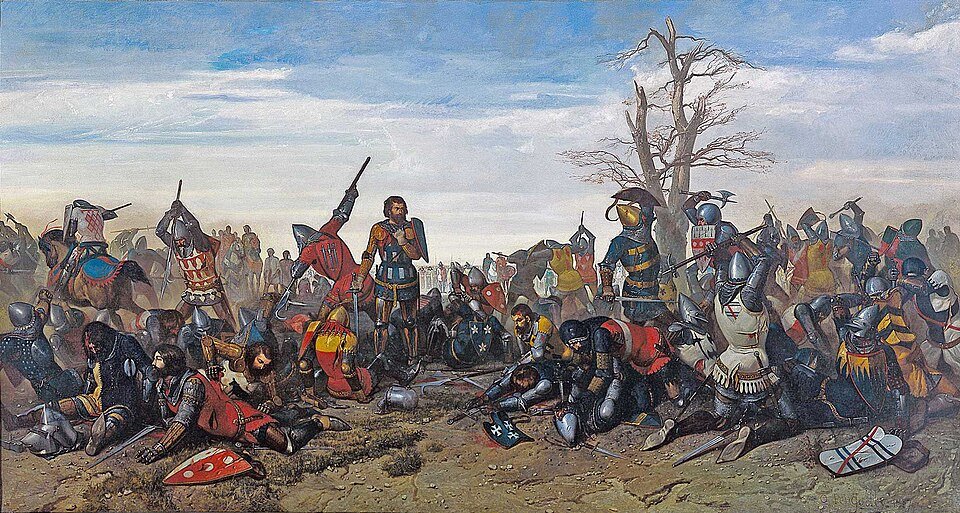
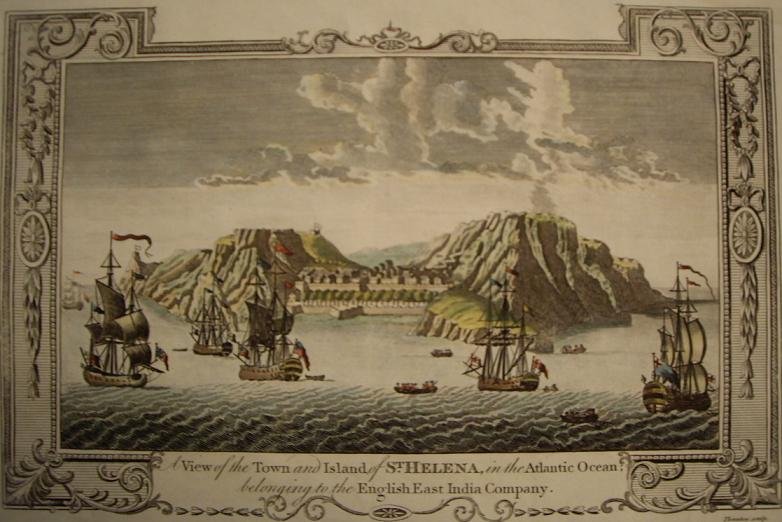
The Battle of the Thirty (1350). By Octave Penguilly L'Haridon. Source: Public domain, available here. 

The Failures at Crécy

In 1346, Edward successfully invaded France in a large-scale campaign known today as the Crécy Campaign. Edward saw it as a chance to press deeper into a France already reeling, striking further into its territories.  At first the campaign was risky for Edward: supplies ran short and morale was low. At the time, Charles of Blois was facing challenges as Edward was still sending in reinforcements to help strengthen the Montfort claim to the Duchy of Brittany.

Charles knew what Edward was about to do and had no choice but to face the fight.  Instead of a war for succession, it was now a fight for the survival of France. Philip VI, the first Valois king of France, saw much of the country fall apart. In 1337, he watched Edward lay claim to the French crown, and knew a reckoning between them was only a matter of time. A few years later, John III, Duke of Brittany, died, causing the War of the Breton Succession. Philip had a chance to win at first, but as the years dragged on, French morale collapsed.  He kept sending in as many men as he could, but the defeats kept coming.

Philip asked Charles for support to defeat Edward, but the risk was considerable. After the French defeat at Crécy, Charles lost hope, and a year later he was captured at La Roche-Derrien.


Charles vs the Hands of the English

In 1347, Charles had one more chance to lay siege to La Roche-Derrien and recapture it — but he was captured in the attempt. The battle showcased the power of the English longbowmen, whose arrows had an effective range of roughly 200m. Longbowmen would prove just as decisive nearly 70 years later at Agincourt. As at Crécy, the French besieging force heavily outnumbered the English relief force, yet still suffered the heavier losses.  The French were also backed by Genoese mercenaries, who remained a key part of their forces throughout the Hundred Years’ War. Despite their numbers, the French seemed unable to learn from their repeated defeats. The battle also saw surprise attacks on Charles’ forces by townsfolk armed with axes and swords, who harried his men and the longbowmen alike.

Charles thought he had won after his initial charge succeeded, but the English rallied and turned the battle against him. Charles was taken prisoner — another decisive victory for the English. With Charles gone, Philip’s support in Brittany had collapsed, and the English were closer than ever to securing their claim.

Charles was then held in the Tower of London for years, and little is known for certain about the conditions of his imprisonment. At the time, the Tower served as a central political prison, a royal residence, and a site for coronation ceremonies. The French pope, Innocent VI, was alarmed by the conflict and pressed for a peace treaty.  It allowed both factions to hold part of the territory and maintain an uneasy peace.


At Last Victory

At this time came one of the most famous episodes of medieval chivalry: in 1351, the Combat of the Thirty.  It came to represent the very peak of knighthood and honor. Both sides had thirty knights each, and the French were led by Marshal of Brittany, Jean de Beaumanoir, and for the English, Robert Bemborough. It was part duel, part military exercise — not simply a show for entertainment. The arrangements were straightforward: Jean challenged Robert to a fight, and both men accepted.

The fight itself lasted only a few hours, with four French knights and two English dead by the time of a short break. Bemborough was killed soon after, followed by several more of his knights. The English were surrounded and defeated, securing a French victory that underscored the era’s ideals of chivalry. The casualties were nine dead for the English vs six for the French. Unlike a typical battle of the period, it was remembered above all as a display of chivalric ideals. Chroniclers such as Jean Froissart cited the encounter as an example of chivalry itself.

Though the Combat of the Thirty had little effect on the war itself, Edward signed the Treaty of Westminster in 1353, formally recognizing Charles as the rightful Duke of Brittany — though this recognition proved short-lived. If Charles could pay a large ransom and forge an alliance with England, the arrangement would hold. Edward also wanted the young John of Montfort to marry his daughter Mary, though this required approval from both the Papacy and France. Amid the struggles, the treaty was never enacted, and Charles was freed and returned as the rightful duke.

This moment in history raises many questions, but it also offers lessons. Edward was now in his early forties and physically weakening, but his mind remained fixed on the prize. The English enjoyed strong support on both sides of the Channel, which helps explain Edward’s deep investment in the treaty. Charles became a political pawn after his capture — and so, in a sense, did France, which faced its own struggle for power.

How could France decide its own fate now? With Charles restored to his rightful duchy, peace settled over Brittany — but not for long. Ten years later, a new claim to the duchy would rise, asking the same question all over again.


Now read the final part in the series on how the war ended here.


Bibliography

GRAHAM-GOERING, E. (2021). Princely power in late medieval France: Jeanne de Penthievre and the war for Brittany. CAMBRIDGE UNIV PRESS.

Sumption, J. (1991). The Hundred Years' War. University of Pennsylvania Press.

By the time Catherine Parr became the sixth wife of Henry VIII in July 1543, England had endured more than three decades of political upheaval, religious revolution, and dynastic uncertainty. The women who had preceded her had experienced exile, disgrace, execution, and death in childbirth. Catherine entered a royal court haunted by the memories of Catherine of Aragon, Anne Boleyn, Jane Seymour, Anne of Cleves, and Catherine Howard. Unlike any of them, however, she would survive the king. Her story is not merely one of personal endurance but of intellectual achievement, religious influence, and political skill. As the final chapter in Henry VIII's tumultuous marital history, Catherine Parr's life provides a fitting conclusion to a saga that transformed England forever.

Terry Bailey explains.

Read part 1 on King Henry VIII here, part 2 on Catherine of Aragon here, part 3 on Anne Boleyn here, part 4 on Jane Seymour here, part 5 on Anne of Cleves here, and part 6 on Catherine Howard here.

Catherine Parr, attributed to Master John. Source: Public domain, available here.

Catherine Parr was born around 1512 into a respected northern gentry family closely connected to the royal court. Unlike many noblewomen of her age, she received an unusually broad education. She became proficient in several languages, including French and Latin, and developed a lifelong passion for learning. Humanist ideas, which had spread throughout Europe during the Renaissance, influenced her thinking and fostered an interest in theology, literature, and religious reform. Her education distinguished her from most Tudor women and would later make her one of the most intellectually accomplished queens England had ever known.

Before becoming queen, Catherine had already experienced much of life's complexity. She was married first to Sir Edward Burgh, who died after only a few years of marriage. Her second husband, John Neville, Lord Latimer, was considerably older and placed her in the midst of the political and religious tensions that marked northern England. During the Pilgrimage of Grace, the great Catholic uprising against Henry VIII's religious policies, rebels held Catherine and her stepchildren hostage while Lord Latimer was absent. The experience exposed her to the dangers of political instability and strengthened her understanding of the consequences of religious conflict. Following Latimer's death in 1543, Catherine attracted several suitors, including the ambitious Thomas Seymour. Yet circumstances—and the king's interest—would alter her future dramatically.

When Henry VIII proposed marriage, Catherine understood both the honor and the risks involved. The king was no longer the athletic and charismatic prince who had captivated Europe in his youth. He was aging, obese, frequently in pain from chronic leg ulcers, and increasingly suspicious of those around him. Yet Catherine accepted the proposal, likely recognizing both her duty and the opportunity to influence the kingdom's future. Their marriage took place at Hampton Court Palace on the 12th of July, 1543.

As queen, Catherine demonstrated remarkable political skill. She understood that survival required caution, diplomacy, and an ability to navigate competing factions at court. Unlike Anne Boleyn, whose rise had been closely linked to religious reform, Catherine pursued her beliefs with greater subtlety. She worked to reconcile divisions within the royal family, helping restore positive relationships between Henry and his daughters Mary and Elizabeth. Through her influence, both princesses were returned to the line of succession, a decision that would have profound consequences for English history.

Catherine's greatest political achievement came in 1544 when Henry departed for France on a military campaign. During his absence, he appointed her regent of England, entrusting her with significant governmental authority. The appointment reflected an extraordinary degree of confidence. As regent, Catherine oversaw the administration of the kingdom, signed official proclamations, managed finances, and coordinated preparations against a potential Scottish invasion. Her performance demonstrated that a woman could successfully exercise political authority at the highest level of government, even within a society that largely excluded women from formal power.

Her regency highlighted one of the central themes running throughout the story of Henry's six wives: the relationship between power and gender in Tudor England. Again and again, Henry's queens found themselves navigating a system designed by men yet dependent upon women to secure dynastic stability. Catherine Parr's success showed that women could exercise authority effectively when given the opportunity, although such opportunities remained rare and precarious.

Religion, another recurring theme throughout Henry's reign, played a crucial role in Catherine's life. By the 1540s, England's religious transformation remained incomplete. Henry had broken with Rome and established royal supremacy over the Church, yet many traditional Catholic practices remained intact. Catherine increasingly sympathized with Protestant reformers who sought further changes. She encouraged the reading of scripture, sponsored religious discussion, and surrounded herself with scholars who supported reformist ideas.

Unlike her predecessors, Catherine was also an author. She became the first English queen to publish works under her own name. Her devotional writings reflected both her personal faith and the growing influence of Protestant thought. Through books such as Prayers or Meditations and later The Lamentation of a Sinner, she contributed to the spread of religious ideas during a critical period in England's spiritual transformation.

Yet Catherine's religious interests nearly proved fatal. Conservative opponents at court, alarmed by her reformist sympathies, sought to undermine her position. They convinced Henry that the queen's theological discussions bordered on heresy. In 1546, an arrest warrant was reportedly prepared, and Catherine suddenly found herself facing a danger familiar to several of Henry's previous wives.

Her response revealed the political intelligence that had enabled her survival. Learning of the king's displeasure, Catherine approached Henry with humility and tact. She explained that their theological debates had never been intended to challenge his authority but merely to distract him from his physical suffering and allow him to display his superior knowledge. Henry, pleased by her submission and perhaps genuinely reassured, accepted her explanation. When officials later arrived to arrest her, the king angrily dismissed them. Catherine had narrowly escaped the fate that had consumed Anne Boleyn and Catherine Howard.

The incident illustrates the continuing intersection of marriage and politics within the Tudor court. Henry's queens were never simply wives. Their relationships with the king carried profound political, religious, and national consequences. Catherine's ability to survive where others had fallen reflected not only good fortune but a sophisticated understanding of power and personality.

By the final years of Henry's life, Catherine had effectively become both wife and nurse. The king's health deteriorated steadily, and his once formidable energy faded. Catherine provided companionship and care during a period marked by physical decline and growing isolation. Her experience offered a striking contrast to the youthful romance that had characterized Henry's early marriages. The king who had once dazzled Europe now depended increasingly upon the support of the woman who would become his final queen.

Henry VIII died on the 28th of January, 1547. After years of political danger, Catherine Parr had achieved what none of her predecessors except Anne of Cleves had managed: she survived her marriage to the king. Yet her story did not end there. Freed from her royal obligations, she quickly married her long-time admirer Thomas Seymour. The marriage, however, proved less happy than she may have hoped. Seymour's ambition and questionable conduct created tensions within the household, particularly concerning the young Princess Elizabeth.

In 1548, Catherine became pregnant for the first time. At approximately thirty-six years of age, she gave birth to a daughter, Mary Seymour. Tragically, complications followed. Like Jane Seymour before her, Catherine died from puerperal fever shortly after childbirth. The woman who had survived Henry VIII ultimately succumbed to one of the era's most common dangers.

Despite her relatively brief period as queen, Catherine Parr's legacy was immense. Her influence upon Elizabeth was especially significant. Through her encouragement of education, learning, and religious inquiry, she helped shape the intellectual development of the future queen. Elizabeth would later become one of England's most successful monarchs, and many historians see Catherine's household as an important influence on her formation.

Catherine also left a lasting mark on England's religious development. Her support for reform helped sustain Protestant ideas during a transitional period, contributing to changes that would accelerate under Edward VI and become firmly established during Elizabeth's reign. In this sense, religion remained both a cause and consequence of the events surrounding Henry's marriages, just as it had throughout the series.

Looking across the lives of all six wives, Catherine Parr serves as a fitting conclusion to the story. Catherine of Aragonrepresented the old medieval order and the international power of Catholic Europe. Anne Boleyn helped trigger the English Reformation. Jane Seymour secured the long-awaited male heir. Anne of Cleves demonstrated the realities of international diplomacy. Catherine Howard exposed the dangers of youth and courtly intrigue. Catherine Parr brought together the lessons of all who came before her, combining intelligence, caution, political skill, and resilience.

Her story also mirrors the evolution of Henry VIII himself. The young king who had sought glory, romance, and dynastic certainty became an aging monarch preoccupied with control, security, and legacy. Through six marriages, England witnessed not only the transformation of a king but also the emergence of a new political and religious order.

The long-term impact upon the English monarchy was profound. Henry's marital decisions reshaped the succession, altered England's relationship with Europe, transformed the national church, and redefined the powers of the crown. Catherine Parr helped ensure that the next generation of Tudor rulers inherited not only a kingdom but also the educational and intellectual foundations necessary to govern it.

In the end, Catherine Parr earned a unique place in history. She was not the most famous of Henry's wives, nor the most controversial, but she was perhaps the most accomplished. Scholar, author, regent, reformer, queen, and survivor, she stands as one of the most remarkable women of the Tudor age. Her life provides a powerful final chapter in the extraordinary story of Henry VIII and the six women whose marriages shaped the destiny of England.

Needless to say, in many respects, Catherine Parr's life encapsulates the triumphs, tragedies, and transformations that defined the Tudor age. She entered Henry VIII's court at a moment when England stood at a crossroads, shaped by decades of dynastic uncertainty, religious upheaval, and political change. Through intelligence, education, diplomacy, and remarkable personal resilience, she succeeded where so many before her had failed. Yet her significance extends far beyond the simple fact that she survived her marriage to Henry. Catherine emerged as one of the most influential and accomplished women of sixteenth-century England, leaving a legacy that would resonate long after her death.

As the final wife of Henry VIII, Catherine served not only as queen but also as mediator, counsellor, regent, scholar, and reformer. She helped restore unity within the fractured royal family, supported the education of the future rulers of England, and demonstrated that a woman could exercise authority with competence and wisdom at the highest levels of government. Her regency during Henry's absence in France remains one of the clearest examples of female political leadership in Tudor England, while her published writings established her as a pioneering voice in English religious and intellectual life.

The story of Catherine Parr also highlights the extraordinary challenges faced by women in positions of power during the sixteenth century. Throughout Henry's reign, each queen was expected to fulfil multiple roles simultaneously: wife, political partner, dynastic safeguard, and symbol of royal legitimacy. Success in one area offered no guarantee of security in another. Catherine understood these dangers better than anyone. Her survival was not merely the result of fortune but of careful judgement, emotional intelligence, and an acute understanding of the volatile court in which she lived. She recognized that influence often depended not on confrontation but on persuasion, patience, and strategic restraint.

Viewed within the broader narrative of Henry VIII's six marriages, Catherine Parr represents the culmination of a remarkable historical journey. Each queen contributed in some way to the remaking of England. Catherine of Aragon embodied the old order of Catholic Europe; Anne Boleyn helped unleash the forces of religious revolution; Jane Seymour secured the Tudor succession; Anne of Cleves reflected the complexities of international diplomacy; and Catherine Howard revealed the dangers of courtly ambition and youthful indiscretion. Catherine Parr inherited the lessons of all these experiences and, through her actions, helped guide England toward the future that would emerge under Edward VI and Elizabeth I.

Her influence upon Elizabeth in particular cannot be overstated. The future queen's love of learning, intellectual confidence, and commitment to religious moderation were nurtured within an environment that Catherine helped develop. Through education and example, she contributed to the formation of a monarch whose reign would later be celebrated as one of the greatest in English history. In this sense, Catherine's legacy extended well beyond her own lifetime, shaping the character of the Elizabethan age and the development of England as a Protestant kingdom.

The wider story of Henry VIII and his six wives remains one of the most compelling narratives in British history because it is about far more than marriage. It is a story of power, faith, ambition, survival, and national transformation. Through these six unions, England experienced a break with Rome, the emergence of royal supremacy, repeated succession crises, and profound changes in the relationship between crown, church, and people. The personal lives of the king and his queens became inseparable from the destiny of the nation itself.

Catherine Parr stands as a symbol of endurance amid uncertainty and wisdom amid turmoil. She witnessed the final years of one of history's most famous monarchs and helped shape the world that followed him. Scholar, regent, author, reformer, stepmother, and queen, she embodied many of the finest qualities of the Renaissance while navigating one of the most dangerous political environments in Europe. Her life reminds us that history is often shaped not only by kings and battles but also by those whose intellect, courage, and perseverance quietly influence the course of events.

The story of Henry VIII's six wives is ultimately the story of England's transformation from a medieval kingdom into a nation entering the modern age. Among those six remarkable women, Catherine Parr occupies a distinctive place—not because she was the last, but because she helped ensure that the legacy of the Tudor dynasty would endure. Through her influence on religion, education, government, and the next generation of rulers, she became far more than Henry VIII's final queen. She became one of the architects of England's future.


If you enjoyed this series and would like to say ‘thank you’ and help us with site running costs, please consider donating here.

Now read about the alleged secret seventh wife of Henry VIII here.

Posted
AuthorHistory Is Now Magazine
CategoriesBlog Post

Keeping a watchful eye over Philadelphia for nearly 255 years — Fort Mifflin is much more than just a decaying structure overlooking the Delaware River. It’s the site of Philadelphia bravery during the American Revolution — and its faded white masonry walls still bear the battle scars of American Freedom from 1777 — just as the unearthed cell (Casemate #11) found in 2006 and believed to encapsulate both graffiti as well as a coin and wine bottle from the Civil War.

Michael Thomas Leibrandt explains.

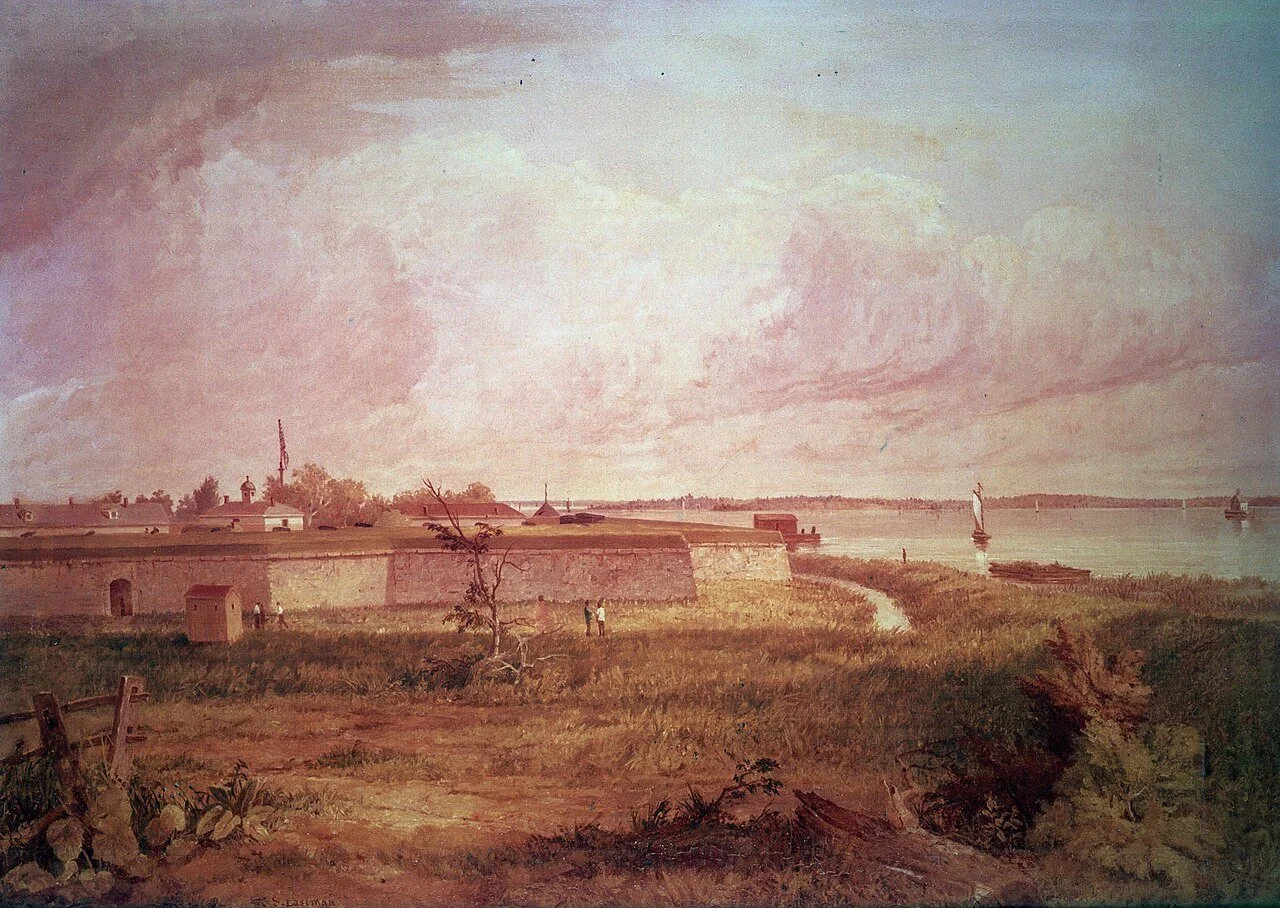
Fort Mifflin by Seth Eastman. Source: Public domain, available here.

If you want to see the true measure of the humble beginnings of American democracy and resolve — visit Independence Hall. If you want to see military determination and heroism in the face of nearly insurmountable odds in order to defend the Delaware River— then visit Fort Mifflin. And that very heroism — may have saved General George Washington’s Continental Army.

First constructed on Deep Water Island in the Delaware River in 1771 — Fort Mifflin was originally named Fort Mud at the time of the American Revolution. The British — after defeating Washington’s Army at the Battle of Brandywine in 1777 — may have captured Philadelphia with hardly a shot fired. But at Fort Mifflin — they found an unyielding resistance.

Some four hundred American soldiers had entrenched in Fort Mifflin — hampering British efforts for control of the Delaware. From his headquarters in Philadelphia — General Howe ordered the British fleet up the Delaware River to supply his army in Philadelphia. The resistance of those brave four hundred Patriots from within the Fort was challenged by what is considered to be the largest cannonade in all of the American Revolution — culminating with a massive bombardment on November 10th of 1777. Under the cover of darkness each night — French Major Francois de Fleury oversaw repairs to the Fort.

With only ten cannon left to defend the Fort — Commanding officer Major Thayer and his men abandoned Mifflin on November 15th — famously setting the fort ablaze in the night sky with the American Flag still fluttering in the darkness. The result of the efforts of those Americans in Fort Mifflin who defended against the British — Washington’s Continental Army was able to make it to winter encampment at Valley Forge.

The British would hold the Fort until their retreat from Philadelphia in June 1778. After the Revolution — Fort Mud was actually rebuilt and in 1795 — it was renamed after Continental Army Officer and Pennsylvania Governor (Thomas) Mifflin. When repairs to Mifflin were finally complete in 1863 — it actually held Confederate prisoners — including a significant number from the Battle of Gettysburg from across the state. The Fort actually endured a prisoner rebellion in 1863 and an ultimately doomed tunnel escape in 1864 also by inmates. One prisoner was even executed there in 1864.

Fort Mifflin’s role was a bit different during the First and Second World Wars. Funds were allocated for the repair of Fort Mifflin and a railroad was constructed which would serve to connect Fort Mifflin to both of the Depots of the Army Corps of Engineers Depot and the Naval Ammunition.

The Army declared the site as a (national) historical monument in 1915 and finally decommissioned it in 1954. Threeyears ago — a replica cannon was stolen from Fort Mifflin’s 14-foot exterior wall. Ownership of Fort Mifflin was transferred to the city of Philadelphia in 1962.

Today — visitors can still see Fort Mifflin for themselves for nearly ten months of the year. Tours are available, events are scheduled regularly during certain months, and weekends even have a ceremonial cannon firing at Philadelphia’s aging Fort from a bygone era being celebrated around America this year. For Philadelphia — Fort Mifflin means a lot more than just that.


Michael Thomas Leibrandt lives and works in Abington Township, PA.

Posted
AuthorHistory Is Now Magazine
CategoriesBlog Post

The War of the Breton Succession, or Breton War of Succession (1341–1365), was a war over the succession to the dukes of Brittany, in north-western France, that lasted for over twenty years. The war was a major conflict in the long Hundred Years’ War, which drove both France and England into a fight for survival and a contest for supremacy in Western Europe. Talia Bega explains — and look at French struggles in Crécy.

Part 1 on the origins of the war is here, and part 2 on the rise of the English is here, and part 3 on the rise of the English here.

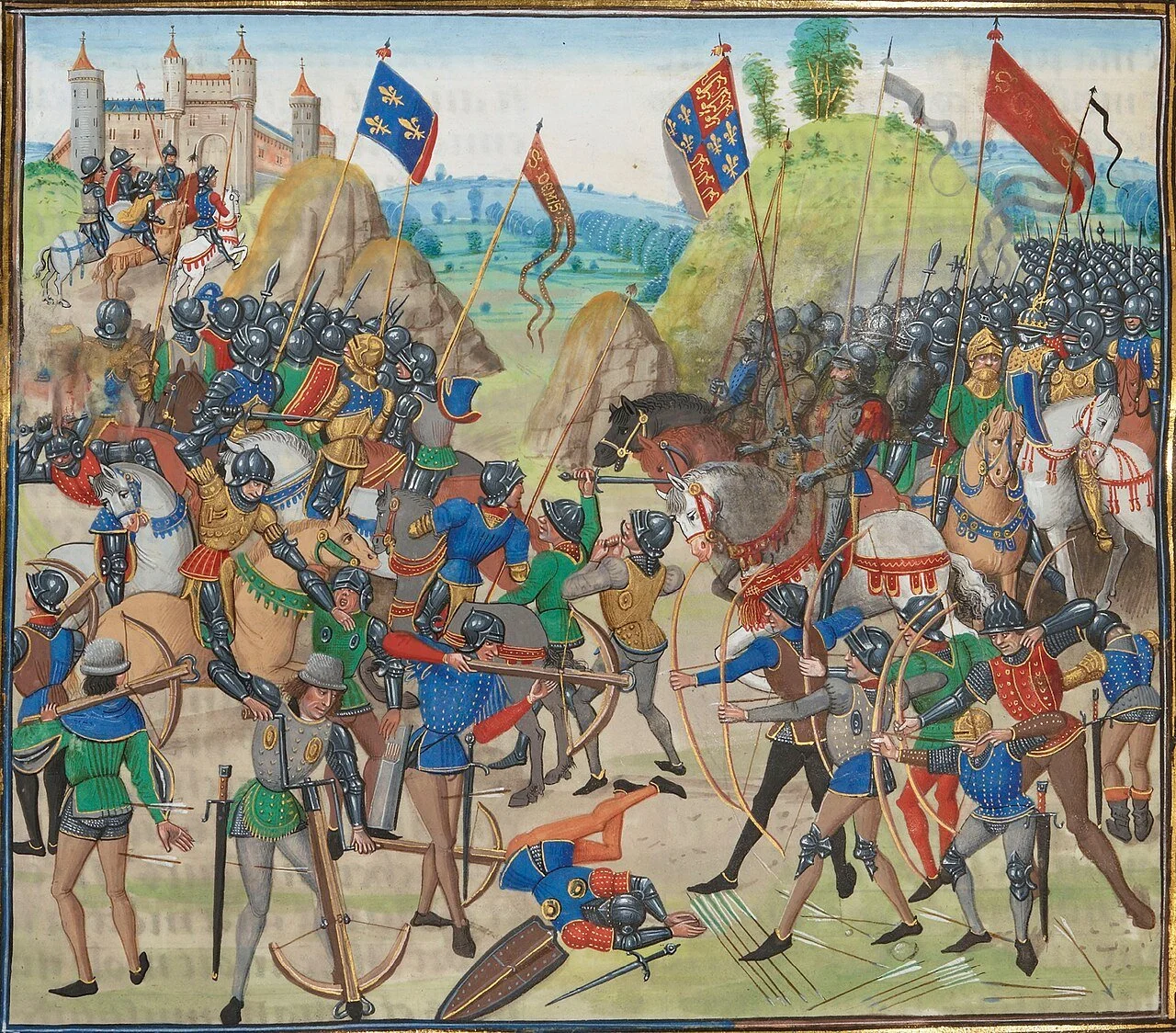
Battle of Crécy. From an illuminated manuscript of Jean Froissart's Chronicles. Source: Public domain, available here.

A Lost Tide

The effects of the Truce of Malestroit challenged the French about whether the world really supported the English cause in France. Signed on January 19, 1343, the truce paused the war until September 1346 and allowed the English to make gains in France, as the treaty was signed in favor of the English. The monarchs did not meet in person as the treaty itself was signed by the Papal legates who mediated between the two crowns. However, the truce did not last long as Edward III was planning something larger, what would become known as the Crécy campaign.  Edward also saw that after John, the Duke of Montfort, was released, Charles fought on, which angered Edward further.

In 1344, Charles led a siege in the town of Quimper, in south-western Brittany, which fell shortly after a one-month siege. An estimated 2,000 citizens were killed, and a few hundred English prisoners were captured. John, even though he was in his late 40s, had lost the drive he once had, and fled to England. Edward saw this as a chance to break the truce and sent a large force into Brittany with John to check Charles’ advance.  The forces were also led by the Earl of Northampton, who helped John get a victory in Central Brittany that defeated Charles of Blois at Cadoret.

Charles and John were locked in another back-and-forth, with John now looking as though he might be the rightful heir after all.  As king, Edward had to raise heavy taxes to fund these campaigns, but this tax raise was largely deferred, since he was already struggling with mounting debt.  John tried to recapture Quimper, but died shortly after in September, ending his long struggle for the duchy.

His death shocked many, since he had been the central figure in the dispute, and it plunged the conflict into fresh chaos. Charles now held the upper hand as duke, but the English were far from finished.  This also helps explain why Edward broke off the truce: he could see that John was already losing. Crucially, the war had now become a land campaign, with Edward using Breton territory as a springboard to invade France on a far larger scale. He understood the stakes: at heart this remained a succession crisis, not merely another campaign.

The new heir was the 6-year-old John, and his family could only wait for the right moment to intervene and weigh what best served them. Edward’s Gascon campaign would continue to ravage France and inflict humiliating losses on the French leadership. Brittany descended into chaos as English forces used the sea lanes to bring in supplies as fast as ever, sustaining their large-scale offensives in the Gascon region. 


The Crécy Campaign

After the fighting resumed in 1345, Edward wanted far more, sensing that a decisive victory was within reach. The truce was meant to last until 1346, but neither side honored it, least of all Edward. It would prove one of the most humiliating defeats the French suffered on their own soil. The brutal campaign saw Edward overrun much of northern France, bringing him a step closer to Paris.

The campaign began with an invasion of Normandy in the summer of 1346, designed to lay waste to the countryside. It came a year after Edward’s victorious Gascon campaign, which had inflicted a heavy defeat on the French in their own lands. For France, Philip VI had to borrow heavily from the papacy to keep France from falling to the English. Edward, by contrast, won strong backing from Parliament, which approved the invasion and the taxes needed to fund it.

The French again employed Italian mercenaries, especially Genoese crossbowmen, while the English drew support from the Flemish and the Holy Roman Empire.  The French suffered a humiliating defeat at Caen, but English casualties were also beginning to mount. One problem for Edward during this campaign was not only these losses but also supply, which grew into a serious difficulty for an army of such size. The French also shrewdly denied the English supplies, making it harder for them to advance. 

One of the most famous battles was at Crécy, which resulted in heavy French losses. It was also the battle in which the sixteen-year-old Edward, the Black Prince, won his first victory. The fighting was grueling, with both sides locked in a hard struggle until the French were broken. Casualties were heavy: the French lost many thousands, while the English lost only a few hundred. It was a humiliation: the French had the larger army yet were routed, raising hard questions about their leadership. In 1347, after a brutal siege, Calais fell to the English, who held it until 1558. With everything collapsing around them, the French even turned to Scotland, England’s old enemy, for support. That hope collapsed when the Scottish king was captured by the English at Neville’s Cross.

The campaign was a deep embarrassment for France — not only because so large an army had been defeated, but because of how that defeat came about, especially against an English force that seemed to have a clear plan. Edward was well prepared and widely supported; the French, by contrast, were in disarray, already stretched by the war in Brittany. How could France lose, even under Philip’s hands, having lost so much support, even from his own court? Despite these failures, the Truce of Calais was signed in 1347, halting the war for some time, helped in part by the Black Death that struck around 1348. The truce held for some time, surviving the death of Philip in 1350 and the accession of his son as John II.


What Now?

The Crécy campaign is closely bound up with the Breton War of Succession, since both formed part of the wider Hundred Years’ War. France’s defeats shaped much of Brittany’s future, especially now that Edward controlled so much of this territory. Many questions about the campaign remain, but much of the outcome can be put down to France’s financial crisis, poor morale, and weak planning. Charles faced a mounting problem, especially after Crécy: how could he hold on if England held all the cards?


Now read part 45on how the French started to turn the tide (somewhat) here.


Bibliography

GRAHAM-GOERING, E. (2021). Princely power in late medieval France: Jeanne de Penthievre and the war for Brittany. CAMBRIDGE UNIV PRESS.

Sumption, J. (1991). The Hundred Years' War. University of Pennsylvania Press.

For Henry VIII, the years following the death of Jane Seymour marked a period of increasing uncertainty. The king who had once dazzled Europe as a vigorous Renaissance prince was now entering middle age, burdened by ill health, political anxieties, and the growing consequences of the religious revolution he had unleashed. His brief and disastrous marriage to Anne of Cleves had ended in embarrassment, but it also opened the way for a new queen. Into this atmosphere stepped Catherine Howard, a young woman whose beauty and vivacity seemed to offer Henry a glimpse of his lost youth. Yet her rise from obscurity to the throne of England would end not in triumph, but in one of the most tragic episodes of Tudor history.

Read part 1 on King Henry VIII here, part 2 on Catherine of Aragon here, part 3 on Anne Boleyn here, and part 4 on Jane Seymour here.

Unknown woman engraved as Catherine Howard, 1797, by Francesco Bartolozzi after Hans Holbein. Public domain, available here.

Catherine Howard was born into one of the most powerful noble families in England. She belonged to the influential Howard dynasty, headed by the powerful Thomas Howard, one of the kingdom's most prominent aristocrats. The Howards were deeply conservative in religion and had watched with concern as the Reformation transformed England under Henry's rule. Through Catherine, they saw an opportunity to restore their influence at court and strengthen the position of traditional Catholic interests. Yet despite her prestigious lineage, Catherine's childhood was far from privileged. Raised largely in the household of her step-grandmother, the Dowager Duchess of Norfolk, she received only a limited education and grew up in an environment that lacked the strict supervision expected of young noblewomen. The experiences of her youth would later become central to the accusations that destroyed her.

When Henry first encountered Catherine, he was captivated. She was perhaps in her late teens, while the king was approaching fifty and suffering from chronic health problems, including the painful leg ulcers that increasingly limited his mobility. Contemporary observers described Catherine as attractive, cheerful, and energetic. To Henry, she represented a refreshing contrast to the politically arranged marriage with Anne of Cleves. Their wedding took place in July 1540, only weeks after Anne's marriage had been annulled. The speed of the union reflected both Henry's infatuation and the determination of the Howard faction to place one of their own at the center of royal power.

The marriage initially appeared to bring new life to the aging monarch. Henry lavished gifts and affection upon his young queen, referring to her as his "rose without a thorn." Foreign ambassadors noted the king's obvious devotion and remarked upon the renewed enthusiasm he displayed in court ceremonies and entertainments. For a brief period, Catherine seemed to embody the ideal Tudor queen: youthful, charming, and capable of providing emotional comfort to a ruler increasingly isolated by age and authority. Yet beneath the glittering surface of court life lay dangerous tensions that would soon erupt into scandal.

The Tudor court was a place where personal relationships and political ambitions were inseparable. Every conversation, friendship, and romantic attachment could have political consequences. Catherine entered this world with little preparation. Unlike her predecessors, she lacked extensive education and political experience. Her youth and inexperience left her vulnerable to manipulation by those around her, while the immense scrutiny directed toward a queen made every aspect of her past a matter of state concern.

Rumors began to circulate concerning Catherine's conduct before her marriage to Henry. Investigations revealed previous intimate relationships, most notably with her music teacher, Henry Manox, and later with Francis Dereham. In modern terms, these relationships occurred before she became queen and might have attracted little attention. In Tudor England, however, such matters carried enormous significance. Questions arose regarding whether Catherine had entered into a pre-contract of marriage with Dereham, a circumstance that could potentially invalidate her marriage to the king. What might otherwise have remained private indiscretions became political weapons in a court where rivals constantly sought opportunities to weaken one another.

The situation became even more dangerous when allegations emerged concerning Catherine's conduct after becoming queen. Attention focused on her relationship with Thomas Culpeper, a gentleman of the king's household who enjoyed Henry's trust. Evidence suggested secret meetings between the pair, although the precise nature of their relationship remains debated by historians. Whether the relationship was romantic, emotional, or physically intimate, the appearance of impropriety alone was devastating. In a monarchy built upon dynastic legitimacy, any suggestion that a queen had been unfaithful threatened not only personal honor but also the stability of the royal succession.

Once the allegations reached the king, events moved rapidly. Henry was reportedly devastated by the accusations. Having endured the failures of multiple marriages, he now faced the possibility that another queen had betrayed him. An extensive investigation followed, conducted with the same determination that had characterized earlier royal inquiries. Witnesses were interrogated, confessions extracted, and evidence assembled. The process reflected both the legal mechanisms of Tudor government and the ruthless realities of court politics. Former acquaintances who might once have protected Catherine instead became liabilities, while political enemies found opportunities to advance their own interests.

Catherine was stripped of her royal status and confined while Parliament prepared legislation enabling her punishment. Unlike Anne Boleyn, whose downfall had involved charges of conspiracy and treason, Catherine's destruction rested upon allegations of sexual misconduct and betrayal of royal trust. Nevertheless, the outcome was equally final. On the 13th of February, 1542, Catherine Howard was executed at the Tower of London. According to later tradition, she declared that she died a queen but would rather have died the wife of Thomas Culpeper, though the authenticity of this statement remains uncertain. What is certain is that she faced death at an age when many young women were only beginning their adult lives.

Catherine Howard's fall illustrates the profound imbalance of power between men and women in Tudor England. Queens occupied positions of immense visibility and influence, yet their security often depended upon standards of behavior that were applied far more harshly to women than to men. A queen's body, reputation, and conduct were considered matters of national importance because they were directly linked to the legitimacy of future heirs. Catherine's tragedy reveals how little room existed for error within this system and how vulnerable even the highest-ranking women could be when caught in political struggles beyond their control.

Her story also highlights the continuing intersection of marriage and politics that shaped Henry's reign. Just as Catherine of Aragon's marriage had been tied to international diplomacy, Anne Boleyn's to religious transformation, and Anne of Cleves' to foreign alliances, Catherine Howard's marriage reflected factional competition within England itself. The Howard family hoped to secure influence through their young relative, but her downfall instead weakened their position and demonstrated the dangers of tying political fortunes too closely to royal favor.

Religion continued to cast a shadow over events as well. Although Catherine herself played only a limited role in religious debates, her rise occurred during a period of intense struggle between conservative Catholics and reformers at court. Her marriage strengthened conservative hopes, while her destruction removed a figure associated with that faction. The episode demonstrated how religious and political rivalries remained deeply intertwined in the years following England's break with Rome.

For Henry VIII, Catherine's execution marked another stage in his personal transformation. The athletic and charismatic prince who had once sought admiration increasingly ruled through suspicion and fear. Each failed marriage seemed to deepen his mistrust of those around him. The emotional devastation caused by Catherine's alleged betrayal reinforced a growing tendency toward harshness that characterized the later years of his reign. The king who had once pursued love and dynastic security through marriage now appeared increasingly isolated within the very system of power he had created.

The consequences extended beyond Henry's lifetime. The repeated rise and fall of queens during his reign altered perceptions of monarchy and royal authority. Future generations would remember Catherine Howard as a symbol of the dangers lurking behind the splendor of the Tudor court. Her story became a warning about the risks of political ambition, the fragility of favor, and the devastating consequences that could follow personal mistakes in an environment where private lives were inseparable from affairs of state.

Today, Catherine Howard remains one of the most tragic figures among Henry VIII's wives. Unlike Anne Boleyn, she left no enduring political movement, and unlike Catherine of Aragon, she became no symbol of religious resistance. Instead, her legacy rests in the stark contrast between youthful promise and catastrophic downfall. Her brief reign serves as a cautionary tale about power, vulnerability, and innocence confronted by the unforgiving realities of Tudor politics. As Henry's fifth queen, she occupied the throne for only a short time, yet her story continues to illuminate the human cost of a monarchy in which personal relationships could determine the fate of nations.

Needless to say, in many ways, Catherine Howard's story represents the final collapse of the romantic ideals that had once driven Henry VIII's search for marital happiness and dynastic security. What began as a union seemingly founded upon affection and renewed vitality ended in accusation, fear, and death. Her rise and fall exposed the harsh realities of Tudor power, where personal relationships were inseparable from political ambition and where a queen's private life could become a matter of national consequence. Catherine's youth, inexperience, and inability to navigate the dangerous currents of court politics ultimately left her vulnerable in a world that offered little mercy to those who misjudged its rules.

Her tragedy also serves as a powerful lens through which to view the broader themes that defined Henry's reign. The unequal balance of power between men and women, the use of marriage as a political instrument, and the continuing religious tensions unleashed by the English Reformation all converged in her brief queenship. Catherine became both a participant in and a victim of forces far larger than herself, illustrating how individual lives could be shaped—and destroyed—by the ambitions of powerful families, rival court factions, and the demands of monarchy.

For Henry VIII, the loss of Catherine Howard further accelerated the transformation of the king from the charismatic prince of his youth into an aging and increasingly distrustful ruler. The optimism that had accompanied his early marriages had long since faded, replaced by suspicion and disappointment. Catherine's execution deepened the atmosphere of uncertainty that surrounded the later Tudor court and reinforced the perception that proximity to royal power could be as dangerous as it was desirable.

Viewed from the perspective of history, Catherine Howard remains one of the most poignant figures of the Tudor age. She was neither a great political strategist nor a religious reformer, yet her fate continues to resonate because it reflects the human cost of living within one of the most powerful and unforgiving courts in Europe. Her story is a reminder that beneath the splendor of palaces, pageantry, and royal ceremony were individuals whose lives could be irrevocably altered by a single accusation or a shift in political fortune.

As this series approaches its final chapter, Catherine Howard's life stands as a somber turning point in the story of Henry VIII and his queens. The promise of youth and renewal had ended in tragedy, leaving a king more isolated than ever and a kingdom still grappling with the political and religious upheavals of his reign. Yet one marriage remained. Henry's sixth and final queen would bring neither scandal nor execution, but something that had become increasingly rare in the Tudor court: stability. In Catherine Parr, the aging king would find a companion capable of guiding his fractured household through its final years and helping to shape the future of the Tudor dynasty long after Henry himself was gone.


Now, read part 7 on Catherine Parr here.

Posted
AuthorHistory Is Now Magazine
CategoriesBlog Post

By the seventh inning of a baseball game, the ritual is as dependable as a close play at first base. Fans rise, stretch their legs, and sing words that have echoed through grandstands for more than a century: “Take me out to the ball game / Take me out with the crowd…”

It is one of the most recognizable songs in American life, a tune so embedded in the national pastime that it can feel as old as baseball itself. Yet the man who wrote the lyrics, Jack Norworth, remains a fascinating footnote in both sports and entertainment history—a vaudeville performer, prolific songwriter, serial romantic, and a figure forever attached to one of popular culture’s great ironies: the longstanding claim that he wrote baseball’s anthem despite never having attended a game.

Like many good American legends, the truth is a little murkier—and more interesting.

Brian D’Ambrosio explains.

Jack Norworth. Source: Public domain, US Library of Congress, available here.

Jack Norworth was born John Godfrey Knauff on January 5, 1879, in Philadelphia. His family had ties to the theater world, and he gravitated toward performance early in life. As a teenager, he joined vaudeville, the rough-and-tumble entertainment circuit that dominated American popular culture before radio and film transformed the industry.

Vaudeville performers had to do a little of everything—sing, dance, act, improvise, and survive endless travel schedules. Norworth proved adaptable. He became both a performer and lyricist, eventually changing his name because “Jack Norworth” sounded more theatrical and marketable than John Knauff.

By the early 1900s, he was working in New York during the heyday of Tin Pan Alley, the bustling district where songwriters churned out hits for sheet music publishers. This was an era when hit songs traveled not through streaming services or radio playlists, but through family pianos and sheet music sales. A catchy tune could sweep the country.

In 1908, inspiration struck in famously ordinary fashion. According to the most widely repeated story, Norworth was riding a subway train in Manhattan when he noticed a sign advertising a baseball game at the Polo Grounds between the New York Giants and Chicago Cubs. He grabbed an envelope and quickly scribbled lyrics.

The opening chorus became instantly immortal:

Take me out to the ball game/Take me out with the crowd/Buy me some peanuts and Cracker Jack/I don’t care if I never get back.

The song’s lesser-known verses are equally charming—and far less remembered by modern fans. They center on Katie Casey, a young fan thoroughly obsessed with baseball:

Katie Casey was baseball mad/ Had the fever and had it bad.

When her suitor invites her to a show, Katie rejects the idea entirely. She wants baseball.

It was a clever twist for 1908: Katie Casey is portrayed as the true fanatic in the relationship. She understands where she wants to be and what matters.

She also delivers what may be baseball’s most enduring command:

Root, root, root for the home team/If they don’t win it’s a shame.

That line perfectly captures baseball loyalty. Your team may disappoint you repeatedly, but allegiance remains.

Norworth brought in composer Albert Von Tilzer to write the music. Ironically, Von Tilzer reportedly knew little about baseball himself. Together, the pair created a song that neither could have imagined would become permanently stitched into American sporting culture.

The famous claim that Norworth had never attended a baseball game when he wrote the song remains difficult to fully verify. He often admitted he was not a devoted baseball follower at the time, which helped fuel the legend. Later in life, however, he attended games regularly and embraced his connection to the sport.

The song became an immediate success in sheet music form in 1908, but its transformation into a baseball ritual took decades. For many years, it remained simply a popular song among many others.

Its biggest revival came through broadcaster Harry Caray, who famously led fans in singing it during the seventh-inning stretch while calling games for the Chicago White Sox and later the Chicago Cubs. Caray’s exuberant performances helped turn the tune into a permanent stadium tradition nationwide.

Today, the song is inseparable from baseball itself. It echoes through historic venues and modern ballparks alike, sung by generations of fans who may know only the chorus while remaining unaware of Katie Casey altogether.

Norworth’s life extended well beyond one song. He wrote dozens of compositions during his career and remained active in entertainment for decades. He was married several times, most notably to vaudeville star Nora Bayes, one of the era’s most prominent performers. Their marriage was often turbulent and frequently made headlines.

His life reflected the instability and glamour of early show business—equal parts ambition, reinvention, and spectacle.

Norworth died on September 1, 1959, in Laguna Beach, California, at age 80. By then, his place in American cultural history was secure.

What makes “Take Me Out to the Ball Game” endure is not simply its familiarity. The song captures baseball’s atmosphere as much as the game itself: noisy crowds, snack vendors, hope, heartbreak, and the communal optimism that arrives every season.

Baseball has changed dramatically since 1908. Ballparks are larger. Salaries are astronomical. Analytics shape strategy. Rules evolve.

Yet during the seventh inning, everything briefly slows. Fans stand. Voices rise.

And a songwriter who may not have fully understood baseball gave America one of its most lasting traditions.

That may be the most fitting baseball story of all.


You can read about the role of baseball in the US Civil War here.

Brian D'Ambrosio is the author of Montana Eccentrics, New Mexico Eccentrics, and Italian-Americana: Explorers, Entertainers, and Eccentrics. Available here: Amazon US | Amazon UK

​He is currently working on a volume of American Eccentrics: Mavericks, Misfits, and Visionaries.


Sources:

Library of Congress: https://guides.loc.gov/baseball-music/take-me-out-to-the-ball-game

Songwriters Hall of Fame: https://www.songhall.org/profiles/jack-norworth

Various Obituaries, Newspapers.com

Baseball Hall of Fame: https://baseballhall.org/discover/baseballs-anthem-began-as-tin-pan-alley-hit

Posted
AuthorHistory Is Now Magazine

By the mid-1920s, one in six American families owned a car, and the Federal Highway Act of 1921 had funded a national network of roads suitable for automobiles. Europe lagged far behind. Automobiles were still largely a status symbol and even major roads were woefully unsuited for long journeys by car. In the rest of the world, automobiles were rare, and the roads on which to drive them were limited to the areas in and immediately around major cities. Most people in rural India, China, and elsewhere had never seen a car, and the roads they used to get from place to place were suitable only for foot traffic and carts.  But driving became intoxicating for a small number of auto enthusiasts who decided it would be possible to travel the world by car, and both of the serious global circumnavigation efforts in the 1920s involved women who felt born to drive.

Laurel Corona explains.

Laurel has written the book Aloha Wanderwell Takes the Wheel (Amazon US | Amazon UK)

Walter and Aloha Wanderwell with their Ford car. Source: Public domain, "Greetings and Goodbyes" Japan Overseas Travel Magazine 14 (March 1925): 47. Available here.

The Guinness Book of World Records acknowledges that the first woman to drive around the world was Aloha Wanderwell. She was born Idris Hall in Winnipeg in 1906 and spent her childhood in Qualicum Beach, on Vancouver Island, British Columbia. While Idris was in her teens, her mother relocated the family to France, and while in boarding school in Nice, Idris ran across an advertisement Walter “Cap” Wanderwell had put in the local paper for a woman with “Brains, Beauty, and Breeches” to join his around-the-world expedition by automobile. Though only sixteen, Idris got her mother’s permission to join for the short time the expedition would be in France. She changed her name to Aloha Wanderwell and never looked back.

Walter Wanderwell was a pioneer. In addition to his groundbreaking expedition, he was the first to underwrite a travel adventure by making films (in his time still silent and black-and-white) of his travels. At a time when most people did not venture far from their place of birth, audience paid a small admission fee to see his films of faraway parts of the world, while youthful and attractive expedition members hawked brochures and postcards for a little extra cash outside the theaters. Cap was a brilliant, self-taught engineer. Though his cars were called Model Ts, they really were Wanderwell cars. He built the cars using a Model T chassis, relying on Ford parts because Ford had by far the largest distribution around the world and it would make getting parts easier in remote locations. He built them with extra storage for supplies and fuel, and in a later model, a built-in darkroom that could be pulled out on hinges from the trunk to develop their film before they reached their next stop. Construction from aluminum and other lightweight materials made the cars easier to push or drag across inhospitable terrain. This made them painfully bouncy, and the substitution of a tarp for a roof made the journey even more uncomfortable. Most crew quit within a few months from the hardship of the road, but Aloha would continue traveling with Cap for the next decade, eventually marrying him.


Aloha and Walter Wanderwell’s Route Around the World

The route around the world was not meant to be in a straightforward line, and they set no timetable, or even a concrete plan for much of it. In fact, they spend one entire year driving around Europe before setting out for Egypt. After driving the length of Egypt, they went by steamer to India, and she and Cap, now in two cars and without any other crew, drove 1100 miles across India. Teams of oxen dragged them across rivers and marshes, and they battled deserts, monsoons, and nearly impenetrable terrain. From India they went by steamer to Malaysia and after a stop in Singapore they began their drive the length of eastern China. Eventually they arrived in Vladivostok, where Aloha celebrated her eighteenth birthday. They continued on through Japan, Hawaii, and across the United States to Detroit, where the expedition officially ended.


Later Travels

Aloha and Cap went on to travel nearly the entire length of Africa on their “Cape to Cairo” expedition, but were stopped by a murderous civil war in Sudan and ended their African adventure in Mombasa. Next, they undertook another daring expedition in South America, driving from Buenos Aires across the Andes to Lima, where the crew disbanded. Cap and Aloha made the rest of the drive by themselves up through Central America to the United States. It would be their last adventure together. Wanting to try something new, Cap bought a schooner to sail around the world, but in December 1934, an assailant came aboard and killed him. The murder and subsequent trial were the subject of a devastating tabloid frenzy for Aloha, made worse by the insinuations that she was involved, and the shocking acquittal of the obvious suspect. Aloha tried to continue the travel film adventures without Walter, but wasn’t able to adapt to the new technologies of sound and color, and audiences for her personally narrated films waned when she was no longer an ingenue. She married again and settled into a comfortable life in Newport Beach, California, where she died in 1996 shortly before her ninetieth birthday.


Clärenore Stinnes

The other person to lay claim to the title of first woman to drive around the world is Clara Eleonore Stinnes, who went by the name Clärenore. She was the daughter of a wealthy German industrialist, who in her twenties took up auto racing as a hobby. When she began winning shorter races, she decided to enter endurance contests, and in 1925 she became the only woman to win a 2600-kilometer race across western Russia. It was on that race that she decided she wanted to drive around the world. Clärenore had substantial backing for her project, including a cash reserve, a diplomatic passport, two mechanics, a supply truck, and supplies of gasoline and spare parts that were pre-ordered and waiting for her on her scheduled stops along her route. Traveling with her was Carl-Axel Söderström, a Swedish film maker. Their route took them by land across Asia to Beijing. After being stranded for months in the Russian winter, they resumed the drive to Beijing, and returned by ship via Japan, Hawaii, and the United States. Two years after setting out, they returned to Berlin.  Stinnes and Söderström married in 1930, and were done with their world travels, retreating to Sweden, where they bought a farm and raised their children. She lived to be 89, dying in 1990.


The Two Journeys Compared and Contrasted

While the hardships of driving in much of the world were comparable, the logistics were different. Clärenore’s journey was planned out meticulously and well financed. The Wanderwell expedition made its way by raising money on the spot. They had only a general sense of their itinerary and often took side trips when they heard about something out of the way that sounded worth exploring. Clärenore’s itinerary was designed to take her in as straight a route as possible. Clärenore and Aloha’s roles were different as well. Clärenore was clearly in charge of her project, and although the strikingly beautiful Aloha was the star of the Wanderwell expedition, Cap was its undisputed leader. Although Clärenore was quite young, still in her twenties at the time she set out, Aloha was only sixteen when she joined the Wanderwell expedition, and her extreme youth is another differentiating factor.  Aloha and Cap thrived on the fame and attention they received, whereas Clärenore was more focused on succeeding at the task she had set for herself. And of course, a final difference is that when Clärenore succeeded, she was finished. Cap and Aloha went on to travel the world for ten years total, across five continents, before Cap’s murder put an end to their life together.


Who Was First?

The question of whether Aloha or Cläremore deserves acknowledgment as the first woman to complete an around-the-world expedition by automobile has been contentious. At first glance, it would appear that Aloha is the clear winner, because her journey was complete before Clärenore even set out.  However, Clärenore’s journey from Europe to China was entirely by land, and the Wanderwells took freighters from Aden to India and from India to Penang, Malaysia. Because of a civil war in China, one stretch was taken by train for safety. Therefore, Clärenore’s journey was more completely done by car. Some argue, however, that because the oceans make it impossible to drive around the world anyway, the important thing is who got back to their starting point first after driving across every land mass they encountered on whatever route they chose. A semantic argument has arisen as well over what constitutes an expedition. Some argue that because Clärenore’s sole purpose was to drive in as direct a manner as possible around the world, her journey might more properly be called an expedition. The Wanderwells took their time and did so much else along the way that perhaps theirs should be called something else, like a global travel adventure. In fact, in promotional materials for the expedition, Cap gave the dates as “1921-?” Indicating that its purpose went far beyond making the most direct circuit around the globe. Hair splitting aside, the important thing is that the first two successful circumnavigations of the globe both had women at the wheel. Aloha and Clärenore defied the gender expectations of their time and did something thought impossible even for men of their day. Though there is no evidence they ever met, they are clearly kindred spirits who leave behind one of the most fascinating but underappreciated stories in automotive history.


Laurel’s book is out now: Aloha Wanderwell Takes the Wheel (Amazon US | Amazon UK)

In the winter of 1540, the court of Henry VIII once again turned toward marriage, though this time less from passion than from political necessity. England stood in a precarious position within Europe. The break from Rome had transformed the kingdom into a religious outlier, while Catholic powers such as France and the Holy Roman Empire watched England with increasing hostility. The king who had once imagined himself a great Catholic prince now faced diplomatic isolation, and the search for a new queen became inseparable from the survival of the Tudor state itself. Into this atmosphere stepped Anne of Cleves, a German noblewoman whose marriage to Henry represented not romance, but strategy. Her story would become one of the strangest and most revealing episodes of the Tudor age, exposing the fragile intersection of politics, image, gender, and royal power.

Terry Bailey explains.

Read part 1 on King Henry VIII here, part 2 on Catherine of Aragon here, part 3 on Anne Boleyn here, and part 4 on Jane Seymour here.

Anne of Cleves by Hans Holbein the Younger. Source: Public domain, available here.

The marriage negotiations were orchestrated largely by Thomas Cromwell, Henry's chief minister and the architect of many of the English Reformation's most dramatic transformations. Cromwell understood that England required powerful Protestant allies if it hoped to resist the influence of Catholic Europe. The Duchy of Cleves, situated within the politically fractured territories of the Holy Roman Empire, offered precisely such an opportunity. Anne's brother, the Duke of Cleves, belonged to a network of German Protestant princes whose cooperation might provide England with diplomatic security and strengthen the Protestant cause across northern Europe. For Cromwell, the proposed marriage was not merely advantageous; it was essential to the future direction of the English state and religion.

By this stage in Henry's reign, marriage had become an instrument of government. His unions no longer revolved primarily around affection or dynastic fertility alone, but around the broader political needs of the kingdom. The evolution of Henry's character could be seen clearly in this transition. The athletic and charismatic prince who had once dazzled the courts of Europe had become increasingly suspicious, volatile, and physically diminished. Years of political conflict, personal disappointment, and worsening health had hardened him. Yet despite this transformation, Henry still retained a deeply personal expectation from marriage: he wished not only for political advantage but also admiration, obedience, and attraction. The tragedy of Anne of Cleves lay partly in the impossibility of satisfying both the political and emotional demands of such a king.

Before meeting Anne, Henry relied upon the work of Hans Holbein the Younger, the celebrated court painter whose portraits had become essential tools of diplomacy. Holbein was dispatched to Cleves to paint Anne and her sister Amalia, allowing Henry to inspect his prospective bride from afar. The resulting portrait of Anne was elegant, dignified, and carefully composed, presenting her as calm, noble, and attractive. In an age before photography, portraits functioned as instruments of international negotiation, shaping political decisions and royal expectations alike. Holbein's image became one of the most famous paintings in Tudor history because it sat at the center of a disastrous misunderstanding that would alter the fortunes of everyone involved.

When Anne arrived in England in late 1539, Henry was reportedly disappointed upon meeting her in person. Whether his reaction was genuinely one of shock or later exaggerated to justify the collapse of the marriage remains debated by historians. Contemporary accounts were shaped heavily by politics and by Henry's own desire to distance himself from responsibility. Anne, raised in the comparatively modest court culture of Cleves, lacked the polished education and flirtatious sophistication expected within the English court. She spoke little English, possessed limited familiarity with music and courtly games, and entered a royal environment defined by intrigue and performance. Henry, increasingly self-conscious about his age and physical decline, responded with resentment rather than patience.

Their marriage was celebrated in January 1540, yet from the outset it was marked by discomfort and emotional distance. Henry quickly expressed his desire to escape the union, claiming he found Anne unattractive and insisting the marriage had never been consummated. The personal dissatisfaction of the king soon became a matter of state importance. In Tudor England, the body of the monarch could never be separated from politics. A failed marriage threatened diplomatic alliances, succession planning, and the stability of government itself. The annulment proceedings therefore unfolded not merely as a domestic dispute but as an international political crisis.

Anne's response to the situation revealed a remarkable degree of intelligence and pragmatism. Unlike Catherine of Aragon or Anne Boleyn, she chose neither resistance nor confrontation. Instead, she cooperated fully with Henry's wishes. She accepted the annulment on the grounds of non-consummation and acknowledged the legality of the king's previous pre-contract negotiations. In doing so, Anne avoided the catastrophic fates that had consumed several of her predecessors. Her compliance reflected not weakness, but a keen awareness of the dangerous political realities surrounding the Tudor court. Women in Henry's world possessed little formal power, yet survival often depended upon understanding precisely how and when to yield.

The collapse of the marriage destroyed Thomas Cromwell. Henry, humiliated by what he perceived as a failed arrangement, turned his fury against the minister who had engineered the alliance. Cromwell's enemies at court, especially conservative nobles opposed to Protestant reforms, seized their opportunity. Accused of treason and heresy, Cromwell was arrested, condemned, and executed in July 1540. His downfall demonstrated the terrifying volatility of power under Henry VIII. No service, however loyal or transformative, guaranteed safety. Cromwell had helped reshape England politically, administratively, and religiously, yet in the end, he became another casualty of the king's increasingly unpredictable authority.

Religion remained deeply entwined throughout these events. The Cleves marriage had emerged from Protestant diplomacy, while Cromwell's fall strengthened conservative religious factions at court. Yet Henry himself continued to occupy an ambiguous religious position. He had rejected papal supremacy, dissolved the monasteries, and established royal control over the Church of England, but he retained many traditional Catholic beliefs. This ambiguity defined much of the English Reformation during his reign. Religion functioned simultaneously as a matter of conviction, political survival, and royal control. The annulment of Anne's marriage therefore symbolized more than personal failure; it reflected the unstable and often contradictory religious identity of Tudor England itself.

Remarkably, Anne of Cleves adapted successfully to her altered position. Granted a generous settlement by Henry, she received estates, income, and the honorary title of the king's "beloved sister." She lived comfortably in England for the remainder of her life, outliving Henry himself as well as several of his subsequent wives. Freed from the pressures of queenship, she occupied a unique place within the Tudor court: respected, financially secure, and politically safe. In many ways, Anne achieved what none of Henry's other wives fully managed, survival combined with stability.

Her later years also reveal important truths about gender and power within Tudor society. Queens were expected to embody obedience, fertility, grace, and political usefulness simultaneously, yet their positions remained perilously dependent upon the king's favor. Anne's success came not through influence or manipulation, but through adaptability. She recognized the realities of royal authority and navigated them with caution and intelligence. In doing so, she transformed herself from a discarded foreign bride into one of the most secure women in England.

The legacy of Anne of Cleves extends beyond the brief duration of her marriage. Her story illustrates the central role of diplomacy in royal unions and the immense power of image within Renaissance politics. Holbein's portrait became symbolic of the dangers inherent in political expectations shaped by art and propaganda, while the marriage itself demonstrated how rapidly international alliances could rise and collapse around the personal desires of a monarch. At the same time, Anne's fate contrasted sharply with the violence surrounding so many Tudor queens, reminding historians that survival could itself become a form of quiet triumph.

Within the broader narrative of Henry VIII's reign, Anne's chapter marks another stage in the king's transformation. The energetic monarch who once pursued love with reckless passion had become a ruler increasingly governed by suspicion, vanity, and authoritarian power. His marriages no longer promised renewal or romantic ambition; instead, they exposed the instability of a court shaped by fear and political calculation. Yet these unions also permanently altered the English monarchy. Through Henry's marital struggles emerged a redefined relationship between crown, church, and state that would shape England for generations.

Anne of Cleves therefore occupies a unique place in Tudor history. She arrived in England as a diplomatic solution, became the victim of royal disappointment, survived the destruction of powerful men around her, and ultimately secured a peaceful existence within the very court that had once threatened to consume her. Her life reveals that in the dangerous world of Henry VIII, endurance could prove more powerful than ambition, and adaptability more enduring than passion.

In the final assessment of Anne of Cleves and her brief marriage to Henry VIII, what emerges most clearly is not failure, but revelation. Her story exposed the fragile foundations upon which Tudor power so often rested: dynastic ambition, diplomatic necessity, religious uncertainty, and the dangerous unpredictability of royal favor. Though her queenship lasted only a matter of months, the consequences of the marriage reverberated far beyond the annulment itself, reshaping political alliances, destroying one of the most powerful ministers in English history, and further revealing the increasingly unstable nature of Henry's court during the later years of his reign.

Anne's experience also illuminates the wider realities faced by women within Tudor England. Queens were expected to fulfil impossible expectations, serving simultaneously as political symbols, dynastic instruments, obedient wives, and embodiments of royal magnificence. Yet despite occupying the highest female position in the kingdom, their security remained entirely dependent upon the king's satisfaction. Anne of Cleves survived because she understood these realities with unusual clarity. Rather than allowing pride or resistance to destroy her, she adapted to circumstances that had already consumed others. In doing so, she demonstrated a quiet but formidable resilience that distinguished her from nearly every other woman connected to Henry VIII.

The political dimensions of her marriage further reflected the transformation of England itself during the Reformation. The alliance with Cleves had been conceived as part of a broader Protestant strategy designed to protect England from Catholic hostility abroad. Its collapse revealed how deeply personal desire and political calculation had become intertwined within the Tudor monarchy. Henry's private dissatisfaction carried international consequences, while the downfall of Thomas Cromwell illustrated how swiftly religious and political fortunes could shift within an atmosphere dominated by fear, factionalism, and royal absolutism. Religion during Henry's reign remained neither entirely Protestant nor wholly Catholic, but a volatile mixture shaped largely by the king's own changing priorities and insecurities.

Anne's legacy also speaks to the growing importance of image and perception in Renaissance politics. The famous portrait by Hans Holbein the Younger became far more than a work of art; it symbolized the immense power of representation in an age where diplomacy often depended upon carefully constructed appearances. The controversy surrounding the portrait reflected the dangers of political expectation, but it also revealed the increasingly theatrical nature of the monarchy itself. Tudor power relied not only upon armies and laws, but upon spectacle, symbolism, and the cultivation of royal authority through image and performance.

Within the broader narrative of Henry VIII's six marriages, Anne of Cleves occupies a uniquely paradoxical place. She was neither crowned in triumph like Catherine of Aragon, nor destroyed like Anne Boleyn or Catherine Howard. Instead, she quietly endured. In many respects, hers became the most successful outcome possible within the perilous environment of Henry's court. By surviving, maintaining dignity, and securing independence, Anne achieved a form of victory rarely available to Tudor queens.

Ultimately, the story of Anne of Cleves serves as both a personal and political mirror of Henry VIII's later reign. It reveals a king who had evolved from the celebrated Renaissance prince of his youth into a ruler increasingly isolated by power, suspicion, and vanity. His marriages had become reflections of England's own transformation, where religion, politics, and personal authority collided with consequences that would shape the monarchy for generations. Yet amid this turbulence, Anne's calm pragmatism and remarkable survival ensured that her legacy would endure not as a tragic victim of Tudor politics, but as one of its most perceptive and resilient survivors.


Now, read part 6 about Catherine Howard here.

Posted
AuthorHistory Is Now Magazine
CategoriesBlog Post