In the nineteenth century, Mr. Peter Doxtater pursued a claim that reached back to one of the darkest (and still discussed to this day) episodes in Pennsylvania's colonial history. He argued that descendants of the Conestoga people retained rights to land in Manor Township, Lancaster County, despite the passage of more than eighty years since the massacre that had devastated their community. The land had long since become part of a landscape of private ownership, and the federal government did not recognize the former reservation as an existing Native landholding. Doxtater nevertheless continued his campaign, seeking to establish that the destruction of the Conestoga settlement had not extinguished the rights of its descendants.
His efforts took him from a land claim begun in 1845 to negotiations with a Lancaster attorney, correspondence with federal officials, and a congressional resolution introduced in 1872. None secured the return of the original reservation. Yet the surviving records preserve an important chapter in the aftermath of the massacre - the efforts of descendants to establish their connection to their ancestors and recover land they believed had never been lawfully surrendered.
Eric Schubert explains.
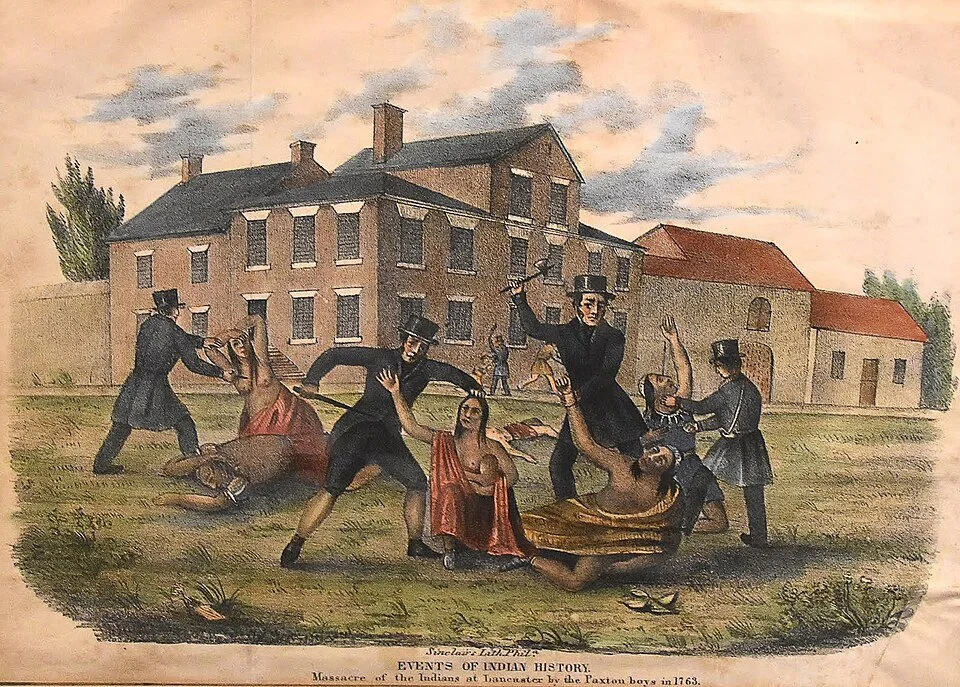
19th century lithograph of the Paxton Boys' massacre of the Conestoga in Lancaster, Pennsylvania. Source; Public domain, lithograph, available here.
The Conestoga and Their Land
The Conestoga were an Indigenous people associated with the Susquehanna River and the surrounding region of what is now Pennsylvania. Historical sources frequently identify them with the Susquehannock, a people whose communities had experienced warfare, disease, displacement, and the expansion of European settlement over generations. By the eighteenth century, the Conestoga maintained a settlement in Lancaster County and had established relationships with Pennsylvania's colonial government.
The land associated with Conestoga Town became central to later disputes over the community's fate. In 1872, a congressional resolution described a tract extending from the mouth of Pequea Creek approximately fourteen miles up the Susquehanna River toward Blue Rock, in Manor Township, and eastward along Pequea Creek. The resolution asserted that this land had been reserved to the Conestoga through an agreement with William Penn. That description is important, but it must be understood in its historical context. The congressional resolution expressed the claimants' understanding of the original landholding; its language was not a judicial determination of title.
By the middle of the eighteenth century, the Conestoga population had declined considerably. The community lived amid expanding European settlement and increasing tensions between frontier colonists and Native peoples. The French and Indian War, which ended in 1763, had intensified fears and hostilities throughout Pennsylvania, even though the Conestoga at Lancaster were not shown to have been responsible for the attacks that some settlers alleged against Native communities. These tensions contributed to the events of December 1763, when a group of armed settlers known as the Paxton Boys attacked the Conestoga.
The Massacre of 1763
On December 14, 1763, the Paxton Boys attacked Conestoga Town, killing six people and burning their homes. The remaining members of the community were subsequently placed in protective custody at the Lancaster workhouse by local authorities. The intention was to prevent further violence, but the protection proved inadequate. On December 27, the attackers returned. They broke into the workhouse and killed the fourteen Conestoga who had been sheltering there, including women and children. The killings became known as the Conestoga massacre and provoked controversy throughout Pennsylvania.
Benjamin Franklin condemned the murders in his 1764 pamphlet, A Narrative of the Late Massacres in Lancaster County. He challenged the justification offered by the attackers and criticized the failure to protect the Conestoga and uphold the law. The controversy extended beyond the immediate killings, becoming part of a broader dispute over colonial government, frontier security, and the treatment of Indigenous peoples. The massacre devastated the Conestoga community at Lancaster. A distinction between the destruction of the settlement and the survival of descendants became central to the claims advanced in the nineteenth century.
The fate of the land was a related but separate question. In the decades following the massacre, the former settlement and surrounding property became increasingly incorporated into private landownership. For descendants who maintained a connection to the Conestoga, the destruction of the community did not necessarily mean that their ancestral rights had been surrendered. It was this question that Peter Doxtater would pursue.
Peter Doxtater and the Claim of 1845
According to the historical documentation published by the Conestoga-Susquehannock Tribe, Peter Doxtater was a second-generation Conestoga descendant through his grandparents. Living among the Oneida in New York, he became the leading figure in an effort to recover the land associated with his ancestors. In 1845, Doxtater and six other descendants pursued a collective claim to the property in Manor Township. The tribal account identifies the other claimants as members of a community in Madison County, New York, and describes their efforts as an attempt to secure the rights they believed had been retained by their ancestors.
The claimants' position challenged the assumption that the Conestoga had simply disappeared from history. They maintained that descendants had survived among other Native communities and had preserved knowledge of their ancestral homeland. Doxtater's own understanding of the land's location was, according to the tribal account, passed down through his family. The claim involved two related issues. First, the descendants needed to establish their connection to the people who had occupied the original tract. Second, they argued that the land rights associated with the reservation had never been lawfully surrendered.
These assertions were not the same as a legally established title. The passage of time, the transfer of property into private ownership, and the difficulty of reconstructing colonial land records all presented obstacles. Nevertheless, Doxtater and his fellow claimants continued to seek official recognition of their position. The campaign also attracted legal assistance. In 1868, according to the Conestoga-Susquehannock Tribe's historical account, Doxtater transferred the legal negotiations to Christian Shenk, a Lancaster attorney. Shenk argued that the Haudenosaunee, also known as the Iroquois Confederacy, did not possess the legal authority to sell land on behalf of the Conestoga. His argument challenged the possibility that the original land rights had been extinguished through transactions involving other Native peoples. The negotiations did not produce the outcome Doxtater sought. As he grew older, he became increasingly concerned about the lack of progress and turned toward a more direct appeal to the federal government.
The Bureau of Indian Affairs Responds
In February 1870, the Bureau of Indian Affairs responded to an inquiry that Doxtater had sent to President Ulysses S. Grant concerning the Conestoga land claim. The surviving correspondence, reproduced by the Conestoga-Susquehannock Tribe, indicates that the bureau reported having no record of the Conestoga possessing land in Lancaster County and stated that it did not appear that any such lands remained in existence. The response illustrates the institutional difficulty facing the descendants. Rather than abandoning the campaign, he sought support for a legislative remedy. If the existing administrative system would not recognize the land claim, a congressional resolution offered another possible route toward federal action.
The Congressional Resolution of 1872
On April 15, 1872, Representative Robert Holland Duell of New York introduced House Joint Resolution 134 in the United States House of Representatives. The measure addressed the history of the Conestoga land claim and the asserted survival of descendants among the Oneida in New York. The resolution described the tract in Manor Township and maintained that the Conestoga had occupied it as owners until the massacre of 1763. It asserted that a remnant of the people had survived among the Oneida and that the Conestoga had never surrendered their title to the land to either the United States or Pennsylvania.
Its proposed remedy was explicit. The resolution called for Congress to declare the title to the tract vested in the Conestoga tribe, recognize the survivors' entitlement to possession and use of the land, and direct the secretary of the interior and the commissioner of Indian affairs to take the steps necessary to restore it to the survivors and their descendants. The measure therefore went beyond a request to investigate the claim. It proposed a declaration of title and a direction to federal officials to restore possession. Had it passed and taken effect, it would have provided a formal federal basis for the action the descendants sought. It did not pass. The resolution was referred to the House Committee on Indian Affairs and failed to advance. The land was not restored under its provisions, and the descendants did not obtain the federal recognition they had pursued. The episode nevertheless placed their argument before Congress. The resolution's language preserved the claim that the massacre had not extinguished the Conestoga people's identity or their rights to their ancestral land. Its failure meant that this argument did not become federal law.
The Deed and the Historical Record
Another part of Doxtater's campaign survived in a deed reportedly covering 200 acres in the Lancaster area. The Conestoga-Susquehannock Tribe's historical account states that Doxtater secured the deed and that a 1948 newspaper article described it as having been left with Huldah A. Hall, a missionary and advocate who had worked with the Oneida. The reported deed is an important detail, but it should not be confused with the successful recovery of the original Conestoga reservation.
This story nevertheless reveals the practical steps taken by Doxtater and his supporters. Their efforts involved more than petitions and political appeals. They also sought documentary evidence that might support their claim and preserve it for future generations. The surviving correspondence, congressional resolution, and later newspaper account demonstrate that the claim continued to be pursued long after the massacre. They also provide a record of the people who supported the effort, including Christian Shenk and Huldah A. Hall.
A Claim That Outlived Its Proponent
Peter Doxtater did not secure the return of the Conestoga land. The congressional resolution failed, and the former reservation remained in private hands. Yet his campaign preserved a lesser-known part of the aftermath of the massacre of 1763. The killings destroyed the Conestoga settlement at Lancaster, but the subsequent history of the descendants was more complicated than the disappearance of a community. Doxtater and his fellow claimants maintained that their ancestors' rights had never been surrendered and sought recognition of their continued connection to the land.
Their efforts passed through several stages: the claim begun in 1845, the legal negotiations with Christian Shenk, the response from the Bureau of Indian Affairs in 1870, and the congressional resolution of 1872. The reported deed added another element to a campaign that continued across decades without achieving its central objective. The history of the Conestoga cannot be reduced to the destruction of their settlement in December 1763, nor can the legal history of their land be resolved simply by pointing to the passage of time.
Today, the former settlement lies within a landscape transformed by farms, roads, and development. The reservation is no longer readily visible in the surrounding property boundaries. Yet the documentary record preserves the efforts of those who challenged the assumption that the Conestoga had vanished and that their ancestral land had passed beyond question. Doxtater's campaign did not return the land, but it ensured that the descendants' claim remained part of the historical record. More than a century after the massacre, the consequences of the violence were still being contested through family histories, deeds, government correspondence, and congressional proceedings. The killings ended the Conestoga community at Lancaster as it had existed in 1763; they did not end the struggle over what that destruction meant for the people who came after.
Enjoyed the piece?
Join thousands of history readers getting occasional updates on new blog posts, books, and video releases — plus a free history book to get you started.
Sources:
Digital Paxton. “The Aftermath of the Conestoga Massacre.” Accessed October 25, 2026. https://digitalpaxton.org/works/digital-paxton/the-aftermath-of-the-conestoga-massacre.
Franklin, Benjamin. A Narrative of the Late Massacres in Lancaster County, of a Number of Indians, Friends of This Province, by Persons Unknown. With Some Observations on the Same. 1764. https://content.wellcomecollection.org/works/q7feuyh9.
Kenny, Kevin. Peaceable Kingdom: The Paxton Boys and the Destruction of William Penn’s Holy Experiment. Oxford University Press, 2009.
Kenny, Kevin. “Peaceable Kingdom Lost: The Paxton Massacres.” Digital Paxton. https://digitalpaxton.org/works/digital-paxton/peaceable-kingdom-lost-the-paxton-riots.
United States. Congress. House. House Joint Resolution 134. 42nd Congress, 2nd session, April 15, 1872. Reproduced by the Conestoga-Susquehannock Tribe. https://www.conestogasusquehannocktribe.com/about-5.
United States. Department of the Interior. Bureau of Indian Affairs. Correspondence concerning Peter Doxtater’s Conestoga land claim, February 1870. Reproduced by the Conestoga-Susquehannock Tribe. https://www.conestogasusquehannocktribe.com/the-1870-letter-from-the-bureau-of-indian-affairs.
Conestoga-Susquehannock Tribe. “The 1845 Land Claims.” https://www.conestogasusquehannocktribe.com/the-1848-township-manor-files.
Bio:
Eric Schubert is a public historian and White House Historical Association Next-Gen Leader specializing in American biography, presidential history, and Lancaster County history. He is co-author, with Sarah Richardson, of Images of America: Lancaster, forthcoming from Arcadia Publishing in 2027–2028. Schubert’s research on civil-rights leader W. Miller Barbour (1908–1957), conducted with historian Abigail Sholes, includes contributions to the award-winning documentary The Prospect for Freedom: W. Miller Barbour’s Human Rights Journey and helped bring Barbour’s legacy into the Congressional Record through remarks by U.S. Representative Scott Perry in September 2026. He holds an M.A. in History from Millersville University of Pennsylvania, where his award-recognized thesis examined political leader Barr Spangler (1822-1922) and Pennsylvania’s Prohibition Party. His research also includes Sarah Tyson Rorer and Pennsylvania social and political history. An internationally featured genealogist and human identification expert, Schubert’s work has appeared on Good Morning America and in People magazine.