The Flintstones, the beloved cartoon family, has been popular with audiences since the show first aired in 1960. However, few people know the behind-the-scenes story of how the show was created, how it got on the air, and how a famous television and movie actor almost had it taken off the air. The show achieved strong ratings when many expected it to fail. Its advertising sponsors changed to reflect an increasingly young audience, and some Flintstones products are still sold today. Even its famous theme song did not appear until the third season.
The show also pushed the boundaries of censorship while still following most of the standards of the day, and its success paved the way for the longest-running animated prime-time series. The Flintstones was pioneering and influential, and its effects are still felt today.
Daniel Boustead explains.
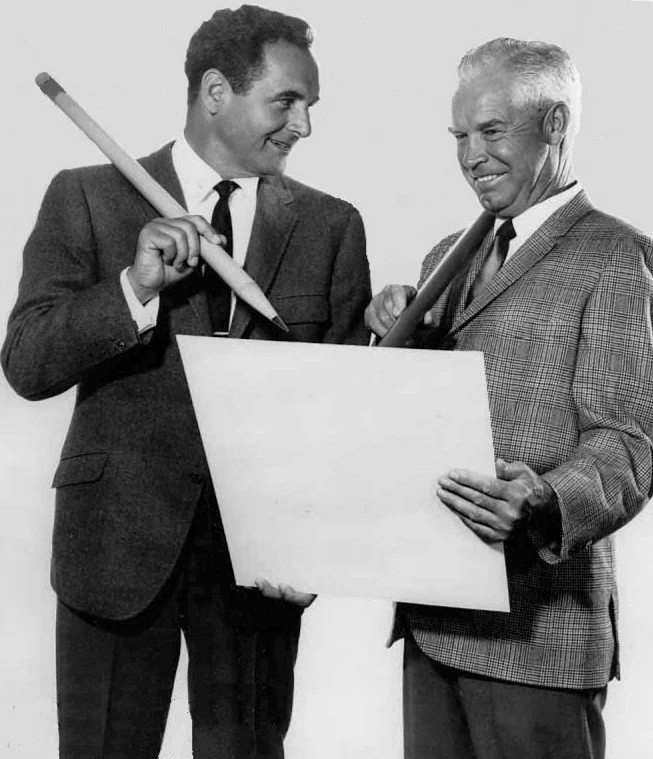
Joseph Barbera and Bill Hanna, 1960s. Source: Public domain, no copyright, available here.
It all began when John Mitchell of Screen Gems approached Hanna-Barbera Productions with the idea for a prime-time animated series.[1] William Hanna and Joseph Barbera tried out ideas for family sitcoms featuring Romans, farmers, hillbillies, and even Gypsies (Romani), but nothing worked. The breakthrough came when storyboard artist Dan Gordon sketched two cave people and a bird playing a stone record. Soon afterward, Gordon, working with designer Ed Benedict, drew Fred and Wilma Flintstone, Barney and Betty Rubble, and the world of Bedrock, and Joe Barbera and Dan Gordon sketched the plots for two episodes: P-1, “The Swimming Pool,” and P-2, “The Flintstone Flyer.”[2]
Once the artwork was complete, Joe Barbera and John Mitchell, Hanna-Barbera’s agent at Screen Gems, went to New York City in early 1960 to pitch the show to advertising agencies and television networks, a campaign that lasted eight weeks. At this stage, the show was called The Flagstones.[3] ABC bought it in March 1960. Screen Gems then sent Joe Barbera to sell the remaining advertising time, believing he was the best person for the job. He traveled to Winston-Salem, North Carolina, to pitch the show to the R.J. Reynolds Tobacco Company, which signed on because, as one of its executives put it, “At least there’s no blood and guts running in the street.”[4] In Chicago, Illinois, Barbera also secured Miles Laboratories as a sponsor; the company later created Flintstones Vitamins.[5] Bayer AG bought Miles Laboratories in 1979 and retired the Miles name in 1995,[6] and Bayer still makes Flintstones Vitamins today.[7]
Early days
Meanwhile, the show’s name changed. To avoid a legal dispute with the comic strip Hi and Lois, whose family was named Flagston, the producers dropped the name The Flagstones.[8] For a while, the show was called The Gladstones, until someone at Screen Gems suggested The Flintstones, and the name stuck.[9] The first episode, “The Flintstone Flyer,” aired on ABC on September 30, 1960. “The Swimming Pool,” although produced first, aired third, on October 14, 1960.[10]
The show almost did not survive, because actor Jackie Gleason considered legal action against the producers. It has long been reported that The Flintstones was based on Gleason’s TV show The Honeymooners, and Henry Corden, Gleason’s friend and the second voice of Fred Flintstone, confirmed the story. As Corden remembered, “Jackie’s lawyers told him he could have ‘The Flintstones’ pulled right off the air. But they also told him, ‘Do you want to be known as the guy who yanked Fred Flintstone off the air? The guy who took away a show that so many kids love, and so many of their parents love, too?’ And apparently Jackie thought it over and decided against it.” Flintstones co-creator Bill Hanna acknowledged the Honeymooners connection: “‘The Honeymooners’ was there, and we used that as a kind of basis for the concept.”[11]
The show not only survived but thrived in the ratings. Early on, critics predicted The Flintstones would be a flop.[12] The Nielsen ratings proved them wrong. In the October 1960–April 1961 season, The Flintstones ranked No. 18 among all U.S. programs, with a rating of 24.3. In the 1961–62 season, it ranked No. 21 with a rating of 22.9, tied with CBS’s The Many Loves of Dobie Gillis, and in the 1962–63 season it ranked No. 30 with a rating of 20.5.[13]
The show’s sponsors changed to suit its audience. During the first two seasons, Fred and Barney appeared in Winston cigarette commercials during the show’s breaks.[14] Winston cigarettes were made by the R.J. Reynolds Tobacco Company and had been on sale since 1954.[15] By the third season, which began in September 1962, Winston was out as a sponsor and Welch’s grape juice was in, reflecting the growing number of children watching the show.[16] The change came several months before Pebbles was born on the show in early 1963. During commercial breaks, Fred would also open his medicine cabinet to reveal Alka-Seltzer and One-A-Day vitamins, both made by Miles Laboratories, the show’s other main sponsor.[17]
Legacy
The last original episode of The Flintstones aired on April 1, 1966.[18] However, two products closely associated with the show were only beginning their long commercial lives. In 1968, Miles Laboratories began producing Flintstones Vitaminsfor children, and in 1971, Post introduced Pebbles cereal in Fruity and Cocoa varieties. By 1992, more than 60 million boxes of Pebbles cereal had been sold.[19] Both Flintstones Vitamins and Pebbles cereal are still sold today.
Interestingly, the famous theme song was not used when the show first aired. The original theme, “Rise and Shine,” was used for the first two seasons[20] and was a jazzy instrumental with no lyrics.[21] The melody of the now-famous “Meet the Flintstones” first appeared as sad instrumental background music in the episode “The Swimming Pool.”[22] “Meet the Flintstones,” composed by Hoyt Curtin with lyrics by Bill Hanna and Joe Barbera, became the theme song in season three.[23]
The show also challenged a censorship barrier of its time. Fred and Wilma Flintstone were among the first television couples, and very likely the first animated one, to be shown sharing a double bed, something network standards had long discouraged. At the same time, The Flintstones followed the network standards of the day: a stone toilet was strictly prohibited and never appeared on screen, and when Wilma was pregnant, the word “pregnant” was banned and replaced with “expecting.”[24]
The show’s success also paved the way for The Simpsons. The Flintstones was the first animated sitcom to air in prime time.[25] It ran until April 1, 1966, for a total of 166 episodes.[26] It remained the longest-running prime-time animated series until The Simpsons, which is still airing new episodes today, broke the record in 1997, and it went on to spawn several spin-offs and crossovers.[27] Reruns of the original series began after the show ended.[28]
The Flintstones has been a cultural phenomenon since it first aired in 1960. The show avoided legal trouble twice. It achieved strong ratings despite critics’ predictions that it would fail. Its advertisers changed as its audience grew younger. It challenged one censorship barrier while respecting others. And it laid the foundations for the success of The Simpsons. More than six decades on, the legacy of The Flintstones endures.
To my paternal grandfather, John Boustead (November 11, 1913 – January 14, 2006): a fan of The Flintstones, a lover of history, and a productive patent lawyer.
Did you enjoy the piece? Join us on X here to receive regular updates: @HistoryIsNowMag
References
Adams, T.R. The Flintstones: A Modern Stone Age Phenomenon. Atlanta, Georgia: Turner Publishing, Inc., 1994.
Brooks, Tim, and Earle Marsh. The Complete Directory to Prime Time Network and Cable TV Shows: 1946–Present. 9thed. New York, New York: Ballantine Books, 2007.
“Flintstones Vitamins.” Bayer. Accessed September 6, 2026. https://www.flintstonesvitamins.com. “Bayer Global – Home.” Bayer Global. Accessed September 7, 2026. https://www.bayer.com/en/.
“The Flintstones (1960): 15 Weird Facts You Didn’t Know!” Remember When. YouTube video, 28:13. Uploaded August 1, 2026. https://www.youtube.com/watch?v=jgKMi4LvSTg.
Inside Toon. “Flintstones 30th Anniversary Entertainment Tonight 1991 Jean Van der Pyl, Henry Corden.” YouTube video, 3:25. Accessed September 16, 2026. https://www.youtube.com/watch?v=DYt4K1kXfd0.
“Miles Laboratories.” The Flintstones: Welcome to Bedrock (Fandom wiki). Accessed September 10, 2026. https://flintstones.fandom.com/wiki/Miles_Laboratories.
“Winston.” First Versions. Accessed September 18, 2026. https://www.firstversions.com/2017/06/winston.html#google_vignette.
[1] Adams, T.R. The Flintstones: A Modern Stone Age Phenomenon. Atlanta, Georgia: Turner Publishing, Inc., 1994, 22.
[2] Adams, The Flintstones, 22–23.
[3] Adams, The Flintstones, 22–23, 25.
[4] Adams, The Flintstones, 26.
[5] Adams, The Flintstones, 29.
[6] “Miles Laboratories.” The Flintstones: Welcome to Bedrock (Fandom wiki). Accessed September 10, 2026. https://flintstones.fandom.com/wiki/Miles_Laboratories.
[7] “Flintstones Vitamins.” Bayer. Accessed September 6, 2026. https://www.flintstonesvitamins.com; “Bayer Global – Home.” Bayer Global. Accessed September 7, 2026. https://www.bayer.com/en/.
[8] “The Flintstones (1960): 15 Weird Facts You Didn’t Know!” Remember When. YouTube video, 28:13. Uploaded August 1, 2026. https://www.youtube.com/watch?v=jgKMi4LvSTg.
[9] Adams, The Flintstones, 36.
[10] Adams, The Flintstones, 26, 146.
[11] Adams, The Flintstones, 38.
[12] Inside Toon. “Flintstones 30th Anniversary Entertainment Tonight 1991 Jean Van der Pyl, Henry Corden.” YouTube video, 3:25. Accessed September 16, 2026. https://www.youtube.com/watch?v=DYt4K1kXfd0.
[13] Tim Brooks and Earle Marsh, The Complete Directory to Prime Time Network and Cable TV Shows: 1946–Present, 9th ed. New York, New York: Ballantine Books, 2007, 1679, 1682–1683.
[14] “15 Weird Facts You Didn’t Know!,” Remember When.
[15] “Winston.” First Versions. Accessed September 18, 2026. https://www.firstversions.com/2017/06/winston.html#google_vignette.
[16] “15 Weird Facts You Didn’t Know!,” Remember When.
[17] Adams, The Flintstones, 126.
[18] Adams, The Flintstones, 113.
[19] Adams, The Flintstones, 129.
[20] Adams, The Flintstones, 65.
[21] “15 Weird Facts You Didn’t Know!,” Remember When.
[22] Adams, The Flintstones, 65, 146; “15 Weird Facts You Didn’t Know!,” Remember When.
[23] “15 Weird Facts You Didn’t Know!,” Remember When.
[24] Adams, The Flintstones, 62.
[25] “15 Weird Facts You Didn’t Know!,” Remember When.
[26] Adams, The Flintstones, 113, 187.
[27] “15 Weird Facts You Didn’t Know!,” Remember When.
[28] Adams, The Flintstones, 113.