In the early 18th century, Liverpool entered the transatlantic slave trade, the darkest chapter in its history. The remnants of this period can still be seen today, scattered throughout the city centre and beyond. From the waterfront to the Town Hall, reminders of Liverpool’s involvement remain embedded in its landscape. This raises the question: what did the slave trade actually mean for the people of Liverpool, and how did an economy built around Atlantic commerce transform the city's workplaces and industries?
Sophie Leigh Riley explains.
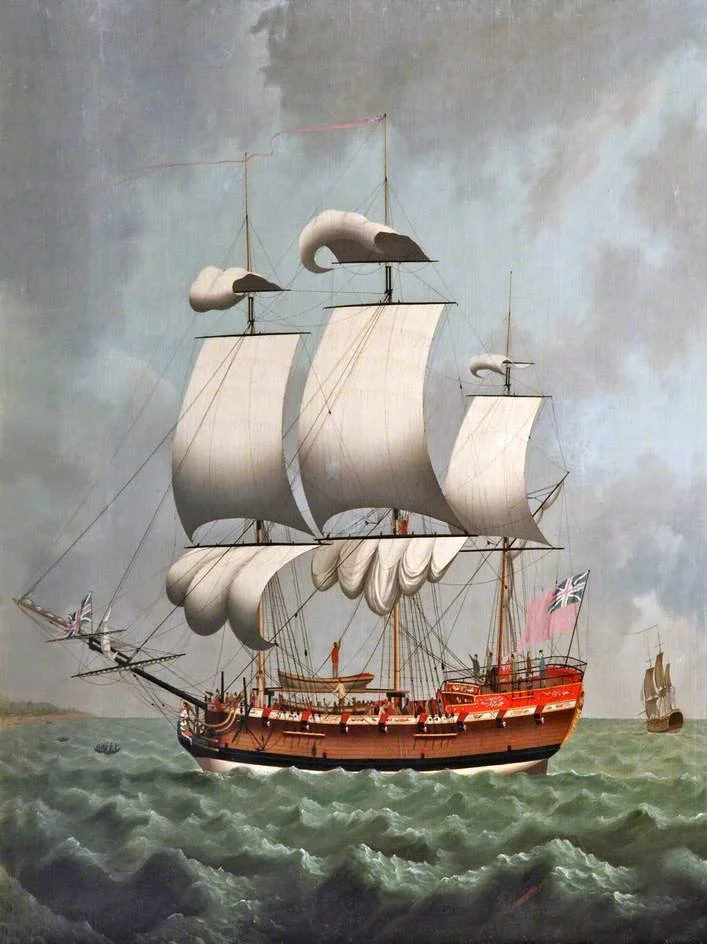
A Liverpool Slave Ship by William Jackson. Source: Public domain, Merseyside Maritime Museum, available here.
For Liverpool to become deeply involved in the trade, it first became part of a wider system linking British merchants and ships with the coasts of West Africa and the American plantations. The system involved the forced capture, sale and transportation of more than 12 million African men, women and children across the Atlantic, where those who survived the voyage were subjected to enslavement and forced labour. The commodities they were forced to produce, including sugar, tobacco and cotton, fuelled a vast network of trade and commerce across the globe.
To understand Liverpool’s growth as a port, we need to go back to the city’s humble beginnings. For centuries, the Liverpool we see today was a small town whose economy relied on fishing, farming and coastal trade. The restoration of King Charles II in 1660 marked a period of significant change, as Liverpool began its transformation from a minor port into a major maritime centre. During this period, Parliament passed several maritime laws that helped create favourable conditions for the expansion of English shipping. The Navigation Acts, for example, required colonial goods to be carried in English-owned ships, contributing to the growth of Liverpool’s ship-owning and shipbuilding industries.
Yet the port itself remained undeveloped. Before 1715, Liverpool had no purpose-built docks: ships entered the river and anchored offshore, and their cargo was brought ashore by small boats. In 1709, Parliament passed legislation enabling the construction of the world’s first commercial enclosed wet dock, designed by the London engineer Thomas Steers. It opened in 1715, providing a safe harbour for the burgeoning overseas trade in sugar, tobacco, grain and timber. As Liverpool’s growth accelerated throughout the late 18th century, an intricate network of docks and spacious warehouses developed along the waterfront, creating the infrastructure for the next stage of the city’s maritime expansion.
The reasons for Liverpool’s rise in the transatlantic slave trade are still debated, but historians point to a combination of geography, commercial opportunity and the rapid development of the port’s infrastructure. National Museums Liverpool notes that the city’s geographical position gave its merchants ‘easy access to the goods that would sell in Africa’. Liverpool’s connections to the wider British manufacturing economy also gave merchants access to commodities that could be exchanged on the West African coast, including Lancashire cotton and firearms from Birmingham. The Old Dock strengthened Liverpool’s position further by allowing ships to stay afloat and load or unload cargo regardless of the tides. As the port expanded, so too did the network of businesses and industries surrounding it. The wealth generated by this expanding Atlantic commerce helped fuel Liverpool’s commercial and urban growth, while creating an increasingly large workforce whose livelihoods depended on the trade.
But Liverpool’s involvement in the slave trade was not confined to the merchants who financed the voyages or the captains who commanded them. Behind every ship leaving the Mersey was a workforce whose labour kept the city’s maritime economy moving. Dockers, shipwrights, coopers and sailors all contributed to the operation of Liverpool’s expanding port, with some directly repairing and maintaining slave-trading vessels, while others were employed in industries that supplied them. As the trade expanded, so too did the number of livelihoods connected to the commercial networks it sustained. For some workers, opposition to the slave trade threatened their employment and wages, creating an uneasy relationship between the working class and the city’s elite. This hostility towards abolitionists could turn violent. When Thomas Clarkson visited Liverpool in 1787 to gather evidence about the slave trade, he was cornered by a hostile group of men on the pier head and barely escaped with his life. The incident demonstrated just how deeply the trade had become embedded within the city’s working and commercial life.
The influence of this wealth can still be traced through Liverpool’s streets today. As you walk past the city’s grand architecture and historic street names, the question of how they were funded is often less visible. Wealthy merchant families, including the Gladstones and the Gildarts, built vast fortunes through connections to West Indian plantations and the slave trade, helping to fund the city’s institutions and shape its landscape. John Gladstone, for example, was a wealthy Liverpool merchant who owned or held mortgages over 2,508 enslaved people on plantations in British Guiana and Jamaica. When slavery was abolished, he received around £106,000 in compensation from the British government, one of the largest awards made, and his wealth helped fund the elite education of his son, the future Prime Minister William Gladstone.
These fortunes were not confined to individual families. They also became part of Liverpool’s wider financial and commercial expansion. To understand Liverpool’s rapid rise as a financial centre, we must look at the men who financed the docks and participated in the city’s expanding commercial networks. Prominent merchants such as Thomas Leyland and the Heywoods built substantial fortunes through a range of commercial activities, including the slave trade. Their wealth was later channelled into banking: the banks they founded were eventually absorbed into institutions that are now part of Barclays and HSBC. This illustrates how capital generated through Liverpool’s trading networks could be reinvested in the city’s developing economy. By the late 18th century, the transatlantic slave trade was therefore connected to a wide range of Liverpool businesses and workplaces, extending far beyond the merchants who directly financed the voyages.
The expansion of Liverpool’s docks was central to this economic transformation. The profits generated by the city’s maritime trade helped drive investment in its pioneering dock system, from the construction of the Old Dock in 1715 to George’s Dock in 1771. These developments transformed Liverpool from a relatively small port town into an international shipping hub, with its population rising from around 5,000 people to between 77,000 and 85,000 people by the end of the 18th century. In the city’s bustling workplaces, the trade created an insatiable demand for manual labour and skilled trades. Between 1701 and 1810, local shipyards built some 2,120 vessels for the slave trade, as well as repairing and refitting many more. Nearby ropewalks and sailmaking lofts supplied rigging and canvas, while iron foundries forged the chains and manacles carried on long-distance slaving voyages.
Furthermore, the slave trade had economic consequences far beyond Liverpool’s docks, stimulating demand across Lancashire’s manufacturing industries. Cooperages thrived by producing barrels to hold imported commodities such as sugar, rum and tobacco, while local textile mills processed raw cotton cultivated by enslaved labourers in the Americas. The connections stretched across industries, linking Liverpool’s port to manufacturers, merchants and workers throughout the region. By the late 18th century, capital generated through the slave trade had become deeply embedded in Liverpool’s commercial and industrial life, connecting the docks to workplaces and industries far beyond the waterfront.
However, despite the impact the slave trade had on Liverpool’s expansion, a crisis emerged in 1807 when Parliament passed the Slave Trade Act, abolishing the trade in enslaved people across the British Empire. This was followed by the Slavery Abolition Act of 1833, which abolished the institution of slavery itself in most British colonies and, in turn, freed around 800,000 enslaved people, although most were forced to serve a period of ‘apprenticeship’ until 1838. Despite the fears and objections of local merchants, Liverpool adapted its docks, workplaces and industries to new and lucrative forms of global trade, such as palm oil, much of which was still produced by enslaved labour in West Africa. Furthermore, although the Acts stopped British ships from carrying enslaved people, Liverpool continued to profit from slavery elsewhere. The port became the principal point of entry for raw cotton, much of it grown by enslaved people in the American South, and the city’s brokers supplied millions of bales to the textile mills of Lancashire.
Today, attitudes towards the slave trade have shifted, and Liverpool has sought to confront and remember its past through dedicated museums, annual commemorations and educational initiatives, including bronze street plaques explaining the slavery links of names such as William Brown Street. Rather than erasing or renaming the past, these actions demonstrate an approach centred on accountability and education rather than denial.
Ultimately, the history of the slave trade and its impact on Liverpool was not made only by the merchants whose names appear in ledgers. It was also made by the thousands of workers whose labour kept the port moving, and by the enslaved people whose forced labour produced the commodities that passed through it. So, next time you walk around Liverpool, ask yourself: what stories should we tell when we look at the docks, warehouses and city streets?
Enjoyed the piece?
Join thousands of history readers getting occasional updates on new blog posts, books, and video releases — plus a free history book to get you started.
Author Bio
Sophie Riley is a history writer specialising in twentieth-century Europe and the interrogation of historical myth. Her work focuses on figures such as Witold Pilecki, whose experiences complicate dominant narratives of contemporary history. She is the creator of Sophieleighwrites on Substack and shares her work on LinkedIn and Instagram, where she examines overlooked histories and reconsiders widely held historical assumptions.
Further Reading Material
Anthony Tibbles, Liverpool and the slave trade, (Liverpool University Press, 2018)
National Museums Liverpool (2023). Archive sheet 3 - Liverpool and the transatlantic slave trade. [online] National Museums Liverpool. Available at: https://www.liverpoolmuseums.org.uk/archivesheet3 [Accessed 23 Sept. 2026].
Roger Anstey, and P E H Hair, Liverpool, the African slave trade, and abolition: Essays to illustrate current knowledge and research, First Edition edn, (Liverpool: Historic Society of Lancashire and Cheshire, 1976)
Rice University (2019). Slave voyages. [online] Slavevoyages.org. Available at: https://www.slavevoyages.org/ [Accessed 23 Sept. 2026].
Suzanne Schwarz, Slave captain: the career of James Irving in the Liverpool slave trade, (Liverpool University Press, 2008)