More than two-thousand people were present to greet the Soviet Agricultural delegation that arrived in Des Moines, Iowa on July 18, 1955. Their leader, Vladimir Matskevich, a bald, rotund man, who looked a lot like Nikita Khrushchev, stepped off the plane and enthusiastically greeted the cheering Iowa crowd.
Lee Winningham explains.
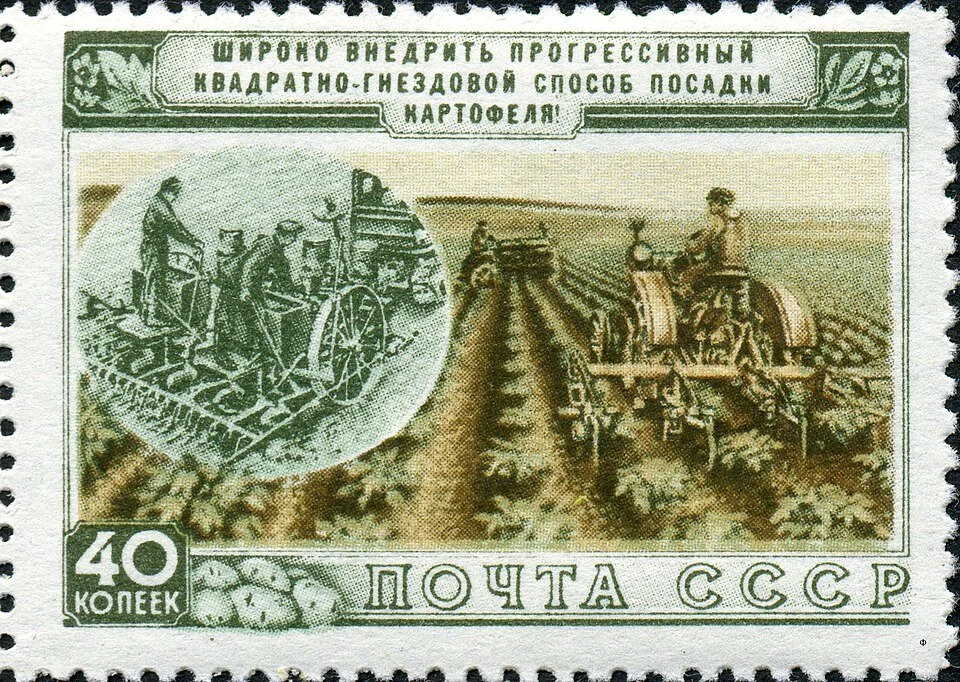
1950s Soviet stamp showing agriculture in the USSR - planting potatoes. Source: Public domain, Post of the USSR, available here.
The arrival of the Soviet delegation on July 18 was the culmination of an effort that originated with an invitation extended by the Des Moines Register on February 10, 1955. In the editorial “If the Russians want more Meat…,” Lauren Soth, in response to Nikita Khrushchev’s desire, expressed a month earlier, to apply United States agricultural methods to the Soviet Union, offered Iowa’s help toward this goal.
The Russians quickly accepted the invitation and in the months that followed, neither Iowa citizens nor elected officials nor other newspaper editors were shy with their opinion on the invitation. By July, all the annoying bureaucratic details had been ironed out, itineraries set, and ordinary American farmers and a dozen Soviet officials crossed the Iron Curtain. From the American perspective it was a student/teacher relationship, but one that also offered a chance to break the ideological and cultural barriers that separated each nation.
Back in 2007, I wrote about this topic for History News Network, where I tied the trip to politics and foreign policy. It has been two decades, and the agricultural exchange is still a neglected episode in Cold War history, usually only appearing as evidence or data point in a broader argument. Moreover, Nikita Khrushchev’s more publicized 1959 trip to the United States overshadows the 1955 trip.
My focus has always been the interactions between the Soviet officials and American citizens, trained by a culture to despise, fear, and view with suspicion anything associated with the Soviet Union or Communism. How ordinary Americans felt about and reacted to the presence of real communists from the Soviet Union in their communities, not ones from their imagination, provides a window into how much Americans really “feared” Communism and the Soviet Union. This was an era where everything and everyone from popular culture to shameless demagogues, conditioned Americans to fight communism in almost every aspect of life. Americans often said it was better to be dead than red, while, at the same time, families in Iowa were wining, dining, and letting actual “Reds” spend the night in their homes.
Beyond the big questions about Cold War foreign policy, cultural exchange programs, and Red Scare culture and politics, Soviet officials traveling the country from Iowa to Texas to California is just interesting. Unique stories emerge in all the places that the Soviets visited. Many of these stories are local histories that have never been told or gone unnoticed for decades. This was my experience with Ennis, Texas, a town where the local paper won a journalism award for its coverage of the visit almost a year later. Despite the coverage then, this is an obscure event for residents today. These are not stories that will ever solve a grand historical mystery or give a definitive answer to larger questions, but they are no less valuable. There are many such examples as one follows the Soviets state by state.
The delegation arrived in Minnesota in early August. It was here that the Russians saw the first real demonstration of their presence, when over four hundred Ukrainian nationalists showed up to protest the Russian arrival in Minneapolis. “Beware of the Russian Smile” read a placard on a car outside of the Nicollet Hotel in Minneapolis. The demonstration in Minnesota did not derail the tour, but it does present quite the contrast since, at the same time, the leader of the Soviet delegation was visiting farms in North Texas, arguably the most anti-Communist state in the country, with no such public outcry.
Likewise, in South Dakota, the headline “Russians Get Scant Notice in Mitchell,” kicked off an editorial tit for tat between the Mitchell Republic of Mitchell, South Dakota, and the Argus-Leader of Sioux Falls from early to mid-August. Was the Argus-Leader’s headline a shot at Mitchell? It certainly looked that way for the editors of the Republic because they accused Sioux Falls of being jealous that Mitchell, not Sioux Falls, was on the Russian itinerary. This debate over the nature of each paper’s coverage continued long after the Russians had left the state. Later, an editor would call the trip a “most unusual event.” Indeed, it produced two newspapers in the heartland arguing over supposed jealousy concerning the clout that came with hosting Soviet Communists.
“Extralegal diplomacy” is what William C. Ives of Galesburg, Illinois called the Des Moines Register’s invitation to the Soviet Union in March of 1955. Ives was one of many that wrote to the Register in the days and weeks after the February 10th invitation with an opinion on it. Some were for it, many were against it, and some just had a million questions.
On March 1st, Robert Herz of Dallas, Texas wrote that he wanted an even larger cultural exchange of each other’s citizens. On March 22nd, Guy Wright of Earlham, Iowa thought the invitation was a great idea and (along with others) offered his farm for a visit. Four days later, I.L. Dunnington, a Methodist minister in Iowa City, referenced his experience travelling in Russia to declare that there was nothing to fear and that this could do more for the cause of freedom and teach the American way of life.
Most of the people that wrote in favor of the invitation expressed the belief that cultural understanding could promote peace or that it presented an opportunity to teach the Soviets. On the other side of the argument, many citizens were deeply suspicious of the Russians. They viewed them as the enemy, one that should not be courted or aided in any way. On March 22nd, sandwiched in between two letters praising the Register, Mary Helen of Webster City, Iowa called the proposed visit an “ill-advised publicity stunt.” A week earlier, Sivert Myres asked if the newspaper was “dumb,” and told the Register that the Soviet’s real agricultural problem was that they were “crooks,” while Josephine McHenry, from Denison, Iowa expressed the belief, on March 12th, that in the long run it was better for the Russian people to remain hungry and discontented with their government.
Most of the opposition was couched in language of fear, suspicion, and a belief that nothing the United States could do would educate a Communist and such efforts would only weaken us. Some Iowans were undecided and just had questions, like the thirteen sophomores at Meservey Consolidated High School who sent, on April 6th, no less than ten questions to the Register and Mrs. Torkelson from Ringsted, Iowa who, on July 9th, had no firm opinion but felt as though something this big should be put to a vote. None of this, however, derailed the tour. The preparations continued through the spring and with the support of President Dwight Eisenhower and most of Iowa’s elected officials, the Russians boarded their plane bound for Iowa. It would remain to be seen how Iowans would react once the Russians began travelling the state.
From that hot afternoon in July until the end of August 1955, Soviet delegation traveled to over a dozen states. REVISE SENT: They traveled to Minnesota, Nebraska, California, Missouri, North and South Dakota, Michigan, Wyoming, Texas, and Iowa, where they spent most of their time. They ate burgers, hot dogs, complained about the heat, ate barbecue, went to shows, experienced local cultures, and hammed it up with reporters and civilians wherever they went all the while, they talked of goodwill, cooperation, and coexistence at a tense, but nonetheless optimistic, time of the Cold War. It was an era in which the Cold War appeared to be thawing, and both nations were openly talking about “peaceful coexistence.” In the summer of 1955, ordinary Americans and a dozen Soviet agricultural officials would put such talk to the test.
Enjoyed the piece?
Now read our fascinating book on the Cold War – get it here!
References
Russell, J. S. “It’s Down to Business for Group Today.” Des Moines Register (Des Moines, Iowa), July 18, 1955. Newspapers.com.
Soth, Lauren. “If the Russians Want More Meat ... “ Des Moines Register (Des Moines, Iowa), February 10, 1955. Newspapers.com
Bus, Daniel W. “News Rated Tops in News Writing.” Ennis Daily News (Ennis, Texas), June 23, 1956. 1st ed. University of North Texas Libraries, The Portal to Texas History.
Smith, Robert T. “City Ukrainians Demonstrate Against Russ.” Star Tribune (Minneapolis, Minnesota). Mon, Aug 8, 1955. Newspapers.com.
“Russians Get Scant Notice in Mitchell.” Argus-Leader (Sioux Falls, South Dakota).
Aug 2, 1955. Newspapers.com.
“Russian Farm Group Leaves Argument Behind in S.D.” Argus-Leader (Sioux Falls, South Dakota).
Aug 11, 1955. Newspapers.com.
Ives, William C. Letter to the Editor. Des Moines Register (Des Moines, Iowa), March 22, 1955.
Herz, Robert. Letter to the Editor. Des Moines Register (Des Moines, Iowa), March 1, 1955.
Wright, Guy W. Letter to the Editor. Des Moines Register (Des Moines, Iowa), March 22, 1955.
Dunnington, I.L. Letter to the Editor. Des Moines Register (Des Moines, Iowa), March 26, 1955.
Helen, Mary. Letter to the Editor. Des Moines Register (Des Moines, Iowa), March 22, 1955.
Myres, Sivert. Letter to the Editor. Des Moines Register (Des Moines, Iowa), March 15, 1955.
McHenry, Josephine. Letter to the Editor. Des Moines Register (Des Moines, Iowa), March 12, 1955.
“School Class in Doubt on Russian Visit.” Letter to the Editor. Des Moines Register (Des Moines, Iowa), April 6, 1955
Torkelson, Mrs. Thomas. Letter to the Editor. Des Moines Register (Des Moines, Iowa), July 9, 1955.