The Civil War had a major impact on presidential politics for the next two generations. I want to develop a hypothesis as to exactly how the War impacted the electoral aftermath. Seven future Presidents of the United States were of military age during the Civil War. Five were Union generals. Aside from Grant, one or two others were bona fide battle heroes, one an enlisted man who rose to major, and one who paid a substitute when drafted.
Lloyd W Klein explains.
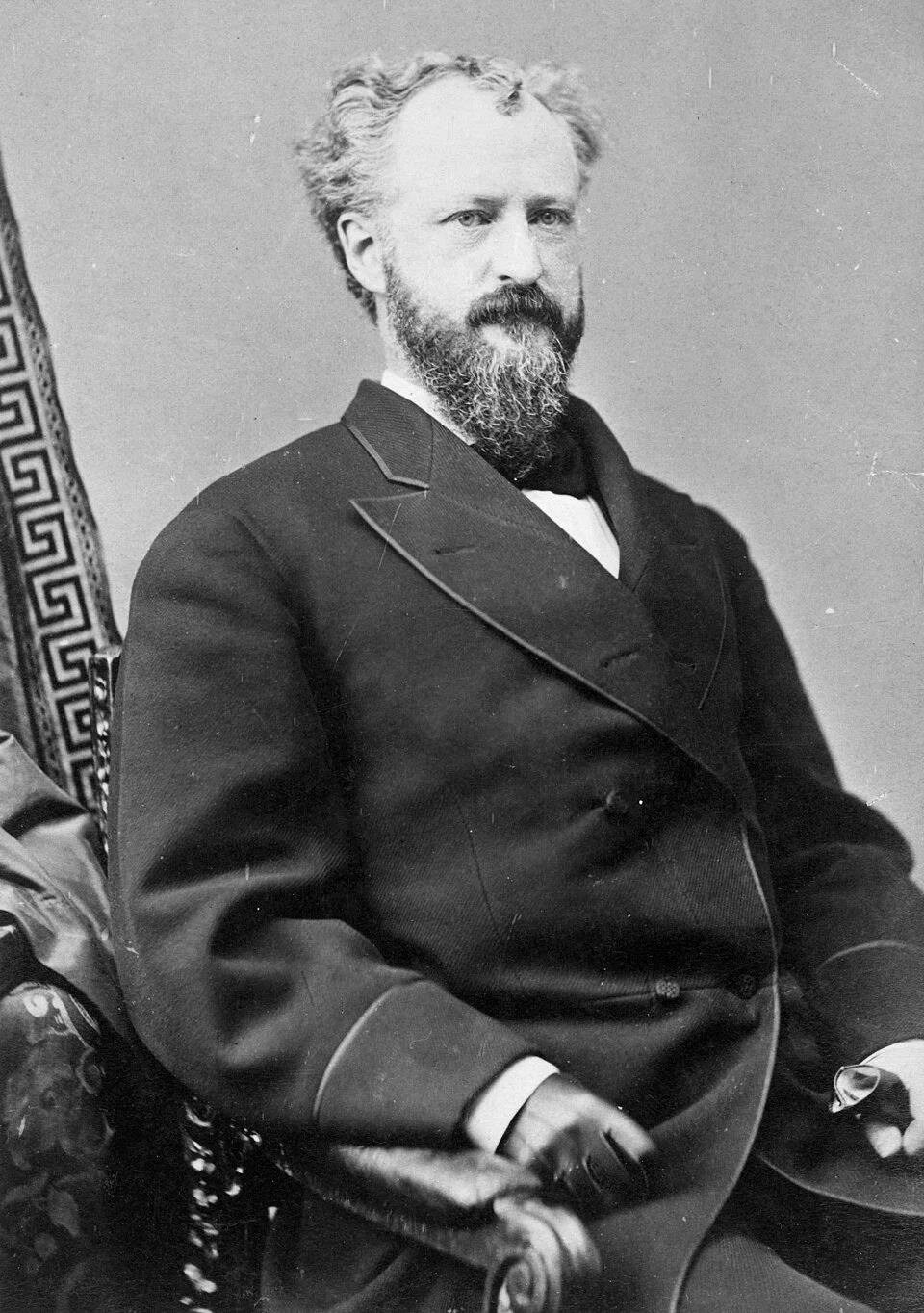
Roscoe Conkling. Source: Public domain, National Portrait Gallery, available here.
These men and their service during the war:
Rutherford B Hayes: From Cincinnati, Appointed Major of the 23rd Regiment of Ohio Volunteers; saw action in Kanawha Division. Fought at South Mountain, leading a charge against an entrenched position, and was wounded in the left arm but applied a tourniquet and continued to lead. Promoted to colonel and brevet brig gen, he fought in several skirmishes, raided lead mines, and fought at Cloyd’s Mountain. He later led in the Shenandoah, where he was wounded at Kernstown, and fought at Opequon Creek, Fisher’s Hill, and Cedar Creek under Sheridan. Then promoted to brig gen and brevet major general.
James Garfield: A state legislator when the war began, he deferred service to 1862 at the request of Governor Dennison of Ohio. He was appointed colonel of the 42nd Ohio, and served initially under Buell. He led troops at Middle Creek and promoted to brig gen and command of the 20th Brigade of the Army of Ohio. He fought at Shiloh and Corinth, then fell ill with hepatitis. He served as a judge on Porter’s court martial, voting to convict. This led to his appointment as chief of staff to General Rosecrans. He served at Chickamauga where his ride to General Thomas’s line at Henry Hill and his telegram to Stanton for reinforcements made him famous. Thomas’s promotion to command led to Garfield being sent to Washington, where he was promoted to major general., and also elected to Congress. Anxious for a command, Lincoln disappointed him and instead advised him to take his seat. He didn’t get along with either Grant or Lincoln.
Chester Arthur: A lawyer in a prestigious New York law firm, he won several prominent slavery and racial desegregation cases before the war. Appointed to the Governor’s military staff, he proved highly effective at housing and equipping New York troops. Despite being offered battle commands, he remained at this post as brig gen, ultimately promoted to quartermaster general of the state militia. When the governor did not stand for re-election in 1864, he returned to his highly successful practice of law.
Grover Cleveland: Paid $150 to George Benninsky, a 32-year-old Polish immigrant to serve as his substitute by the Conscription Act of 1863 while he served as a lawyer in Cleveland. Benninsky survived the war.
Benjamin Harrison: Grandson of William Henry Harrison and great-grandson of a signer of the Declaration of Independence. Recruited the 70th Indiana Volunteer Regiment, appointed colonel despite no military background, trained them by day and studied military tactics at night, and led them through several years in guarding and picket duty, culminating in an attack on the 2nd day at Resaca in which he personally led his brigade to capture a redoubt with artillery, eventually capturing 4 pieces. He was promoted to Brigadier General, led the 1st Brigade at Nashville, and led his regiment with pride in the Grand Review of the Western Armies May 24, 1865.
William McKinley: Joined as a private at age 18 in the 70th Ohio with Hayes as its major. and Rosecrans as its commander, and later Crook’s Corps. He fought with the regiment, being promoted to sergeant, then an officer, ending the war as a major at age 22.
Interestingly, only Grover Cleveland was not a military man, and only Chester Arthur was not from the Midwest (Ohio or Indiana). The winner of every election in this time frame was a former Union officer except one. From 1868 to 1900, there were nine presidential elections. Six were won by former Union generals and one by a former major. There is really only one exception to this pattern, Grover Cleveland.
The chart shows who won the election that year and their opponent.
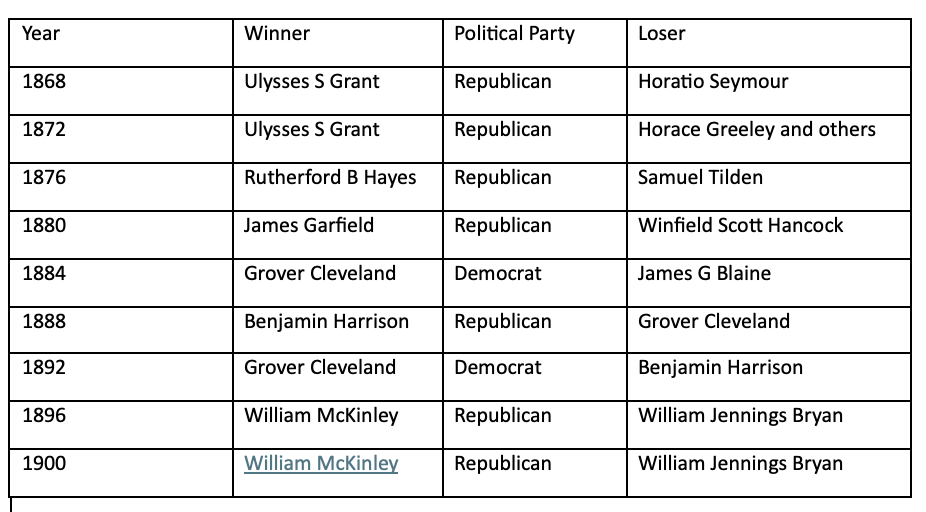
This simple chart shows a number of interesting trends.
The Republicans NEVER failed to nominate a Union officer except once, and he got beat. Second, there was only one Democrat who was nominated who was a former officer, and he had no prior political experience and lost to another former officer who was a career politician. And finally, when the Republicans ran out of generals to run, they chose a major who had been very young in the war. And it worked. Leaving aside the 1876 election, which we have reviewed in depth previously, and it’s an outlier in many ways, the Republicans won every election except two. Another factor is that the population moved to the midwest, so Ohio, Illinois and Indiana rather than Virginia and Massachusetts, were now the main centers, and these were highly important states for the Union in the war.
Obviously, the Republicans were the Party of Lincoln, had won the war, had freed the slaves, and the heroes of the war believed in the cause. The Republicans waved the bloody shirt for 32 years, and it worked most of the time. More tomorrow.
There are two huge exceptions to the general rule that Union officers were elected when they ran for president, Grover Cleveland and James G Blaine. How James G Blaine got the Republican nomination in 1884, and why another general wasn’t nominated is one issue. And Grover Cleveland was the only figure who understood how to break the Republican monopoly , which he did twice and failed once.
Blaine was not the usual person. He enrolled in college at age 13, graduated 2nd in his college class at age 17 and was hired as a professor of mathematics and ancient languages at age 18. He began to study law in Philadelphia at age 22 but then became an editor and co-owner of a newspaper. At age 26 he was a delegate to the Republican National Convention and became editor of a newspaper in Portland Maine, then was elected to the state legislature. By 1861, he as a successful editor and experienced politician, becoming speaker of the Maine House of Representatives. He was elected to Congress in 1862, and was Speaker of the House by 1869. His beautiful home in DC still stands near DuPont Circle, and I have visited it. In 1876 he was considered the frontrunner for the presidential nomination but barely lost to Hayes when all of his opponents joined Hayes. Instead he was appointed to the US Senate from Maine. IN 1880, he was considered the leader of the anti-Grant faction; in a deadlocked convention, his delegates threw their support to Garfield. For his support, he became Secretary of State under Garfield and head of the cabinet, while Chester Arthur, his main opponent, became VP.. When Garfield was shot, he was actually walking with Blaine. Arthur’s ascendancy meant Blaine would have to resign 6 months later. In 1884, Blaine tried to get General Sherman to run, but when famously refused, he ran himself a third time, this time defeating Arthur and General Logan. The tricky part of this was that General Logan was his VP nominee: so in fact, the Republicans continued to run generals, but this election as VP.
Grover Cleveland was nominated by the Democrats and ran against Blaine by suggesting that Blaine was involved in financial scandals, including the sale of railroad bonds that enriched him. Cleveland was supposedly an honest man. The problem was that it turned out that Mr Cleveland had sired an illegitimate child and was paying child support. American voters, being the morally upright people we know ourselves to be, found neither scandal that bad. But then Arthur and the New York Republicans refused to support Blaine, resulting in the loss of New York by 1200 votes, the popular vote by 0.7%, and the Electoral College by 37 votes. Blaine would go on to serve as Secretary of State for Harrison 4 years later, being only one of two men to be Secretary of State under three presidents.
Cleveland was the first and only Democrat to win the presidency after the Civil War until Woodrow Wilson. He was a mayor of Buffalo and Governor of New York who had succeeded politically opposing Tammany Hall. The Democrats saw Arthur and Roscoe Conkling’s opposition and saw in the governor, supported by a rising star named Theodore Roosevelt, someone who could pick off New York and wasn’t tainted by the slavery and Southern connections of the war. His loss to Harrison
in 1888 occurred despite winning the popular vote by 0.8%, when New York went Republican, and his re-election 4 years later again was led by New York going Democrat. The issue then was his reputation from his first term as an excellent administrator, rising costs, and the divisive effects of tariffs. The parallels with the non-consecutive terms of our current president have not been lost on historians.
Roscoe Conkling
Roscoe Conkling was one of the most powerful men in American politics, and it is interesting that a man who influenced his generation so profoundly could be virtually unknown today. All of which raises the question of who was Roscoe Conkling, a man few of us have even heard of. But his influence in presidential politics in this era was singular.
It turns out that he was the major powerbroker of the Republican Party for several decades. We may not have heard of him, but he was the power behind several Civil War people we have heard of and admire, and many of the political events we know about had Conkling behind the curtain, moving the levers of his power.
His father was a congressman and federal judge, and his mother was the cousin of Lord Chief Justice Alexander Cockburn of England; both families emigrated to America in the mid-1600s. He was said to have an amazing memory and to take after his mother, described as having a talent for “brilliant talk”. Through his father, he was acquainted personally with the leading Whigs, including Martin Van Buren, John Quincy Adams, and Thurlow Weed. He also knew William Henry Seward as an old family friend. He studied law at age 17, was elected to the state legislature at age 19, and was interim district attorney of Oneida County at age 21. In the early 1850’s he supported Whigs for high office with minimal success as the party disintegrated. He was a founder of the Republican Party and was elected mayor of Utica in 1858 and to Congress in 1860. He was a strong supporter of Lincoln when Seward was not nominated. Given an opportunity to advise the new president on federal appointments, he began his lifelong power base, stating, "Gentlemen, when I need your assistance in making the appointments in our district, I shall let you know.". In Congress, he was a leader of the Radical Republicans and insisted on Congressional oversight of the war but lost re-election to his former law teacher on a ticket led by his brother-in-law, Horatio Seymour, who was elected Governor.
Lincoln continued to support him, and he was elected for a third term in 1865. There, he was instrumental in the 14thAmendment and the Joint Committee on Reconstruction. Conkling was a Radical Republican, favoring equal rights for ex-slaves and reduced rights for ex-Confederates. He was active in framing and pushing the legislation framing Reconstruction, including the Civil Rights Act of 1875. If you remember yesterday’s table that we made, Horatio Seymour ran for president against Grant in 1868, losing by just 5% of the popular vote.
The feud between Roscoe Conkling and James Blaine had a huge impact on American politics for several election cycles. His feud with James Blaine began over the alleged corruption of Major John A Haddock, where they clashed over making the office of Provost Marshall General a permanent office. The political disagreement became personal, with Blaine accusing Conkling of personal gain which was investigated and found to be unwarranted. Conkling was then elected to the Senate, where he voted to impeach Andrew Johnson, and then supported Grant for president. He became a very powerful voice in the Senate on numerous committees. When Salmon Chase died, Grant offered him Chief Justiceship of SCOTUS but he declined, saying he would be “forever gnawing on my chains”.
With William Seward’s death in 1869, Conkling suddenly found himself the most senior and powerful New York Republican. As we alluded to yesterday, when the former Confederate states returned to the Union, the Republicans had majority control of the states and electoral votes, as long as New York stayed aligned with the national party. Conkling would go on to use this power for 20 years, controlling appointments in New York, opposing Hayes, Garfield, and Blaine, and having his private fiefdom, essentially a Republican Tammany Hall.
Chester Arthur was nominated as Garfield’s VP expressly to assuage Conkling. Conkling and Arthur were so intimately associated that it was feared after President Garfield was assassinated that the killing had been done at Conkling's behest to install Arthur as president and bring about the restoration of the patronage system of political appointments. He, in fact, did try to sway Arthur as to the Collector of the Port Authority of New York, but Arthur was indeed a champion of civil service reform and didn’t bow to this pressure.
The Importance of the Civil War in Presidential Politics
James Buchanan left office in March 1861, and Franklin Delano Roosevelt was inaugurated in March 1933, a span of 72 years; during the time span of 1856-1932, there were 19 national elections, of which the Republicans won 14 and were in executive power for 60 years. Only Grover Cleveland and Woodrow Wilson broke the pattern, and arguably, it wasn’t Cleveland so much as Roscoe Conkling who was responsible for 8 of those years. The election of FDR was an offshoot of the Great Depression, and Wilson won because of the feud between Theodore Roosevelt and William Howard Taft. Indeed, Wilson was the only Southern-born elected president from 1848 to 1964, and he had been educated at Princeton and Johns Hopkins and then later was Governor of New Jersey.
Therefore, if we take away one massive economic disaster and two personal feuds, the Civil War determined American national elections for over 7 decades. Put another way, in 236 years under the Constitution, we have had 47 presidents of who only 16 have been Democrats, of which 6 (Buchanan, Jackson, Johnson, Pierce, Polk, and van Buren) were before 1868.
The lasting domestic political consequences of the war have been as profound as the election outcomes seem to suggest. The Civil War permanently altered the balance between federal and state power, shaped racial politics, and set the stage for ongoing struggles over civil rights and governance. The war solidified federal authority over states, ending the doctrine of secession and significantly limiting states’ rights in areas related to national unity and civil rights.
Reconstruction and the 13th, 14th, and 15th Amendments abolished slavery, granted citizenship to all born or naturalized in the U.S., and protected voting rights regardless of race. The Republican Party, which had opposed the expansion of slavery, emerged as the dominant political force in the North and on the national stage for decades. Meanwhile, the Democratic Party became associated with the South and opposition to Reconstruction. During the war, Abraham Lincoln exercised broad executive powers, setting precedents for future presidents regarding war powers and national security measures. The Civil War and Reconstruction redefined regional political loyalties, with the South largely remaining Democratic until the mid-20th century, while the North leaned Republican.
While the Civil War set the stage for major political and social changes, the reality was that much of the progress remained incomplete, contested, or reversed in the decades that followed. While secession was definitively settled, the struggle over federal power continued. The federal government expanded its role in civil rights during Reconstruction, but after 1877, states regained control, often using it to suppress Black rights through Jim Crow laws. The 13th, 14th, and 15th Amendments were groundbreaking on paper, but enforcement was weak.
Sharecropping and Black Codes kept many African Americans in conditions resembling slavery, and voter suppression tactics like literacy tests and poll taxes effectively nullified the 15th Amendment in much of the South. While the Republican Party controlled Southern state governments during early Reconstruction, the rise of groups like the Ku Klux Klan and voter suppression tactics led to the Democratic Party regaining control by the late 1870s. The North won the war, but it lost the peace that followed, allowing local and state governments to determine how, or even whether, to enforce these laws. After Reconstruction ended in 1877, Southern states implemented segregation and voter suppression tactics that limited Black political participation for nearly a century despite constitutional protections. Enforcement of the 3 new amendments was contested, particularly in the South. Legal and constitutional battles over civil rights that began during Reconstruction continued into the 20th century, culminating in the Civil Rights Movement and landmark legislation like the Civil Rights Act of 1964 and the Voting Rights Act of 1965.
The Southern economy was still based on agriculture, and former slaveholders needed a labor force. Sharecropping trapped many Black farmers in cycles of debt and poverty, limiting economic independence and political power. Northern industries benefited from Southern raw materials, making economic reconciliation with the South more appealing than continued federal intervention. Judicial rollbacks were especially damaging to progress. The Supreme Court weakened civil rights protections in cases like Plessy v. Ferguson (1896), which upheld racial segregation. The Court also weakened the 14th and 15th Amendments, allowing states to impose discriminatory voting laws like literacy tests and poll taxes. Racial attitudes remained deeply entrenched in both the North and South. The idea of Black inferiority was reinforced through laws, education, and media, maintaining a racial hierarchy despite legal advancements.
The resistance from the Old South fragmented political will. While some leaders pushed for radical change, many Americans were more focused on economic issues, westward expansion, and industrialization. The rise of Jim Crow laws in the late 19th century largely went unchallenged until the Civil Rights Movement of the mid-20th century.
While the Civil War and Reconstruction laid the foundation for civil rights, deeply embedded social, economic, and political forces prevented success. It took nearly a century of activism, legal battles, and federal intervention—culminating in the Civil Rights Movement—to regain the momentum lost after Reconstruction’s collapse.
The war shaped the two parties until about 1932 or so, then things started to get weird. (For an authoritative take on this, let me suggest Prof. Heather Cox Richardson’s “To Make Men Free,” which is a history of the Republican Party.) The Democratic Party became the party of secession, rebellion, racism and segregation, with a strong base in the states of the former Confederacy/former 1860-slave states. The Republican Party slowly abandoned its moral roots, and swung to its Whiggish “business/prosperity” wing. But the GOP could count on the new states of the west in addition to its traditional base in New England and the Upper Midwest. Looked at numerically, the Democrats had a much smaller Electoral College base than the Republicans did, and this drove the disparity in Presidential outcomes.
Things started changing in the 1930s. The GOP had long taken the black vote for granted, and Northern Democrats began moving their party (kicking and screaming) away from its secessionist past. What is often referred to as “the switch” or “the flip” of the two parties on racial and Civil Rights issues began in the 30s, accelerated rapidly in the immediate post-WW2 period, and was more or less finished by 1980.
Why do we study the Civil War? Because it is essential to understanding our history. The Civil War determined American politics well into the 20th century, up to the Great Depression.
Enjoyed the piece?
Join thousands of history readers getting occasional updates on new blog posts, books, and video releases — plus a free history book to get you started.