The War of the Breton Succession, or Breton War of Succession (1341–1365), was a war over the succession to the dukes of Brittany, in north-western France, that lasted for over twenty years. The war was a major conflict in the long Hundred Years’ War, which drove both France and England into a fight for survival and a contest for supremacy in Western Europe. Talia Bega explains — and look at French struggles in Crécy.
Part 1 on the origins of the war is here, and part 2 on the rise of the English is here, and part 3 on the rise of the English here.
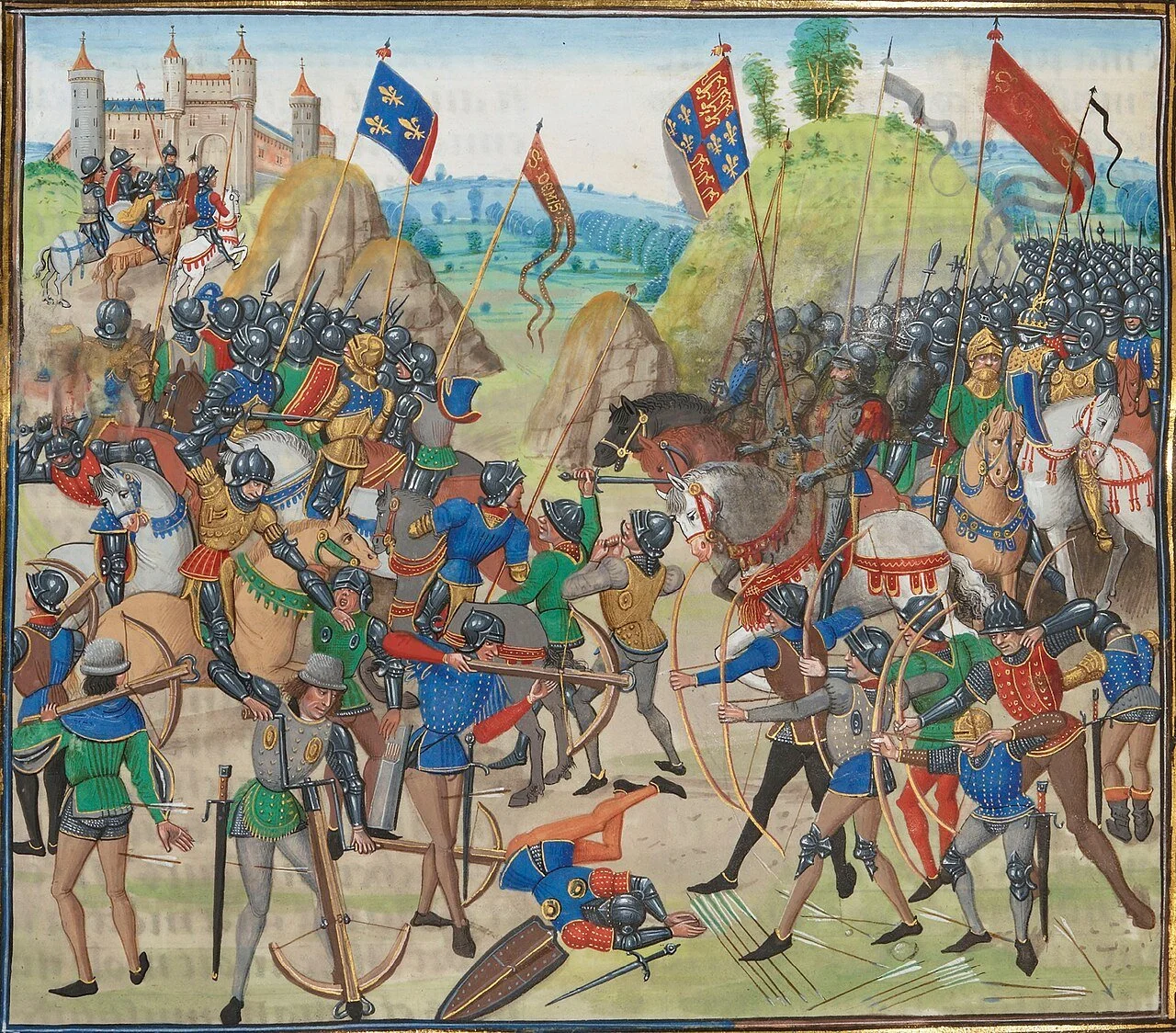
Battle of Crécy. From an illuminated manuscript of Jean Froissart's Chronicles. Source: Public domain, available here.
A Lost Tide
The effects of the Truce of Malestroit challenged the French about whether the world really supported the English cause in France. Signed on January 19, 1343, the truce paused the war until September 1346 and allowed the English to make gains in France, as the treaty was signed in favor of the English. The monarchs did not meet in person as the treaty itself was signed by the Papal legates who mediated between the two crowns. However, the truce did not last long as Edward III was planning something larger, what would become known as the Crécy campaign. Edward also saw that after John, the Duke of Montfort, was released, Charles fought on, which angered Edward further.
In 1344, Charles led a siege in the town of Quimper, in south-western Brittany, which fell shortly after a one-month siege. An estimated 2,000 citizens were killed, and a few hundred English prisoners were captured. John, even though he was in his late 40s, had lost the drive he once had, and fled to England. Edward saw this as a chance to break the truce and sent a large force into Brittany with John to check Charles’ advance. The forces were also led by the Earl of Northampton, who helped John get a victory in Central Brittany that defeated Charles of Blois at Cadoret.
Charles and John were locked in another back-and-forth, with John now looking as though he might be the rightful heir after all. As king, Edward had to raise heavy taxes to fund these campaigns, but this tax raise was largely deferred, since he was already struggling with mounting debt. John tried to recapture Quimper, but died shortly after in September, ending his long struggle for the duchy.
His death shocked many, since he had been the central figure in the dispute, and it plunged the conflict into fresh chaos. Charles now held the upper hand as duke, but the English were far from finished. This also helps explain why Edward broke off the truce: he could see that John was already losing. Crucially, the war had now become a land campaign, with Edward using Breton territory as a springboard to invade France on a far larger scale. He understood the stakes: at heart this remained a succession crisis, not merely another campaign.
The new heir was the 6-year-old John, and his family could only wait for the right moment to intervene and weigh what best served them. Edward’s Gascon campaign would continue to ravage France and inflict humiliating losses on the French leadership. Brittany descended into chaos as English forces used the sea lanes to bring in supplies as fast as ever, sustaining their large-scale offensives in the Gascon region.
The Crécy Campaign
After the fighting resumed in 1345, Edward wanted far more, sensing that a decisive victory was within reach. The truce was meant to last until 1346, but neither side honored it, least of all Edward. It would prove one of the most humiliating defeats the French suffered on their own soil. The brutal campaign saw Edward overrun much of northern France, bringing him a step closer to Paris.
The campaign began with an invasion of Normandy in the summer of 1346, designed to lay waste to the countryside. It came a year after Edward’s victorious Gascon campaign, which had inflicted a heavy defeat on the French in their own lands. For France, Philip VI had to borrow heavily from the papacy to keep France from falling to the English. Edward, by contrast, won strong backing from Parliament, which approved the invasion and the taxes needed to fund it.
The French again employed Italian mercenaries, especially Genoese crossbowmen, while the English drew support from the Flemish and the Holy Roman Empire. The French suffered a humiliating defeat at Caen, but English casualties were also beginning to mount. One problem for Edward during this campaign was not only these losses but also supply, which grew into a serious difficulty for an army of such size. The French also shrewdly denied the English supplies, making it harder for them to advance.
One of the most famous battles was at Crécy, which resulted in heavy French losses. It was also the battle in which the sixteen-year-old Edward, the Black Prince, won his first victory. The fighting was grueling, with both sides locked in a hard struggle until the French were broken. Casualties were heavy: the French lost many thousands, while the English lost only a few hundred. It was a humiliation: the French had the larger army yet were routed, raising hard questions about their leadership. In 1347, after a brutal siege, Calais fell to the English, who held it until 1558. With everything collapsing around them, the French even turned to Scotland, England’s old enemy, for support. That hope collapsed when the Scottish king was captured by the English at Neville’s Cross.
The campaign was a deep embarrassment for France — not only because so large an army had been defeated, but because of how that defeat came about, especially against an English force that seemed to have a clear plan. Edward was well prepared and widely supported; the French, by contrast, were in disarray, already stretched by the war in Brittany. How could France lose, even under Philip’s hands, having lost so much support, even from his own court? Despite these failures, the Truce of Calais was signed in 1347, halting the war for some time, helped in part by the Black Death that struck around 1348. The truce held for some time, surviving the death of Philip in 1350 and the accession of his son as John II.
What Now?
The Crécy campaign is closely bound up with the Breton War of Succession, since both formed part of the wider Hundred Years’ War. France’s defeats shaped much of Brittany’s future, especially now that Edward controlled so much of this territory. Many questions about the campaign remain, but much of the outcome can be put down to France’s financial crisis, poor morale, and weak planning. Charles faced a mounting problem, especially after Crécy: how could he hold on if England held all the cards?
Now read part 45on how the French started to turn the tide (somewhat) here.
Bibliography
GRAHAM-GOERING, E. (2021). Princely power in late medieval France: Jeanne de Penthievre and the war for Brittany. CAMBRIDGE UNIV PRESS.
Sumption, J. (1991). The Hundred Years' War. University of Pennsylvania Press.