The 1847 Battle of Buena Vista was part of the Mexican-American War. It involved hard fighting between US forces led by General Zachary Taylor and Mexican forces General Antonio López de Santa Anna. James F. Byrne Jr explains what happened in the battle.
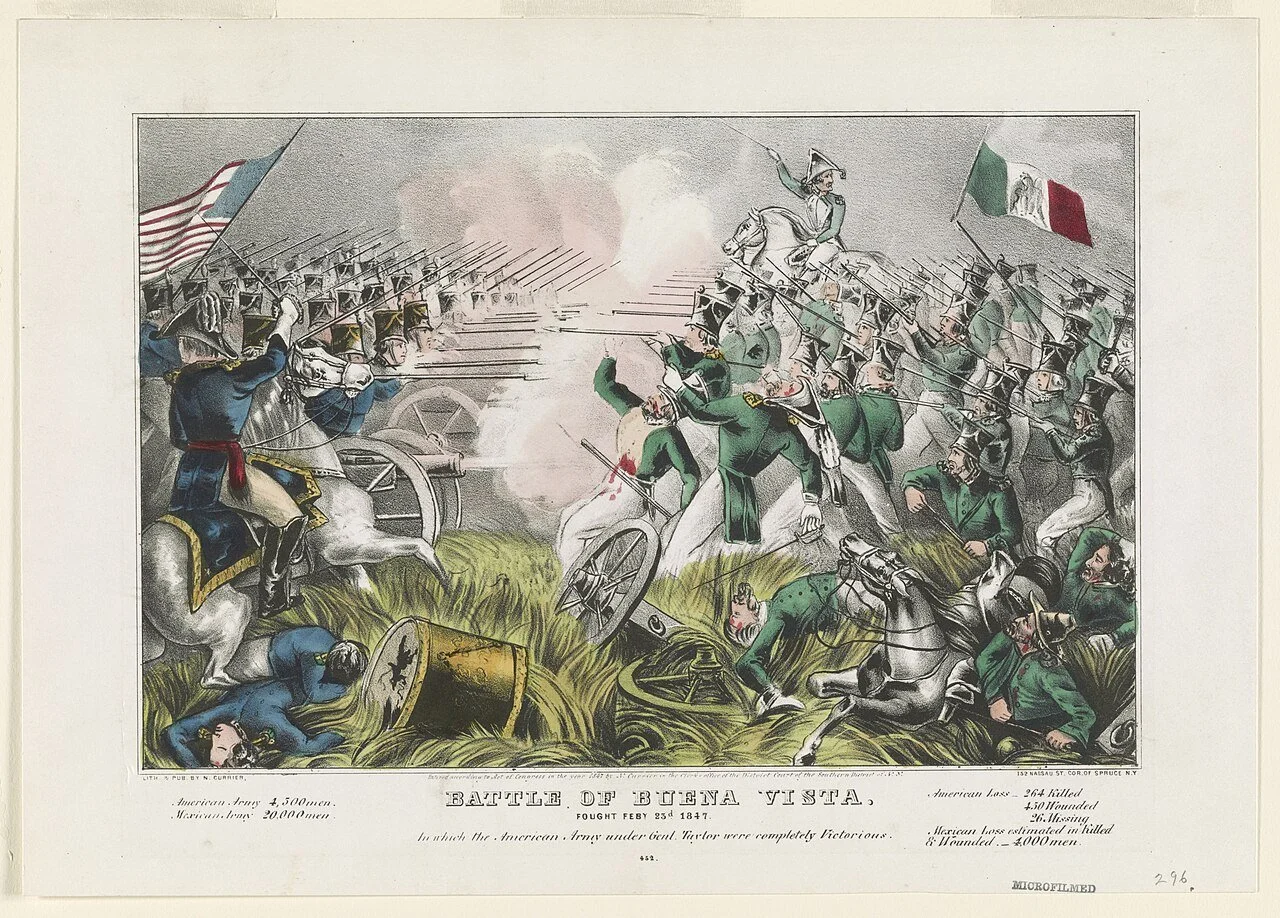
The Battle of Buena Vista. Source: Library of Congress/N. Currier, Public domain, available here.
Returning from an inspection of the frontlines, the staff officer reined in his lathered mount and reported to the commander. Outnumbered, outmaneuvered, and at times outfought, the American soldiers had tenaciously resisted the seemingly inexorable advance of their Mexican foes. However, driven from their positions and their rear area threatened by marauding horsemen, the reeling troops were, according to the staff officer, whipped. “I know it,” responded Major General Zachary Taylor, “but the volunteers don’t know it. Let them alone and we’ll see what they do.” What they would do is fight the Mexican army to a standstill at Buena Vista on February 23, 1847.
Five months into the Mexican War Taylor’s forces had won three major victories and seized much of Northern Mexico. These tactical successes did not produce commensurate strategic results, and the US government ordered an advance on Mexico City. To support this advance, Taylor was stripped of his 9,000 Regulars and instructed to remain on the defensive with his remaining 4,000 volunteers. To add to Taylor’s challenges, General Antonio de Santa Anna raised a new army of 20,000 to clear Northern Mexico of the Yankee invaders.
In mid-January Santa Anna’s scouts captured dispatches detailing the reduction of Taylor’s army. Taking advantage of this intelligence, Santa Anna immediately launched his host north on a 280 mile forced march across a stark, barren landscape.
Santa Anna was marching over territory Taylor believed impassable. In fact, Taylor ignored warnings from his scouts until Santa Anna was within 40 miles of his own force. Finally, convinced that a crisis was at hand, he ordered his command to assume defensive positions at a pass through the Sierra Madre mountains. Unfamiliar with the terrain, he ordered BG John Wool to position and fight the forces, leaving Taylor free to move around the battlefield. Wool established the defense where the main road passed through a narrow defile. Terrain to the west was largely impassable. A plateau to the east was navigable but was crisscrossed by gullies restricting movement. Wood blocked the defile with infantry and artillery and positioned the rest of his force along the plateau to the east.
Santa Anna sent cavalry units around the American left flank to threaten their rear area, while launching massed infantry attacks against the thin line on the plateau. However, his cavalry was unable to overcome the ad-hoc defensive forces assembled behind the American lines, and his infantry, due to the restrictive terrain, was unable to mass its firepower. Woods did a superb job moving infantry to fill gaps and repositioning artillery to seal off Mexican penetrations. As for Taylor, he let his subordinates fight their individual battles. One officer discovered this when seeking guidance. After due consideration Taylor replied, “Give ‘em hell, Bragg.”
The courage of the Mexican soldiers and their superiority in numbers had Santa Anna on the brink of victory by the close of the 2d day. Most of the American officers believed one more push and the Mexicans would carry the day. Instead of a final push, Santa Anna withdrew. Concerned about his lack of supplies and heavy (18%) losses, Santa Anna lost his nerve, the battle, and quite possibly the war. Never again would he take the offensive, and never again would the Mexican army come as close to victory as it did at Buena Vista.
Lessons Learned
Terrain is a force multiplier – Wool’s masterful use of terrain negated the Mexican advantage in numbers.
Operational security is a table stake – Santa Anna’s knowledge of Taylor’s diminished strength nearly had disastrous consequences.
The enemy has their own plans – Taylor’s reluctance to believe Santa Anna would move through barren terrain put his own command at risk.
Let good leaders lead – Taylor had the right people in the right place and expected them to perform.
Did you enjoy the piece? Join us on X here for more: @HistoryIsNowMag