The Avignon Papacy (1309-1376) was the period during which seven successive popes resided at Avignon, in modern-day southern France, rather than at Rome. It followed a bitter conflict between the papacy and King Philip IV of France, and the death of Pope Boniface VIII in 1303 marked a decisive shift in the balance of power within the Church. Talia Bega explains — and looks at the problems with the Church in the 13th century.
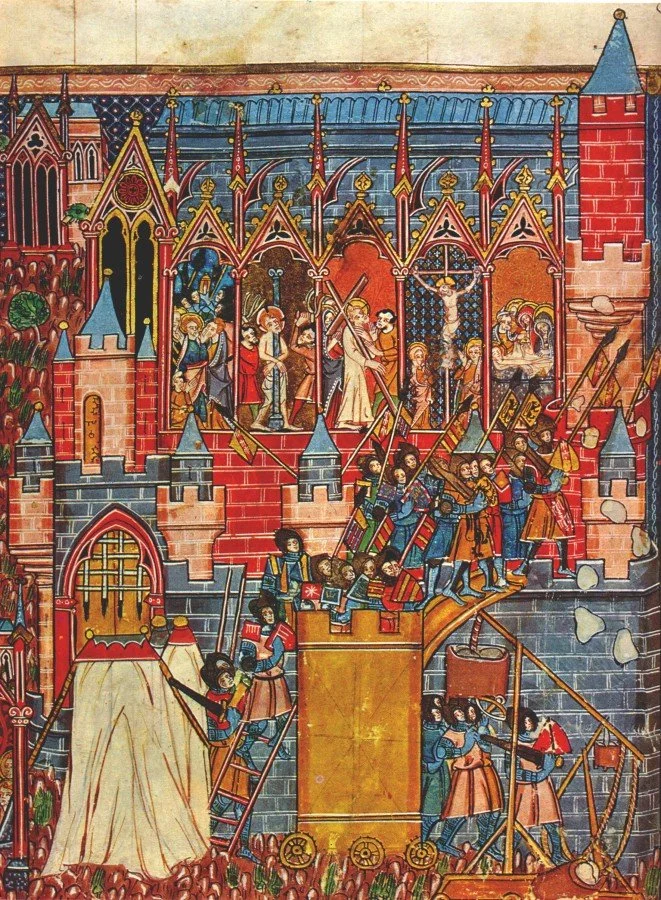
Siege of Jerusalem during the First Crusade. Source: Public domain, Guillaume de Tyr, Historia, BNF ms FR 352 fol. 62, available here.
What was the Church at the Time?
In the Middle Ages the papacy stood at the summit of the Church's hierarchy and wielded an authority that reached deep into government. At a time when Europe's kings were steadily consolidating their power, the Church acted as a check on their ambitions whenever their aims collided with its teaching. Its canon law touched even the conduct of war and the ordinary business of governing. Based in Rome, the pope held the ancient title of Pontifex Maximus, or high priest, and claimed spiritual authority over all Catholics, from questions of law to matters of leadership. After the East-West Schism of 1054 divided the Eastern and Western churches, Catholicism remained the dominant faith of western Europe; but over the following centuries - and especially through the Crusades (1095-1291) - much of the initiative gradually passed to the increasingly centralized kingdoms (Leff 1961, 37). The pope's word carried immense weight, and a ruler who defied it risked excommunication - in effect, banishment from the Church.
Yet monarchs chafed at papal oversight of their every act, and above all at the principle that a war could not lawfully be waged without the Church's sanction (Leff 1961, 37). In France, and especially during the Crusades, the papacy served as a counterweight between throne and altar (Howe 1988, 331). Under pious kings such as Louis IX, personal devotion and asceticism became a way of demonstrating the strength of the faith and of leading his people by example. The thirteenth century, however, brought mounting conflict - the horrors of the later Crusades and the rising power of the Holy Roman Empire - that would challenge the Church anew.
The Crusades grew out of a single pressing question: how could Christendom regain access to the Holy Land - and above all Jerusalem, the site of Christ's crucifixion and resurrection - after these territories passed into Muslim hands?
The First Crusade was a startling success. Preached by Pope Urban II at the Council of Clermont in 1095 as an armed pilgrimage to Jerusalem, it culminated in the capture of the city in 1099 and the founding of the Kingdom of Jerusalem, alongside a cluster of other Crusader states such as the County of Edessa, the Principality of Antioch, and the County of Tripoli. The kingdom had its own Latin patriarch at the head of its church and drew nobles from across Europe to defend it, becoming for a time a stronghold of Latin Christian authority in the East - though rivalries among kingdoms such as France and England limited what it could achieve. Its ascendancy did not last: in 1187 Jerusalem fell to Saladin, and the struggle to recover it would consume the Church for generations, even as the kingdom's own nobility fractured into infighting.
At the start of the thirteenth century Pope Innocent III launched the Fourth Crusade. It became a notorious debacle: instead of striking at Egypt, the Crusaders turned on the Christian Byzantine Empire and sacked its capital, Constantinople, in 1204 (Queller 1974, 461), establishing the Latin Empire that endured until 1261 (Madden 2012, 313). That Christians had made war on fellow Christians appalled contemporaries and drew excommunications, and the campaign left the Church more heavily indebted and secular rulers more powerful over the conquered lands (Madden 2012, 317). Later Crusades fared little better - most disastrously the Seventh, led by Louis IX of France, who was taken captive in Egypt.
The Crusades left a deep mark on the Church, forcing hard questions about how it was to survive and sustain itself. Powerful kingdoms - France, England, and the Holy Roman Empire among them - increasingly cast themselves as its champions, and their rulers cultivated close ties to the Church in order to enlarge their own influence (Queller 1974, 459). Nowhere was that ambition sharper than in the second great pressure on the papacy: the Holy Roman Empire, which seized whatever advantage it could.
The Holy Roman Empire
The Holy Roman Empire did not spring directly from the fall of Rome in 476; it took shape centuries later, conventionally dated to the coronation of Charlemagne in 800 and refounded under Otto I in 962. Centered on Germany but reaching into Burgundy and much of Italy, it cast its rulers as heirs to Rome - indeed as kings of the Romans - and their imperial coronations traditionally took place in Rome, in echo of Charlemagne's. Throughout the Middle Ages these emperors clashed repeatedly with the Church, above all over their claims in Italy. One of the most troublesome was Frederick Barbarossa, whose long series of campaigns in northern Italy - against the cities of the Lombard League and the popes who backed them - brought him into open conflict with Rome. His dynasty's grip on Sicily came only later, through the marriage of his son, the future Henry VI, to the Norman heiress Constance.
Barbarossa's defiance made him one of the first emperors to provoke a serious rupture with the Church, and the contest over imperial authority in Italy carried on into the thirteenth century. Again and again, he sought to extend his power, and again and again he met resistance on every side; only after years of conflict - and a public reconciliation with Pope Alexander III at the 1177 Peace of Venice - was an uneasy peace restored.
Tensions sharpened further with the capture of Richard the Lionheart, seized in December 1192 by Duke Leopold V of Austria as he made his way home from the Third Crusade and handed the following year to Emperor Henry VI, who held the English king for a vast ransom - a striking assertion of imperial power over a fellow monarch, and one the Church condemned. A generation later another formidable emperor, Frederick II, held the crowns of both Sicily and - through his marriage to Isabella II (Yolande) of Jerusalem - the Kingdom of Jerusalem, and was determined to press his authority in the Holy Land. He was excommunicated by Pope Gregory IX in 1227 for repeatedly delaying the crusade he had vowed to lead, and again in 1239 as the breach between emperor and papacy widened (Bird 2022, 87). Frederick's hunger for territory, above all Sicily and southern Italy, which he claimed as the Norman heir, made a collision with the Church all but inevitable, for the papacy was equally unwilling to surrender its authority over the empire (Powell 1963, 493). Significant tension resumed after Innocent IV became pope in 1243, and at the First Council of Lyon in 1245 the pope issued the bull Ad apostolicae dignitatis apicem, which declared Frederick deposed and unworthy to rule and released his subjects from their allegiance (Powell 1963, 490). The sentence changed little on the ground: Frederick fought on, campaigning in Lombardy until his death in 1250.
Such pressure was precisely what the papacy could least afford. Hemmed in on every side, how was it to grow, let alone hold its ground? Sicily remained a source of friction for decades after Frederick's death, and arguably taught later kings that the Church could be defied with impunity. The signs of weakness were unmistakable, not least the papacy's dwindling ability to field armies of its own. These pressures - among many others, from chronic shortages of money to the loss of territory - helped pave the road to Avignon, especially once ambitious monarchs such as Philip IV set out to bend the Church to their will (Leff 1961, 38). The Crusades stand as a vivid example of the damage done across Europe, and of the lessons learned, from the raising of armies to the question of whom to trust. Central as the Church had been, by 1309 it had passed effectively into French hands - a shift that would reshape its diplomacy and, in the eyes of many, shatter its old authority.
The Church on the eve of Avignon
Why dwell on the Crusades and the Holy Roman Empire before turning to Avignon? Together they acted as a catalyst for the decline of a once-dominant Church, exposing the corruption - the bribery and the diplomatic blunders - that ran through the crusading effort and the long struggle with the empire. They also reveal a pattern about power: rulers like Philip IV were now ready to exploit the popes. When Philip sought funds for his campaigns early in the fourteenth century, Boniface VIII refused him - a confrontation that ended in the pope's downfall and, a few years later, in the suppression of the Knights Templar (Théry 2013, 120). Philip, like Frederick before him, saw a Church at its weakest and moved to remake it to his advantage.
The Crusades are the clearest evidence of the strain the Church faced entering the fourteenth century: the Holy Land had been lost for good, and Europe now had to hold together simply to keep the Church intact. The Avignon Papacy that began in 1309 gathered a succession of French popes who governed from Avignon and sought a more centralized authority. Some seventy years on, the papacy would fracture in the Western Schism, when rival claimants - two, and eventually three - split Latin Christendom. The pattern rhymes with what came before; but to understand how matters reached a head in 1309, we must first trace the long road that led there.
Now read about the War of the Breton Succession here.
References
BIRD, JESSALYNN LEA. “PROPHECY, ESCHATOLOGY, GLOBAL NETWORKS, AND THE
CRUSADES, FROM HATTIN TO FREDERICK II.” Traditio 77 (2022): 31–106. https://www.jstor.org/stable/27191187.
Howe, John. “The Nobility’s Reform of the Medieval Church.” The American Historical Review 93, no. 2 (1988): 317–39. https://doi.org/10.2307/1859921.
Leff, Gordon. “Heresy and the Decline of the Medieval Church.” Past & Present, no. 20 (1961): 36–51. http://www.jstor.org/stable/650135.
Madden, Thomas F. “The Venetian Version of the Fourth Crusade: Memory and the Conquest of Constantinople in Medieval Venice.” Speculum 87, no. 2 (2012): 311–44. http://www.jstor.org/stable/23488041.
Powell, James M. “Frederick II and the Church: A Revisionist View.” The Catholic Historical Review 48, no. 4 (1963): 487–97. http://www.jstor.org/stable/25017141.
Queller, Donald E., Thomas K. Compton, and Donald A. Campbell. “The Fourth Crusade: The Neglected Majority.” Speculum 49, no. 3 (1974): 441–65. https://doi.org/10.2307/2851751.
Théry, Julien . “A Heresy of State: Philip the Fair, the Trial of the ‘Perfidious Templars,’ and the Pontificalization of the French Monarchy.” Journal of Medieval Religious Cultures 39, no. 2 (2013): 117–48. https://doi.org/10.5325/jmedirelicult.39.2.0117.