Before the axe fell on the cold January afternoon of 1649, England had already crossed political frontiers that few believed could ever be crossed. For centuries, kings had ruled by inherited right, anointed in sacred ceremonies that proclaimed their authority came from God rather than from the consent of those they governed. Monarchs might lose battles, be deposed by rivals or even die violently in civil wars, but the institution of monarchy itself remained untouchable. The idea that a reigning king could be placed on public trial by his own subjects, judged by a court invoked specifically for that purpose, convicted as a criminal, and deliberately executed in the name of the people was almost unimaginable. Yet this extraordinary sequence of events unfolded during the English Civil War, transforming not only England but also the political imagination of Europe. The execution of King Charles I marked one of history's greatest constitutional revolutions, challenging ancient assumptions about sovereignty, justice and the relationship between rulers and the governed.
You can read part 1 on the background to the war here, part 2 on how the English Civil War began here, part 3 on the New Model Army the turning of the tide here, and part 4 on the King’s defeat here.
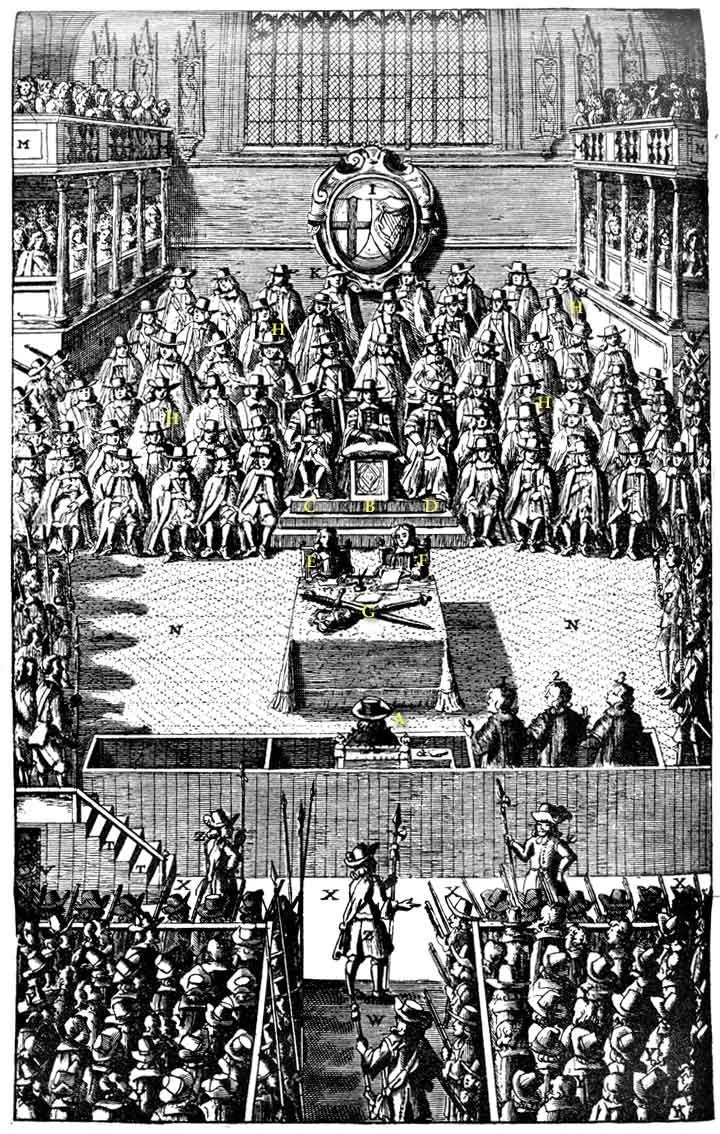
King Charles I on trial. Source: Public domain, engraving from "Nalson's Record of the Trial of Charles I" in the British Museum, available here.
The victory of the New Model Army over Royalist forces had not brought peace. Instead, it exposed profound divisions within Parliament itself. Many Members of Parliament still hoped to negotiate with Charles, believing that monarchy remained essential for national stability despite the years of bloodshed. Others, particularly senior officers within the army, had reached a very different conclusion. To them, Charles had repeatedly demonstrated that no agreement could ever be trusted. He had entered negotiations while secretly encouraging renewed conflict, sought military assistance from foreign powers, and supported a second civil war that had claimed thousands more lives after his earlier defeat. Every attempt at compromise appeared only to encourage further violence. Increasingly, influential figures within the army concluded that lasting peace could never be achieved while Charles remained alive.
The growing determination to bring the King to justice culminated in one of the most dramatic political interventions in English history. In December 1648, Colonel Thomas Pride led soldiers into Parliament and physically prevented Members who favored further negotiations with Charles from entering the House of Commons. This event, remembered as Pride's Purge, fundamentally altered England's political landscape. Those remaining formed what became known as the Rump Parliament, a much smaller body that was willing to pursue measures previously considered impossible. By excluding moderate voices, the army ensured that Parliament would no longer seek reconciliation but instead prepare the unprecedented legal machinery required to put a king on trial.
Evolving a court capable of judging the sovereign presented enormous constitutional difficulties. English law had always recognized the monarch as the ultimate source of justice. Courts operated in the King's name, judges exercised authority granted by the Crown, and legal proceedings assumed that the King himself stood above the law. There existed no legal precedent for trying a reigning monarch because the legal system itself derived its legitimacy from the monarchy. Parliament therefore established an entirely new institution, the High Court of Justice, specifically designed to hear the case against Charles I. It represented a revolutionary departure from centuries of constitutional tradition, asserting that legal authority could exist independently of the Crown.
The legal arguments advanced by the prosecution reflected equally revolutionary ideas. Rather than accusing Charles of ordinary crimes, the court charged him with being a tyrant, traitor, murderer and public enemy of the people of England. According to the indictment, Charles had abused the authority entrusted to him by waging war against his own subjects and causing immense suffering throughout the kingdom. The prosecution argued that sovereignty ultimately rested not with the monarch but with the people, represented through Parliament. By violating the trust placed in him, Charles had forfeited his right to govern. This concept overturned the traditional doctrine of divine right, replacing it with the radical proposition that rulers were accountable to those they governed.
Such reasoning reflected broader changes that had been gathering strength throughout the seventeenth century. Political thinkers increasingly questioned whether kings possessed unlimited authority simply because of birth. Religious debates about conscience, liberty and the relationship between God and government had encouraged many to reconsider long-established assumptions about power. The Civil War accelerated these developments by forcing English society to confront fundamental questions. If a king deliberately destroyed the laws he had sworn to uphold, who possessed the authority to restrain him? Could a ruler who attacked his own people still claim divine protection? These questions lay at the heart of Charles's trial.
Charles himself refused to accept the legitimacy of the proceedings from the moment he entered the courtroom. Calm, composed and maintaining the dignity expected of a monarch, he consistently challenged the authority of the judges rather than answering the charges against him. He repeatedly demanded to know by what lawful authority the court claimed jurisdiction over an anointed king. Since no recognized legal body possessed the right to try the sovereign, Charles argued that the entire process was illegal and unconstitutional. He refused to plead either guilty or innocent, believing that participation would acknowledge the court's legitimacy. Throughout the trial, he remained steadfast in defending both his personal innocence and the ancient institution of monarchy.
Observers recorded Charles's remarkable composure during the proceedings. Even political opponents acknowledged the dignity with which he conducted himself. His refusal to submit transformed the trial into a contest over constitutional principles rather than merely a criminal prosecution. Supporters viewed him as courageously defending lawful monarchy against revolutionary extremists, while his enemies interpreted his silence as further evidence of arrogance and unwillingness to recognize the rights of the nation. The courtroom therefore became not simply a place of legal judgement but a stage upon which competing visions of government confronted one another before the eyes of England and Europe.
Public reaction to the trial was deeply divided. Many ordinary people struggled to comprehend events that seemed to overturn the natural order established by centuries of tradition. Royalists regarded the proceedings with horror, believing that England had descended into lawlessness by placing God's anointed sovereign before a human tribunal. Ministers sympathetic to the Crown denounced the trial from their pulpits, warning that divine punishment would surely follow such sacrilege. Others, particularly supporters of Parliament who had witnessed years of warfare and devastation, believed justice demanded that even a king should answer for the suffering caused under his rule. Yet even among those hostile to Charles, many hesitated at the prospect of execution. Removing a monarch from power seemed one matter; deliberately putting him to death was quite another.
Printed pamphlets, sermons and newspapers played a central role in shaping public opinion throughout these extraordinary weeks. Both Royalists and Parliamentarians recognized that control of information had become a powerful political weapon. Royalist publications portrayed Charles as a Christian martyr who patiently endured persecution for defending lawful government. Parliamentary writers instead presented him as a dangerous tyrant whose ambition had plunged the nation into civil war. Woodcut illustrations, public speeches and printed declarations circulated widely, each attempting to persuade readers that history and providence favored one side or the other. The struggle for public opinion had become almost as important as the military victories that had preceded it.
On the 27th of January, 1649, the High Court pronounced Charles guilty. Three days later, on the bitterly cold afternoon of 30 January, the sentence was carried out outside the Banqueting House at the Palace of Whitehall. A specially constructed scaffold stood before a large crowd gathered in uneasy silence. Charles wore an extra shirt beneath his clothing, explaining that he wished to avoid shivering in the winter air lest observers mistake natural cold for fear. Shortly before his execution, he declared that he died "the martyr of the people," insisting that true liberty consisted not in popular government but in living under established laws administered by a lawful king. Moments later, he laid his head upon the executioner's block.
With a single stroke of the axe, centuries of constitutional tradition came to an abrupt and shocking conclusion. Contemporary accounts describe a collective groan rising from the assembled crowd as the executioner raised the severed head and proclaimed the sentence fulfilled. Many spectators wept openly, while others stood in stunned silence. Some reportedly dipped handkerchiefs into the King's blood, preserving them as relics of a man they believed had died a martyr. Regardless of political allegiance, few present could fully comprehend the enormity of what had occurred. England had executed its own sovereign by deliberate judicial process, an event without precedent in its national history.
News of the execution spread rapidly across England and throughout Europe, provoking disbelief, outrage and fascination. Continental monarchs viewed the regicide with alarm, recognizing that if an English king could be tried and executed by his subjects, then the principle of hereditary monarchy itself faced an unprecedented challenge. Royal courts issued formal condemnations, while many foreign observers regarded the English experiment as both dangerous and extraordinary. Across Europe, governments closely watched developments in England, aware that revolutionary ideas could cross national boundaries as readily as armies.
Within England, the political revolution continued at remarkable speed. Parliament formally abolished the monarchy, declaring that the office of king had become unnecessary, burdensome and dangerous to the liberty and welfare of the people. Soon afterwards, the House of Lords was also abolished because it served no useful purpose within the new constitutional order. These decisions swept away institutions that had shaped English government for centuries. What had begun as resistance to royal policies had evolved into the complete dismantling of the traditional structure of the English state.
In place of monarchy, Parliament proclaimed England to be a Commonwealth. The nation would henceforth be governed as a republic, with authority exercised in the name of the people through Parliament rather than through a hereditary sovereign. Although the practical reality remained heavily influenced by the army and its commanders, the declaration represented an extraordinary constitutional innovation. England had become one of the very few European states to reject monarchy entirely in favor of republican government. The transformation demonstrated how profoundly the Civil War had altered political thinking within less than a decade.
Yet the new Commonwealth faced immediate challenges in establishing legitimacy. Many people remained loyal to the monarchy, while Scotland proclaimed Charles II as the rightful king almost immediately after his father's execution. Ireland likewise became a center of Royalist resistance. The republic therefore emerged not into peace but into renewed conflict, requiring military campaigns to secure its authority across the British Isles. The abolition of monarchy had resolved one constitutional crisis while producing another, forcing the new government continually to defend both its existence and its principles.
Propaganda became indispensable in sustaining the revolutionary regime. Parliamentary publications celebrated the execution as an act of justice that had liberated England from tyranny, presenting the Commonwealth as the beginning of a more righteous political order. Royalist writers responded with equal determination, portraying Charles I as a saintly martyr whose death demonstrated the wickedness of the revolution. One of the most influential works, Eikon Basilike, published shortly after the King's death, depicted Charles as a deeply pious ruler betrayed by ambitious enemies. Whether genuinely written by Charles or compiled by supporters, the book became an immediate bestseller and transformed the dead king into a powerful symbol of loyalty, sacrifice and divine kingship. Parliament responded by commissioning works defending the execution, recognizing that the battle for historical memory had become almost as significant as the struggle for political power itself.
The symbolism surrounding the regicide extended far beyond England. Philosophers, theologians and political thinkers debated its meaning for generations. Some interpreted the execution as proof that rulers could be held accountable under law, laying intellectual foundations for constitutional government and popular sovereignty. Others regarded it as a dangerous precedent that threatened social order by encouraging rebellion against legitimate authority. These competing interpretations would influence political revolutions across Europe and the wider world, from the Enlightenment to the American and French Revolutions.
The trial and execution of Charles I therefore stand among the defining moments in the history of constitutional government. The event permanently altered the relationship between monarchy, Parliament and the law, demonstrating that political authority could be questioned, challenged and ultimately transformed through revolutionary action. Although the Commonwealth itself would prove short-lived, many of the ideas unleashed during these years survived long after the monarchy returned. The belief that government derives legitimacy from the consent of the governed, that rulers are accountable for their actions, and that sovereignty ultimately belongs to the nation rather than solely to a hereditary monarch would continue to shape the evolution of modern democracy.
England's constitutional revolution thus reveals far more than the death of a single king. It marks the dramatic collision between medieval concepts of sacred monarchy and emerging ideas of representative government, between inherited authority and political accountability, between divine right and parliamentary sovereignty. The execution at Whitehall shattered centuries of accepted political doctrine and forced England, and indeed Europe, to confront profound questions about power, legitimacy and justice that remain central to constitutional debate today. Even now, nearly four centuries later, the image of a king standing calmly upon the scaffold continues to symbolize one of history's most extraordinary moments, when a nation declared that no ruler, however exalted, stood beyond judgement.
Needless to say, the execution of Charles I did not bring an end to England's political upheaval; rather, it opened a new and uncertain chapter in which every assumption about government would be tested. The Commonwealth that emerged in the King's absence would soon discover that removing a monarch was considerably easier than constructing a stable republican state. Internal divisions, military authority, religious tensions and competing visions for England's future continued to shape events, ultimately leading to the rise of Oliver Cromwell as Lord Protector and, after his death, the eventual restoration of the monarchy in 1660. Yet the Restoration could not simply erase what had occurred. No subsequent English monarch could entirely ignore the lessons of the Civil War or the extraordinary fact that one of their predecessors had been called to account by his own people.
Perhaps the greatest legacy of the regicide was not the brief existence of the Commonwealth but the permanent transformation of political thought. Before 1649, the doctrine of the Divine Right of Kings had appeared almost beyond challenge. Afterwards, it could never again command unquestioned acceptance. Even those who condemned the execution of Charles I were forced to confront a new political reality: monarchy was no longer viewed by all as an institution beyond criticism or restraint. The events of the Civil War had demonstrated that political authority rested not solely upon tradition and hereditary succession, but also upon legitimacy, public confidence and the willingness of a nation to accept the exercise of power. The balance between Crown and Parliament would remain contested for decades, culminating in the Glorious Revolution of 1688 and the constitutional settlement that firmly established parliamentary supremacy.
The trial also introduced a principle that has echoed through subsequent centuries: that no ruler should be entirely beyond the reach of the law. Although the legal arguments employed against Charles I were controversial and remain debated by historians, they represented one of the earliest and most dramatic assertions that political leaders could be held personally accountable for the consequences of their actions. In this respect, the High Court of Justice foreshadowed ideas that would eventually influence constitutional government, international law and the modern expectation that even the most powerful individuals may be judged according to legal standards rather than personal status.
Equally significant was the role played by public opinion throughout these revolutionary years. The Civil War was fought not only with muskets and cannon but also with sermons, pamphlets, newspapers and books. Competing narratives sought to define Charles either as a tyrant who deserved justice or as a saintly martyr who died defending lawful government. The remarkable success of Eikon Basilike demonstrated the extraordinary power of the printed word to shape national memory, while Parliament's determined efforts to counter its influence revealed an emerging understanding that political legitimacy depended as much upon persuasion as upon military victory. In many respects, the propaganda battles of the seventeenth century anticipated the central role that public opinion continues to play in modern democratic societies.
For historians, the execution of Charles I remains one of the defining turning points in the evolution of the modern state. It encapsulates the recurring themes that have run throughout the English Civil War: the conflict between divine monarchy and parliamentary sovereignty, the powerful influence of religion upon political life, the emergence of competing political ideologies, the growing importance of propaganda, the decisive role of military innovation, and the enduring struggle to establish legitimate government. Above all, it demonstrates that constitutional change is rarely achieved without profound conflict or sacrifice.
Nearly four centuries later, the scaffold erected outside the Banqueting House at Whitehall continues to cast a long shadow across British constitutional history. The image of Charles I kneeling before the executioner's block remains one of the most enduring and symbolic moments in Western political history, not simply because a king died there, but because an ancient understanding of sovereignty died with him. From that cold January afternoon emerged new and enduring questions about liberty, accountability, representation and the limits of political power. Those questions would shape not only the future of England but also the development of constitutional government across the world. The regicide of 1649 therefore stands not merely as the dramatic conclusion to a civil war, but as one of the great watershed moments in the continuing evolution of democratic government and the rule of law.
Now read part 6 on the English Republic that became a new monarchy here.
Note:
Eikon Basilike (Greek: Εἰκὼν Βασιλική) translates into English as "The Royal Image" or, more fully, "The Image of the King."
The complete title of the book is often rendered as: Eikon Basilike: The portraiture of His Sacred Majesty in his solitudes and sufferings