
A little-known aspect of history revolves around the Christian Samurai of medieval Japan. Some might know that Pope Francis beatified the feudal medieval Japanese daimyo Justo Takayama Ukon (1552-1615), who was persecuted and exiled from Japan for his faith as the country’s rulers became hostile to Christians, forcing their conversion or expulsion. Few emulated Takayama, who stood firm in the faith, refusing to recant Christ and forgoing his rich inheritance and prestige and power. But he was neither the first nor the last feudal Japanese Christian lord in the islands to need correcting by the government.
Jeb Smith explains.
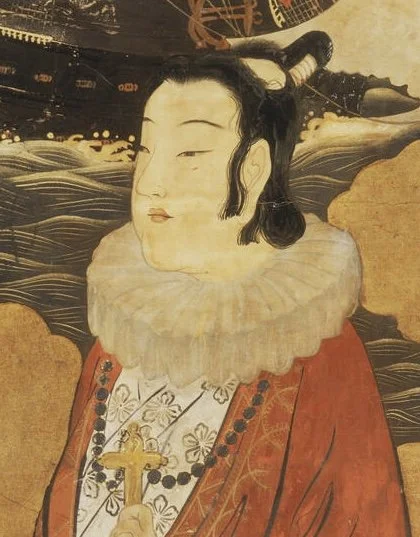
Masuda Shiro Tokisada/Amakusa Shirō (Christian name Geronimo Francisco). Source: Art Seattle Museum, Public domain, available here.
I recently completed Christ’s Samurai by Professor Jonathan Clements, who wrote that “In 1638, the ruler of Japan ordered a crusade against his own subjects, a holocaust upon the men, women, and children of a doomsday cult…the Christians would have to die.” But why would the Shogun do such a thing, to his own people?
Christianity was spreading; formerly common among the lower classes, it was now influencing many lords in southern Japan, especially in the Shimabara region. These rebellious Christians claimed there was another god above the divine emperor, one owed fealty exceeding that due to any human or government of this world. After a devastating civil war which reversed the upward trend of Christianity, with many Christian Samurai perishing, the Shogun did not want any more internal trouble. He isolated Japan from the West, and all missionaries were killed, exiled or went into hiding. Persecution of Christians began, the government desiring a people unified around the twin pillars of Shinto and Buddhism.
Growth of Christianity
Jesuits had brought a printing press to Japan, and various Christian works spread rapidly, converting many. At one point, Nagasaki was home to 60,000 Christians. In 1580, the city and its surrounding region was placed under Jesuit administration, with 150,000 Christians and 200 churches, staffed by 85 priests. Many of the Samurai were Christian as well, and they decorated their swords and armor and flags with Christian symbols.
The first anti-Christian law was enacted in 1587. By 1596, Japanese rulers were convinced that missionaries were secretly collaborating with the Spanish crown to unseat the Shogun and convert Japan to Christianity. In 1597, 26 Christians (both European and Japanese), missionaries and laymen, were crucified. More widespread persecution followed, mostly against Catholics, including gruesome public executions, various brutal forms of torture and expulsion from Japan. Inquisitors were sent to homes to discover and punish Christians.
Eventually, the government killed anyone suspected of Christian allegiance, and they forced any suspect to prove they were not Christian by renouncing Christ, Mary, and the saints, ensuring they held no loyalties to some foreign God beyond the sea. In 1614, Catholics were banished from Japan entirely. The island country, known for its isolationist ways, was to be kept “pure” from outside forces economically, politically, and religiously. Yet, there remained over 300,000 Christians in Japan at this time.
The Resistance
Masuda Shiro Tokisada (Christian name Geronimo, the Spanish form of Jerome) was born into a Christian Samurai family c. 1621. Though the religion was persecuted, the family was one of many that were part of the underground church, which also hid foreign and domestic priests and evangelists. In an echo of long-ago Roman days, many at this time willingly faced martyrdom, turning themselves in, from all ages, to tell government officials that they were Christians just to be killed; even being very respectful to those who would kill them, and also very kind. The martyrs' behavior bothered governmental officials, especially since all they had to do was tell a white lie and be left alone. Instead, the underground church that Geronimo and his family were part of faced constant persecution involving brutal torture and death.
For example, sometimes they would be scalded in water, or drowned slowly over days, their flesh cut, dipped in hot water until near death, just to be pulled out and the torture repeated over and over. However, it was not just religion that was punished, but also tax evaders faced such torture and murder as well. And it was a mix of persecution of local Christians and also heavy taxation in the area that led to rebellion.
It began in 1637. Rebellion started when, as usual, citizens who were discovered to be Christians were rounded up and executed, but the locals, in turn, then killed one of the government officials, in part because of the brutal torture of various non-compliant young women. This had outraged the local rural farming communities, many of whom were underground Christians. Thought to be a rabble of peasant farmers, many were former Christian lords and samurai who had taken up farming after losing their status during an earlier civil war, often hiding in rural areas to practice their religion.
They began by burning down Buddhist temples while the rebels adorned their clothing and hairstyles with Christian symbolism. And then engaged in various battles and skirmishes, achieving many victories. The rebels were helped by the fact that the governmental forces consistently underestimated their ability, not realizing they had a decent number of former samurai, and instead thought of them as just rural peasant farmers, thus allowing the rebels to gain multiple small-scale victories.
Though he was young, Geronimo became the leader of the resistance. A fiery preacher, he was said to be a miracle worker sent by God to lead the rebellion. The rebels never expected victory, they prepared for and assumed death. They were vastly outnumbered, had few weapons to match the government's, no armor, and most were peasant farmers with no experience, but they were fighting for eternal reasons and were willing, even desiring, to die for the faith. After various local successes in battle and advances, they decided it was enough. Instead of advancing and capturing more towns, they chose a defensive position to gather and be besieged and die together, this in turn allowing the opposition to mass its forces for a final battle.
Eventually, the rebels settled into a ruined fort to defend themselves, constructing timber barricades to supplement the broken-down walls. They then, surprisingly, repelled multiple attempts by governmental forces to break through their defenses. They even taunted the professional army and told them just how fearless they were. Geronimo told his men “as we have resolved to sacrifice our lives for the sake of our religion it is not to be supposed that we will easily be overthrown.” They proclaimed to their opponents “We have assembled in this castle merely to sacrifice our lives for our religion here, and then depart to the future world…in the present world we must meet the punishment of the sword, but in the future, we will, without a doubt, be raised on high.” The defenders did what they could to avoid a long siege as they would rather die fighting, but after multiple failed attempts, a siege ensued that lasted for months.
The governmental forces even brought in a Dutch ship and massive artillery to bombard the fort. After the garrison began to starve and suffer from artillery fire, the defenders were allowed to go home so long as they would disown Christianity and accept Buddhism. They refused, and after months of siege, the starving, depleted garrison was assaulted and taken. They fought to the death, many women leaping off a cliff rather than surrender, and horrifically, some burning themselves and their children alive. Some ran into burning buildings and lay on top of their children, so they also would die rather than be taken by the invaders. Out of ammunition and even rocks, the final assault by the professional and modern governmental army was at times met with pots and pans being thrown from the castle walls.
After the defeat of the rebels, universal Buddhism was instituted to unify the people and prevent further wars, while maintaining the Japanese shogun and government as the sole authority; no other gods or allegiances were allowed. Persecution of the remaining Christians continued until the church was all but eradicated.
The few traders that were allowed must first reject Christian principles before admission to the islands. All written works of Christians were burned and destroyed. But word of mouth remained, and when in the 19th century Japan was forcibly opened to Western contact it was found that a hidden church had endured the intervening centuries in rural areas. Although without written texts various heretical beliefs had crept in, a form of Christianity had survived, once again, despite persecution and repression by all the power of the State.
Now read about the person who opened the world of Japan to the West here.
Jeb Smith is an author, speaker, and historian who has written five books, published over 130 articles in several publications, and has been featured on various podcasts, television, and radio interviews. For speaking engagements, interviews, or questions, please get in touch with him at authorJebSmith.com.
_(cropped_2).jpg)