
On a cold January afternoon in 1649, the executioner's axe severed far more than the head of King Charles I. It also shattered centuries of political tradition. Never before had an English monarch been publicly tried, condemned by his own subjects and executed in the name of the people. With the monarchy abolished and the House of Lords dissolved, England stood on uncertain ground. For the first time in its history, the kingdom would attempt to govern itself without a king. The experiment would become known as the Commonwealth of England, and at its center stood one man whose influence would shape the nation for generations: Oliver Cromwell.
Terry Bailey explains.
You can read part 1 on the background to the war here, part 2 on how the English Civil War began here, part 3 on the New Model Army the turning of the tide here, part 4 on the King’s defeat here, and part 5 on King Charles I’s trial and execution here.
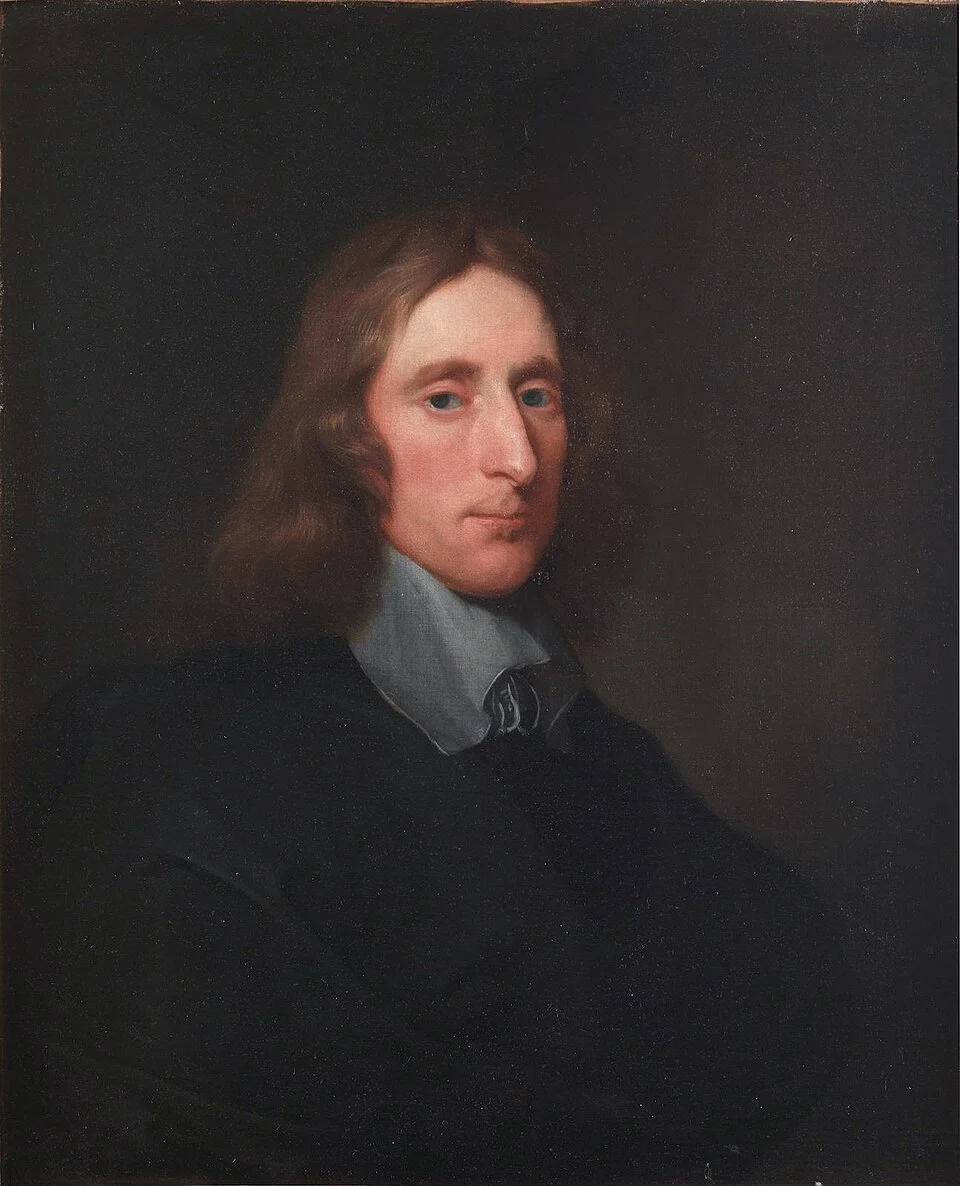
Richard Cromwell (1626-1712), Second Lord Protector by Gerald Soest. Source: Public domain, rom Theo Johns Fine Arts, London, available here.
To many contemporaries, Cromwell was the faithful servant of God who had delivered England from tyranny and sought to build a nation founded upon righteousness. To others, he was little more than a military dictator whose authority came not from law or consent but from the swords of the New Model Army. His life remains one of the most controversial in British history because it embodies one of history's great paradoxes. The man who helped destroy absolute monarchy would eventually wield powers strikingly similar to those of the kings he had overthrown.
The abolition of the monarchy in May 1649 marked a constitutional revolution without precedent. England was formally declared a Commonwealth, a republic in which sovereignty theoretically rested with the people through Parliament rather than through hereditary monarchy. The House of Commons became the sole legislative authority, while executive power rested in the Council of State. Royal titles disappeared from official documents, coins no longer bore the king's portrait, and England briefly attempted to redefine itself as a nation governed by republican principles.
Yet from the beginning, the Commonwealth faced immense challenges. Royalists refused to recognize its legitimacy, while many ordinary people regarded the abolition of the monarchy with suspicion. Throughout Europe, monarchs viewed the English experiment with horror, fearing revolutionary ideas might spread across their own kingdoms. Charles II, the executed king's eldest son, immediately claimed the throne and sought support abroad, ensuring that England's civil wars were far from over.
Religion remained inseparable from politics. The Parliamentarians had not fought merely to alter government but to invoke what many believed would be a godly nation. Cromwell, deeply influenced by Puritan theology, viewed England as a people chosen by divine providence. He believed victories in battle were evidence of God's favor and interpreted national events through the lens of Scripture. In his mind, England had entered into a covenant with God, and success depended upon national obedience to divine law.
The greatest immediate threat to the new republic emerged in Ireland. The Irish Confederate Wars, combined with Royalist alliances, had produced a dangerous base from which Charles II might reclaim England. Parliament therefore entrusted Cromwell with commanding an expedition to restore English control.
The Irish campaign of 1649 became one of the darkest chapters in British and Irish history. Cromwell landed with approximately 12,000 experienced soldiers of the New Model Army, veterans hardened by years of civil war. His first major objective was the fortified town of Drogheda. After breaching its walls, Parliamentarian forces stormed the town. Cromwell ordered that no quarter be given to many of the defenders, resulting in the deaths of several thousand soldiers and civilians.
Contemporary accounts and later historical research suggest that between 2,500 and 3,500 people were killed during the sack of Drogheda, although precise figures remain debated. Similar events followed at Wexford. Cromwell defended his actions as acts of divine judgement intended to discourage further resistance. To the Irish population, however, the massacres became enduring symbols of conquest, brutality and religious persecution. Even centuries later, Cromwell's name remains deeply controversial in Ireland.
Military success enabled Parliament to confiscate vast tracts of Irish land. Catholic landowners lost millions of acres, which were redistributed to English Protestant settlers and soldiers as payment for military service. The social, political and religious consequences transformed Ireland for generations, entrenching divisions that would continue to shape relations well into the modern era.
While Ireland was being subdued, Scotland presented another challenge. Unlike England, the Scots had proclaimed Charles II their lawful king after his father's execution. Determined to prevent a Royalist invasion, Cromwell led his army north in 1650.
The Scottish campaign demonstrated both Cromwell's military brilliance and the professionalism of the New Model Army. At the Battle of Dunbar on 3 September 1650, Cromwell found himself in an apparently hopeless position. His army of around 11,000 men was trapped between the sea and superior Scottish forces numbering perhaps 20,000 under David Leslie.
Believing the English were cornered, the Scottish commanders descended from their strong defensive position on Doon Hill in an attempt to crush Cromwell's army. During the early morning hours, Cromwell recognized that the Scottish deployment had produced fatal weaknesses. Launching a sudden and aggressive counterattack, English cavalry and disciplined infantry shattered the Scottish lines. Within hours, approximately 3,000 Scots had been killed and around 10,000 captured, while English losses remained remarkably light. Cromwell famously declared after the battle, "The Lord hath done this." To him, Dunbar represented unmistakable evidence of divine intervention.
The following year, Charles II attempted to reclaim his throne by invading England with a Scottish army. Cromwell intercepted him near the city of Worcester on the 3rd of September 1651, exactly one year after Dunbar. The resulting Battle of Worcester became the final major engagement of the English Civil Wars.
The battle demonstrated the maturity of the New Model Army as one of Europe's most effective military forces. Cromwell coordinated simultaneous assaults across multiple fronts, using disciplined infantry, mobile cavalry and artillery with exceptional precision. The Royalist army collapsed under sustained pressure. Thousands were killed or captured, while Charles II narrowly escaped, famously hiding in the branches of an oak tree before eventually fleeing to continental Europe. Cromwell later described Worcester as "a crowning mercy." The victory effectively ended organized military resistance against the Commonwealth.
These campaigns also illustrated the remarkable evolution of military organization during the civil wars. The New Model Army represented a revolutionary institution. Promotion increasingly depended upon merit rather than aristocratic birth, discipline was rigorously enforced, logistics were professionally organized, and soldiers were motivated by both religious conviction and political purpose. Military innovation had become inseparable from political revolution.
Despite overwhelming military success, governing England proved considerably more difficult than conquering it. The Commonwealth struggled with economic problems, political divisions and disagreements between Parliament and the Army. Radical groups such as the Levellers demanded expanded voting rights and greater political equality, while more conservative members feared social revolution.
Frustrated by Parliament's inability to enact reforms, Cromwell took the extraordinary step of forcibly dissolving the Rump Parliament in April 1653. According to witnesses, he entered the Commons accompanied by soldiers and declared, "You have sat too long for any good you have been doing." The experiment in parliamentary republicanism had reached an impasse.
Later that year, England adopted its first written constitution, known as the Instrument of Government. Drafted largely by Major-General John Lambert, the document established Oliver Cromwell as Lord Protector. It provided for regular Parliaments, defined executive authority and attempted to balance military power with civilian government. Although imperfect, it represented an important constitutional milestone. Britain had never before possessed a single written constitutional framework outlining the structure of national government.
As Lord Protector, Cromwell refused the title of king despite repeated invitations to accept the crown. He believed accepting monarchy would betray the principles for which so many had fought. Nevertheless, many features of his government increasingly resembled royal authority. He lived in former royal palaces, maintained elaborate state ceremonies, appointed ministers, directed foreign policy, commanded the armed forces and exercised considerable executive power.
This contradiction lay at the heart of Cromwell's rule. The revolution had abolished kingship but not the practical necessity for strong government. Faced with continual political instability, Cromwell increasingly relied upon personal authority backed by military force.
Perhaps the clearest example came with the establishment of the Rule of the Major-Generals in 1655. England and Wales were divided into eleven military districts, each governed by a Major-General responsible for maintaining order, collecting taxes and enforcing moral discipline. These officers supervised local government, monitored Royalist activity and implemented Puritan social reforms.
To supporters, the Major-Generals provided stability in a nation still recovering from civil war. To critics, they represented military dictatorship. Civil government had effectively become subordinate to army officers, raising uncomfortable questions about whether the republic truly differed from the authoritarian monarchy it had replaced.
Religion remained central to Cromwell's vision. Unlike many of his contemporaries, he believed certain forms of religious toleration were both desirable and politically necessary. Independent Protestant congregations, Baptists and other nonconformists generally enjoyed greater freedom than they had under earlier governments. Most remarkably, Cromwell permitted the formal return of Jewish communities to England in 1656 after more than three and a half centuries of exclusion following their expulsion in 1290. This decision reflected both religious conviction and practical commercial considerations.
However, Cromwell's toleration had clear limits. Roman Catholics continued to face severe legal restrictions, particularly in Ireland, where Catholic worship was often associated with political rebellion. Anglicans who supported episcopal church government likewise encountered discrimination. Cromwell believed liberty of conscience should exist only within the boundaries of Protestant Christianity and political loyalty to the Commonwealth.
Puritan ideals profoundly influenced everyday life. Many forms of public entertainment considered immoral were restricted or prohibited. Theatres remained closed, bear-baiting and certain popular festivities were discouraged, excessive drinking was condemned, and strict observance of the Sabbath was enforced. While some modern portrayals exaggerate the severity of these measures, there is little doubt that Cromwell sought to evolve a society reflecting Puritan moral values.
These reforms generated mixed reactions. Supporters argued that England was becoming a more disciplined, virtuous and orderly nation. Opponents complained that traditional customs and pleasures were being unnecessarily suppressed. The tension reflected a broader debate over whether government should shape the moral character of its citizens or simply maintain public order.
Abroad, Cromwell pursued an energetic foreign policy designed to enhance England's commercial and strategic position. The Navigation Act of 1651 required that goods imported into England or its colonies be transported primarily on English ships or vessels belonging to the exporting nation. The legislation directly challenged Dutch commercial dominance and contributed to the outbreak of the First Anglo-Dutch War.
The conflict demonstrated England's rapidly growing naval strength. Commanders such as Robert Blake transformed the navy into a highly effective fighting force. Naval tactics became increasingly sophisticated, with English fleets adopting disciplined line-of-battle formations that would dominate maritime warfare for centuries. Although the war concluded without decisive territorial gains, England emerged as a major naval power capable of challenging the wealthiest maritime republic in Europe.
Cromwell later turned his attention towards Spain, seeking both commercial opportunities and strategic advantage. English forces captured Jamaica in 1655, establishing what would become one of Britain's most valuable Caribbean colonies. The acquisition marked an important step in the development of England's overseas empire, providing economic benefits through sugar production while expanding English influence across the Atlantic.
By the late 1650s, England possessed a far stronger navy than it had before the civil wars. This expansion of naval power would prove one of Cromwell's most enduring legacies, laying foundations for Britain's future dominance of global trade and maritime warfare.
Yet despite military victories, constitutional innovation and expanding international influence, Cromwell never succeeded in securing widespread political legitimacy. Republicans criticized him for concentrating too much authority in his own hands. Royalists viewed him as a usurper. Radical reformers believed he had abandoned the revolutionary ideals of equality and parliamentary supremacy. Even many loyal supporters struggled to reconcile his immense personal power with the principles that had justified resistance to Charles I.
The irony was striking. Charles I had been condemned for governing without Parliament, relying on military force and claiming exceptional authority. Cromwell, although motivated by profoundly different ideals, increasingly governed through similar mechanisms. The forms had changed, but many contemporaries wondered whether the substance had truly altered.
Propaganda played an essential role throughout this period. Government publications portrayed Cromwell as God's chosen instrument, preserving England from anarchy and foreign enemies. Royalist writers, meanwhile, depicted him as a hypocritical tyrant whose republic merely concealed military despotism. Printed pamphlets, sermons and engravings shaped public opinion in ways that foreshadowed the increasingly influential political press of later centuries.
Underlying these debates was the larger question of legitimacy. Could governments derive authority from military victory? Did Parliament represent the people more effectively than hereditary monarchy? Was divine favor demonstrated through success in battle, or through lawful succession? These issues would continue to influence British political thought long after Cromwell's death.
Oliver Cromwell died on the 3rd of September 1658, the anniversary of both Dunbar and Worcester, a coincidence that many of his followers regarded as providential. He was sixty years old. His son, Richard Cromwell, succeeded as Lord Protector, but lacked both his father's military reputation and political authority. Within months, divisions within the Army and Parliament rendered his position untenable.
Without Oliver Cromwell's commanding personality to hold the fragile republic together, the Protectorate rapidly unraveled. Political instability returned, military factions quarreled, and confidence in republican government evaporated. By 1660, General George Monck marched south from Scotland, restored parliamentary authority and facilitated the return of Charles II. The monarchy, abolished with such revolutionary certainty only eleven years earlier, was restored with remarkably little resistance.
The collapse of the Protectorate demonstrated that institutions built upon the authority of a single individual rarely endure without broad constitutional support. Yet Cromwell's republic was far from a historical failure. It had permanently altered the relationship between Crown, Parliament and the people. The belief that kings ruled solely by divine right had been irrevocably weakened. Parliament had demonstrated that it could govern independently, while the Army had shown that political power ultimately depended upon more than hereditary succession alone.
The English Republic lasted little more than a decade, yet its influence extended far beyond its brief existence. It accelerated debates about constitutional government, religious liberty, military authority and popular sovereignty that would continue throughout the seventeenth century and beyond. Many of the constitutional questions first confronted under Cromwell would later find more durable solutions during the Glorious Revolution of 1688 and the gradual evolution of parliamentary democracy.
Oliver Cromwell remains one of history's most complex figures. He was simultaneously liberator and conqueror, reformer and authoritarian, republican and ruler. Driven by profound religious conviction, he sought to develop a nation governed by justice, godliness and constitutional order. Yet the practical realities of governing a divided country repeatedly pushed him towards centralized authority and military control. In attempting to abolish tyranny, he discovered the enduring difficulty of exercising power without becoming, in the eyes of many, a tyrant himself.
The story of Cromwell and the English Republic therefore stands as one of history's greatest political experiments. It revealed both the possibilities and the perils of revolutionary government, demonstrating that overthrowing an old order is often far easier than constructing a stable new one. England's brief republic ultimately failed to survive, but the constitutional transformations it unleashed ensured that neither monarchy nor Parliament would ever again exercise power in quite the same way. The revolution had not ended with the Restoration. It had simply entered a new and lasting phase in the long evolution of the modern British state.
Although the Commonwealth and Protectorate endured for barely eleven years, their influence upon the history of Britain has proven immeasurable. The republican experiment ultimately collapsed, and the monarchy was restored, yet England could never simply return to the world that had existed before the Civil Wars. The execution of Charles I had forever destroyed the notion that a monarch ruled by unquestionable divine authority alone. Parliament had demonstrated that it possessed the capacity to challenge, even overthrow a king, while the New Model Army had shown that military power, political ideology and religious conviction could fundamentally reshape the constitutional order of an entire nation. The old certainties had disappeared, replaced by new and often uncomfortable questions concerning sovereignty, legitimacy and the proper limits of governmental authority.
Oliver Cromwell himself remains one of the most fascinating and divisive figures in British history. To his admirers, he was a man of unwavering faith who sought to build a nation governed by biblical principles, justice and moral discipline. To his detractors, he became the very embodiment of the tyranny he had once condemned, replacing one form of concentrated power with another sustained by military force. Both interpretations contain elements of truth. Cromwell was neither the flawless champion of liberty portrayed by some nor the irredeemable despot depicted by others. Rather, he was a deeply complex leader attempting to govern a fractured nation during one of the most turbulent periods in English history. His successes and failures reveal the immense difficulty of translating revolutionary ideals into stable and enduring institutions.
The contradictions of Cromwell's rule also illuminate one of history's enduring lessons. Revolutions often succeed in destroying established systems of government, but constructing a viable alternative is infinitely more challenging. The Commonwealth abolished monarchy yet struggled to govern without concentrating power in the hands of a single individual. It championed liberty of conscience while restricting those whose beliefs were deemed dangerous. It sought constitutional government while increasingly relying upon military authority. These tensions were not unique to seventeenth-century England; they have echoed throughout countless revolutions across the world, demonstrating the delicate balance between liberty and order, idealism and practicality.
The constitutional innovations introduced during Cromwell's lifetime would resonate long after the Protectorate itself had disappeared. The Instrument of Government represented Britain's first attempt at a written constitution. The principle that government should derive its authority from institutions rather than hereditary privilege gained increasing acceptance. Parliamentary sovereignty, though not yet fully realized, had taken a decisive step forward. Future generations would continue to debate the proper relationship between Crown and Parliament, but the events of the 1640s and 1650s ensured that no English monarch could again assume absolute authority without encountering determined resistance.
Equally significant was the transformation of England into an emerging military and maritime power. The New Model Army established new standards of professionalism, meritocracy and organization that influenced military thinking for generations. Meanwhile, Cromwell's investment in naval expansion and commercial policy laid important foundations for Britain's future global influence. The victories at sea against the Dutch and Spanish, coupled with the acquisition of strategic territories such as Jamaica, marked the beginning of England's emergence as a dominant maritime nation whose influence would eventually span the globe.
Religious conflict, too, left an indelible mark upon the nation. Throughout Cromwell's rule, faith remained inseparable from politics, shaping legislation, foreign policy and everyday life. Yet the very intensity of these religious struggles gradually encouraged a growing appreciation that lasting political stability might ultimately require greater religious accommodation. Although Cromwell's own toleration remained limited by modern standards, the debates begun during his Protectorate contributed to the slow evolution of broader religious freedoms that would emerge over subsequent centuries.
Perhaps the greatest legacy of the English Republic lies not in the institutions it invoked but in the questions it forced succeeding generations to confront. Who possesses the ultimate authority to govern? Can rulers be held accountable to the people? Is political legitimacy derived from hereditary succession, military success, parliamentary consent or the rule of law? How should liberty be balanced against security, and religious conviction against political stability? These questions have remained central to constitutional democracies ever since and continue to shape political discourse across the modern world.
As England moved towards the Restoration of Charles II in 1660, many felt the revolutionary experiment had failed. In reality, the restoration of the monarchy represented not a return to the past but the beginning of a new constitutional journey. The Crown would return, but it would never again possess the unquestioned supremacy enjoyed by the early Stuart kings. Parliament had emerged as an indispensable partner in government, and the seeds of constitutional monarchy had already been planted. Over the following decades these developments would culminate in the Glorious Revolution of 1688 and eventually provide the constitutional framework that continues to influence parliamentary democracies throughout the Commonwealth and beyond.
The age of Oliver Cromwell therefore occupies a unique place in British history. It was an era of extraordinary courage and profound violence, of genuine idealism and undeniable brutality, of constitutional innovation and political contradiction. It demonstrated both the immense possibilities and the grave dangers inherent in revolutionary change. Above all, it transformed England from a kingdom founded upon the medieval doctrine of divine monarchy into a nation increasingly defined by constitutional government, parliamentary authority and the principle that political power must ultimately be accountable. In that sense, the republic may have fallen, but the revolution itself endured, shaping the course of British history long after Cromwell, his Protectorate and the Commonwealth had passed into history.
Now read the final part in the series about the restoration of the monarchy here.
,_by_Gerard_Soest.jpg)