Honoring the past is a historian’s greatest task, with a truly noble purpose: preserving the memory of those who shaped the world. By doing so, they not only ensure subsequent generations follow suit, but also help them learn from these legends’ successes/failures. After all, as has been said many times, those who don’t learn from the past are forever doomed to repeat it.
On that note, each new year brings a plethora of anniversaries to celebrate, one of this year’s most trumpeted ones being America’s 250th birthday. However, there are many other such dates deserving of notice, including some whose impact was far greater than many realize. In the interest of tradition, let’s look at sixteen landmark battles also celebrating significant anniversaries this year.
Andrew Nickerson explains.
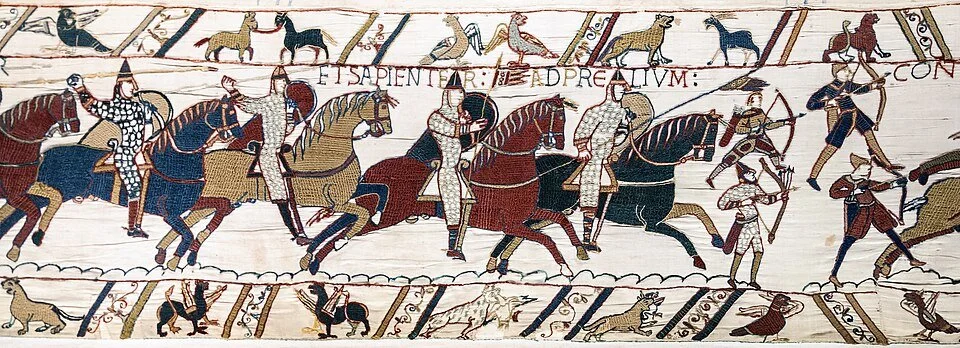
Bayeux Tapestry, scene 51: Battle of Hastings with Norman knights and archers. Source: Public domain, Musée de la Tapisserie de Bayeux, available here.
The Battle of Hastings, 960 years: On October 14th, 1066, William the Conqueror’s Norman force faced off with King Harold Godwinson’s Anglo-Saxon army for control of England. In a very close call, William and his forces killed Harold, his famed Housecarl bodyguards, and most of his noble supporters, allowing the Norman Conquest (one of the most influential events in western history) to unfold.
The Battle of Legnano, 850 years: On May 29th, 1176, Frederick Barbarossa’s German knights went into battle against the Lombard League in northern Italy. The latter, seeking independence from the Holy Roman Empire, managed to overwhelm and defeat Barbarossa’s knights, plus nearly killed the man himself. In the process, the League won significant political autonomy, as well as taught all European leaders that mounted knights weren’t invulnerable to peasants, as they’d previously believed.
The Battle of Arsuf, 835 years: On September 7th, 1191, England’s King Richard I was on crusade, shadowed by the Muslim forces of Saladin. Carefully working his way along the Mediterranean coast, the former’s stern discipline kept his knights in check despite constant harassment, ultimately lulling the latter into complacency. However, some Knights Hospitaller finally snapped and charged, leading to a general assault that crushed Saladin’s forces. Thus, Richard earned the immortal title “Lionhearted”, and his peers learned Muslim forces could lose to superior generalship.
The Battle of Crecy, 680 years: On August 26th, 1346, the English King Edward III met the French King Phillip in one of the Hundred Years’ War’s most famous battles. Intending to trap Edward, the French knights instead let themselves be goaded into a frontal assault, where they were shattered by the former’s longbow archers. Despite a close call where Edward’s son, the Black Prince, famously “won his spurs”, the day ended with the fruit of France’s nobility dead/captured, as well as secured the longbow’s place as one of history’s most decisive weapons.
The Siege of Belgrade, 570 years: From July 4-22nd, 1456, the Ottoman Turks laid siege to Belgrade, hoping for an easy win against Europe’s divided nations. Instead, a composite force of Hungarians, city militia, and peasants under Janos Hunyadi broke the Turks’ galley blockade, destroyed an incoming janissary assault, and raided the enemy camp, forcing their withdrawal. Thus, a ragtag force crushed an army most thought invincible, plus enacted a longstanding victory tradition: ringing church bells in celebration.
The Battle of Lepanto, 455 years: On October 7th, 1571, the Christian Holy League fleet, led by Don Juan de Austria, and the Ottoman Turk fleet, led by Ali Pasha, clashed for control of the Mediterranean. In a daring display, Don Juan placed his faith in firepower, namely galleasses (massive vessels loaded with guns and musketeers), an effort which paid off when he obliterated most of the Ottoman fleet and Ali Pasha. The result freed thousands of Christian prisoners, renewed Western European morale, and proved cannons would dominate naval warfare from then on.
The Battle of Breitenfeld, 395 years: On September 7th, 1631, Swedish King Gustavus Adolphus II’s army took on the Catholic army of Johann Tilly to support the struggling Protestants in the Thirty Years War. Although his Saxon allies were defeated early on, Gustavus pulled off an incredible win thanks to his revolutionary military reforms, including better artillery and strict combined arms. Ultimately, he destroyed a huge portion of Tilly’s force and, although he didn’t achieve total Protestant victory, ignited a new tactical trend that saw his reforms become the standard throughout Europe.
The Siege of Yorktown, 235 years: From September 29th-October 19th, 1781, George Washington and his French allies besieged British General Charles Cornwallis on the coast of Virginia as the latter tried to rest/refit following a long, arduous campaign in the American south. After the British were bottled up along the coast, a French fleet stopped royal navy intervention, allowing a proper siege to unfold. Ultimately, Cornwallis surrendered, destroying popular support back in England and guaranteeing American independence despite the conflict not technically ending until 1783.
The Battle of Copenhagen Harbor, 125 years: On March 30th, 1801, Lord Admiral Horatio Nelson faced off with a Danish fleet in a side dispute of the Napoleonic Wars. Despite having little room to maneuver, the former led a daring attack and, ignoring an initial gaffe and orders to disengage, pulled off an epic win. While this didn’t conclude the matter entirely, a rumor that Nelson famously placed his spyglass to his blind eye to ensure he didn’t see the retreat signal didcoin a new pop culture term: “Turning a blind eye.”
The Battle of the Little Bighorn, 150 years: On June 25th, 1876, Lt. Colonel George Armstrong Custer led the U.S. 7thCavalry against the Sioux tribe under Sitting Bull to try and force the latter onto reservations. However, Custer arrogantly ignored alarming reconnaissance reports, refused to bring along several gatling guns, and rushed into an attack after splitting his force in the face of a superior foe. In the end, Custer and almost 300 men were killed in the worst defeat the U.S. cavalry ever suffered at Native American hands.
The Battle of Adwa, 130 years: On March 1st, 1896, the Italian army under General Oreste Baratieri faced the Ethiopian Imperial army under Emperor Menelik to further Italian colonial aims. Although Baratieri had significant firepower, his commanders made a series of clumsy mistakes, including pushing ahead without proper provisions and taking the wrong roads; hence, the Ethiopians outmaneuvered them, then forced them into a panicked rout. As a result, Italian colonial hopes were temporarily smashed, and the victory became a symbol of hope to other blossoming independence movements throughout Africa.
The Battle of Verdun, 110 years: From February 21st-December 15th, 1916, the German army under General Erich Falkenhayn launched a brutal offensive on the French army’s eastern flank, hoping to drag them into a war of attrition and “bleed them white”. Sadly, the battle became a massive slogging match that depleted both armies, particularly after the French, rallying under the dynamic leadership of General Henri Petain and the now immortal vow “They shall not pass”, began a massive counterattack. In the end, the battle lines were mostly restored, and German morale cratered as both sides slowly recovered from the millions of casualties suffered in arguably history’s bloodiest battle.
The Battle of Jutland, 110 years: On May 30th, 1916, the British Grand Fleet under Admiral John Jellicoe went into action against the German High Seas Fleet under Admiral Reinhard Scheer to prevent the latter from breaking free of Europe’s north coast. However, the ensuing battle was a mess of unexpected encounters and confusion. Ultimately, the British lost more ships due to their emphasizing mobility over armor for defense, but were able to keep the Germans bottled up. Then again, the battle also led to a hard revelation: given the deadly nature of improving weaponry, that lack of armor left the former’s ships dangerously vulnerable to plunging fire AKA a shell landing directly atop a vessel. Thus, all heavy warships would need better protection going forward, particularly when aircraft became more viable.
The First Day of the Battle of the Somme, 110 years: On July 1st, 1916, the British army under Field Marshall Douglas Haig launched an offensive on the German lines in northern France, hoping to ease pressure on the French at Verdun. The result was a bloody mess, most infamously the first day (the worst in British military history to date), with almost 58,000 men (19,240 of which were dead) shot down, the majority dying from machine gun fire. Worse, British artillery rounds were terribly ineffective, mostly due to either dud rounds or a lack of high explosive shells to blow gaps in the German wire. The offensive did make some progress, but eventually reached a bloody stalemate weeks later, both sides having lost around a million troops apiece.
The Siege of Wake, 85 years: From December 8th-23rd, 1941, following the attack on Pearl Harbor, a Japanese force attacked this small atoll’s Marine garrison, confident of an easy win after a string of epic victories. Instead, their initial force was badly shot up, losing two destroyers, numerous aircraft, and hundreds of troops to its brave defenders. Although the island ultimately fell to a second, larger attempt, that initial win boosted the Allies’ badly mauled morale, as well as produced one of the greatest (albeit deliberately misquoted) news headlines in American history: “Send us more Japs.”
There’re plenty of other such anniversaries worth mentioning, many of which can be found in this essay’s source material: Richard Overy’s A History of War in 100 Battles, Bryan Perrett’s Last Stand!, Helen Doe’s Great Naval Battles: From Medieval Wars to the Present Day, and Ian Westwell’s World War I: An Illustrated History. Yet, all should serve as a reminder of our duty to the past and future. After all, if we neglect the former, the latter will pay the price…a mistake too many have failed to learn as is.
Did you enjoy the piece? Join us on X here for more: @HistoryIsNowMag
Bibliography
Helen Doe. Great Naval Battles: From Medieval Wars to the Present Day. London: Arcturus Publishing Limited, 2022.
Richard Overy. A History of War in 100 Battles. London: Harper Collins Publishers, 2024.
Bryan Perrett. Last Stand!. London: Cassell Military Paperbacks, 1998.
Ian Westwell. World War I: An Illustrated History. Hemel Hempstead: Anness Publishing Ltd, 2023.