The Confederate victory at Second Manassas, August 28-30, 1862, followed victories in the Valley Campaign and the Peninsula. The casualties incurred by the Army of the Potomac included 14,000 killed or wounded of 62,000 engaged, compared to about half of that for the Army of Northern Virginia. Then, on September 1, Stonewall Jackson defeated a Union cohort retreating from the battlefield at Chantilly. General Pope was relieved of command and sent to Minnesota to deal with the Sioux, and was never again involved in the Civil War. Pope would blame Fitz-John Porter for the loss, even though that wasn’t the case; Porter would be heard from again at Antietam but would go through a devastating court martial soon after. One of Pope’s generals said of him, “Suffice to say ... that more insolence, superciliousness, ignorance, and pretentiousness were never combined in one man.”
In this multi-part series, here Lloyd W Klein looks at what happened during the Battle of Antietam itself.
Read part 1 on the background here, and part 2 on General McClellan’s Response to Finding the Lost Order here.

The Charge across the Burnside Bridge by Edwin Forbes. Source: Public domain, US Library of Congress, available here.
McClellan was now in a position to destroy Lee’s divided army. Knowing they were being pursued, Lee's army set up defensive positions behind Antietam Creek. Lee expected a battle, but the half of his army under Jackson was still in Harper’s Ferry.
The first two Union divisions arrived on the afternoon of September 15 and the bulk of the remainder of the army late that evening. McClellan's limited activity on September 15 after his victory at South Mountain gave Lee time to unite his scattered divisions at Sharpsburg.
On the morning of Tuesday, September 16, McClellan had nearly 60,000 soldiers facing Lee’s 15,000. His heavy 20-pound Parrott rifles were sending case shot across the creek, feeling out the enemy. As Longstreet ordered a vigorous response – more for bluff than effect – Lee realized his one chance for salvation lay with McClellan’s reverting to his old, timid behavior. McClellan did not disappoint him. By noon, Jackson and Brig. Gen. John Walker began to arrive, taking up the Confederate line on the left along the Hagerstown Pike near Dunker Church, north of town, then sweeping southeasterly to a worn farm lane on the Mumma property a mile away. On the left flank, Maj. Gen. J.E.B. (‘Jeb’) Stuart placed Brig. Gen. Fitz Lee’s cavalry brigade with his three batteries of Captain John Pelham’s Horse Artillery and three additional batteries on an unpretentious hillock known locally as Nicodemus Hill. East of the Hagerstown Pike, Brig. Gen. Evander M. Law’s brigade had taken position in the East Woods. Law sent his videttes well to the north and east, keeping a close eye on the Upper Bridge.
Once again, the traditional history doesn’t do McClellan justice. What is said in the books: If he had attacked either of those days, the war might have ended in September 1862 with a definitive victory. Having arrived on the afternoon of September 15, he delayed his attack until September 17. He outnumbered Lee by as much as 2:1 all that time, and what he was waiting for is unclear. He somehow didn’t know that Jackson was still in Harpers Ferry, so he was facing just half of Lee’s divided army.
But the reality was a lot more complex than it seemed from that summation. By the afternoon of September 15, McClellan found himself confronted by two significant Confederate forces flanking Elk Ridge, a geographical feature extending north to south, located west of South Mountain. To McClellan's right, Lee and Longstreet commanded an indeterminate number of troops, while to his left, McLaws and Anderson operated under the overall leadership of Stonewall Jackson. With Jackson positioned on one side and Lee on the other, it was prudent for McClellan to take a moment to assess which of the opposing forces represented a greater threat. Franklin had indicated that he was up against an enemy force that was twice the size of his own. If McClellan accepted Franklin's assessment, it suggested that the Confederate troops in Pleasant Valley exceeded 25,000, a formidable adversary.
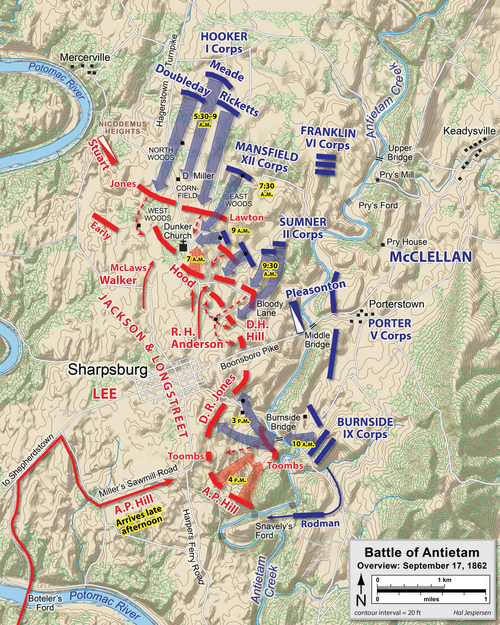
Map of the Battle of Antietam by Hal Jespersen. Source: Map by Hal Jespersen, www.posix.com/CW, Creative Commons license 3.0, available here.
Initially, Lee and Longstreet seemed to be retreating toward Virginia, but as the afternoon progressed, it became clear that Lee had opted to hold his position in Maryland. Concurrently, the Confederate forces in Pleasant Valley, located to McClellan's left, began their withdrawal back to Virginia. The dynamic nature of the battlefield, coupled with the challenges of maneuvering large troop contingents along generally inadequate roads, made September 15 an unfavorable day for launching an offensive.
September 16 presented a different scenario for McClellan. Aware that Lee had gathered his troops around Sharpsburg, McClellan planned to launch an attack with his largely unified forces in the morning. However, dense fog obscured his view of the Confederate positions. By 8:30 to 9:00 a.m., the fog dissipated, revealing that Lee's forces remained in their locations. Nevertheless, McClellan was still unable to identify the Confederate left flank. For three and a half hours, he scoured the area along Antietam Creek in search of the enemy's line. Ultimately, realizing that only direct engagement would reveal their position, he instructed Hooker to move his First Corps across the creek at 12:30 p.m. Federal cavalry began patrolling the western bank of the creek shortly after 1:00 p.m. It took an additional four hours for Hooker to position his troops for the attack that commenced later that evening. In summary, the variable conditions hindered McClellan's ability to launch an assault on September 15, leading to a delayed attack on September 16.
Despite the traditional narrative, the Union army was not fully prepared for combat on September 16. On the afternoon of the 15th, Richardson and Sykes, with approximately 6,700 infantry, arrived at the Portertown bridge. Hooker's 1st Corps, consisting of 8,600 infantry, reached the area in the early evening and established a position near the Pry House. Meanwhile, Sumner's two additional divisions were stationed along the Keedysville Road. The 12th Corps was positioned at Boonsboro, the 9th Corps was located around Appletown, roughly six miles away, and the 6th Corps was in Pleasant Valley. Morell and Weber remained at Frederick or Middletown.
On the morning of the 16th, Sumner successfully moved his remaining two divisions to Keedysville, allowing McClellan to muster around 25,000 effective infantry by mid-morning. However, Burnside was still lagging; his Corps did not arrive at Portertown until noon and subsequently camped about two miles from the battlefield. Burnside advanced to receive orders regarding the placement of his corps, but by dusk, only three brigades had managed to reach the bluffs overlooking the Rohrbach Bridge. The balance of the corps was a couple of miles east and didn't break camp until 0900 on the 17th. The 12th Corps marched from Boonsboro and approached Keedysville quite late in the afternoon. As they arrived, McClellan ordered them to cross the creek and support Hooker. Morell's division and Weber's brigade are behind them. Any attack on the 16th would have been fought solely by the 1st and 2nd Corps, and Sykes' division.
It may have been to his benefit to attack immediately, although McClellan would have had to advance troops in fog and against an opponent he believed outnumbered him. Had he pushed Sumner’s Second Corps across the Middle Bridge at daybreak, regardless of the fog, it probably would have forced Lee to withdraw his troops from the heights opposite the Rohrbach Bridge, where Ambrose Burnside and Jacob Cox waited with the Ninth Corps. They could then have crossed against the Confederate right. Hooker could have crossed on the Confederate left and engaged Jackson’s men there. Pursuing a strategy such as this would have likely stretched Lee’s force thin in multiple places, allowing the Federals to punch through. I doubt that in this type of scenario, Lee could have held his position for longer than 24 hours.
Lee intuited that the initial attack would be on his left. Intelligence came in all day on September 16, indicating a Federal advance on the left, but little activity on the right and in the middle. Concentrating forces against the Confederate left focused Lee there as well. All he needed to do was shift men from the right and center until a threat materialized in those sectors, and that did not occur until later in the afternoon on September 17.
Lee cornered himself on purpose, unlike what some historians suggest. He did so because his campaign objective was to fight and win a battle north of the Potomac that would fulfill the promise of protection his proclamation of Sept. 8 gave to Marylanders in favor of secession. His plan to fight north of Boonsboro had unraveled when Jackson took a day longer than Lee anticipated to capture Harpers Ferry, and because McClellan had unexpectedly attacked the South Mountain gaps. This left Lee with no choice but to move back toward Virginia to bring the army's various pieces closer together. Sharpsburg was the last place Lee could find with somewhat advantageous terrain. However, his left was vulnerable to a large-scale attack, which is exactly why McClellan struck there.
McClellan did not appear to have “the slows” in his approach to Antietam. This is yet another tenet of the history of the battle that does not hold up to scrutiny. This has been a persistent myth since Sears & Catton. Its origin was the 1864 Lincoln election propaganda campaign. McClellan's army did not fully arrive until September 17. By the end of the day on the 15th, his corps was stretched out on the road back over South Mountain. McClellan also faced the possibility that Jackson commanded the portion on his left flank, where the Sixth Corps was, and Lee the portion on the right flank at Sharpsburg. Being between these two commanders is not an enviable position.
By the morning of Sept. 16, McClellan hoped to attack, but could not see the enemy's lines. He therefore scouted along them for a better idea, but did not glean one. It is only after these scouting missions that he ordered Hooker to cross the creek and develop the Confederate left flank, something that could only be done through contact. Sure, McClellan could have ordered Hooker across earlier and had more daylight, but it is unclear what that might have accomplished. We need to remember as well that McClellan believed his army to be outnumbered. We know that is false, but no commander in his right mind would push his force into unknown territory while facing a stronger opponent. That said, McClellan did make a mistake by not sending the Twelfth Corps along with Hooker, and perhaps the Second Corps as well.
Exactly what McClellan was thinking on September 17th is anyone’s guess. McClellan, of course, has been skewered throughout history for generating a piecemeal attack. But his actual plan was to attack en echelon, Napoleon style. But, if a commander follows such a plan to stretch enemy defenses, the key to victory is to commit the reserves in a timely fashion: “a mass of decision.” This was the Napoleonic principle. He utterly failed in this last and most crucial aspect of his plan. The Tactic of a Napoleon-era en echelon attack was to advance at different times to create a "pressure point" on the enemy's line and to follow up any breakthrough with reserve troops.
True to form as we saw in the Seven Days, his headquarters was over a mile away from the battlefield. That would guarantee that he had no clue what was happening on the field in real time. Communication would be delayed, and any momentary opportunity lost. And I think that is exactly what happened.
McClellan failed to commit his reserves for several reasons. 1). Located at the Pry house, he was on the wrong side of Antietam creek and thus was removed from the battlefield. 2). Burnside was supposed to be coming up from the south in behind Gen. D.H. Hill once Burnside's men cross the bridge and start rolling up the Confederate army from South to North. However, Burnside failed in his mission because of extremely slow development of his attacks. 3). Gen. Fitz Porter supposedly reminded Mac, when Mac was contemplating sending in Porter's men, that "His Corps represented the last troops of the Army of the Potomac". It was a subtle reminder of how Napoleon sent in his only reserve of the Guard at Waterloo and was soundly defeated, which is all Mac needed to hear to become timid and afraid of failure.
McClellan had a long history of delaying attacks. Maybe he thought that he had to plan in great detail before launching them. But these delays were never beneficial and never justifiable. Perhaps:
· McClellan didn’t really know the size of the army in his front at Antietam and therefore, he was being prudently cautious in moving slowly before starting his attack. https://www.historynet.com/mcclellans-war-winning-strategy/
· He had an inability to create original or innovative ideas, even though he was tremendously smart and a quick study.
· He might have been incapable of responding creatively to the real time exigencies of battle. He could not creatively adjust his plan. Thus, at Antietam, when his plan of assault did not unfold like a predetermined Napoleonic success, Mac was unable to develop any new concepts on the spot to adapt to the changed circumstances.
· My own opinion is that McClellan was more concerned with not losing than with winning. In his mind, as the fate of the Union rested on his shoulders, he could not allow a defeat.
· Cpl Thomas Pressnel of Co D, 1st Minnesota said on Sept 18, the day after Antietam: "McClellan is either a fool or a traitor." https://www.hhhistory.com/2019/05/antietam-bloodiest-day.html
McClellan telegraphed that he was going to start the attack on Lee’s left. His artillery opened up all afternoon September 16 in that area. Hooker was sent there. Lee saw all of this. Lee’s ranks had been thinned by casualties, sickness and large-scale desertions, but he had the advantage of position. He’d selected an excellent defensive field in which to fight. The lay of the land permitted the Rebels the opportunity to transfer troops under cover and allowed them to select the most advantageous artillery positions.
Antietam Creek is pretty shallow in most places, ranging from 60 to 100 feet in width, and was fordable in several places. It was crossed by three stone bridges each a mile apart. The bridges over Antietam Creek would be crucial. The top two for Union units to enter the battlefield, the bottom one, a stone bridge, for the final act.
At the Battle of Antietam, more Americans died in battle (September 17, 1862) than on any other day in the nation's history. The bloodiest battle in American history was Gettysburg, but its more than 46,000 casualties occurred over three days. Antietam ranks fifth in terms of total casualties in Civil War battles.
The Cornfield
On the morning of September 17th, a 30-acre cornfield owned by David R. Miller lay between the two armies. The cornstalks were turning from green to brown, ready to be harvested, 30 acres of corn fodder. None of it would exist by that evening. One general remarked, “Every stalk of corn in the northern and greater part of the field was cut as closely as with a knife.” Thousands of men would lie dead in that cornfield, the site of some of the most ferocious, confusing, and deadly fighting of the war.
At first light (around 5:30 a.m. on September 17, 1862), Maj. Gen. Joseph Hooker’s I Corps struck the Confederate left along the Hagerstown Turnpike, aiming for the plateau crowned by the small whitewashed Dunker Church. Hooker’s roughly 8,600 men pressed forward against Stonewall Jackson’s 7,700 defenders, deploying Abner Doubleday on the right, James Ricketts into the East Woods, and George Meade’s reserves in the center. As Union infantry emerged into the Cornfield below the church, an artillery duel erupted: Confederate horse batteries under J.E.B. Stuart to the west and four guns under Col. Stephen D. Lee to the south traded shots with nine Federal batteries behind the North Woods and distant Parrott rifles. Fierce musketry and close‐quarters fighting swirled around the church itself, with repeated advances and withdrawals in the fields and woods before fresh Confederate brigades under McLaws and Hood counterattacked shortly after 7 a.m., stabilizing Jackson’s line near the landmark.
At dawn, a Union corps assaulted Lee's left flank across Miller's Cornfield. The battle began when Hooker’s I Corps attacked around 5:30 a.m. As the Union moved forward, they were met by withering fire from Confederate infantry and artillery, including Stonewall Jackson’s men positioned in the West Woods and behind a fence at the southern edge of the corn. The cornfield turned rapidly into a killing field. The tall corn created a kind of fog of war—soldiers couldn’t see well and often blundered into enemy fire at close range. Units were slaughtered in rows, sometimes without even seeing who was shooting them. Men layed prone and shot at legs through the stalks; if they stood up they couldn’t see and more apt to be killed. Fighting surged back and forth repeatedly, with Union troops advancing, getting repulsed, and attacking again.
At 7AM, Mansfield’s XII Corps brought in fresh troops, hoping to support Hooker, but was mortally wounded. His men also suffered heavy casualties as they entered the killing zone.
Next, General John Bell Hood’s division, including the famed Texas Brigade, launched a devastating counterattack, pushing Union troops back out of the Cornfield temporarily. Hood’s men took over 60% casualties—he later said his division was “dead on the field.” Control of the field changed hands perhaps 6 to 8 times in three hours. Casualties mounted on both sides—some regiments lost over half their men in minutes. By 9:00 a.m., the Cornfield fight had run its course; the area was covered with bodies. As regiments and brigades entered the Cornfield, only to be demolished in waves of attacks and counterattacks, a layer of smoke covered the field so that no one could see what was happening. Soldiers later related that they lay on the ground and shot at the legs of their enemies
Perched roughly three‑quarters of a mile southwest of the North Woods, the knoll known as Nicodemus Hill (or Heights) was crowned by more than a dozen Confederate cannon placed there overnight by J.E.B. Stuart’s cavalry artillery, under the direct command of Maj. John Pelham. From this vantage the guns enfiladed the right flank of Hooker’s advancing columns as they poured out of the woods into the open terrain toward the Cornfield and Dunker Church. Pelham’s batteries swept the ground with shell and canister, inflicting severe casualties and helping to check the Union drive long enough for Jackson’s infantry to form a defensive Stonewall Jackson held the Confederate lines, and the Union suffered heavy casualties. Neither side seemed able to gain the upper hand, and one witness described the clash as "Artillery Hell."
2) While numerous countercharges held off Union advances, this Union division commander ordered yet another attack, resulting in Jackson’s left and center being in imminent danger. 3) Then this illustrious Union brigade charged parallel with Hagerstown Pike, sweeping the field. 4) His lines collapsing all around him, and out of men on the line, Stonewall Jackson turned to this general, his last reserve, being held after his men were in the center of the battle at Harpers Ferry.5) Which Confederate troops advanced in a desperate situation to save the southwest corner of the field? 6) After all of the intense action, which Confederate brigade held the line? 7) Both Hooker and Jackson each had one more brigade to throw into this killing field. Who were they led by? Which Union General led the attack? Hint: This general seemed to be everywhere Jackson’s men were during the war. 8) At the end of the fighting, who held the Cornfield? What was the staggering toll of casualties in just this one part of the field? 9) When did Jackson arrive at Sharpsburg?
Joseph Hooker was the Union corps commander that led the attack on the Cornfield. John Gibbon bravely led the first wave of that attack. The Iron Brigade struck hard at Jackson’s line and advanced deep into the Cornfield. Despite success, they met withering Confederate counterfire and were eventually pushed back. Units like the 6th Wisconsin and 2nd Wisconsin suffered casualty rates over 50%. Still, they inflicted enormous damage and helped set the stage for XII Corps’ later advance. You will notice that many of those who rose to high command later in the war courageously led in smaller roles in this battle. Arguably, that is why the tide of the war turned eventually: the cream rose to the top. 2) Abner Doubleday. 3) The Iron Brigade. 4) John Bell Hood. 5) Hays’ Louisiana Brigade. 6) The Stonewall Brigade. 7) Maj Gen Joseph KF Mansfield vs General DH Hill. Alpheus Williams led the 1st Division, XII Corps. His contributions to this campaign were enormous. He would go on to be a lawyer, judge, journalist, and later U.S. Congressman. His division had been defeated twice by Stonewall Jackson, once in the Valley and once at Second Bull Run. At Antietam, his division, which had found Special Order 191, had 25% casualties against Jackson’s Division. He would meet Jackson’s men again at Chancellorsville, where his men entrenched and stopped Jackson’s offensive, with heavy casualties. Williams finally stopped Jackson’s corps, without Jackson, of course, on Culp’s Hill. 8) It hardly mattered at that point, but the Army of the Potomac did hold part of it, however tenuously. Estimates suggest 8,000–10,000 men were killed or wounded in or near the Cornfield in just those few hours.9) It is so important to note that Longstreet was the only corps commander through South Mountain, and that Jackson wasn’t there because he was capturing Harpers Ferry, which he accomplished on September 15. Jackson then pushed his men to join the rest of the army at Sharpsburg, Maryland. Jackson arrived in time to bear the brunt of the Federal advances on the northern end of the battlefield in the morning phase. https://www.historynet.com/battle-of-antietam-carnage-in-a-cornfield/?f
The Sunken Road
The focus of battle swung southeast from The Cornfield to Bloody Lane. This sunken dirt farm road had been used by local farmers to bypass the town, and its level was below the fields around it due to use and rain. The Confederates fortified it, using the sunken road as a natural trench. This part of the battle occurred roughly between 9:00 a.m. and 1:00 p.m. Around 9:00 a.m., Union II Corps under Gen. Edwin Sumner attacked. Led by Gen. William H. French’s division, then Gen. Israel Richardson’s, they hit the lane from the east in wave after wave. The Confederates poured musket fire into the advancing Federals from the cover of the lane. Union troops returned fire, turning the area into a brutal stand-up firefight, lasting hours.
Casualties were enormous on both sides. Bodies piled up in the narrow lane—thus the name “Bloody Lane.”
Maj. Gen. Daniel Harvey Hill placed his division of approximately 2,600 men along the road, piled fence rails on the embankment to further strengthen the position and waited for the advance of the Union army. As Federal troops moved to reinforce the fighting in the West Woods, Union Maj. Gen. William H. French and his 5,500 men veered south, towards Hill's position along the Sunken Road. As French's men approached the Sunken Road, the Confederate troops staggered them with a powerful volley delivered at a range of less than one hundred yards.
Union and Confederate troops dug in. For nearly four hours, from 9:30 a.m. to 1 p.m., bitter fighting raged along this road as French, supported by Gen. Israel B. Richardson`s division, sought to drive the Southerners back. Outnumbered but with a well-defended position, the Confederates in the road stood their ground for most of the morning. Eventually, a gap opened in the Confederate line due to miscommunication and shifting reserves. Union troops flanked the lane, firing down its length, turning it into a death trap. Confederate resistance collapsed, and survivors fled toward Sharpsburg.
After the Union broke through the Sunken Road around 1:00 p.m., there was a real opportunity to split Lee’s army in two and possibly end the battle—and maybe the war—right there. An opportunity to crush Lee’s army was missed.
2) 3) 4) At the critical moment, as the Sunken Road collapsed, the Confederate Army was in great danger of being overrun. Why didn’t he throw in his reserves at this desperate time as Jackson did? 5) Who led the brigade that broke the defense of the Sunken Road? 6) How severe were the casualties?
The great Union heroes of this portion of the battle were immigrants from another country who came here seeking a better life and escape from a famine. The Irish Brigade (New York and Massachusetts Irish Americans) advanced upon Confederate troops who had taken up a position in No fewer than eight times were the colors of the Irish Brigade struck down, but nine times they were taken up and carried forward. Men sacrificed their lives to rush a fence and tear it down rather than have the entire brigade take fire through being slowed by the barricade. The Irish Brigade advanced under heavy fire, living up to the Gaelic phrase written upon their regimental colors: “Riamh Nar Dhruid O Spairn lann”, “Who never retreated from the clash of spears”.
Eventually, the Irish Brigade was able to flank the sunken road, and rather than facing entrenched riflemen head-on, they were then able to shoot down the Sunken Road, so effectively that The Sunken Road became The Bloody Lane. Union assaults against the Sunken Road carried the Confederate center, but the resulting advantage was squandered. The two remaining divisions of Sumner's corps that had not attacked the Hagerstown Road. They had entered the field through the North bridge then divided up.
DH Hill’s division had already intervened in the fluid battles near the East Woods, so even though it held a strong position in the sunken road, the division was somewhat weakened. The Union general who led the attack that broke the line was Francis Channing Barlow, who would go on to fame on Day 1 at Gettysburg and become one of the great heroes of the war, and a division commander under Hancock in the Overland Campaign.
Colonel John B Gordon was wounded 6 times that day, might have drowned in his kepi from his blood that collected in it, and had a facial scar forever. He promised General Lee "The men are going to stay here, General, till the sun goes down or victory is won!"
McClellan has been criticized ever since for advancing portions of his line at different times rather than at once and holding back an entire corps entirely. At the moment when the battle was hanging in the balance, McClellan did not send in an entire corps he held in reserve, which might well have won the battle and perhaps the entire war that very day. The infamous story is that the reserve troops belonging to McClellan’s most trusted corps commander, Gen. Fitz-John Porter, were ready to take the field at the Sunken Road. For a brief moment, McClellan seemed ready to commit the V Corps reserves and looked to Porter, his most trusted subordinate. Porter is said to have slowly shaken his head with disapproval and is purported to have said to McClellan, “Remember, General! I command the last reserve of the last army of the Republic.” Modern scholarship suggests that this never happened, and that Porter was blamed after the fact, before his court-martial set up by Pope. It would take many years for Porter to get justice, and he would never command again. I have never believed that story. I think McClellan was so far away from the battlefield, the only time he left his HQ was to scout the far right near Nicodemus Heights around 2 pm, that by the time he was informed of the opportunity, Lee had already moved reinforcements to plug the hole in the center. Troops under Gen. James Longstreet and others helped stabilize the line, and the artillery was the real savior. That gave the Confederate army time to regroup and survive the day. This was his story to protect his reputation.
There were roughly 5,600 total casualties in this phase alone. The road remained choked with the dead and wounded for hours—an iconic image of Civil War carnage.
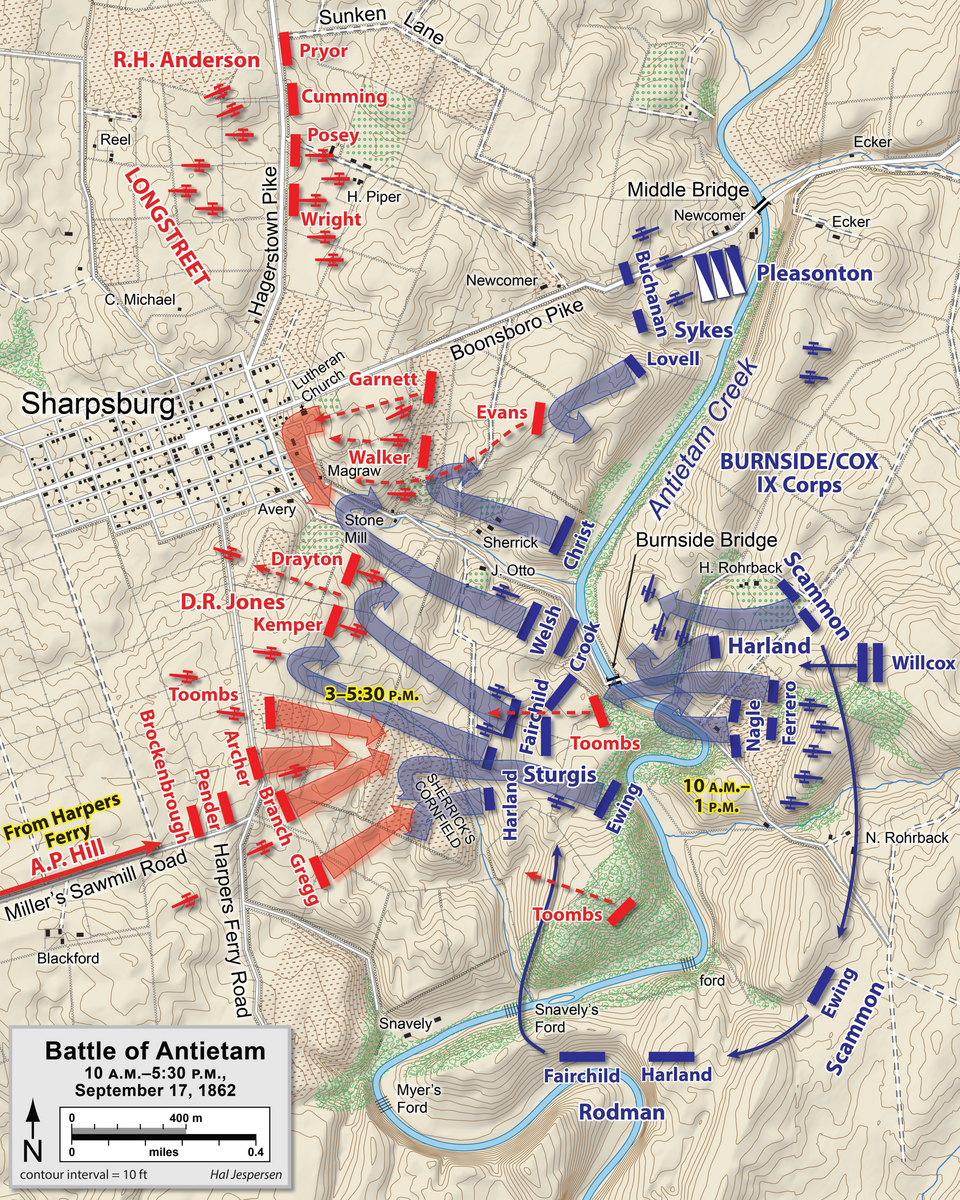
Map of Burnside Bridge by Hal Jespersen. Source: Map by Hal Jespersen, www.posix.com/CW, Creative Commons license 3.0, available here.
The Burnside Bridge
Late in the afternoon, the fiercest fighting again switched, now to the south part of the field, the Union left. There, General Ambrose Burnside and XI Corps had been attempting for hours to cross Antietam Creek via a narrow stone arch bridge called the Rohrbach bridge at that time, and which would later bear the name Burnside Bridge. Hartwig claims that this name change was intended derisively and mockingly. This the site of one of the most dramatic and frustrating episodes of the war. Burnside is often criticized for his action, or lack thereof, to cross the creek for hours when doing so would have flanked Lee’s position. It is often said that his failure to perform a proper reconnaissance caused him to not realize there were several other places to ford his troops.
Burnside spent hours trying advance his troops through the bottleneck bridge under the accurate and deadly fire of Confederate sharpshooters. The bridge was defended by just 500 Confederate sharpshooters, who had terrific position to attack anyone trying to cross. They held the bluffs above the bridge, giving them a commanding view and position. From this high ground, they rained down musket and artillery fire on any Union troops attempting to approach.
Burnside had three divisions (thousands of men) but committed them in piecemeal assaults. Rather than flanking the bridge with a quicker ford (there were two nearby), he focused on direct frontal assaults. His troops tried repeatedly to storm the narrow bridge, each time taking heavy losses. After more than three hours, the Union finally succeeded around 1:00 p.m., with Brig. Gen. Edward Ferrero’s brigade (including the 51st Pennsylvania and 51st New York) storming the bridge. Once across, Union troops pushed back the Confederates, climbing the heights and threatening the Confederate right.
It looked like a Union victory was inevitable. Just as Burnside’s men were preparing to roll up Lee’s right flank, Gen. A.P. Hill’s division arrived from Harpers Ferry after a forced march. At this critical moment, with the Confederate line breaking, A. P. Hill's division arrived after a forced march from Harpers Ferry and launched a surprise counterattack. They slammed into Burnside’s left around 3:30 p.m., halting and driving back Burnside.
Ambrose Burnside typically receives criticism for his slow advance at Antietam (and in other battles). Sears is especially critical, opining that his delay here had a serious impact on the battle and the war, which cannot be overstated. He wrote that Burnside should have found a way to cross the creek much earlier.
The opposite bank of the bridge was held mainly Georgians under Brig. Gen. Robert Toombs, the former Confederate Secretary of State, who had warned President Davis not to fire on Fort Sumter. He then resigned and took division command. He was wounded in action that day.
Stephen Sears, in his authoritative book Landscape Turned Red, makes the case that Ambrose Burnside’s sluggish performance at Antietam was at least partly due to his frustration with the command structure, especially with how McClellan treated him. Before Antietam, McClellan had organized his army into “wings” rather than corps directly under army command. Burnside was given command of the right wing, which included IX and I Corps. But just before the battle, McClellan reassigned I Corps to Hooker, leaving Burnside with just IX Corps—effectively demoting him in all but name. Sears argues that this shift bruised Burnside’s ego and left him resentful and confused about his role. He suggests Burnside was “acting out” in response by dragging his feet, waiting for more direct orders. Rather than taking initiative, as a wing commander might have done, Burnside behaved like a corps commander waiting for instructions—possibly as a passive protest. But while this interpretation is widely cited, this is entirely Sears’ own interpretation, with no source whatsoever. Hartwig doesn’t even mention it.
There has also been some controversy whether Antietam Creek had several areas that were easily crossed on foot, rendering the bridge much less important It’s fascinating to remember that Henry Kyd Douglas first said this, the man who might have been the courier who lost the Special Order. Hartwig notes that this was disingenuous because the creek was much deeper than that, and the entire bank was covered by Confederate troops. Hartwig notes that McClellan did not criticize Burnside until a year later, when he blamed Burnside for the delay. He also notes that the IX Corps Commander mostly ran the action, and that he tried very hard to cross the creek, had called for reinforcements, which McClellan would not send, instead shoring up his right flank. McClellan’s criticisms of Burnside as he was preparing to run for president. The fact is that Burnside faced severe resistance that day.
AP Hill was in Harpers Ferry, paroling prisoners. His entrance just when he did save the day for the Confederates. Just as it looked like the battle would be lost when Burnside's men began to turn the right of the Confederate line, A.P. Hill, leading the last elements of Jackson's Corps, arrived on the field from Harpers Ferry and stopped the Federal Advance. I am guessing that the reports of Lee’s final words about how AP Hill must come up, which I don’t think really happened, relate to this moment.
Now read part 4 on the aftermath of the battle here.
Did you enjoy the piece? Join us on X here to receive regular updates: @HistoryIsNowMag