Following Japan’s unconditional surrender to the Allied Powers at the end of World War Two, there was much discussion over what to do at the Japanese war crimes trials – including whether to include Japanese Emperor Hirohito in the trials. Ken Wright explains.
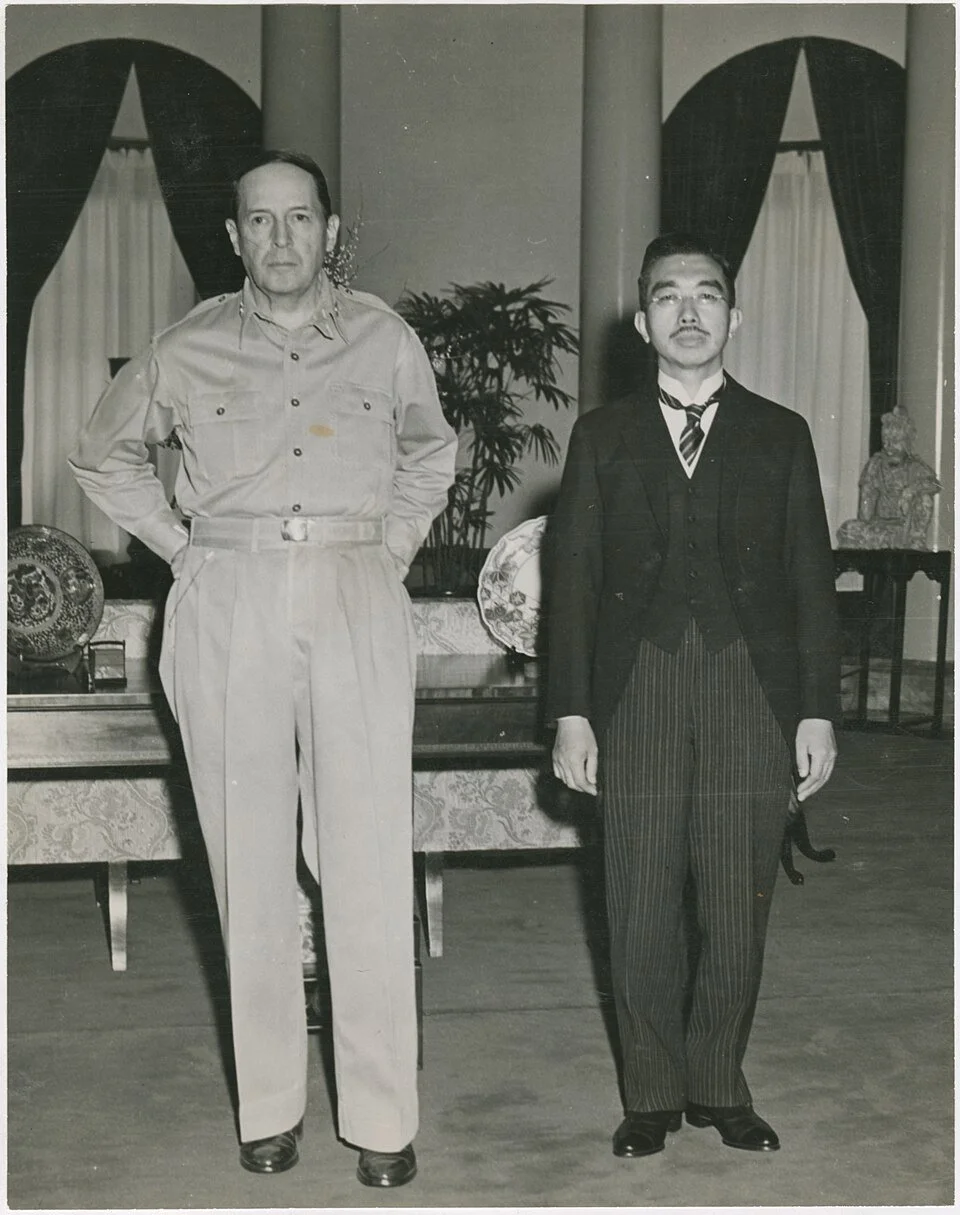
Emperor Hirohito and General MacArthur at the U.S. Embassy, Tokyo, 27 September, 1945. Source: Public domain, US Army, available here.
Ever since World War Two, the myth has persisted that the Japanese Emperor Hirohito was an unwilling pawn of an elite group of militarists who started and conducted the war against the Allied powers. It was one of the most successful public relations exercises by the United States last century and a completely deliberate distortion of history. The truth is that Emperor Hirohito had a strong and decisive role in Japan's militaristic wars of conquest, beginning with the occupation of Manchuria in 1931, the attempted takeover of China, and the decision to attack Pearl Harbor on December 7, 1941. He knew about the establishment of the biological warfare unit 731 and the massacre in Nanking in China after the Chinese capital fell to the Japanese. He made no attempts to stop any of the terrible acts carried out in his name. To the Japanese, the Emperor was a divinity, a living god; therefore, a simple no from him could have spared the world so much death and destruction. Whether the militarists would have still gone ahead with their planned war of conquest even if he had said no is debatable. When it became painfully obvious Japan was losing the war, he stubbornly delayed seeking peace. His prolonging of the conflict cost thousands of lives on both sides and might have spared his defeated country from the horror of being the first victim of atomic weapons. Japan had virtually no oil. After six months of US bombing, Japanese cities were in ruins. The Imperial Japanese Navy’s sea and air capacity was almost non-existent, and the entire nation was suffering severe food shortages. Only with the destruction of Hiroshima and Nagasaki by atomic bombs and the Soviet Union's entry into the war against Japan did he finally find the excuse he needed to end the war and save what was left of his war-ravaged country from a no-win situation. He instructed his representatives to seek peace on August 10, 1945. After brief negotiations by radio, Japan accepted the Allied terms for an ‘unconditional surrender'.
At midday on 14 August, the entire Japanese nation heard for the first time their Emperor’s voice broadcast, via a recording, his ‘Unconditional Surrender’ speech. It was a masterstroke of public relations propaganda avoiding the words ‘dishonour’ and ‘defeat’ but most importantly, redefined the Emperor’s image as a pacifist and an anti-militarist who above all, cared for his people. It also sowed the seeds for the relatively smooth occupation of Japan by the Allies. The Emperor’s representatives signed the formal ‘Instrument of Surrender’ on September 2, 1945. No member of the imperial family was to be directly involved in this humiliating episode of Japanese history. In the first few days of peace, the Emperor was naturally concerned about his future as it was customary in Japan for senior leaders to take full responsibility for their mistakes. Would he be tried as a war criminal by the Allies? Should he resign now or later? He needed to protect himself and the throne. As it was, he need not have worried. The obvious question is why not?
The Supreme Commander of the Allied Powers [SCAP] General Douglas MacArthur arrived in Japan on August 30, 1945, to begin the military occupation and reconstruction of Japan, which would last six years. American and Japanese policymakers promptly started to outline the basic plan for the new Japan, but for the American government, there was no cultural or linguistic access to Japanese society. Codenamed ‘Blacklist’, President Truman instructed MacArthur to utilise the existing Japanese bureaucracy and Emperor Hirohito. Any hope of success depended on keeping the Emperor and his image as an innocent pawn manipulated by his military generals and admirals to the world. Accordingly, an alliance was formed between MacArthur, the brash and domineering showman, and the diffident, uncharismatic, and obtuse Hirohito. These two men and their respective governments would go on to shape and distort world history.
With Japan now in Allied (mainly American) control, it was expected that some form of retribution would be taken against those responsible for war crimes. General MacArthur received a directive from Washington, which was later approved by the other Allied nations, to begin major war crimes trials on October 6, 1945. The categories of accused were divided into A, B, and C-class war criminals. By 19 January 1946, an International Military Tribunal for the Far East with judges from eleven countries was established to start the trials. The countries represented were Australia, New Zealand, China, Canada, India, France, the Soviet Union, Great Britain, the Netherlands, the Philippines, and the United States. Prominent Japanese intellectuals also wanted Hirohito tried for war crimes but were rejected by MacArthur. During one of the most shameful episodes in American history, authorities dishonoured the justice system by ensuring Emperor Hirohito would never, under any circumstances, be brought to trial as a war criminal. This undermined the legitimacy of the war crimes trials and led to one of the biggest misrepresentations of history to serve the political interests of both nations. It was a year when morality was lost, and it would continue to be so throughout the American occupation and beyond.
Trials
The actual trials began in Tokyo on May 3 and lasted two and a half years. Twenty-eight high-ranking political and military leaders were indicted on fifty-five counts of ‘crimes against peace, crimes against humanity and conventional crimes.’ From the outset, the trials were plagued with problems. There were too many Japanese war criminals to investigate, and investigators had to rely on hostile Japanese police and government officials to track down suspects and witnesses. The issues of limited financial resources, insufficient investigators or prosecutors, and the fact that the Japanese military had destroyed as much incriminating evidence as possible before surrender, along with the lack of documentation, hampered the swift progress of all the trials. Then there were the underhanded deals behind the public façade of the war crimes trials. Two examples highlight how low the US government was willing to stoop, in the name of politics. The first example was that the prosecution and American authorities colluded with the principal military leader, General Hideki Tojo, who was also the Prime Minister, by asking him, during his trial, to take all the blame for Japan’s involvement in the war to keep the Emperor blameless. As a fiercely loyal Japanese, he agreed and went to his death with the Emperor’s responsibility left unchallenged. On the matter of atrocities, Tojo stated; ‘We did not suspect that such things had happened. The Emperor especially, because of his benevolence, would have had a contrary feeling. Such acts are not permissible in Japan. The character of the Japanese people is such that they believe that neither heaven nor earth would permit such things.’
As the Royal Air Force Douglas Dakota C47 [KN414] lifted off the runway of Hong Kong’s Kai Tak Airport on September 25, 1946, one of the fourteen passengers was the British Mission’s Chief Investigating Officer to the Japanese War Crimes Trials, thirty-eight-year-old Colonel Cyril Hew Dalrymple Wild. He was on his way to Singapore with a briefcase full of incriminating evidence of not only the role of the Emperor of Japan and the Imperial Princes in war crimes, but also proof that one Japanese General had been hanged for war crimes he did not commit. Colonel Wild wanted especially to bring to justice one man, Colonel Masanobu Tsuji. This man and his staff were responsible for the Sook King massacre of an estimated 30,000 Chinese civilians in Singapore, the killing of over two hundred patients and staff at the Alexandra Hospital and the atrocities of the infamous Bataan Death March, where American and Filipino POWs were murdered. The Japanese admitted during the war crimes trials that 5,000 were executed, but there are claims that about 50,000 perished. The actual number is unknown. The ‘Sook Ching’ meaning [‘purification by purge’] Chinese massacres were carried out from 18 February to 4 March 1942.
Colonel Wild’s fight for justice started during his captivity by the Japanese. Wild was a Major in the 3rd Indian Corps based in Kuala Lumpur at the time of the British surrender of Singapore on February 15, 1942. He spoke fluent Japanese and has been immortalised by a photograph of him holding the white flag of truce whilst accompanying Lieutenant-General Arthur Percival as an interpreter to Lieutenant-General Tomoyuki Yamashita’s headquarters in the deserted Ford factory located on the Upper Bukit Timah Road in Singapore to sign the formal surrender document. As a POW, he witnessed many atrocities carried out in the name of the Emperor in the Sonkurai camp in Northern Thailand.
Several days before his flight to Singapore, he informed the American authorities in Japan through General MacArthur and Major General Willoughby [MacArthur’s Chief of Intelligence], that he possessed enough evidence to arrest and put on trial Emperor Hirohito and several members of the Imperial family for war crimes. Wild was ordered to stop any further work on this matter and to hand over all accumulated documentation. He was also warned not to share his incriminating evidence with anyone. Believing in justice, Wild refused to be intimidated or to change his mind. Later, he received a message from MacArthur’s office telling him to proceed to Singapore and bring all the collected evidence. The transport aircraft, a Douglas Dakota DC3, was only minutes into the flight when it shuddered midair, nose-dived from 4000 feet, and crashed into a hillside in a blaze of flames. Nobody survived. A Chinese civilian reportedly saw the aircraft on fire before it crashed. Colonel Wild’s briefcase, containing the damaging evidence against the Emperor, was destroyed. Was this just an unfortunate accident or murder? Many high-ranking Allied and Japanese individuals, including General Douglas Macarthur and his aide Willoughby, might have been relieved by Colonel Wild’s untimely death.
Briefcase
What was in the briefcase that was so important and damning that someone might have killed all the passengers and crew? There is no solid proof that Colonel Wild’s death was either an untimely accident or that he was murdered. However, certain facts should be considered when forming a judgment. Wild was a thorough man. He always made duplicates of all his work. When his successor, Captain James Godwin, searched for Colonel Wild’s duplicate papers, they had mysteriously vanished and were never seen again. If the report that the aircraft was on fire just before it crashed is correct, was an explosive device placed on board? The United States Intelligence Service had a device that could be installed in the tail section of an aircraft and timed to detonate at a predetermined altitude. The fact that Wild had been warned not to proceed with his presentation of his damning evidence but ignored the warning, followed by his sudden summons to Singapore, is noteworthy. The day before his departure, Wild inquired if an aircraft was available, only to be told none were ready, but later informed that one [KN414] would be ready the following morning. Even if the alleged report of a fire on board before the aircraft crashed was wrong, DC3S, better known as ‘The Gooney Bird’ in World War Two parlance, rarely caught fire after crashing unless they were shot down.
Another theory suggests that if the aircraft was in a climbing turn to port and a small explosive device was detonated in the port engine, the power from the starboard engine would spin it into the ground. An explosion on the other side could have the same effect. Was it possible that the United States Bureau of Economic Warfare, the precursor to the CIA, decided in the interest of a ‘greater good’ to act against Wild? It seems quite suspicious that there was no recorded information at the time about the condition of the engines when recovered. On board were five experienced British crew members from 110 Squadron, trained to handle emergencies like losing an engine or sudden gusts of wind. Unfortunately, even if Colonel Wild had not met an untimely end, higher authorities would likely never have allowed him to present his evidence against the Emperor and Colonel Tsuji. Wild’s death had an immediate and lasting impact on Britain’s operations against war crimes in Southeast Asia. In Singapore in particular, interest in locating Tsuji swiftly diminished, and Captain Goodwin was also instructed to cease further investigations.
Although the trials were still ongoing in 1948, the political situation had shifted. China had come out of the war under communist control, and America needed Japan not only as a free democratic nation but also as an ally against the communist threat from China and the Soviet Union. Additionally, Japan being used as a base during the Korean War and the difficulty in managing the newly independent countries that had shed their colonial rulers made continuing the trials very difficult. President Truman believed, rightly or wrongly, that keeping the war crimes trials and prosecuting war criminals would alienate the Japanese people, so the trials were halted in 1949. On 1 January the following year, President Truman issued a full amnesty to all Japanese war criminals not serving prison sentences. This paved the way for many murderers to swap the hangman’s noose for legal employment and become respected citizens in the new Japan. In a further injustice, most of those serving lengthy prison terms were released early. One of the men who benefited greatly from the amnesty was Colonel Masanobu Tsuji, the same man Colonel Wild had been so intent on finding and bringing to justice.
Colonel Tsuji was no fool. Before the Japanese surrendered, he avoided capture by the British by escaping to Nationalist China, where he was protected by Chiang Kai Shek in exchange for his military intelligence against rival Communist Chinese. He secretly returned to Japan around mid-1946 and lived under the protection of Takushiro Hattori, an old comrade working in the Repatriation Agency, and Major General Charles Andrew Willoughby, the US Intelligence Chief in Japan. Both knew his background and understood that Tsuji could be a valuable asset in the Cold War against the Communists. The United States, by dropping all charges against the cold, calculating, brutal, and sadistic Tsuji—one of the most notorious war criminals from the Asia Pacific war—was never brought to trial. Even before the charges were dropped, Tsuji was involved in covert activities backed by US military intelligence. Tsuji then started a writing career and entered politics, winning election to the Japanese Diet and pursuing a flamboyant political career. In 1954, he became a founding member of the Liberal Democratic Party. When his wartime atrocities were finally exposed in parliament and to the public, Tsuji, in a desperate effort to salvage his reputation and career, decided to undertake a peace tour of Southeast Asia, leaving Japan early in 1961. He was last seen boarding a plane bound for Hanoi on 10 July and was never seen or heard from again.
Aftermath
Regarding the officers and men of the Japanese military who committed atrocities during the war in China and throughout the Pacific in World War Two and managed to escape justice, they have never been troubled by the Japanese government or any other foreign governments. Nor will they ever be. They simply went back to their families—mothers, fathers, wives, girlfriends, sons, and daughters—and continued with their lives. What atrocities? What murders? We were just following orders! As for those Japanese still alive and who escaped the vengeance of the victorious allies, there is no hope of ever bringing them to court for their crimes against humanity. The world, in general, has even lost the will to publicly name and shame them before they pass away. Can Japan and any other nations involved in this massive cover-up be claimed to have any moral principles when morality, legality, and justice were—and still are—disregarded for political convenience? It’s true some Japanese who participated in atrocities felt remorse and tried to inform the world about what happened. Additionally, many in modern Japan want open and honest examination of their country’s role in World War Two. Sadly, most remain indifferent. As time passes, the past simply becomes pages in history books—old news to the modern generation across the globe.
In short, the propaganda machine of that era had made it all seem so historically simple. Twenty-eight people were blamed for the war, and twenty-eight have been tried. Some were hanged, while others served prison sentences. It’s all done now. The Emperor was not held responsible. The people aren’t responsible, and the hundreds of thousands involved in the war aren’t responsible. It could be argued that this travesty of justice betrayed all those who suffered at the hands of the Japanese and who fought and died for the ideals of freedom, truth, and justice. If nothing else, future generations should at least be made aware of a past that is accurate and not riddled with lies and deceit.
There is an old saying: ‘all that is necessary for evil to succeed is for good men to do nothing.’ Colonel Wild tried to fight evil and was possibly murdered for his trouble. Or was it just a tragic accident?
Enjoyed the piece?
Join thousands of history readers getting occasional updates on new blog posts, books, and video releases — plus a free history book to get you started.