By 1215, England had reached a point where opposition to King John was no longer a collection of private grievances among a handful of dissatisfied nobles. Years of military failure, heavy taxation, arbitrary government and disputes with the Church had steadily eroded confidence in the king. The loss of Normandy and much of the Angevin Empire had damaged John's prestige, while his repeated demands for money to finance further military campaigns placed an increasingly heavy burden upon his subjects. For many of the barons, the question was no longer simply whether John was a successful king. It was whether his authority could continue without restraint.

Terry Bailey explains.

You can read part 1 on the cruel King who made his own enemies here, and part 2 on losing an empire here.
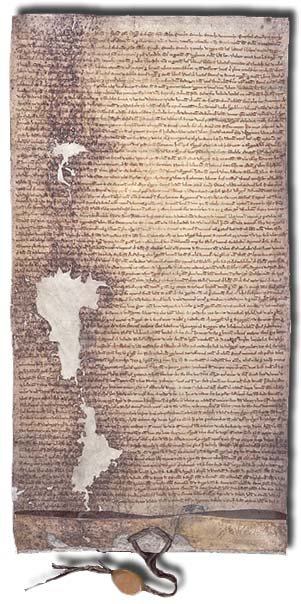
The 1225 version of Magna Carta issued by Henry III of England. Source: Public domain, National Archives, available here.

The rebellion that emerged was therefore organized rather than spontaneous. A group of powerful barons formed a coalition against John, coordinating their demands and presenting a united political front. They were not attempting to abolish the monarchy, nor were they seeking to produce a modern democracy. Their objective was to force the king to recognize that even a monarch was subject to established law and custom. In medieval England, this was a revolutionary proposition in practice, even though the rebels themselves largely expressed their demands in terms of restoring traditional rights.

The rebels understood that military pressure alone might not be enough. They needed to demonstrate that John could no longer govern effectively without their cooperation. Their campaign therefore combined armed resistance with political organization. When negotiations failed, the barons moved against royal strongholds and eventually seized London in May 1215. The capture of the capital was a decisive turning point. London was not merely England's largest and most important city; it was a center of royal finance, administration and trade. Its loss placed enormous pressure upon John and demonstrated that the rebellion had become a national political crisis.

With London in rebel hands, John was forced to negotiate. The king and the barons met at Runnymede, a meadow beside the River Thames, in June 1215. The negotiations were difficult, and neither side entirely trusted the other. The barons wanted enforceable guarantees that John would respect their liberties, while John wanted to preserve the authority of the Crown. The resulting document, eventually known as Magna Carta, was therefore not a declaration of democracy but a negotiated attempt to prevent the kingdom from descending further into civil war.

Magna Carta was sealed by John on 15 June 1215. Its immediate purpose was practical: to settle the dispute between the king and the rebel barons. Yet the document contained principles whose significance would eventually extend far beyond the circumstances in which it was produced. It established the idea that the king's authority was not unlimited and that royal government should operate according to recognized law and custom.

One of the earliest provisions concerned the Church. Magna Carta declared that the English Church should be free and possess its liberties unimpaired. This reflected the bitter struggle between John and the papacy that had dominated part of his reign, but it also reinforced the broader principle that the king could not simply treat every institution within his kingdom as an extension of his personal authority.

The charter also dealt extensively with property and inheritance. The arbitrary seizure of land, excessive financial demands and abuses of feudal authority had invoked deep resentment among the barons. Magna Carta attempted to establish clearer rules governing inheritance, debts, property and the responsibilities of royal officials. These provisions were particularly important to the aristocracy, but the underlying principle was broader: property could not simply be taken or manipulated at the king's personal whim.

Taxation was another major source of conflict. John had repeatedly demanded money from his subjects to finance his wars, including through scutage, a payment traditionally made by knights in place of military service. Magna Carta placed important restrictions on the king's ability to impose certain extraordinary financial demands without the "common counsel" of the kingdom. Although this was not parliamentary taxation in the modern sense, it represented an important step towards the principle that taxation required consultation and consent.

Perhaps the most famous principle appears in Clause 39, which addressed imprisonment, dispossession and justice. It stated that no free man was to be arrested, imprisoned, dispossessed, outlawed or exiled except by the lawful judgment of his equals or by the law of the land. The provision did not establish universal equality before the law as we understand it today, because medieval society was deeply hierarchical. Nevertheless, it placed an important conceptual limitation upon arbitrary royal power: the king could not simply punish a free man according to personal preference without reference to lawful process.

The famous phrase "law of the land" would acquire enormous importance in later centuries. Magna Carta did not invent the idea that kings should obey the law, but it gave that principle a powerful written expression. The significance of Clause 39 lies therefore not simply in what it meant to a thirteenth-century baron, but in how later generations interpreted and developed its underlying concept of due process and lawful government.

Another extraordinary provision was the security clause, Clause 61. This introduced a mechanism through which a committee of twenty-five barons could monitor the king's compliance with the charter. If John violated its terms, the barons could take action against him, including seizing royal property until the breach was corrected. In effect, the clause attempted to give the charter an enforcement mechanism rather than relying solely upon the king's goodwill.

The inclusion of Clause 61 reveals just how little trust existed between John and his opponents. The rebels clearly believed that a simple promise from the king would be insufficient. They wanted a practical means of compelling him to obey the agreement. In doing so, they were challenging one of the fundamental assumptions of medieval kingship: that royal authority ultimately rested in the person of the monarch.

Although the barons were the driving force behind the rebellion, the crisis affected a much wider section of English society. Merchants depended upon predictable laws and secure trade, while townspeople were increasingly important to the economy and administration of the kingdom. Freemen had interests in property, justice and protection from arbitrary authority, while peasants, although largely excluded from political power, were affected by the taxation, feudal obligations and administrative abuses generated by royal government.

It would therefore be misleading to portray Magna Carta as a document written for ordinary people in the modern democratic sense. Most of its immediate beneficiaries were members of the political and social elite, particularly the barons and other free men. Yet the principle that government should be constrained by law possessed a potential far greater than the intentions of those who penned it. Over succeeding centuries, lawyers, politicians and reformers would repeatedly return to Magna Carta as evidence that royal authority had limits.

This is where the events of 1215 become particularly important in the longer history of constitutional government. England did not suddenly become a constitutional monarchy when John sealed Magna Carta. There was no parliament in the modern sense, no universal suffrage and no concept of equal political rights. Nevertheless, the confrontation established a powerful precedent: the king could be compelled to recognize that his authority was subject to law and that certain decisions required consultation and established procedure.

For John, however, Magna Carta was never a settlement he genuinely intended to embrace. He had accepted the charter because the political and military circumstances had left him with little alternative. Almost immediately, both sides began preparing for the possibility that the agreement would collapse. John appealed to Pope Innocent III, who regarded the charter as an unacceptable limitation upon the authority of an anointed king. The pope subsequently annulled it, and the fragile peace of 1215 disintegrated.

England was once again plunged into civil war. The rebels had achieved an extraordinary victory at Runnymede, but they had not solved the fundamental problem of John's kingship. The charter had been sealed, but it had not been secured. The struggle between the king and his opponents would therefore continue, setting the stage for the final and most dramatic phase of John's reign.

Needless to say, the sealing of Magna Carta in June 1215 was therefore neither the end of King John's troubles nor the sudden birth of English democracy. It was the product of a profound political crisis in which military defeat, financial demands, arbitrary government and conflict with the Church had combined to undermine confidence in the Crown. The barons had forced John to accept written limitations upon his authority, but the charter remained a fragile compromise rather than a lasting peace. Its provisions were shaped by the immediate concerns of medieval society, particularly the rights of the Church, the aristocracy and free men, and they did not create equality, representative government or universal rights. Nevertheless, the principle that emerged from the confrontation was immensely significant: the king was not entirely above the law. Royal authority could be challenged, negotiated and, at least in principle, restrained by established law and custom.

Yet Magna Carta's immediate failure is as important as its later legacy. John's appeal to Pope Innocent III and the papal annulment of the charter demonstrated how little genuine trust existed between the Crown and the rebel barons. Within months, England had returned to civil war, proving that a document alone could not resolve a political struggle when neither side was prepared to accept its terms. The conflict would ultimately outlive John himself, whose reign descended into further military and political crisis before his death in October 1216. Magna Carta would also be reissued in modified forms under his successors, gradually separating the enduring principles of lawful government from the circumstances of its troubled birth.

The true importance of 1215 therefore lies not in the notion that England suddenly became free, but in the precedent established by the confrontation between John and his opponents. Magna Carta became a symbol of the proposition that government must operate within the law and that even a monarch cannot exercise power entirely according to personal will. Over the centuries, later generations would reinterpret its provisions, particularly those concerning lawful judgment, due process and taxation, giving them meanings far beyond what the barons at Runnymede could have anticipated. The rebellion of 1215 was born from medieval grievances and elite political interests, but its consequences reached into the development of constitutional government itself. In that sense, the crisis surrounding King John transformed a desperate attempt to restrain an unpopular monarch into one of the most enduring political landmarks in English history.


Now, read Terry’s series on King Kenry VIII and his wives here.
Posted
AuthorHistory Is Now Magazine
CategoriesBlog Post

The reign of King John entered its most dangerous phase not simply because he was unpopular, but because military failure began to undermine the very foundations of his authority. When John became king in 1199, he inherited one of the most extensive collections of territories ever assembled by an English monarch. The Angevin Empire stretched across large parts of modern-day France, from Normandy and Anjou to Aquitaine, while England itself provided the wealth and political base from which these possessions could be governed. Yet within little more than a decade, much of this vast inheritance had disappeared. The loss of these territories would have consequences far beyond the battlefield. It would damage John's reputation as a ruler, drain the English treasury, increase the financial demands placed upon his subjects and, ultimately, convince many of his most powerful nobles that the king himself had become a threat to the stability of the realm.

Terry Beiley explains.

You can read part 1 on the cruel King who made his own enemies here.

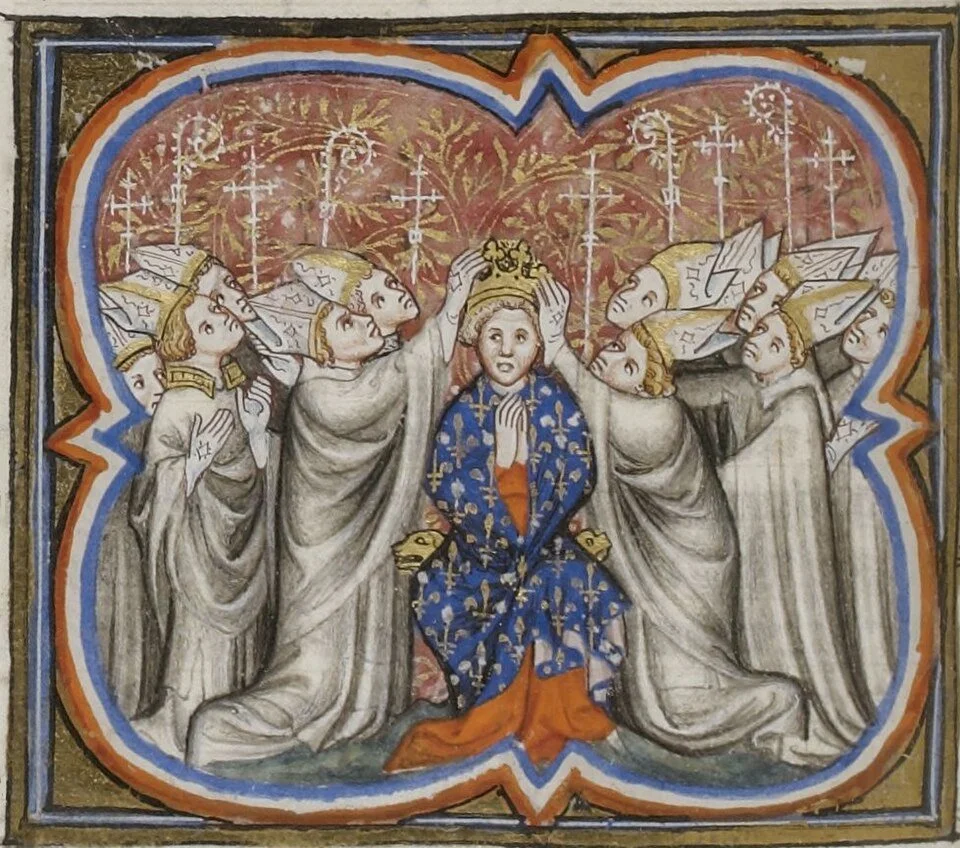
The coronation of Philip II of France. Source: Public domain, Bibliothèque nationale de France, available here.

John's difficulties began almost immediately after his accession. His claim to the French territories inherited from his brother Richard I was challenged by his nephew, Arthur of Brittany. Arthur was supported by Philip II of France, who saw an opportunity to weaken the Angevin territories that had long represented a formidable obstacle to Capetian expansion. John initially appeared capable of containing the threat, but his position deteriorated rapidly. His military response was undermined by political divisions within his French territories, and several important nobles began transferring their allegiance to Philip.

The decisive crisis came in 1203–1204 with the loss of Normandy. John had been unable to prevent Philip II from systematically attacking the duchy, while a combination of military pressure, defections and political miscalculation weakened the English position. The fall of Château Gaillard, the great fortress constructed by Richard I to guard Normandy, was particularly significant. When Château Gaillard fell in March 1204, the strategic position of Normandy became increasingly untenable. Rouen itself surrendered soon afterwards. By the end of 1204, Normandy, Anjou, Maine and Touraine had effectively been lost to the French crown.

The loss was catastrophic for John's prestige. Normandy had been under English royal control for generations and was not merely another possession across the Channel. It had been central to the political and economic power of the Norman and Angevin kings. Its loss meant that John had failed to defend one of the most important parts of his inheritance. Worse still, much of the defeat had occurred without the kind of spectacular final battle that could easily be blamed upon bad luck. Philip had gradually dismantled John's position through military pressure, diplomacy and the exploitation of John's political weaknesses.

The collapse of Normandy marked the beginning of the end of what historians commonly call the Angevin Empire. The term itself is somewhat misleading, because these territories were not a unified empire in the modern sense. They were a collection of duchies, counties and lordships held by the same ruling dynasty, each with its own traditions, laws and political relationships. Nevertheless, the territories together gave the English monarchy enormous prestige and resources. Their loss dramatically altered the balance of power between England and France.

John did not simply accept the loss. He spent much of the remainder of his reign attempting to recover the territories taken by Philip. This created a dilemma. To regain his continental possessions, John needed money. To obtain money, he had to place greater financial demands upon England. Yet the more money he extracted, the greater the resentment among the very people whose support he needed.

The king's strategy was ambitious. John attempted to build alliances against Philip and encouraged his nephew Otto IV, Holy Roman Emperor, to challenge French power. Other rulers and nobles were drawn into a broad coalition that sought to contain Philip II. In 1214, John launched a major campaign in France while his allies attacked from the north. If successful, the operation could have reversed years of French expansion and restored much of John's lost position. Instead, the campaign ended in disaster.

The crucial confrontation took place at the Battle of Bouvines in July 1214. John had already suffered a setback at La Roche-aux-Moines, where his advance into Anjou collapsed after resistance from local forces and the approach of enemy troops. Meanwhile, the allied army led by Otto IV met Philip II at Bouvines. The French king achieved a decisive victory. The defeat destroyed the coalition's immediate hopes of reversing French expansion and left John in an increasingly desperate position.

For John, Bouvines was far more than a military defeat. It represented the failure of years of diplomacy, taxation and military preparation. The enormous sums raised for the campaign had produced no corresponding victory. England had paid heavily for a war that had failed to restore the lost territories. The political consequences were therefore particularly severe.

John's attempts to finance his wars had already placed considerable pressure upon the English nobility. Medieval kings did not possess a modern taxation system capable of providing a predictable national income. The crown depended upon a mixture of traditional revenues, feudal payments, customs duties, fines, land income and extraordinary demands imposed when circumstances required additional money.

One of the most important mechanisms available to John was scutage, a payment traditionally made by knights or their lords in place of military service. In principle, scutage allowed the king to hire soldiers rather than requiring every knight owing military service to serve personally. It could therefore be a practical method of financing warfare. Under John, however, its repeated use and increasing financial burden contributed to the growing perception that the king was exploiting his feudal rights to extract as much money as possible from his subjects.

Scutage was not the only source of resentment. John imposed a range of extraordinary financial demands, fines and levies, and his administration became increasingly aggressive in collecting royal revenues. The issue was not simply that taxation existed; medieval kings had always demanded money. The problem was the scale and frequency of John's demands, particularly when the money appeared to be financing unsuccessful military campaigns.

For the barons, this produced a deeply troubling situation. They were expected to provide money to a king who had already lost enormous territories and then demanded still more resources to recover them. The argument could easily be turned against John: if his wars had repeatedly failed, why should the barons continue paying for them?

There was also a fundamental political issue beneath the financial dispute. Feudal government depended upon relationships of obligation and loyalty. A king expected service and money from his nobles, while nobles expected the king to protect their interests, respect established customs and administer justice. When either side believed the other was failing in its obligations, the relationship could begin to fracture.

John's reputation made the problem considerably worse. His military failures reinforced existing suspicions about his judgement, while his methods of government created fear and hostility among many of his subjects. His dealings with powerful nobles were frequently confrontational, and his use of financial penalties could leave wealthy men vulnerable to the king's demands. A monarch who was already distrusted could not easily impose extraordinary taxation without provoking resistance.

The Church also became increasingly hostile towards John. The dispute over the appointment of the Archbishop of Canterbury, Stephen Langton, had already brought John into conflict with Pope Innocent III. When John refused to accept the papal choice, England was placed under an interdict in 1208, suspending many public religious services. John himself was eventually excommunicated in 1209.

The dispute eventually became another source of political isolation. Although John ultimately submitted to the papacy and made substantial concessions, the episode damaged his relationship with important Church leaders. His willingness to confront the Church demonstrated the extraordinary extent to which he was prepared to resist opposition, but it also meant that he had alienated an institution possessing enormous political and social influence.

By the time John returned from his failed campaign in France in 1214, his position had become increasingly precarious. He had lost Normandy and most of the Angevin territories that had once formed the foundation of his family's continental power. His attempt to recover them had ended in failure. His treasury had been depleted by years of warfare, while the financial burden placed upon the English nobility had become increasingly difficult to justify.

The barons' dissatisfaction therefore cannot be explained simply as opposition to taxation. Their grievances were connected to a much larger question: could John still be trusted to govern effectively? A king could demand extraordinary sacrifices from his nobles if those sacrifices produced security, victory and prosperity. John was increasingly asking them to pay for failure.

This distinction was crucial. Had John won a spectacular victory over Philip II, many of his financial demands might have been remembered as the necessary price of restoring the kingdom's continental possessions. Instead, the defeat at Bouvines left the barons with little to show for the enormous resources they had provided. The king had not restored his lost empire. He had merely spent more money attempting to recover it.

John was therefore becoming politically isolated. His relationship with the barons was deteriorating, his relationship with the Church had been severely damaged, and his reputation as a military leader had suffered repeated blows. Even his eventual reconciliation with the papacy could not repair the deeper problem: too many powerful men had begun to question whether John's rule served the interests of the kingdom.

The loss of Normandy had begun as a military and territorial disaster. By 1214, however, it had developed into a constitutional and political crisis. John's inability to defend the inheritance of his dynasty had damaged his prestige; his determination to recover it had exhausted resources; and his methods of raising money had turned financial necessity into political resentment.

For an increasing number of barons, the issue was no longer simply whether John was an unpleasant or unpopular king. They were beginning to believe that his judgement, policies and methods of government were actively endangering the kingdom itself. If John could not win his wars, protect the realm, respect established political relationships or restrain his demands for money, then the traditional bonds between king and subjects were in danger of collapsing.

The stage was therefore set for open confrontation. The next crisis would not be fought primarily on the battlefields of France, but in the political heart of England, where John's opponents would attempt to force the king to accept limits upon his authority.

And it was there, in 1215, that the struggle would produce one of the most famous documents in English history: Magna Carta.

The story of John's failures in France was not simply one of lost castles, defeated armies and disappearing territories. It was the story of how military failure transformed the relationship between a medieval king and the people upon whom his authority depended.

When John inherited the throne in 1199, he inherited the vast territorial legacy of Henry II and Richard I. Within a few years, however, Normandy, Anjou, Maine and Touraine had been lost to Philip II. The fall of Château Gaillard and Rouen became powerful symbols of a king unable to defend his inheritance, fundamentally weakening his prestige.

John's response was to attempt to recover what he had lost. But war required enormous financial resources, creating the central contradiction of his reign: he needed the support of his kingdom to finance his wars, yet the taxes, scutage, fines and feudal payments used to raise that money increasingly destroyed that support.

The defeat at Bouvines in 1214 brought this contradiction into sharp focus. Despite years of taxation, preparation and alliance-building, John failed to recover his territories. His subjects were being asked to make greater sacrifices without receiving the military success that might have justified them.

The growing opposition was therefore not simply personal dislike of John. It was a crisis of trust. Medieval kingship depended upon reciprocal obligations: the king expected loyalty, military service and financial support, while his subjects expected protection, justice and respect for established customs. John was increasingly failing to uphold his side of that bargain.

Military defeat, financial demands, disputes with the nobility and conflict with the Church combined to produce a dangerous accumulation of grievances. By 1214, these problems had become interconnected: military failure required more money; more money created resentment; resentment weakened loyalty; and weakened loyalty made effective government increasingly difficult.

The question was no longer simply whether John was unpopular, but whether he could be trusted to govern within the accepted customs of the realm.

This was the crisis that led towards Magna Carta. It did not emerge suddenly because the barons disliked John, nor was it originally a declaration of democracy or modern human rights. It was a medieval attempt to resolve a political crisis by reaffirming established rights and limiting the king's ability to act beyond accepted custom.

By the end of 1214, John had lost much of his continental inheritance, failed to recover it, spent heavily attempting to do so and alienated many of the men whose cooperation was essential to his rule. The battlefield had effectively moved from France to England. The next confrontation would be fought not with siege engines and cavalry, but through political pressure, negotiation and eventually rebellion.

In 1215, John's opponents would force him to confront the consequences of years of military failure, financial demands and political miscalculation. The road to Magna Carta had begun with the loss of an empire. It would culminate in one of the first great confrontations over the limits of the English Crown.


Now read part 3 on rebellion and Magna Carta here.

Posted
AuthorHistory Is Now Magazine
CategoriesBlog Post

Few English monarchs have earned a reputation as dark and enduring as King John (reign 1199-1216). More than eight centuries after his death, his name remains synonymous with tyranny, injustice and failure. Unlike many medieval kings whose reputations have softened with the passage of time, John continues to occupy a unique place in English history as the king who alienated almost everyone around him, his family, his nobles, the Church, and ultimately his own people. His reign would culminate in one of the most significant constitutional moments in history: the sealing of Magna Carta in 1215. Yet the famous charter was not born simply from political theory or a desire for liberty. It emerged because one man's methods of ruling pushed his kingdom to breaking point.

Terry Bailey explains.

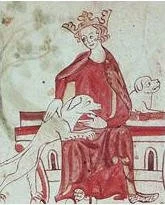
King John of England with dogs. Source: Public domain, painter unknown, available here.

John was born on the 24th of December 1166, the youngest surviving son of King Henry II of England and the formidable Eleanor of Aquitaine. He entered one of medieval Europe's most powerful dynasties, the Angevin Empire, which stretched from the Scottish borders to the Pyrenees and controlled vast territories in France. As the youngest son, however, John was never expected to inherit substantial lands. His elder brothers, Henry the Young King, Richard, Geoffrey and William, stood before him in the line of succession.

This uncertain position shaped much of John's early life. Henry II affectionately called him "Lackland" because he initially had no significant inheritance of his own. The nickname would remain with him throughout history, although later events would give it an ironic twist. While his brothers governed territories and led armies, John remained largely dependent upon his father, fostering a sense of insecurity that many historians believe influenced his later behavior. Growing up in a fiercely competitive royal household, where alliances shifted rapidly and family members frequently rebelled against one another, John learned that power depended as much upon suspicion and manipulation as it did upon loyalty.

Relations between John and his brothers were rarely harmonious. Richard, later immortalized as Richard the Lionheart, became one of the greatest military commanders of the medieval period and enjoyed enormous prestige across Europe. John lived perpetually in his brother's shadow. During Richard's reign, while the king fought during the Third Crusadeand later endured imprisonment in Germany, John attempted to increase his own influence and, at times, entered into political intrigues that appeared to undermine Richard's authority. Although popular legend often portrays John openly conspiring to seize the throne, the reality was more complex. Medieval politics encouraged opportunism, and John's actions reflected both ambition and the instability of the age. Nevertheless, these episodes damaged his reputation long before he became king.

When Richard I died in April 1199 from a wound sustained during a siege in France, John inherited the English crown. His succession, however, was far from universally accepted. Many believed that Arthur of Brittany, the teenage son of John's elder brother Geoffrey possessed a stronger hereditary claim. Although John secured the support of many English nobles and was crowned at Westminster, significant opposition remained across his French territories. From the beginning, his reign rested upon uncertain foundations.

John proved to be an intelligent and energetic administrator. Unlike Richard, who spent comparatively little time in England, John devoted considerable attention to government, finance and legal administration. He travelled extensively throughout his kingdom, supervised officials personally and kept detailed financial records. Modern historians generally agree that he possessed considerable administrative ability. Unfortunately, these talents were accompanied by serious flaws of temperament that ultimately overwhelmed his strengths.

Contemporary chroniclers consistently described John as suspicious, impulsive and deeply vindictive. He rarely forgave those who opposed him, often pursuing enemies with relentless determination long after they had ceased to pose any real threat. Whereas successful medieval kings relied heavily upon rewarding loyalty and maintaining personal relationships with powerful nobles, John frequently humiliated, intimidated or financially exploited those whose support he needed most. Trust became almost impossible within his court because few believed the king would honor promises once circumstances changed.

One event more than any other cemented John's reputation for cruelty. In 1202, during his conflict with the French king Philip II, Arthur of Brittany was captured by John's forces. The young prince disappeared while imprisoned in royal custody. Within months, rumors spread that John himself had murdered his seventeen-year-old nephew, possibly in a drunken rage before disposing of the body in the River Seine. No contemporary source provides definitive proof of exactly what happened. Some chroniclers claimed eyewitness knowledge, while others repeated stories circulating years later. Modern historians remain cautious because the evidence is inconclusive. Nevertheless, few doubt that John bore responsibility for Arthur's disappearance. Whether he personally committed the killing or merely ordered it, the political consequences were catastrophic. Across Europe, many nobles concluded that John had murdered a close relative to secure his throne, permanently staining his reputation.

Military failures compounded these personal controversies. In 1204, John lost Normandy, one of the crown's richest continental possessions to King Philip II of France. The loss represented a profound humiliation for the Angevin dynasty and forced many Anglo-Norman nobles to choose between lands held in England and those in France. John's determination to recover these territories became an obsession, and financing repeated military campaigns required enormous sums of money.

To raise the necessary funds, John pushed the medieval system of taxation to unprecedented levels. He imposed frequent scutage payments, allowing nobles to avoid military service by paying money instead, but demanded these payments far more often than previous kings. He exploited feudal customs to extract heavy inheritance fees, marriage payments and fines whenever opportunities arose. Justice itself increasingly appeared to be for sale. Wealthy individuals could purchase favorable legal outcomes or avoid punishment by paying substantial sums into the royal treasury. Although many of these practices had legal foundations within feudal law, John employed them with such relentless determination that even loyal supporters began to resent the financial burden.

His relationship with the English barons steadily deteriorated. Medieval kings depended upon cooperation with their leading nobles, who provided military service, governed local regions and advised the crown. John instead ruled through fear and financial pressure. Hostages were taken to guarantee obedience. Castles were confiscated. Lands were seized from those who fell from royal favor. Noble families found themselves subjected to crushing fines that could bankrupt entire estates. Rather than strengthening the monarchy, these measures encouraged increasingly organized resistance.

John's approach to justice also attracted widespread criticism. Royal courts expanded under his reign, but many believed legal decisions depended less upon fairness than upon the king's personal interests. Political opponents frequently found themselves prosecuted while allies escaped punishment. Property could be confiscated on questionable legal grounds, and imprisonment without meaningful recourse became an accepted instrument of royal power. Such practices undermined confidence in the very institutions that earlier Angevin kings had worked to develop.

Ordinary people fared little better. Although medieval peasants rarely played a direct role in national politics, they nevertheless experienced the consequences of John's government. Higher taxes filtered through society, while local officials often enforced royal demands with considerable severity. Forest laws, regulating access to woodland resources essential for many rural communities, were harshly applied. Merchants encountered tolls and financial demands, while villages bore the costs of supporting military campaigns. Life for the average English family was already uncertain through poor harvests, disease and local conflicts; John's relentless pursuit of revenue only deepened these hardships.

His troubles extended beyond secular politics. John's prolonged dispute with Pope Innocent III over the appointment of the Archbishop of Canterbury resulted in England being placed under an interdict in 1208, severely restricting religious services throughout the kingdom. When John refused to yield, he was excommunicated. Although he eventually submitted to papal authority and even accepted England as a papal fief, the conflict further damaged his prestige. To many contemporaries, a king condemned by the Church appeared to have lost not only political support but divine favor as well.

The overwhelmingly negative portrait of John owes much to medieval chroniclers, many of whom were monks writing within religious communities deeply affected by his policies. Writers such as Roger of Wendover and Matthew Paris described him as deceitful, greedy, immoral and cruel. Their accounts undoubtedly reflected genuine hostility, but they also carried institutional bias, particularly after John conflicted with the papacy. Modern historians therefore approach these sources carefully, recognizing both their immense value and their limitations. Even allowing for exaggeration, however, the remarkable consistency of criticism from numerous contemporary writers suggests that John's failures as a ruler were both real and widely recognized.

Yet history is rarely as simple as legend. John was not an incompetent fool. He was an able administrator, an intelligent strategist in some circumstances, and a hardworking king who understood the mechanics of government better than many of his predecessors. His tragedy lay in the fact that these strengths were undermined by profound defects of character. Suspicion replaced trust, vengeance displaced reconciliation, and financial exploitation substituted for genuine leadership. In attempting to tighten his grip upon power, he steadily weakened the foundations upon which royal authority depended.

By the second decade of the thirteenth century, England stood on the brink of open rebellion. Noble resentment had hardened into organized opposition. The monarchy's authority was increasingly questioned, while military failures and financial burdens intensified demands for reform. The stage was now set for a confrontation unlike any England had previously witnessed, a struggle that would force an unwilling king to acknowledge that even a monarch's power had limits. That confrontation would soon produce one of the most influential political documents in history: Magna Carta.

In conclusion, King John's reign serves as one of history's clearest reminders that the strength of a kingdom depends not merely upon the authority of its ruler, but upon the confidence and cooperation of those he governs. Although he inherited one of Europe's greatest realms and possessed undeniable administrative ability, his relentless pursuit of power, wealth and control steadily eroded the very foundations upon which that power rested. Through fear rather than trust, coercion rather than compromise, and punishment rather than reconciliation, John transformed political discontent into open hostility. By alienating his family, his barons, the Church and much of the wider population, he produced an alliance of opponents united by little more than a shared determination to curb the excesses of royal authority.

Yet history should resist the temptation to portray John as a one-dimensional villain. Many of the financial and legal mechanisms he employed had existed before his reign, and several would continue after his death. What distinguished John was not the invention of these methods, but the unprecedented scale, frequency and ruthlessness with which he employed them. His inability to inspire loyalty or command genuine respect meant that every military defeat, every financial demand and every perceived injustice compounded the growing belief that the king himself had become the greatest threat to the stability of his own kingdom.

The irony of John's reign is profound. In seeking to strengthen the English Crown, he instead exposed its vulnerabilities. In attempting to make royal authority absolute, he provoked demands that it be restrained by law. His failures would ultimately achieve what his successes never could: they compelled England's leading nobles to insist that even a king must govern within recognized limits. Although Magna Carta was initially conceived as a practical peace treaty between a desperate monarch and rebellious barons rather than a declaration of universal human rights, its enduring principles would echo through the centuries, influencing constitutional government far beyond medieval England.

John himself never accepted these limitations. Within weeks of sealing Magna Carta, he sought to overturn it, plunging the kingdom into civil war. The charter's immediate future appeared bleak, and few contemporaries could have imagined that this fragile agreement, born out of mistrust and conflict, would become one of the most celebrated constitutional documents in history.

The story therefore does not end with King John's failures; it begins with them. His reign illustrates how poor leadership, personal vindictiveness and unchecked authority can drive even the most powerful monarch towards political disaster. The rebellion he provoked would fundamentally alter the relationship between ruler and ruled, setting England upon a constitutional path whose consequences would eventually reach far beyond its shores.

As we continue to delve deeper into the kingdom, political opposition hardens into armed rebellion and the examination of years of mistrust erupted into the Barons' Revolt, the dramatic events leading to the meeting at Runnymede, and the extraordinary negotiations that produced Magna Carta, a document born not from idealism, but from crisis, necessity and the determination that no ruler, however powerful, should stand above the law.


Now, read part 2 on Losing an Empire - War, Defeat and a Growing Rebellion.

Posted
AuthorHistory Is Now Magazine
CategoriesBlog Post

The Magna Carta resulted from a groundbreaking agreement that King John of England submitted to in a very different age. And as we approach its 800th anniversary in 2015, Laura Taylor tells us more about it.

Page 1 of a copy of the Magna Carta. It is currently in the Library of Congress in Washington, D.C.

Page 1 of a copy of the Magna Carta. It is currently in the Library of Congress in Washington, D.C.

Whilst relating to history, and more specifically historical events, there are always particular ones that spring mind.  This can be influenced by current and topical events or historical anniversaries.

A prime example of this is the approaching 800-year anniversary of the signing of Magna Carta. This will be celebrated on June 15, 2015.  Fellow history enthusiasts will know the finer details surrounding Magna Carta, also called Magna Carta Libertatum or The Great Charter of the Liberties of England, and the events preceding its signing at Runnymede. 


Let’s take a look at the history surrounding the event

On the surface it may seem like a group of disgruntled and rebellious Barons who conspired against King John. Magna Carta was authored over many months by the Barons in secret and anticipation in the caves at Reigate, Surrey. Magna Carta was actually rejected by many Barons. History tells us that King John was a volatile and unpredictable King with little compassion or regard for his subjects and his realm. The Barons based their rebellion around John's oppressive government. Magna Carta was the first instant of a Statute being imposed and enforced on a Monarch. Its intention was to limit King John’s powers and protect the rights of the Barons and English subjects.

King John, not wanting to relinquish any powers, which he deemed were his by divine right, tried to appease the Barons, and open up negotiations. The Barons were never going to accept John’s word as past experience proved he was not a man of his word and was selective regarding previous agreements. 

The King tried to delay, whilst waiting for support from Rome and paid mercenaries from other countries.  Further negotiations took place from January to June 1215. These resulted in the document named by historians as 'The Unknown Charter of Liberties'.

The Barons were not going to be suppressed any longer; they had the additional support from Louis the French Prince, and King Alexander II of Scotland. On the June 10, 1215 they marched on the city of London and forced King John to agree to a document known later as the 'Articles of the Barons'. Five days later the seal of King John was duly attached to the document, and in return the Barons reaffirmed their fealty to the King. Thus Magna Carta was set in law.

Twenty-five Barons stood to enforce Magna Carta, and together had the power to overrule the King if he defied any of the provisions of the Charter.

Once the Barons had left London John renounced the Charter immediately. What followed next is known as the “First Barons’ War” The Barons wished to replace King with Prince Louis of France. This was an unpopular choice with many as England and France had been at war for the last 30 years.


Magna Carta may appeared to have failed initially

However, upon the death of King John in 1216 and throughout the next 80 years, Magna Carta really came into provenance, albeit with some clauses removed or amended.  In 1225 King Henry III (King John’s son) was called upon to confirm the Charters, Henry reissued a shorter version of the Charter.  72 years later King Edward I then reissued the 1225 Charter. It is this version that remains in Statute today; obviously the majority of clauses have been repealed.


Forthcoming celebrations

There are many events planned worldwide to mark the 800-year anniversary, and currently there are copies of Magna Carta on tour in America, one of which is owned by Lincoln Cathedral, normally on display at Lincoln Castle.  We visited Lincoln Castle recently and spoke with one of the guides who explained to us that, whilst Lincolnshire’s copy of Magna Carta was currently on loan to the US, they were undergoing the task of having a new vault and display commissioned to house their copy upon its return.

Many readers will be familiar with the connection between Magna Carta and the American Bill of Rights. A prime example of this is when Maryland in 1638 sought to recognize Magna Carta as law in the province. This was not granted by the King.

One can’t help but wonder what would have been if those “disgruntled and rebellious Barons” had not rallied together and made a stand against their king? Would Magna Carta have ever happened in later years, perhaps under a different guise? One could suggest that it was all down to King John and the fact that he was despised by those he suppressed, so he bought it on himself.  History documents quite clearly the popularity of English Monarchs, their shortcomings and legacies.  There does not appear to be another monarch who was held in such disdain as John, or one whose volatile and unpredictable rule left such a legacy. So for that, should we be grateful?

If you are a descendant of the Barons who supported Magna Carta then you may be interested in the following publication: “Magna Carta Barons” 1915 – Baronial Order of Runnemede, by Charles H. Browning.

Posted
AuthorHistory Is Now Magazine
CategoriesBlog Post