The apparent triumph of Magna Carta in June 1215 proved extraordinarily short-lived. The charter had been intended to impose limits upon King John's authority and restore a measure of political stability, but neither side regarded the settlement as a durable peace. John had accepted the document under intense military and political pressure, rather than from any genuine willingness to surrender the powers he believed belonged to the Crown. Almost immediately, disagreements emerged over its interpretation, enforcement and implementation. What had been presented as a constitutional settlement was rapidly becoming little more than an armistice between a king and his rebellious barons.
Terry Bailey explains.
You can read part 1 on the cruel King who made his own enemies here, part 2 on losing an empire here, and part 3 on rebellion and Magna Carta here.
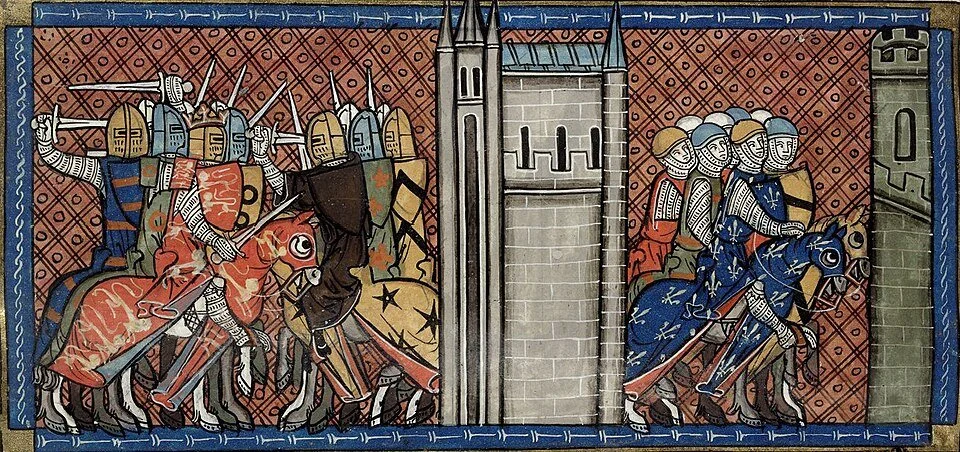
King John of England in battle with the Francs (left), and Prince Louis VIII of France on the march (right). Source: Public domain, British Library, Royal 16 G VI f. 385), available here.
John soon appealed to Pope Innocent III, presenting the Magna Carta not as a legitimate limitation upon royal authority but as an agreement extracted from him by force. The pope was particularly receptive to John's argument. As John's feudal overlord, Innocent regarded the charter as an affront to papal authority as well as an attack upon the rights of a crowned monarch. In August 1215, the pope formally annulled Magna Carta, declaring it invalid and describing the circumstances under which it had been obtained as coercive. The annulment effectively removed any possibility of peacefully enforcing the charter and gave John the ecclesiastical justification he needed to resume the struggle.
With Magna Carta repudiated and the papal condemnation of the charter announced, England descended rapidly into open civil war. The conflict that followed became known as the First Barons' War, pitting those nobles who supported John against the rebel barons who had sought to restrict his authority. The division was not simply a straightforward confrontation between king and aristocracy. Many nobles initially attempted to remain neutral, while others shifted allegiance according to political circumstances, family interests, territorial security and the changing fortunes of the war. England was becoming a patchwork of competing loyalties in which political allegiance could change remarkably quickly.
John now demonstrated why his opponents had feared his determination and military ability. Although his reputation has often been overshadowed by his political failures, he was an energetic and experienced campaigner when circumstances demanded it. His strategy was based upon mobility, intimidation and the systematic reduction of enemy strongholds. Rather than attempting to defeat every rebel army in a single decisive confrontation, royal forces moved between areas of resistance, relieving loyalist garrisons, devastating rebellious territories and besieging castles that represented the physical foundations of baronial power.
Castles were particularly important because they were more than defensive structures. They were centers of aristocratic authority, symbols of political allegiance and bases from which rebellious nobles could control surrounding territories. John therefore targeted them relentlessly. Royal armies laid siege to rebel strongholds, while castles that surrendered could be occupied, dismantled or otherwise neutralized. The destruction and seizure of these fortifications had a psychological purpose as well as a military one: it demonstrated that rebellion could bring not merely defeat but the destruction of the material foundations of a nobleman's power.
John's methods could be extraordinarily severe. His campaigns involved devastation of lands belonging to his enemies, confiscation of property and the use of calculated intimidation to discourage further resistance. Medieval warfare was inherently brutal, but John's actions acquired particular notoriety because he understood the value of terror as a political weapon. The destruction of estates and fortifications could force wavering nobles to reconsider their allegiance, while the prospect of royal vengeance made neutrality increasingly difficult to maintain. Yet this strategy carried an obvious danger: the more ruthlessly John pursued his enemies, the more reason some of them had to believe that reconciliation with him was impossible.
The rebels consequently began searching for a means of defeating John that did not depend upon their own divided military strength. Their solution was extraordinary. They invited Prince Louis of France, the son of King Philip II, to come to England and claim the English crown. Louis was not merely being asked to provide military assistance; the rebels were effectively offering the throne of England to a foreign prince. Their willingness to take such a dramatic step revealed just how profoundly relations between John and sections of the English aristocracy had deteriorated.
Louis had an obvious strategic interest in accepting. The French monarchy had spent decades weakening the Angevin power that had once dominated extensive territories in France. John's disastrous loss of Normandy and other continental possessions had already transformed the balance of power between the English and French crowns. An opportunity to establish a French prince upon the English throne represented a potentially spectacular extension of Capetian influence. Louis therefore accepted the invitation and prepared to intervene.
In 1216, the conflict expanded from an English civil war into an international struggle. Louis crossed the Channel and landed in England with a French army. London welcomed him, and several English barons formally recognized him as king. The speed with which the rebellion attracted substantial support demonstrated the seriousness of John's predicament. What had begun as a revolt against royal government had evolved into a contest over the English succession itself.
John responded by seeking additional military assistance of his own. He recruited foreign mercenaries, particularly from the continent, whose loyalty depended upon payment rather than the increasingly uncertain political loyalties of English nobles. Mercenary forces were valuable because they could provide experienced soldiers at a time when the king could not rely entirely upon his own subjects. Their presence also illustrates the increasingly international character of the conflict: England's civil war was now being fought by English barons, royalist forces, French troops and continental mercenaries, with the political future of the kingdom hanging in the balance.
The campaigns of 1216 were therefore characterized less by one decisive confrontation than by maneuver, siege warfare and the struggle for strategic strongholds. John attempted to maintain royal authority by moving rapidly between theatres of war, exploiting divisions among his opponents and preserving those regions that remained loyal to him. Louis, meanwhile, sought to consolidate his position, capture additional castles and persuade more English nobles to abandon John. Every fortress, town and noble allegiance could alter the strategic balance.
Yet the political landscape was shifting constantly. Some barons who had rebelled against John were reluctant to see England permanently subordinated to a French prince. Others remained committed to Louis because their hostility towards John had become too profound to permit reconciliation. Still others calculated their allegiance according to the military situation. The distinction between "royalist" and "rebel" was therefore never entirely fixed. The war was as much a contest for political legitimacy as it was a struggle for territory.
By the autumn of 1216, however, John's position appeared increasingly precarious. Large areas of the kingdom had fallen under rebel or French influence, London was in Louis's hands, and several prominent nobles had abandoned the king. The campaign had also placed enormous pressure upon John's resources and ability to maintain his forces in the field. Nevertheless, the king continued campaigning rather than surrendering, moving through eastern England in an increasingly desperate attempt to preserve what remained of his authority.
The irony was profound. Magna Carta had been conceived as an attempt to restrain John's arbitrary government and prevent England from being consumed by tyranny and rebellion. Instead, its immediate failure helped produce precisely the catastrophe it had been intended to avert. The charter had been annulled, the political settlement had collapsed, foreign armies were fighting on English soil, castles were being destroyed and the kingdom was divided between competing visions of legitimate rule.
By the end of 1216, John appeared increasingly isolated, yet the war was not over. His political authority had been battered; his enemies had secured powerful allies and England itself had become dangerously fragmented. But the king still possessed loyal territories, experienced soldiers and a formidable capacity for military resistance. The struggle that had begun over Magna Carta was now becoming a fight for the very survival of John's dynasty—and, ultimately, for who would rule England.
The collapse of Magna Carta in 1215 therefore revealed just how fragile the political settlement had been. What had briefly appeared to be a landmark limitation upon royal authority was, in reality, an agreement imposed upon a king who had accepted it only because circumstances left him with little alternative. John's subsequent appeal to Pope Innocent III, the papal annulment of the charter and the rapid descent into the First Barons' War demonstrated that the underlying conflict had never been resolved. Magna Carta had failed to reconcile the Crown and the baronage; instead, its repudiation transformed political disagreement into armed rebellion. The charter's immediate failure was consequently not the end of the struggle but the beginning of a far more dangerous phase in which the survival of the English monarchy itself became uncertain.
John's conduct during the war further exposed the paradox at the heart of his reign. He was a deeply mistrusted and often ruthless monarch, yet he was also an energetic and capable military commander who understood how to exploit mobility, sieges, intimidation and the strategic importance of castles. His campaigns demonstrated that political weakness did not necessarily translate into military ineffectiveness. By striking rapidly against rebel territories and systematically attacking the strongholds upon which baronial authority depended, John temporarily regained ground and forced some of his opponents to reconsider their allegiance. Yet the very severity of his methods also reinforced the fears that had originally driven the barons into rebellion. Confiscation, devastation and intimidation might secure submission in the short term, but they could not easily restore trust. Every castle destroyed and every estate ravaged deepened the conviction among some of his enemies that coexistence with John was becoming impossible.
The invitation to Prince Louis of France represented the most dramatic consequence of this breakdown. The fact that English nobles were prepared to invite a foreign prince to claim their own crown demonstrated the extraordinary depth of their hostility towards John. What had begun as a dispute concerning taxation, feudal obligations and the limits of royal government had developed into an international war over the English throne. French intervention transformed the First Barons' War from an aristocratic rebellion into a struggle involving competing armies, foreign mercenaries, rival dynastic interests and conflicting claims to legitimacy. England was no longer merely divided over how it should be governed; it was divided over who should govern it.
Yet John's position, although desperate, was not irretrievable. The survival of substantial royal support, the effectiveness of his military operations and the continuing uncertainty among the barons prevented Louis from achieving an immediate and decisive victory. Many rebels had opposed John because they wanted to restrain his authority, not necessarily because they wished to replace the English monarchy with a French dynasty. This distinction would become increasingly important. The longer the conflict continued, the more the rebels had to confront the consequences of their alliance with Louis and the possibility that a rebellion intended to defend the liberties of England might instead result in the establishment of a foreign ruler.
Thus, by the end of 1216, the struggle surrounding Magna Carta had entered a new and profoundly uncertain phase. John had repudiated the charter, the pope had condemned it, the barons had taken up arms, and Prince Louis had established himself as a serious claimant to the English crown. Castles had become battlegrounds, political allegiance had become fluid and England had been drawn into a conflict whose consequences extended far beyond the grievances that had first brought the barons together. Magna Carta had apparently failed: its clauses had been annulled, its authority rejected and its signatories plunged into war. Yet the ideas contained within it had not disappeared. Indeed, the violence and political turmoil that followed would ultimately produce the circumstances in which the charter could be reissued and transformed from a failed agreement into something far more enduring.
The death of John in October 1216 would provide the crucial turning point. His nine-year-old son, Henry III, inherited not merely a crown but a kingdom divided by civil war and threatened by a French invasion. For the supporters of the young king, the challenge was no longer simply to defeat Louis militarily; it was to rebuild political legitimacy and persuade former rebels that their interests could be protected without destroying the monarchy. The eventual decision to reissue Magna Carta in a revised form would therefore become an essential instrument in that process. What John had attempted to destroy would instead become part of the means by which his dynasty survived.
The irony of 1215–1216 was therefore complete: Magna Carta had failed to prevent civil war, failed to bind John to its provisions and failed initially to impose the limitations upon royal government that its authors had demanded. Yet its failure did not make it irrelevant. The civil war demonstrated, with devastating clarity, the consequences of attempting to govern England without the cooperation of powerful political interests. John's repudiation of the charter had not eliminated the grievances that produced it; it had intensified them and transformed a constitutional dispute into a struggle for the Crown itself. The next stage of the story would therefore concern not simply the continuation of the war, but the extraordinary reversal that followed John's death—when a document apparently destroyed by its own creator would return to the center of English politics and begin the long transformation from a failed peace treaty into one of the most enduring symbols of limited government and the rule of law.
Now, read Terry’s series on King Kenry VIII and his wives here.