Interest in media history and the origins of widely repeated cultural narratives has remained strong among readers of popular history, particularly cases where modern historical research has substantially revised a long-accepted story. The 1938 War of the Worlds broadcast and the panic narrative attached to it represent one of the most thoroughly reassessed cases in American media history, and the gap between the popular legend and the documented evidence is wide enough to constitute its own separate, fascinating story about how historical myths are manufactured, sustained, and eventually, if incompletely, corrected.
Sami Hashem explains.
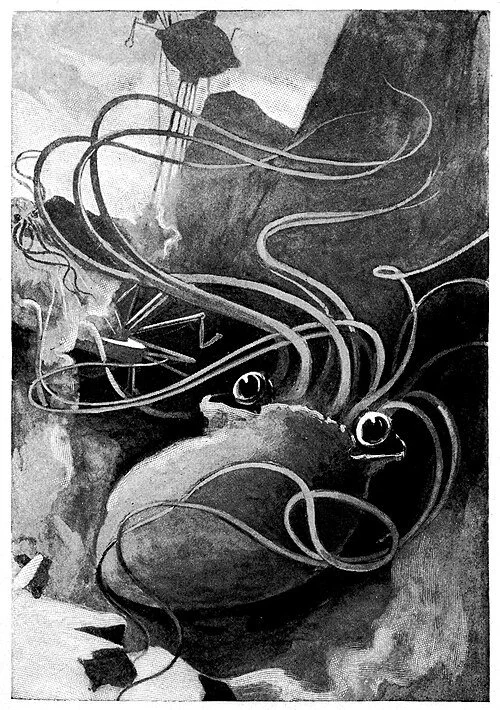
The Martian, Warwick Goble 1897. Source: Public domain, The War of the Worlds, available here.
The Broadcast Itself (October 30, 1938)
On the evening of October 30, 1938, Halloween Eve, CBS Radio's Mercury Theatre on the Air aired a dramatized adaptation of H.G. Wells' 1898 novel The War of the Worlds. The production was directed by and starred a 23-year-old Orson Welles, already a rising figure in American theater and radio, working with a script adapted by writer Howard Koch. Koch made a crucial creative decision that would shape everything that followed: rather than preserving the novel's original Victorian-era English setting, he relocated the invasion to contemporary 1930s New Jersey, and restructured much of the broadcast's opening act as a series of simulated live news bulletins interrupting what listeners were told was a routine dance-music program.
The fictional news bulletins described, with escalating urgency, the crash of a mysterious object near the small town of Grovers Mill, in West Windsor Township, New Jersey, followed by the emergence of hostile Martian war machines and a rapidly worsening invasion. The production's realism was, by nearly all later accounts, impressive for its era, employing the same stylistic conventions listeners had grown accustomed to from real emergency news coverage, without the more obvious theatrical framing a modern audience might expect.
The Legend That Followed
The following morning, October 31, 1938, major American newspapers ran dramatic front-page accounts describing what they characterized as widespread public panic triggered by the broadcast. The New York Daily News and the Bergen Evening Record, among others, published accounts of terrified citizens fleeing their homes. The single most frequently repeated anecdote, from the front page of the New York Times, described more than twenty families in one block of Newark, New Jersey, running outside with wet towels pressed over their faces, apparently believing this would protect them from Martian poison gas.
This narrative, of a broadcast so convincingly staged that it triggered genuine, widespread, and irrational public hysteria across the country, became one of the most durable and frequently repeated stories in American media history over the following decades, cited in textbooks, retrospectives, and popular culture as a cautionary parable about the manipulative power of mass media over a credulous public.
What the Contemporary Ratings Data Actually Shows
The panic narrative's central weakness becomes apparent almost immediately upon examining who was actually listening to the broadcast that night. Contemporary audience measurement, conducted by the C.E. Hooper ratings service, found that only approximately 2 percent of the national radio listening audience was tuned into the Mercury Theatre broadcast at the time it aired. The overwhelming majority of the listening public was instead tuned to a considerably more popular program on a competing network: The Chase and Sanborn Hour, featuring ventriloquist Edgar Bergen and his famous dummy Charlie McCarthy.
CBS itself, reviewing its own internal audience research in the aftermath of the controversy, reached a strikingly modest conclusion about the broadcast's actual reach. Network executive Frank Stanton, examining the available data, concluded that the substantial majority of Americans had simply never heard the broadcast at all, and that among the smaller audience who had tuned in, most had correctly recognized it as a dramatic radio play rather than an actual news broadcast, particularly since the program had opened, as required, with a clear announcement identifying it as a Mercury Theatre dramatic presentation.
This data point alone substantially undermines the foundational premise of the panic legend: a broadcast heard by roughly one in fifty American radio listeners simply could not have generated the kind of literal, nationwide, door-to-door hysteria the newspaper accounts described the following morning.
The 2013 Reassessment
The most influential modern reassessment of the case came in 2013, when media historians Jefferson Pooley and Michael Socolow published a detailed investigation for Slate, timed to the broadcast's 75th anniversary. Pooley and Socolow undertook the considerable task of attempting to verify, individually, the specific anecdotal claims that had accumulated around the broadcast over the preceding seven and a half decades.
Their findings were consistently damaging to the traditional narrative. Wire service reports from the days immediately following the broadcast, upon close examination, turned out to rely overwhelmingly on anonymous, unverified anecdotes rather than named, confirmable individuals. Despite persistent claims circulating for decades that the broadcast had caused suicides among panicked listeners, Pooley and Socolow found that no newspaper had ever actually reported a single verified suicide connected to the program. When the researchers attempted to trace specific contemporary claims that hospitals across the country had treated patients for shock or hysteria caused by the broadcast, those claims likewise failed to hold up under direct examination, with no corroborating hospital records or named patients ever surfacing to substantiate them.
Why Newspapers Told the Story They Told
If the panic itself was substantially overstated, the obvious question becomes why newspapers across the country would independently converge on such a dramatic, and largely unsubstantiated, version of events. Media historians have proposed an explanation rooted not in journalistic error, but in direct commercial self-interest: by 1938, the newspaper industry had come to view radio as an increasingly serious threat to its advertising revenue, a competitive anxiety that had been sharply exacerbated only weeks earlier, when radio networks had substantially outperformed newspaper coverage of the unfolding Munich crisis in Europe, delivering breaking updates to the public faster than print could manage.
Sensationalizing the War of the Worlds broadcast offered newspapers a conveniently timed opportunity to publicly argue that radio, as a medium, was fundamentally reckless and insufficiently responsible to be trusted with serious news reporting, an argument that served the newspaper industry's competitive interests regardless of its accuracy. This argument was not merely implicit; The New York Times itself ran editorial commentary in the aftermath of the broadcast explicitly criticizing radio for having, in the paper's words, failed to "master the material it uses." Broadcast historian Elizabeth McLeod has characterized the newspaper industry's exaggerated response even more directly, describing it as functioning essentially as an act of professional retaliation, in her words, "revenge for being badly scooped" during the preceding month's crisis coverage.
A Story That Burned Bright, Then Quickly Faded
One further detail undermines the traditional panic narrative: large-city newspapers, having run their dramatic initial coverage, largely abandoned the War of the Worlds story within a matter of days. This pattern of coverage, a brief, intense burst of sensational reporting followed by rapid disappearance from the news cycle, is considerably more consistent with a manufactured story that had served its immediate competitive purpose than with genuine, sustained nationwide hysteria significant enough to warrant continued coverage.
The Cantril Study and Its Later Reassessment
Perhaps the single most influential piece of evidence supporting the traditional panic narrative came from psychologist Hadley Cantril, whose 1940 study, published as The Invasion from Mars, estimated that approximately one million Americans had been frightened by the broadcast. This figure, produced by a credentialed academic researcher at Princeton University, lent the panic narrative a veneer of scientific legitimacy that persisted for decades.
Later historians examining Cantril's methodology, however, including Pooley and Socolow, have raised serious concerns about the study's underlying data. Cantril's estimate relied substantially on survey data and reporting that had already been shaped by the preceding weeks of sensationalized newspaper coverage, meaning the study may have been measuring, at least in part, the public's reaction to the newspaper narrative about the panic rather than independently verified reactions to the broadcast itself. Critics have specifically characterized the resulting million-listener estimate as an implausibly large figure given what is separately known about the broadcast's small live audience share.
A Legend That Grew Larger With Time, Not Smaller
In an unusual inversion of how historical accuracy typically develops, the War of the Worlds panic narrative appears to have grown more elaborate and more widely believed in the decades following the broadcast, rather than being gradually corrected as contemporary evidence might suggest it should have been. Over succeeding decades, increasing numbers of individuals came forward claiming personal memories of panic, either their own or that of family members, even as the underlying contemporary documentary evidence for widespread hysteria remained thin and, upon direct examination, largely unverifiable. This pattern, in which a historical event's popular retelling becomes more dramatic over time rather than less, is a recognized phenomenon in the study of collective memory and folklore, though it is somewhat unusual to see it documented so clearly around a twentieth-century mass media event with substantial surviving contemporary records.
What the Case Actually Demonstrates
The enduring popularity of the War of the Worlds panic legend says less, ultimately, about the gullibility of 1930s radio audiences than about the durability of a good story once it serves a broader cultural narrative, in this case, an ongoing anxiety about the manipulative power mass media holds over public perception. The significant historical lesson buried inside this case, that the panic narrative was itself substantially manufactured by a rival media industry pursuing its own competitive advantage, has proven considerably less compelling to popular memory than the far more dramatic, and considerably less accurate, story of an entire nation fleeing imaginary Martians. Nearly ninety years later, the myth continues to circulate more readily than the correction.
Enjoyed the piece?
Join thousands of history readers getting occasional updates on new blog posts, books, and video releases — plus a free history book to get you started.
Sources
Pooley, J. and Socolow, M., "The Myth of the 'War of the Worlds' Panic," Slate, 2013.
Snopes, "Did the 1938 Radio Broadcast of 'War of the Worlds' Cause a Nationwide Panic?" 2023.
National Geographic, "'War of the Worlds': Behind the 1938 Radio Show Panic," 2021.
Freethink, "'War of the Worlds' didn't panic America. Newspapers did." 2025.