Interest in historical sites where popular legend has substantially diverged from the documentary record has remained strong among readers of American history, particularly cases involving a private individual's life story overtaken by commercially convenient folklore after their death. The Winchester Mystery House in San Jose, California, represents one of the clearest such cases in American architectural and cultural history, and tracing its documentary record from beginning to end reveals a gap between legend and evidence wide enough to constitute its own separate historical lesson. Sami Hashem explains.
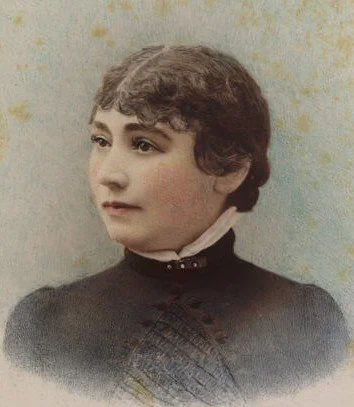
Sarah Winchester. Source: Public domain, History San Jose Research Library, available here.
A Well-Educated Woman From a Prosperous Family (1839–1862)
Sarah Lockwood Pardee was born in 1839 in New Haven, Connecticut, into a prosperous and socially prominent family. She received an unusually extensive education for a woman of her era, studying four languages, including Latin, French, Spanish, and Italian, at a female scholastic institution affiliated with Yale College. Contemporary accounts describe her as intelligent, musically accomplished, and socially admired, and she became known locally as the "Belle of New Haven" during her young adulthood.
In 1862, Sarah married William Wirt Winchester, son of Oliver Winchester, founder of the Winchester Repeating Arms Company, one of the era's most successful and rapidly growing firearms manufacturers. The marriage placed Sarah within one of Connecticut's wealthiest and most prominent industrial families.
A Decade and a Half of Successive Loss (1866–1881)
The couple's only child, a daughter named Annie Pardee Winchester, was born in 1866 and died within weeks, from a condition contemporary medical accounts describe as marasmus, a form of severe malnutrition whose underlying cause in infants of this era was often poorly understood. Sarah reportedly never fully recovered emotionally from this loss, and the couple had no further children.
Oliver Winchester, William's father, died in 1880, passing control of the Winchester Repeating Arms Company to William. William himself, who had suffered from tuberculosis for a considerable period, died only months later, in March 1881, at age 43. Within the span of roughly fifteen years, Sarah Winchester had lost her only child, her father-in-law, and her husband, while inheriting a substantial personal fortune along with nearly half ownership of the Winchester firearms company, an inheritance whose value has been estimated in later accounts at approximately 20 million dollars, an immense sum for the period.
Relocation to California (1884–1886)
Following William's death, Sarah Winchester left New Haven and eventually relocated to California's Santa Clara Valley, an area then known for its agricultural prosperity rather than the urban development that would later define it. She purchased an unfinished eight-room farmhouse on approximately 45 acres of land, which she named Llanada Villa.
According to family correspondence and biographical accounts drawn from archival research, Sarah's initial intention in expanding the property was notably practical rather than mysterious: she hoped to eventually house extended family members in a communal living arrangement on the growing estate. Some of her relatives, for reasons not fully documented, ultimately declined to relocate and join her, though construction on the property continued regardless of this outcome.
Thirty-Six Years of Continuous Construction (1886–1922)
Construction on the property proceeded with little interruption from 1886 until Sarah Winchester's death on September 5, 1922, gradually expanding the original eight-room structure into a mansion of approximately 160 rooms, featuring numerous staircases, an extensive network of hallways, and architectural details that would later be characterized as bizarre or disorienting. In 1888, Winchester's niece, Marion Daisy Merriman, moved into the estate and lived alongside her aunt for approximately fifteen years.
Sarah Winchester employed a substantial household staff and construction crew throughout this period, and by most contemporary accounts maintained an active, hands-on role in directing the ongoing work, though no master architectural blueprint for the property as a whole has ever been located, a detail consistent with decades of incremental, ad hoc expansion rather than a single unified design.
The Origins of the Curse Legend (1895 Onward)
The earliest known published account connecting Sarah Winchester to any supernatural narrative appeared in an 1895 San Francisco Chronicle article, which drew public attention to the unusual scale and continuous pace of the house's construction without yet presenting the full curse mythology later associated with the property. The now-familiar legend, holding that a medium had informed Winchester that the vengeful spirits of individuals killed by Winchester rifles were haunting her family, and that she could only appease them through unceasing construction, developed and expanded considerably through subsequent decades of retelling, well beyond anything documented in that original 1895 account.
No journal, letter, diary entry, or other document written directly by Sarah Winchester has ever been located describing this supernatural motivation, or any belief in a curse connected to her late husband's family firearms business. This absence is particularly notable given that a substantial body of Sarah's personal correspondence with family members has survived and been examined by historians and archivists, none of which corroborates the curse narrative in her own words.
What Household Staff and Family Actually Reported
Household staff members who worked for Sarah Winchester, interviewed in the years following her death, consistently reported that she showed no particular interest in séances or organized spiritualist practice, a detail that stands in direct tension with the popular legend's central premise. Surviving family members likewise did not corroborate later characterizations of Sarah as unusually superstitious or preoccupied with the supernatural. Instead, the picture that emerges from these firsthand accounts is of a highly intelligent, physically frail, and increasingly reclusive woman who withdrew substantially from public society following her successive personal losses, and who found in continuous home renovation and expansion a genuinely engaging project that her considerable wealth allowed her to pursue without any practical limit.
Historians examining Sarah Winchester's likely physical condition have pointed to evidence suggesting she suffered from a form of arthritis or related chronic ailment during her later years, which would help explain both her withdrawal from public life and certain accommodations built into the house's design, including numerous ramps and reduced-height steps in some sections, details that align more naturally with a practical response to mobility difficulties than with any supernatural instruction.
The 1906 Earthquake's Lasting Physical Impact
The 1906 San Francisco earthquake caused significant structural damage to portions of the Winchester house, an event that permanently altered the property in ways later visitors and storytellers would come to associate with its mysterious reputation. Some damaged sections were sealed off entirely rather than repaired, contributing directly to the now-famous architectural oddities associated with the mansion: staircases that terminate abruptly, doors that open onto blank walls, and disorienting hallway configurations that decades of later ghost-story tellers would attribute to deliberate, superstition-driven design choices rather than to ordinary earthquake damage combined with decades of unplanned, incremental construction.
Death, Sale, and the Birth of a Tourist Attraction (1922–1923)
Sarah Winchester died on September 5, 1922, at her California estate. Following her death, the property passed out of family ownership entirely. New owners acquired the mansion and opened it to the public for guided tours beginning June 30, 1923, less than a year after Winchester's death, marketing the property explicitly around both its unusual architecture and, with increasing emphasis over subsequent decades, its purported supernatural history.
This commercial framing proved remarkably durable and lucrative. Unlike the comparatively mundane, if genuinely poignant, documented facts of Sarah Winchester's actual life, the curse narrative offered visitors a considerably more dramatic and marketable story, one that has continued generating substantial tourism revenue for the property's owners for over a century since her death.
The Legend's Continued Growth Through Popular Culture
Over the following decades, the Winchester curse legend continued to expand through books, television specials, and eventually feature films, including a 2018 horror film titled Winchester starring Helen Mirren as Sarah Winchester, which presented a heavily dramatized version of the curse narrative for a contemporary audience largely unfamiliar with the more measured, and less cinematic, documentary record underlying Sarah Winchester's actual life.
Current Historical Assessment
Contemporary historical research, including analysis conducted by California-based historians and archival researchers associated with institutions such as History San Jose, has found little to no documentary support for the traditional ghost-story narrative. Instead, current historical consensus attributes Sarah Winchester's decades of continuous construction to a combination of substantial personal wealth, a genuine and sustained interest in architecture and design, and social withdrawal likely connected to chronic physical ailments and the compounding grief of her early adulthood losses, rather than to any documented belief in a curse or supernatural compulsion.
What the Case Ultimately Demonstrates
The Winchester Mystery House endures as a particularly clear case study in how thoroughly a documentary vacuum can be filled by whichever narrative best serves the commercial and cultural interests of those telling it after the fact. Sarah Winchester left no manifesto, journal, or explanatory letter describing her own motivations for the decades of construction she personally financed and oversaw. That silence created an opening later commercial owners, journalists, and generations of ghost-story tellers were free to fill, and the version of her story that ultimately prevailed, and that continues drawing visitors to San Jose today, was never seriously required to compete against her own words, because she never left any behind to contradict it.
Did you enjoy the piece? Join us on X here to receive regular updates: @HistoryIsNowMag
Sources
National Park Service, "Winchester House."
HISTORY, "Why People Believe California's Winchester House Is Haunted," 2025.
History San Jose, "Sarah Winchester at History San Jose."
California Travel, "The Winchester Mystery House: California's Original Haunted Mansion?" 2024.
Ancestral Findings, "History's Mysteries: The Winchester Mystery House," 2026.