
The controversy surrounding the Tariff of 1828, often identified as the “Tariff of Abominations,” represents one of the earliest and clearest moments when sectional identity and constitutional theory collided in the early United States. What began as a dispute over duties on imported goods evolved into a foundational argument about the nature of the Union itself—an argument later carried forward by John C. Calhoun and ultimately echoed in the secession crisis of 1860–61.
To understand why the tariff provoked such an intense reaction, one must examine four interrelated questions: what the tariff actually did, why it passed, who bore its costs and benefits, and why resistance, especially in South Carolina, took the form it did.
Lloyd W Klein explains.
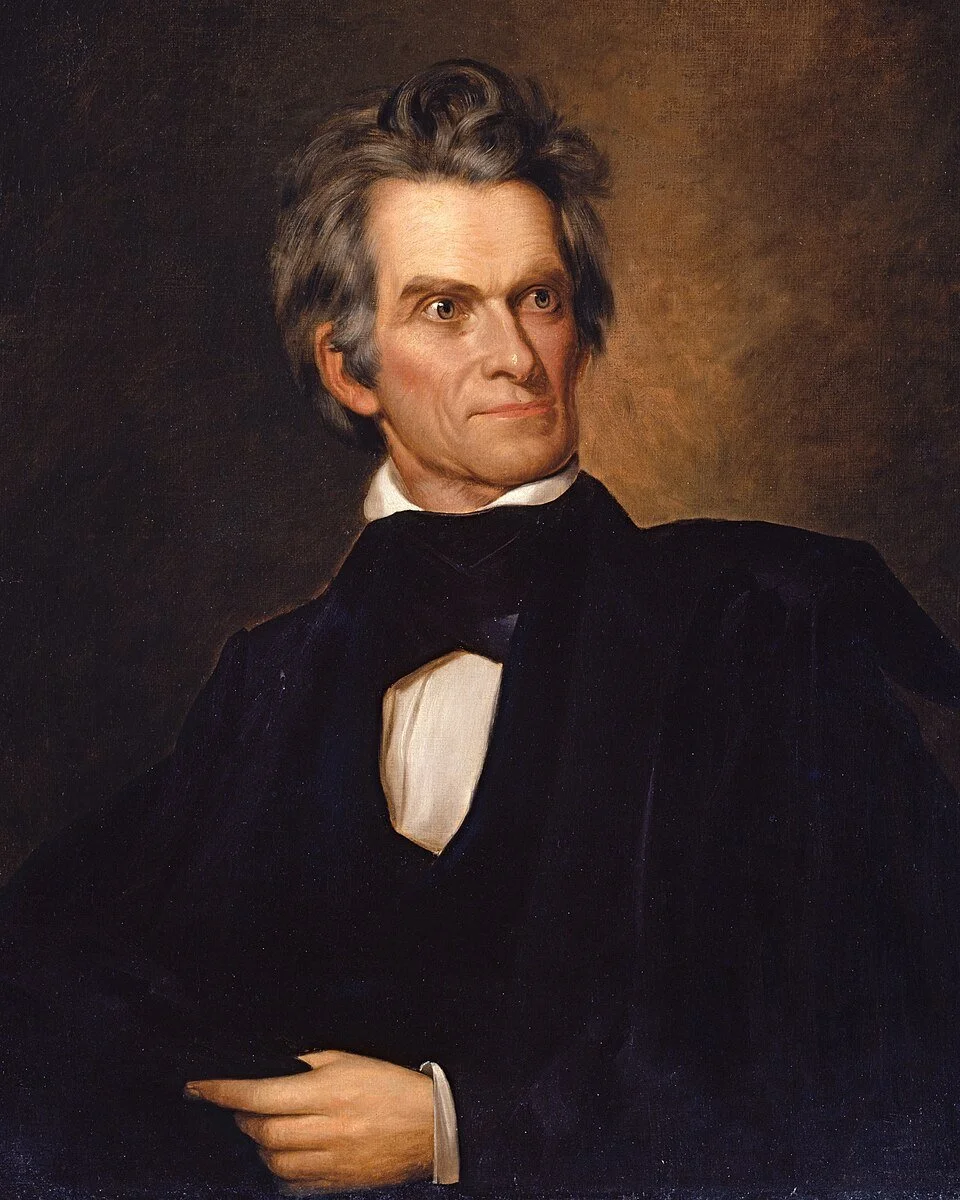
John C. Calhoun. Source: Public domain, National Portrait Gallery, available here.
The Tariff and Its Economic Purpose
The Tariff of 1828 imposed some of the highest duties in American history up to that point, with rates often reaching 35 to 45 percent on dutiable goods, and in some categories exceeding 50 percent. At the same time, it is important to note that tariffs provided roughly 85–90 percent of total federal revenue in the 1820s, making them not only an instrument of protection but the central mechanism of national finance.¹
Its purpose was to protect emerging American industry, particularly in the North, from foreign competition, especially from Great Britain, whose industrial economy was far more advanced and whose post-Napoleonic Wars surplus goods were entering global markets at low prices.
This policy reflected a broader national ambition. Following the War of 1812, many American leaders believed that economic independence required a domestic manufacturing base, particularly for strategic goods like iron and textiles. Earlier legislation, such as the Tariff of 1816, had already introduced protective duties, but the 1828 tariff went much further, signaling a more assertive commitment to industrial development.²
From one perspective, this was entirely rational. Nearly every developing nation in the nineteenth century used tariffs to nurture domestic industry. The United States was doing what Britain itself had done in an earlier phase of its growth. But what made the tariff so contentious was not its logic but rather its uneven regional impact.
A Divided Economy: North and South
By the 1820s, the United States was already developing along two distinct economic paths. In the North, especially in Massachusetts and Pennsylvania, industrialization was accelerating. By 1830, the North contained the overwhelming majority of the nation’s manufacturing capacity—over 80 percent by most estimates.³
In the South, however, the economy was fundamentally different. South Carolina and Mississippi were overwhelmingly agrarian and export-oriented. Their wealth was tied to staple crops, especially cotton, which by the late 1820s accounted for approximately 50–60 percent of total U.S. export value.⁴ They imported most of their manufactured goods, particularly from Britain. By some estimates, as much as two-thirds to three-quarters of manufactured goods consumed in the South were imported rather than domestically produced.³
For the South, the tariff had a very different effect than the northern industrial states. It raised the cost of imported goods without offering a corresponding benefit. Southern planters could not easily shift to domestic manufacturing, nor could they pass increased costs on to buyers, since cotton prices were set globally. The result was a perceived, and to a large extent real, economic squeeze: stable or declining income combined with rising costs. This disparity explains why the tariff came to be seen in the South not merely as bad policy, but as sectional exploitation.
Who Was Harmed—and Who Benefited
The economic impact of the tariff did not fall neatly along class lines; rather, it followed regional and structural divisions. The clearest beneficiaries were Northern industrialists. Protected from foreign competition, they could expand production and charge higher prices within the domestic market. The tariff effectively transferred advantage to them, accelerating the development of American industry.
Those most directly harmed were Southern plantation owners. They faced higher costs for imported goods and feared that Britain might retaliate. Although Britain continued to rely heavily on American cotton, the fear of losing market share was economically and politically significant.⁴
The burden did not fall exclusively on the Southern elite. Ordinary white Southerners, including small farmers, also paid higher prices for everyday goods. In a region with little industrial base, alternatives were limited. Thus, the tariff imposed a broad consumer cost across Southern society. Given that the South produced relatively little manufactured output of its own, less than 20 percent of national manufacturing despite holding roughly one-third of the population, its consumers had few alternatives.³
In the North, the picture was more mixed. Consumers paid higher prices as well, but these costs were often offset by the benefits of industrial growth: jobs, wages, and local economic development. The tariff, in effect, redistributed wealth not simply from poor to rich, but from one region to another
Why the Tariff Passed
Given its uneven effects, the passage of the tariff might seem puzzling. It did not reflect a unified national consensus. The tariff emerged from a complex political process tied to the rivalry between John Quincy Adams and Andrew Jackson. Martin Van Buren and other Jacksonian allies helped construct a bill designed, in part, to fail.⁵ The idea was to create a bill that included extremely high, and in some cases deliberately excessive rates. Their expectation was that the bill would be so unpalatable that it would fail, allowing them to embarrass the Adams administration.
But this strategy backfired. Instead, the bill passed and became law by attracting support from multiple sectors Northern representatives backed it for protectionist reasons. Some Western politicians supported it as part of a broader agenda of economic development and internal improvements. Through the legislative compromise and “logrolling,” a coalition formed that was sufficient to secure passage. In this sense, the tariff was not the product of a coherent national policy so much as the unintended result of political maneuvering. What was conceived partly as a tactical move became, in practice, a transformative and deeply divisive law.
The structure of representation amplified sectional effects. While the South held parity in the Senate, the North’s faster population growth was already translating into increasing dominance in the House of Representatives—shaping fiscal legislation such as tariffs.⁶
Why South Carolina Took the Lead
South Carolina was uniquely exposed economically and psychologically. Its dependence on cotton exports, combined with declining agricultural productivity, made it especially vulnerable.
Crucially, the state also possessed the intellectual leadership of John C. Calhoun, whose South Carolina Exposition and Protest transformed opposition into constitutional doctrine rooted in compact theory.⁵ His theory of nullification provided not just grievance, but justification. Other Southern states hesitated. Virginia and Georgia shared concerns but feared disunion and responded to Andrew Jackson’s firm opposition.
While regions like New York and Pennsylvania were expanding economically, South Carolina’s older plantation system appeared to stagnate. The tariff became, in the minds of many of its leaders, a symbol of a national system working against them. South Carolina’s political culture was more unified and more inclined toward opposition, which made it willing to move where others would not. The plantation owners in South Carolina had strong control over the politics of their state, and they chose to fight.
From Economic Grievance to Constitutional Doctrine
The crisis came to a head in the Nullification Crisis, when South Carolina asserted it could nullify federal tariff laws. President Andrew Jackson rejected this doctrine, asserting the supremacy of federal law and the permanence of the Union. What is critical is that Calhoun’s argument was about permanent minority status. If one section could consistently outvote another, constitutional remedies, or separation, became logical responses.⁵ This argument transformed an economic dispute into a fundamental constitutional question: was the United States a single nation governed by majority rule, or a compact of states retaining ultimate sovereignty?
The most consequential aspect of the tariff controversy was not the policy itself, but the intellectual and political response it provoked. In the South Carolina Exposition and Protest, Calhoun argued that the Constitution was a compact among sovereign states, and that a state had the right to nullify federal laws it deemed unconstitutional. The tariff, in his view, demonstrated that a national majority could impose policies that systematically disadvantaged a minority region.
Compromise and Resolution
Compromise was strained and delayed. The eventual resolution came with the Tariff of 1833, crafted by Henry Clay, which gradually reduced tariff rates and defused the immediate confrontation.
But compromise took several years for several reasons. The dispute had moved beyond rates to principles. For Calhoun and his allies, the issue was not simply how high the tariff should be, but whether a state had the right to resist federal policy altogether. Further, sectional trust was eroding. The North and South were developing increasingly distinct economic systems, and each began to suspect that the other would use political power to its long-term advantage. Moreover, the structure of national politics made lasting balance difficult. As Northern population and influence grew, the South increasingly saw itself as a permanent minority, vulnerable to policies it could not control. The fact that northern and western states formed an alliance in opposition to southern interests made the South concerned that they were losing power to control national politics. Thus, while compromise was achieved in the short term, it did not resolve the underlying issue. The South increasingly viewed itself as a permanent minority in a system where population growth, immigration, and economic development were strengthening the North. By 1860, the free states held a decisive advantage in population, industrial output, and infrastructure.⁶
Conclusion
The Tariff of 1828 revealed structural divisions within the United States and demonstrated how economic policy could produce unequal regional effects. Most importantly, the tariff controversy provided a framework for thinking about states’ rights that would later be invoked in far more consequential circumstances. It introduced a framework for understanding political power in sectional terms. Calhoun’s doctrine articulated a central fear: that a unified national government could become an instrument of regional dominance. This argument would resurface in the secession crisis three decades later. In this sense, the tariff was more than a tax. It was an early warning sign of a deeper conflict, one rooted in competing economic systems, divergent regional interests, and fundamentally different understandings of the Union itself.
This argument carried forward directly into the secession crisis of 1860–61. By then, the South’s concern was not tariffs but rather the structural reality that it could be outvoted on an issue central to its social and economic system: slavery and its expansion. The underlying argument remained the same: that the South, as a minority section, could not rely on the federal government to protect its interests within the Union. When Southern states justified secession, they drew on the same constitutional reasoning first sharpened during the tariff crisis: the compact theory of the Union, the right of a state to judge federal overreach, and the claim that withdrawal was legitimate when sectional balance had been lost. In this sense, the Tariff of 1828 was not an isolated controversy but an early articulation of a political logic that would ultimately lead to disunion.
References
· Douglas A. Irwin, Clashing over Commerce: A History of U.S. Trade Policy (Chicago: University of Chicago Press, 2017).
· Daniel Walker Howe, What Hath God Wrought: The Transformation of America, 1815–1848 (Oxford, 2007).
· Sean Wilentz, The Rise of American Democracy (Norton, 2005).
· Sven Beckert, Empire of Cotton (Knopf, 2014).
· William W. Freehling, Prelude to Civil War: The Nullification Controversy in South Carolina (Oxford, 1965).
· James M. McPherson, Battle Cry of Freedom (Oxford, 1988).