Carl von Clausewitz is one of the most celebrated, referenced, and original military strategists: his magnum opus On War is eclipsed in popularity and impact on the philosophy of war only by The Art of War. The philosophy of war according to Clausewitz is illustrated in the book’s most enduring quote:
‘War is merely the continuation of politics by other means.’
Craig Heslop explains.
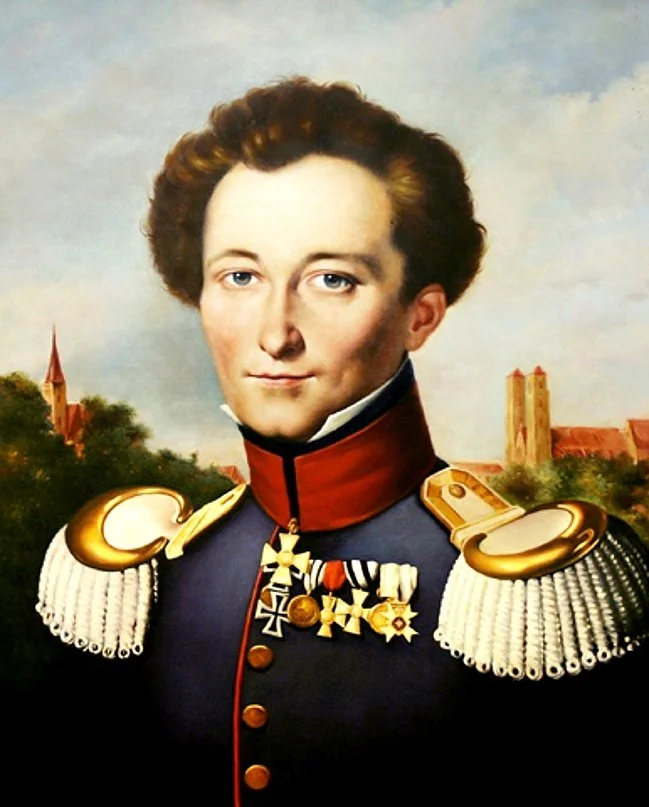
Carl von Clausewitz by William Wach. Source: Public domain, available here.
Meant For War
Clausewitz began his relationship with war from an early age: in 1792 at the age of 12, he enlisted in the Prussian army as a cadet, starting out as a Lance Corporal (he would eventually ascend to Major General). He fought against Revolutionary France from 1793-1795 in the First Coalition campaigns after being commissioned. At the still-young age of 21, he would conduct his major studies under the tutelage of Gerhard Johann David von Scharnhorst at the Berlin Military Academy, Kriegsakademie, becoming a protégé under Scharnhorst, the institute’s head. This was a seminal event in the life of one of the greatest military strategists and philosophers to live; it begun his exploration of the philosophy of war, combined with broadening his knowledge and awareness on worldly subjects, transforming him into a profound thinker and theorist in military affairs, culminating in him finishing first in his class. Arguably his most notable military involvement was in the final campaigns that eventually led to Napoleon’s defeat, from 1813-1815. He served as chief of staff to one of the four Prussian army corps in the ultimate Napoleonic battle at Waterloo, having a hand in defeating not only the most powerful General (later Emperor) since Caesar, but also one of the most formidable and distinguished military strategists in Napoleon himself. The fact that he was involved in the eventual defeat of an enemy who is himself considered one of the best military strategists not only illustrates Clausewitz’s nerve in war, but especially his calibre of strategy in war.
Martial Philosophy
In his masterpiece, On War, Clausewitz echoes his main belief: War & Politics are inextricably linked. Although some military theorists disagree, more so in modern times, this proposition was highly influential in military thought. Clausewitz’s view rationalizes war, arguing for the maintenance of political objectives, the state’s agenda, in carrying out and pursuing war, lest you commit strategic failures due to a lack of focus. This broad and formal view of war serves as a clear example of not only why Clausewitz succeeded in the area of military theory, but also why he is well-read in politics, even to this day. Notably, President Eisenhower was influenced by On War after reading it in the 1920’s as a young officer. This greatly inspired the nuclear deterrence strategy of the 1950’s as Eisenhower was impressed with the clarity of his ‘absolute war’ concept, using it to demonstrate the futility of all out war in the nuclear age by testing, and thus showing, nuclear bombs and their devastation. Clausewitz simply held that War is politics continued, achieving what couldn’t be attained civilly, under international law and agreements, by instead using the proverbial sword when the pen failed. His intertwining of state and warfare continues to influence those in government, the armed forces, and military thinkers of the modern era, leaving a lasting legacy on military strategy which is still having effect today.
Strategy is Forever
Clausewitz is a name that will not fade into obscurity; his principles are still being taught at War colleges, governments continue to reference his thinking and look to it for support, and On War is being discovered by new readers and burgeoning military thinkers. All of this is in spite of the fact that some military theorists claim Clausewitz’s main tenet of war being politics continued, is no longer applicable to modern warfare, or even further that it was never universally applicable. Major military strategists after Clausewitz vehemently disagreed with his political angle on war: where Clausewtiz refused to even conceive of war not being an extension of politics, his main critics argue that this takes for granted a formal, cohesive nation state existing in the first place. Essentially, this theory of war discounts and overlooks rebellions, guerrilla war, revolutions, and civil wars, i.e. domestic wars. You could argue there is a political agenda behind all of these, but there is certainly a lack of cohesive government and state in times of civil war, revolutions, and rebellions when the nation is divided, supporting the idea that there isn’t always grand politics and ‘objectives’ being sought in the political regard, as much as more unreasoned, perhaps even emotional, motives for war.
Ultimately, despite being controversial, having many detractors, the master strategist certainly has more supporters, even lending his name to the type of military strategy he champions — ‘Clausewitzian’. The effect of his writing is overwhelmingly positive, regardless of your own stance on his theories. Warning of the importance of keeping war focused on political objectives precludes senseless belligerence, calling for a rational approach to war as simply a more intensive means of attaining sought after victories for the state’s political agenda. Now more than ever, this approach may deem Clausewitz more important than he’s ever been. In our modern world, the concept of war has shrunk: the ease of deployment and abundance of nuclear weapons and lesser weapons have become so significant that war may not even be necessary — this is what Eisenhower emphasized in the early Cold War era of the 1950s with his nuclear deterrence strategy being analogized to Clausewitz’s concept of ‘absolute war’, and the futility of such a war now that nuclear weapons provided mutually assured destruction (MAD). Focusing on political ends, and the rationality of war, restricts it, at least in theory, to the realm of responsibility in international affairs and military policy. It advises focusing on objectives, not senseless conflict, and clarity in the use of strategy, avoiding rash decisions and catastrophic failures of the government of a state. All in all, Clausewitz’s central philosophy of ‘War is merely the continuation of politics by other means’, provides a rational, clear, and responsible martial philosophy for states and governments, most important to our modern era of warfare where destruction and warfare are at their most ‘absolute’ and swift.
Enjoyed the piece?
Join thousands of history readers getting occasional updates on new blog posts, books, and video releases — plus a free history book to get you started.