As young men, both Winston Churchill and Napoleon’s only son were certain that destiny had marked them out for greatness. Here, Bilal Junejo asks why one lived to save his country while the other died at 21, remembered today as little more than a footnote.
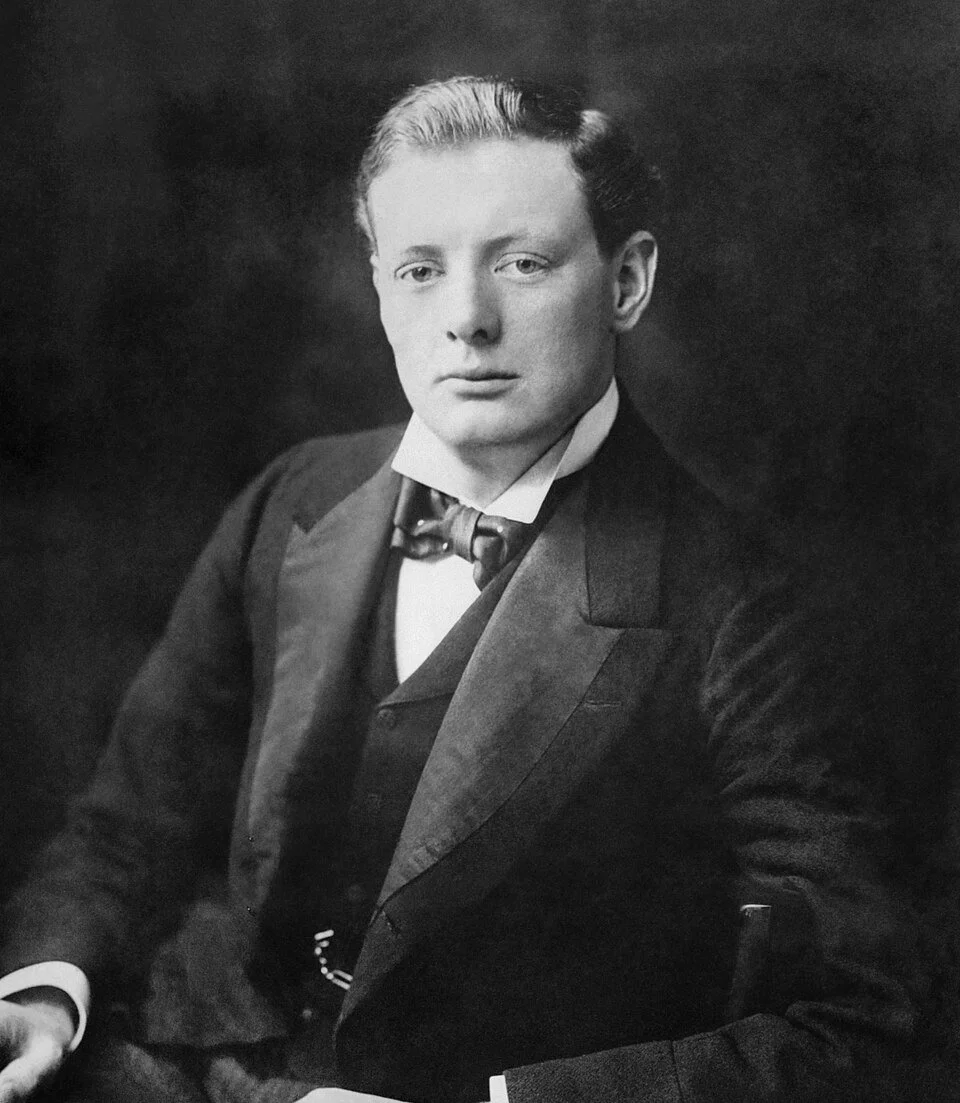
Winston Churchill in 1900. Source: Public domain, Imperial War Museum, available here.
Ever since the erudite Doctor Andrew Roberts — who is, of course, now The Lord Roberts of Belgravia — brought out his magisterial, single-volume biography of the most celebrated statesman in British history, there has been no possibility of ignorance, on the part of anyone who professes to be a student of this country’s chequered past since the beginning of the last century, in relation to that abiding faith in his own destiny which had begun to inform Winston Churchill’s perception of himself even before he entered public life. Entitled ‘Churchill’, and sub-titled ‘Walking with destiny’, what has every right to be considered the magnum opus of His Lordship (at least to date) has a name which is suitably derived from what the subject of this indispensable book wrote with such moving simplicity as he recollected, long after the end of the Second World War, the occasion of his having become prime minister of Great Britain at the height of it — namely that “I felt as if I were walking with Destiny, and that all my past life had been but a preparation for this hour and for this trial.” That the scion of one of England’s oldest and most illustrious political families was destined not merely to achieve greatness, but also to have it thrust upon him, is a view to which it has seldom, if ever, seemed hard to subscribe — not least because it was held so tenaciously by the great man himself. Even as a stripling, he had confided in — or, at any rate, assured — a friend and fellow Harrovian, Murland Evans ,that
“I can see vast changes coming over a now peaceful world, great upheavals, terrible struggles; wars such as onecannot imagine; and I tell you London will be in danger
— London will be attacked and I shall be very prominent in the defence of London … I see into the future. Thiscountry will be subjected, somehow, to a tremendous invasion, by what means I do not know, but I tell you I shall be in command of the defences of London and I shall save London and England from disaster … Dreams of the future are blurred but the main objective is clear. I repeat — London will be in danger and in the high position I shall occupy, it will fall to me to save the capital and save the Empire.”
Words of courage — and, in the event, of prescience — indeed. But were they vindicated by destiny, or by chance alone? Was Churchill’s fulfilment of his own prediction anything more than a most remarkable coincidence? Was he fated to become prime minister in 1940, or was he merely able to? After all, the First World War had come before the Second, but his war was at best mixed, and the Dardanelles came close to ending his career - even if the credit for a prepared Royal Navy in 1914 belongs largely to him. Whatever his contribution between 1914 and 1918, no one credited him with having saved the capital or the Empire, as everyone would after 1945. So was it destiny which gave us the life and times of Winston Churchill? Or was everything over which we gush merely the ticking of one more broken clock that, like any damaged timepiece, just had to be right twice a day?
These are all questions over which I have mulled not as a result of any sudden or regrettable discovery in the story of Winston Churchill, but rather in that of another. Someone whose faith in his destiny was, if the historical record is anything to go by, every bit as great and complete as was Churchill’s in his own — but who was nevertheless condemned not to walk with it. I am speaking, it may surprise you to learn, of one whose place shall forever be among those of whom the poet spoke when he wondered in that rural churchyard whether
“Some village Hampden, that, with dauntless breast, The little tyrant of his fields withstood,
Some mute inglorious Milton here may rest, Some Cromwell guiltless of hiscountry’s blood.”
In The Times in 1932, there appears a short editorial entitled “Napoleon’s son”. Marking the centenary of his untimely death in 1832, when he was but one and twenty years of age, the editorial observes, among other things, that“[w]hen his father clasped him in his arms on a January night of the year 1814, before leaving Paris to fight his losing campaign against the Allies, he was not yet three years old. He never saw his father again. Within a few months he had gone with his mother to live at the palace of Schoenbrunn at Vienna as a member of the House of Hapsburg.” But from this young quintessence of filial devotion, not even the beauty pervading those Danubian banks could conceal their harrowing distance from an island in the South Atlantic called St Helena. As the editorial continues,
“The more Napoleon was hidden the more eager his son became to know him. The spirit of his father, which he had inherited, supplied the means. Thus, when Marie Louise came on one occasion to see her boy, she found him playing Robinson Crusoe in a hut in the garden, and with anxious misgiving perceived that another island and another hero were in his thoughts. It was not, however, until the news of Napoleon’s death reached Vienna and was communicated to his son that the full extent of the failure of Metternich’s plan became apparent. Napoleon Francis, now ten years of age, flung himself down in a passion of tears and refused during many days to be comforted. From that time hiswhole life was directed to preparing himself for the task which had been bequeathed to him from St. Helena and which, as he believed, he would be called upon one day to perform. One of his last letters to his mother, written while at twenty-one years of age he lay dying of consumption, remains to attest his faith:— ‘For the sake of mankind I must somehow or other get over my weakness,’he wrote; ‘I must fulfil my destiny. With so much to do, is it to be believed that I shall not recover?’”
Marie Louise would probably have treated her son’s effusion with less incredulity than young Murland Evans might have done his equally young friend’s — but we all know who was ‘destined’ not to recover only from one illness, and who was ‘destined’ not to recover from even one. Whose vehemence was going to be vindicated, and whose not. But why? For what ‘earthly’ reason were two individuals apparently so similar fated to be treated so differently? Why did one become the saviour of his country, but the other only one more addition to the ranks of so many mute, inglorious Miltons, Hampdens, and Cromwells? Each had blood as illustrious as the other’s. Each grew up in the shadow of a famous and largely absent father. And neither, it would seem, was given to doubting the authority of destiny. Then why can we not speak today of the Duke of Reichstadt with that same breathless adoration which pervades almost every mention of the 7th Duke of Marlborough’s grandson? “I am so conceited,” wrote ayoung Churchill to his mother from India, that “I do not believe the gods would create so potent a being as myself for so prosaic an ending” — and he was right. But the young son of Napoleon, who had also expressed similar sentiments to his own mother some sixty-five years earlier (and when he too, like Churchill, had been only in his early twenties), was not. Mais pourquoi? Has a person’s destiny, after all,absolutely nothing to do with their own convictions? Is everything in spite, and nothing because, of us in our lives? Are we really a lot of flies to wanton boys? It is, I daresay, a mystery which you and Imight contemplate as we stand in the churchyard and look about us — as well as up at the night sky. What might not have happened had Lieutenant Churchill perished, we may wonder. But what might have happened had Napoleon II lived, we shall never know.
Did you enjoy the piece? Join us on X here to receive regular updates: @HistoryIsNowMag