Languages disappear twice. First, people stop speaking them. Later, the archive makes the disappearance look cleaner than it ever was. A language used in homes, markets, jokes, arguments, and work can leave almost no literature if another language controls government, schooling, religion, and durable writing. Ancient Galatian is a brutal example. Celtic-speaking migrants reached central Anatolia in modern-day Turkey in the 3rd century BCE, built political communities there, and then lived for centuries inside Greek, Roman, and Christian worlds. Greek and Latin survived in mountains of text. Galatian survives mostly as names, scattered words, and a few comments written by outsiders.
One of those comments is so late that it is almost irresistible. In the 6th century CE, Cyril of Scythopolis tells a story about a Galatian monk named Procopius who, in the middle of a hagiographic episode involving illness, possession, and healing, speaks Galatisti—“in Galatian.” If that phrase means exactly what it seems to mean, a Celtic language brought into Anatolia roughly eight centuries earlier was still audible in the age of Justinian.
That is a magnificent story. It is also one sentence doing a dangerous amount of work.
Joshua W.J. Brown explains.
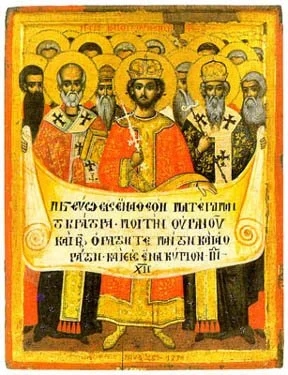
Icon from Mount Athos depicting the First Ecumenical Council at Nicaea.. Source: Public domain, available here.
Jerome’s much stronger checkpoint
The safer place to begin is about 170 years earlier. Around 386–387 CE, Jerome was writing his Commentary on Galatians. He paused to make an extraordinary linguistic observation: the Galatians, although they used Greek like the rest of the East, had “a language of their own, almost the same as the Treveri.” The Treveri were associated with the region around Trier, on the Moselle—far across Europe from Ancyra, the Galatian city now called Ankara.
Jerome’s sentence is strong because it contains several claims that can be kept separate. Greek was normal in Galatia. Greek did not, in his account, exhaust the local linguistic repertoire. A distinct language was still associated with the Galatians. And Jerome thought it significantly similar to the speech of the Treveri.
Just as important, Jerome did not imagine language as a museum specimen. In the same discussion he allows that languages change across places and through contact. His comparison does not require 4th-century Galatian to have sounded exactly like the Celtic speech carried into Anatolia in the 3rd century BCE. Six centuries beside Greek would be an entire history of borrowing, bilingualism, sound change, and shifting social use.
That matters because the romantic version of the story can be as misleading as the dismissive one. Galatia was not an isolated Celtic village somehow missed by history. Ancyra became a major Roman provincial city. Imperial inscriptions stood there in Greek and Latin. Christian controversies crossed the same urban world. A Galatian speaker could be Greek-literate, a Roman subject, and a Christian without the older language instantly becoming useless.
Jerome therefore gives something both narrower and more valuable than a legend of untouched survival. He gives evidence for bilingual endurance.
Then comes Cyril—and the temptation
Cyril of Scythopolis is harder. His Life of Euthymius describes Procopius as a Galatian. During an episode in which the monk is afflicted and unable to speak normally, Cyril says that if Procopius was forced to speak, Galatisti ephthengento: he spoke “in Galatian.”
Read literally, this pushes the language into the 6th century. It is why the passage is so often repeated as the last literary evidence for Galatian.
But a saint’s life is not a census, a grammar, or a field recording. Cyril gives no Galatian sentence. He does not say how many speakers existed, where the language was used, whether children still learned it, or whether Procopius belonged to a broader speech community. The scene is also extraordinary by design: possession and miraculous healing are part of its narrative machinery.
Linguist David Stifter has made the caution unusually precise. Because the reference is isolated and very late, he notes that the possibility cannot simply be excluded that Galatisti meant an especially incomprehensible Greek dialect or accent rather than a still-living Celtic language. That does not make the passage worthless. It changes its evidentiary weight.
Jerome and Cyril therefore should not be placed in the same confidence column. Jerome explicitly contrasts Greek with a Galatian language of its own and supplies a western comparison. Cyril supplies a later language label inside hagiography, but no specimen. Jerome makes prolonged survival difficult to dismiss. Cyril may extend the line. It should not be forced to carry the entire case for an eight-century speech tradition on its back.
The archive has an accent
The real surprise is not whether one dramatic sentence wins or loses. It is how little writing a language can leave while still having existed for centuries.
Galatian is securely Celtic because personal names, tribal names, place names, and lexical fragments preserve recognizable Continental Celtic material. Joseph F. Eska called the work of reconstructing its grammar “salvage grammar”: extracting what can actually be supported from a corpus damaged by time and transmission. That is very different from filling every blank until the lost language looks complete.
The imbalance also explains why ancient Anatolia can sound more Greek in the archive than it necessarily sounded in a street or household. Greek had institutions that wrote. Latin had imperial administration and law. Christianity produced scripture, commentary, sermons, councils, and saints’ lives. A minority spoken language could remain active in domains that generated little durable text and still become nearly silent once its speakers disappeared.
That is why Jerome’s sentence remains so arresting. For a moment, a writer working in Latin admits that the audible world of Galatia exceeded the written one. Greek was there. Something else was there too.
Cyril may let that voice echo two centuries farther. Or he may preserve only the memory of Galatian difference in a word whose meaning had become unstable. The responsible ending is not to choose whichever version sounds better. It is to preserve the asymmetry.
The last Celtic voice in Anatolia may not be recoverable as a voice at all. What survives is a sequence of witnesses of unequal strength. That is not a failure of history. It is history at the exact point where evidence ends—and where invention has to stop pretending it is memory.
Enjoyed the piece?
Join thousands of history readers getting occasional updates on new blog posts, books, and video releases — plus a free history book to get you started.
Author note
Joshua W.J. Brown is a Toronto-based writer, filmmaker, and independent researcher working across history, language, archives, and cultural systems. His current Galatian work asks what can be reconstructed from a language that survived more clearly in other people’s records than in texts of its own.
References