
As one of the wealthiest figures in American history, Andrew Carnegie left behind a legacy that remains deeply contested among historians and the public alike. While his name is permanently memorialized on thousands of public libraries, universities, and cultural institutions across the globe, his rise to unprecedented economic dominance was achieved through methods that raise fundamental questions regarding the true human cost of his late-in-life generosity.
Shubh Samant explains.
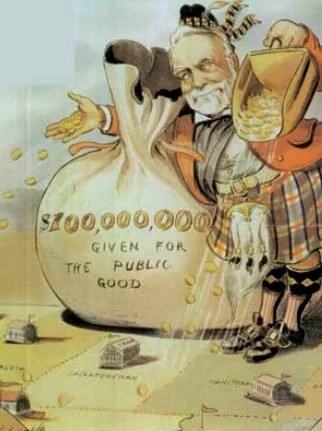
A depiction of Andrew Carnegie's philanthropy. Source: Public domain, Puck magazine cartoon by Louis Dalrymple, published New York City 1903, available here.
During the Gilded Age, which was an era defined by rapid industrialization, unchecked corporate growth, and stark economic inequality, Carnegie transformed the American steel industry into a dominant global force. However, he accomplished this scale of expansion by embracing key tenets of Social Darwinism. This ideology framed relentless economic competition as a natural law of societal progress and was routinely invoked to justify the aggressive suppression of labor unions. Consequently, Carnegie subjected his workforce to dangerous working conditions and grueling shifts while accumulating an extraordinary personal fortune.
The central historical debate surrounding Carnegie centers on whether his vast philanthropic legacy can truly redeem his moral character and business methods. Although Carnegie ultimately donated hundreds of millions of dollars to humanitarian, educational, and civic causes, he cannot be characterized simply as an unblemished hero of American industry. A rigorous examination of his career reveals that his philanthropic endeavors were frequently self-serving and paternalistic, his massive fortune was built directly upon the severe exploitation of industrial labor, and he relied on monopolistic strategies to manipulate municipal governments and eliminate market competition.
Charitable giving
First, Carnegie’s charitable giving was not driven solely by pure altruism; rather, it often served to advance his personal prestige, shape his public image, and promote his specific political objectives. For instance, Carnegie directed substantial funding to Princeton University specifically to establish a synthetic lake named in his own honor—Lake Carnegie—demonstrating a desire for personal vanity and self-aggrandizement. In other instances, he funneled major financial contributions into political causes, such as funding international peace initiatives to promote his personal anti-war agenda on the world stage. These actions reflect a broader pattern characteristic of Gilded Age industrial magnates, who strategically utilized high-profile philanthropy to divert attention from their aggressive business tactics, cultivate political influence, and secure high social status. By retaining strict personal authority over where, how, and when his money was spent, Carnegie exemplified industrial paternalism—the prevailing belief among the Gilded Age elite that wealthy industrial captains understood the needs of the working class far better than the workers themselves. Consequently, his philanthropic model reinforced elite control over public life rather than fostering genuine democratic participation or worker empowerment.
Labor
Second, and perhaps the biggest of reasons: the foundational wealth that enabled Carnegie’s philanthropy was the direct product of severe labor exploitation, defined by long workdays, unsafe environments, and repeated wage cuts. Historical records from the period demonstrate a consistent operational pattern: Carnegie Steel routinely slashed employee compensation and extended work shifts to maximize production efficiency while Carnegie’s personal net worth reached astronomical heights. This strategy aligned with the broader industrial drive to maximize profit margins by minimizing labor costs, a dynamic that directly precipitated major industrial crises, most notably the Homestead Strike of 1892. When workers at the Homestead steel mill organized to protest steep wage reductions, company management—operating under Carnegie’s ultimate authority and directly managed by his associate Henry Clay Frick—locked out the workforce and hired private Pinkerton guards to break the strike. The resulting violence left multiple workers dead and exposed the extreme measures industrial corporations were willing to employ to crush collective bargaining rights. This tragic episode underscores the core contradiction embedded within Carnegie’s famous essay, "The Gospel of Wealth." Carnegie curtailed the living standards and financial independence of his own employees, only to claim moral authority later in life by using those same extracted profits to endow public institutions.
Furthermore, while defenders of Carnegie argue that he provided a vital ladder of social mobility by establishing thousands of free public libraries and educational foundations, his systematic reliance on monopolistic practices suggests a primary concern with economic dominance and control. Carnegie aggressively pursued horizontal and vertical integration to control every stage of the steelmaking process, from the iron ore mines to the transport railroads. In doing so, he eliminated competitors and gained an unmatched hold over the market. Historical evidence indicates that Carnegie also utilized his massive financial reserves to influence municipal governments in key industrial centers ranging from Pittsburgh, Pennsylvania, to his native Scotland. By funding public infrastructure projects and making targeted civic contributions in these municipalities, Carnegie ensured that local governments maintained a favorable operating environment for his mills, often shielding his enterprises from regulatory oversight while he continued to suppress worker wages. Although the libraries, schools, and research centers he endowed undeniably yielded long-term public benefits, these institutions were erected upon a foundation of unchecked corporate power and economic coercion. Philanthropy, in this context, operated as a mechanism to legitimize an industrial structure that systematically restricted worker rights and economic fairness.
Ultimately, while Carnegie’s "Gospel of Wealth" established over 2,500 public libraries and supported scientific institutions that continue to benefit society today, these public goods cannot erase the systemic exploitation that generated the fortune that enabled these in the first place The enduring controversy surrounding his career reflects fundamental questions about the ethics of extreme wealth concentration and the limits of private charity in democratic societies. Because Carnegie's vast donations were underwritten by the grueling labor of thousands of workers subjected to harsh conditions and low wages, late-in-life charitable giving cannot retroactively excuse the human suffering endured during the accumulation process. Indeed, the public outcry against the ruthless business practices of Carnegie and his contemporaries helped catalyze the Progressive Era, inspiring sweeping federal regulations, antitrust laws, and labor protections. Today, the debate over Andrew Carnegie’s legacy continues to resonate, serving as a historic parallel to contemporary discussions regarding modern billionaires, corporate monopolies, and the true social responsibilities of wealth. Carnegie’s life remains a compelling case study in American history: while private philanthropy can create lasting public resources, it cannot purchase a moral pass for the human cost of unchecked monopolistic power.
Enjoyed the piece?
Join thousands of history readers getting occasional updates on new blog posts, books, and video releases — plus a free history book to get you started.