By September 1066, England had become the prize in one of the most extraordinary succession crises of the medieval world. King Edward the Confessor was dead, Harold Godwinson occupied the English throne, and two powerful foreign rulers had already claimed that the crown belonged to them. Duke William of Normandy was preparing an invasion across the Channel, but before William could strike, another claimant had arrived in England. From Scandinavia came Harald Hardrada, King of Norway, one of the most formidable warriors of his age. His invasion would force Harold Godwinson into a desperate gamble: to march north, defeat the Viking army, and then somehow return south before William could land.
Terry Bailey explains.
Read part 1 on the pre-invasion world of 1066 here, and part 2 on the road to invasion here.
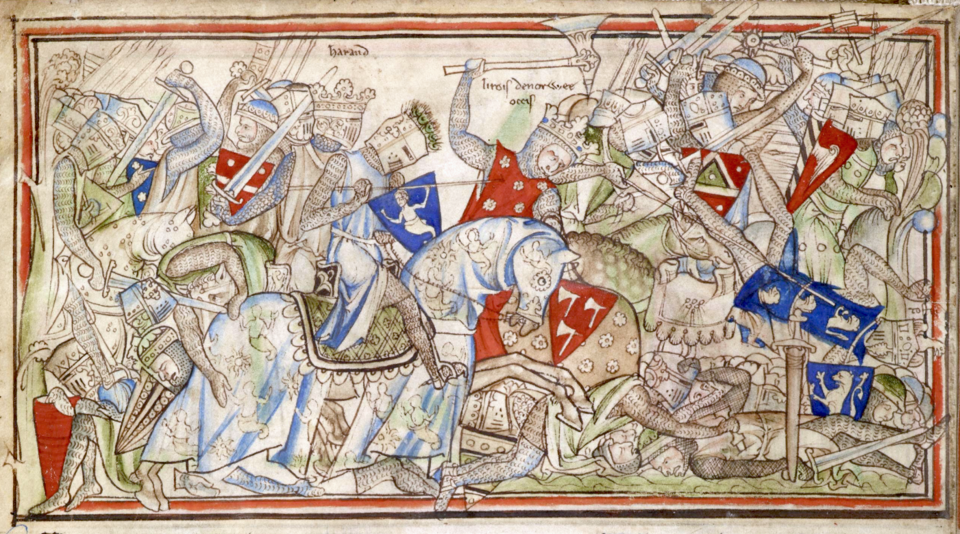
The Battle of Stamford Bridge. Source: public domain, he Life of King Edward the Confessor by Matthew Paris. 13th century, available here.
The Norwegian invasion was not a minor raid. Hardrada was an experienced military commander who had spent much of his life fighting across Europe and beyond. His claim to the English throne rested partly upon an agreement allegedly made between the Norwegian king Magnus the Good and the English king Harthacnut, under which each was said to have inherited the other's kingdom if one died without an heir. Although the legal basis of Hardrada's claim was disputed, the Norwegian king possessed something more immediately important than legal arguments: a powerful army and a fleet capable of carrying an invasion force into England.
Hardrada did not act alone. He was joined by Tostig Godwinson, Harold's estranged brother. Once one of the most powerful men in England, Tostig had been Earl of Northumbria until rebellion against his rule forced him into exile in 1065. His alliance with Hardrada transformed the Norwegian expedition from a foreign invasion into something even more dangerous. Tostig knew England, understood its politics, and possessed his own claim to influence. For Harold, the invasion was therefore both a military and a deeply personal crisis.
In September, Hardrada's forces sailed into northern England. The Norwegians first seized York, one of the most important centres in the north, after defeating an English army at the Battle of Fulford on the 20th of September. The English forces were commanded by the northern earls Edwin of Mercia and Morcar of Northumbria, and their defeat demonstrated how serious the invasion had become. York was effectively at the mercy of the invaders, and Hardrada appeared to have established a powerful base from which he could extend his control.
For Harold Godwinson, the news could hardly have been worse. His army had spent much of the summer waiting in southern England for William's expected invasion. Maintaining a large army in the field was enormously difficult because many of Harold's troops were drawn from the fyrd, the system through which free men were called upon to serve. They could not remain indefinitely away from their homes and farms. As supplies diminished and the campaigning season advanced, Harold had been forced to release many of his men.
Then came the news from the north; Harold reacted with remarkable speed. Gathering the forces available to him, he began one of the most extraordinary marches in English military history. His army travelled north towards York, covering hundreds of miles in a remarkably short period. Medieval armies normally moved at a relatively slow pace, constrained by roads, terrain, supplies, horses and the physical limitations of thousands of men. Harold nevertheless succeeded in concentrating a substantial force in the north before Hardrada and Tostig fully appreciated the danger approaching them.
The speed of Harold's advance was itself a weapon. Hardrada had every reason to believe that the English king would need considerable time to respond. Instead, Harold appeared with an army close to York. The Norwegian forces were caught in a vulnerable position at Stamford Bridge, several miles east of the city. According to the traditional accounts, the Norwegians were not expecting an immediate attack and some were without their armour. Whether every detail of the later accounts is accurate is uncertain, but the essential fact is clear: Harold had achieved surprise.
The two armies met on the 25th of September 1066 and the battle that followed became one of the great encounters of the Viking Age. Hardrada's army initially formed a defensive position, with the English attacking across the River Derwent. The traditional accounts describe a fierce struggle in which the Norwegian position proved extremely difficult to break. One of the most famous episodes tells of a lone Norwegian warrior holding the bridge against the English long enough to delay their advance before eventually being killed. Whether the story is entirely historical cannot be established with certainty, but it reflects the ferocity of the fighting.
As the battle developed, the advantage gradually shifted towards Harold. The Norwegian army had been divided by the speed of the English advance, and Hardrada was forced to fight without the full protection of his preparations. Yet the Norwegians fought with extraordinary determination. Hardrada himself was at the centre of the fighting, as was characteristic of the warrior kings of the period; however, Harald Hardrada was eventually killed.
The Norwegian king was struck in the throat by an arrow, according to the Anglo-Saxon Chronicle and later accounts, although the precise circumstances surrounding his death remain uncertain. With Hardrada dead, the invasion lost its principal commander. Tostig continued the fight, but Harold reportedly offered him the opportunity to abandon the battle. Tostig refused, and the struggle continued until he too was killed.
With the deaths of Hardrada and Tostig, Norwegian resistance collapsed. The Viking invasion of England had been decisively defeated. The scale of the victory was extraordinary. Hardrada had arrived as one of the most formidable military leaders of his generation, accompanied by a substantial invasion force. Within a single day, his ambitions had been destroyed and the last great Scandinavian attempt to conquer England had effectively come to an end.
For Harold Godwinson, Stamford Bridge was an extraordinary personal and political triumph. He had defended his kingdom against a major invasion, defeated a renowned warrior king, and eliminated one of the two principal foreign threats to his crown. Had the story of 1066 ended there, Stamford Bridge might have been remembered simply as one of the greatest victories in English history.
However, the story was only halfway finished; the victory came at a terrible price. The fighting had been exceptionally violent, and the English army suffered substantial casualties. Even more importantly, Harold's force was now exhausted. Many of the men who had marched north had already endured a rapid journey across England followed by a major battle. The army that emerged victorious from Stamford Bridge was therefore very different from the force that Harold had originally assembled to defend the south.
Harold had also lost valuable time. While he had been marching north and fighting Hardrada, Duke William of Normandyhad been waiting for favourable conditions to cross the Channel. The winds that had kept William's fleet in Normandy eventually changed. By the end of September, William was finally able to set sail; the timing was disastrous for Harold.
Only days after Stamford Bridge, the English king received news that William had landed in southern England. The Norman invasion he had anticipated for months had finally begun. Harold now faced an extraordinary military problem. He had just defeated a powerful Scandinavian army in the north, but his kingdom was being invaded from the opposite direction.
There was no easy choice. Harold could remain in the north and allow William to establish himself in southern England, gathering reinforcements and strengthening his position. Alternatively, he could march south once again and confront the Normans before their army became too powerful. Harold chose the second course.
His decision reveals both the strength and the weakness of the English position. Harold's ability to move rapidly across England was impressive, but the same speed that had helped him defeat Hardrada now demanded an extraordinary physical and logistical effort from his army. His men had marched north, fought a major battle and then had to turn around and march south again. Some had been killed or wounded. Others were exhausted. Reinforcements had to be gathered along the way, but there was no time for the leisurely preparation of a campaign.
The two battles of 1066 were therefore becoming connected by more than chronology. Stamford Bridge had removed one enemy, but it had also shaped the conditions under which Harold would face the other. His army had been bloodied, depleted and exhausted. William's army, meanwhile, had arrived fresh in southern England after crossing the Channel and had begun establishing itself on English soil.
There was another crucial difference. Harold had been forced to react to events throughout the year. William, by contrast, had spent months preparing his invasion. He had assembled ships, gathered troops from Normandy and elsewhere, secured the support of powerful nobles and waited for the opportunity to cross. When that opportunity finally came, he landed in England with his army intact.
The road from Stamford Bridge to Hastings would therefore become one of the most consequential marches in English history. Harold's army moved south once again, knowing that another enemy was waiting. The king had achieved what appeared to be the impossible: he had defeated Hardrada, destroyed the Norwegian invasion and demonstrated the military strength of the English kingdom. Yet the victory had not secured his crown. It had merely removed one claimant.
On the 28th of September, William landed at Pevensey on the Sussex coast. The Norman invasion had begun. The irony of Stamford Bridge is therefore at the heart of the story of 1066. Harold's victory was spectacular, but it came at precisely the moment when he could least afford the losses and exhaustion that accompanied it. The battle demonstrated the remarkable speed and military effectiveness of the English king, but it also left him facing the second invasion with an army that had already endured an extraordinary campaign.
Stamford Bridge was not simply the destruction of the last great Viking invasion of England. It was the turning point that connected the Scandinavian struggle for England with the Norman conquest that followed. Within days, the battlefield in Yorkshire would be replaced by another battlefield hundreds of miles to the south. The English army that had celebrated victory over Hardrada would soon be marching towards Hastings.
Harold had defeated one invasion but another had already begun. The succession crisis that had started with the death of Edward the Confessor had now entered its most dangerous stage. England had survived the Viking challenge, but the fate of the English crown would soon be decided not in the north, but on a hill overlooking the Sussex coast.
Enjoyed the piece?
Join thousands of history readers getting occasional updates on new blog posts, books, and video releases — plus a free history book to get you started.
Now, you can read Terry’s series on cruel King John here.