When King John died in October 1216, exhausted, defeated and politically isolated, it might have seemed that the great experiment embodied in Magna Carta had ended with him. The charter had been repudiated by the king, annulled by Pope Innocent III and followed by civil war. Its original settlement had collapsed almost as quickly as it had been created. Yet John's attempt to destroy Magna Carta ultimately proved futile. The document that had been forced upon him at Runnymede survived his death, and with it survived an idea that would prove far more consequential than the political crisis that had produced it: that even a king was subject to law.
Terry Bailey explains.
You can read part 1 on the cruel King who made his own enemies here, part 2 on losing an empire here, and part 3 on rebellion and Magna Carta here, and part 4 on John striking back here.
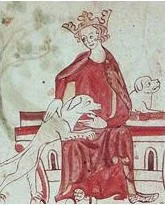
John with hunting dogs. Source: public domain, Anonymous, available here.
The survival of Magna Carta was due in considerable measure to the remarkable political judgement of William Marshal, 1st Earl of Pembroke. One of the most respected knights and statesmen of his generation, Marshal became regent for John's young son, Henry III, following John's death. England was still engulfed in the First Barons' War, with rebel forces supported by Prince Louis of France. Marshal understood that the new king could not simply continue his father's policies. Henry was a child, the kingdom was divided, and the Crown needed to recover the loyalty of the barons. The most effective way to achieve this was not to destroy Magna Carta but to embrace a revised version of it.
In 1216, Marshal therefore issued a new version of Magna Carta in the name of the nine-year-old Henry III. It was substantially shorter than the 1215 charter, with clauses that were considered inappropriate or impractical removed. A further and more important reissue followed in 1217, when the civil war was drawing to a close. Alongside Magna Carta, the government issued a separate Charter of the Forest, dealing with royal forests and restrictions upon their use. These documents helped reconcile the Crown with its opponents and demonstrated something that John had failed to understand: Magna Carta could be transformed from a symbol of rebellion into an instrument of political reconciliation.
The 1217 settlement was particularly significant because it detached Magna Carta from the personality of King John. It was no longer merely a document imposed upon an unpopular monarch at the point of a sword. It was becoming a charter associated with the government of his legitimate successor. When Henry III reissued Magna Carta in 1225, he did so as part of a negotiated arrangement involving taxation and royal government. This version became the authoritative form of the charter for subsequent generations. Although much of the original 1215 document had disappeared or been modified, its fundamental conception remained: royal government was not simply an expression of the sovereign's personal will.
The transformation was gradual. Magna Carta was never originally intended to develop modern democracy, universal equality or a comprehensive catalogue of individual rights. Most of its provisions concerned the relationship between the Crown and the political elite, particularly the barons and the Church. Nevertheless, certain principles contained within it possessed an extraordinary capacity for development. The proposition that government must operate according to established law, that justice should not simply be sold or arbitrarily denied, and that the Crown itself possessed legal limitations provided later generations with a foundation upon which much broader constitutional principles could be constructed.
Among the most enduring ideas was the concept that the ruler was subject to the law. Medieval kings commonly claimed extensive authority, but Magna Carta gave unusually powerful expression to the proposition that royal power could be constrained by established legal obligations. Over the centuries, this principle evolved into what became known as the rule of law: the idea that individuals and governments alike are subject to publicly established laws, administered through institutions capable of applying those laws independently of arbitrary political command.
This evolution was neither straightforward nor inevitable. For centuries, English monarchs continued to exercise enormous authority, and political liberty remained restricted by social status, wealth and gender. Magna Carta was repeatedly interpreted, reinterpreted and sometimes invoked selectively to support political arguments that its original authors could scarcely have imagined. Its significance therefore lies less in what every clause originally meant than in the constitutional language it provided. Later generations repeatedly returned to the charter when challenging excessive governmental authority.
The development of Parliament was closely connected to this wider transformation. Medieval kings required taxation, military support and political cooperation, making consultation with powerful subjects increasingly important. The parliamentary institution that gradually emerged was not created by Magna Carta alone, but the political culture surrounding the charter helped reinforce the principle that royal government required legitimate consent and could not operate entirely according to the monarch's private wishes. Over succeeding centuries, Parliament evolved from a gathering of nobles and representatives summoned by the Crown into the central legislative institution of the English, and later British, constitutional system.
Magna Carta also acquired profound significance in the development of individual legal protections. Its most famous surviving principle concerns imprisonment and punishment according to lawful process. The charter declared that no free man should be deprived of liberty or subjected to punishment except according to lawful judgement and the law of the land. In its original medieval context, this was a relatively narrow protection, but later constitutional thinkers interpreted it as part of a much larger principle: government should not be able to imprison or punish individuals arbitrarily.
That principle eventually became associated with due process of law. The modern concept encompasses far more than Magna Carta itself, including fair procedures, lawful authority, judicial oversight and protection against arbitrary governmental action. The development of the jury system also became intertwined with this broader tradition, although it is important not to imagine that Magna Carta instantly created the modern jury trial. Jury procedures already existed in various forms, and the sophisticated system of criminal and civil juries developed over centuries. Nevertheless, Magna Carta became an enduring symbol of the proposition that individuals should have access to established legal procedures rather than being subject solely to executive command.
The charter's constitutional reputation became particularly powerful during the seventeenth century, when Parliament increasingly challenged the authority of the Stuart monarchy. The Petition of Right of 1628 drew upon older English constitutional traditions to challenge taxation without parliamentary consent, arbitrary imprisonment and the imposition of martial law. Although the Petition of Right was a product of its own political circumstances rather than simply a direct continuation of Magna Carta, its arguments belonged unmistakably to the same constitutional tradition. The central question was increasingly not whether the king possessed power, but whether that power was legally unlimited.
The struggle intensified during the English Civil Wars and the political upheavals that followed. The eventual overthrow of James II in the Glorious Revolution of 1688 produced another landmark: the English Bill of Rights of 1689. It established important limitations upon the Crown and affirmed parliamentary privileges and certain individual protections. Once again, Magna Carta provided historical legitimacy for the proposition that the monarch was not above the law. The constitutional settlement of the seventeenth century therefore represented another stage in a much longer process in which medieval restrictions upon royal authority were transformed into principles governing modern constitutional government.
The influence of this tradition crossed the Atlantic. English colonists in North America were deeply familiar with Magna Carta and the constitutional struggles that had developed around it. American political thinkers regarded inherited English liberties as protections against arbitrary government, and these traditions contributed to the intellectual environment from which the American Revolution emerged. The United States Constitution subsequently established a system of limited government based upon a written constitutional framework, separation of powers and independent institutions. The Bill of Rights, adopted in 1791, contained particularly important protections concerning due process, unreasonable governmental intrusion, criminal proceedings and deprivation of life, liberty or property.
The connection between Magna Carta and the United States Constitution should not, however, be reduced to a simple line of direct inheritance. American constitutionalism was also shaped by seventeenth- and eighteenth-century political philosophy, colonial experience, republican ideas and the writings of thinkers such as John Locke. Nevertheless, the American constitutional tradition consciously inherited the English conception that liberty required protection against arbitrary authority. Magna Carta became an important historical ancestor within that much larger intellectual tradition.
Its influence ultimately reached far beyond Britain and the English-speaking world. After the devastation of the Second World War, representatives of different nations attempted to formulate universal principles capable of protecting human dignity and fundamental freedoms. The result was the Universal Declaration of Human Rights, adopted by the United Nations General Assembly in 1948. The Declaration was not legally descended from Magna Carta in any simple sense, and its intellectual foundations were vastly broader, incorporating natural-law traditions, Enlightenment philosophy and modern international human-rights thinking. Yet the fundamental idea that individuals possess rights that governments cannot legitimately disregard belongs to the same long historical evolution in which Magna Carta occupies a celebrated place.
The journey from Runnymede to modern human rights was therefore neither direct nor inevitable. Magna Carta did not create democracy, constitutional monarchy, judicial independence or universal civil liberties overnight. Its original protections were limited, its language was medieval and its immediate political settlement failed. What made the charter historically extraordinary was the ability of later generations to reinterpret its principles. It became a repository of constitutional memory, repeatedly summoned whenever governments were accused of exceeding legitimate authority.
This is perhaps most clearly reflected in the modern concept of constitutional monarchy. The British monarch remains the formal head of state, but political power is exercised within a constitutional framework established by legislation, convention and judicial principles. Ministers are accountable to Parliament, governments are subject to law, and courts possess an institutional role in determining whether public authorities have acted within their lawful powers. None of these institutions can be attributed solely to Magna Carta, but the charter forms part of the centuries-long historical development through which the concept of limited government emerged.
The same historical inheritance can be seen in modern civil liberties. Protection against arbitrary imprisonment, access to legal procedures, the expectation of an independent judiciary and the principle that governments must justify the exercise of coercive power are now regarded in many constitutional democracies as fundamental safeguards. These principles remain imperfectly implemented, and their protection has never been permanently guaranteed. Throughout history, governments have attempted to restrict liberties during periods of war, crisis and political instability. Magna Carta's continuing importance therefore lies partly in its reminder that legal protections are most valuable precisely when political authority is under pressure.
There is also a profound lesson in the charter's relationship with political power. John believed that his royal authority permitted him to resist the restrictions imposed upon him. In practical terms, he attempted to make Magna Carta disappear. He secured its papal annulment, repudiated its obligations and attempted to defeat its supporters militarily. Yet within a generation, the charter had returned under the authority of his own son. The king who attempted to destroy it inadvertently helped transform it into something considerably more enduring than the settlement he had rejected.
John's greatest political failure was therefore also his greatest unintended legacy. He failed to preserve the Angevin Empire, alienated his barons, lost territories in France, provoked rebellion and ultimately died while his kingdom was still at war. His attempt to repudiate Magna Carta likewise failed. Yet the document that he regarded as an intolerable restriction upon his authority survived him, was reissued by his successors and became embedded within the constitutional memory of England.
Eight centuries later, the significance of Magna Carta is not that it established the democratic world in a single dramatic moment at Runnymede. Its true importance lies in the principle that emerged from its turbulent history: power must ultimately answer to law. From medieval disputes between kings and barons came ideas that were gradually reshaped into constitutional government, parliamentary accountability, judicial protection and civil liberties. John sought to extinguish Magna Carta; instead, his resistance helped ensure that its ideas would outlive him. The king who wanted to remain above the law became, ironically, one of history's most enduring examples of why no ruler should be.
The story of Magna Carta is, ultimately, a story about the unpredictable consequences of political failure. It was born not from a grand philosophical project to create democracy, nor from a universal declaration of human freedom, but from a desperate confrontation between an increasingly isolated monarch and a political elite determined to restrain his authority. King John did not willingly surrender his power at Runnymede. He negotiated because circumstances had left him with few alternatives. The charter itself was imperfect, its provisions were predominantly concerned with the rights and interests of the medieval Church, nobility and landholders, and its original settlement collapsed almost immediately. Yet from this turbulent and distinctly medieval dispute emerged an idea whose historical significance would ultimately far exceed the intentions of those who created it.
The extraordinary achievement of Magna Carta was therefore not that it immediately transformed England. It did not. Its importance lay in the precedent it established and, perhaps even more importantly, in the language it provided for subsequent generations. The proposition that authority could be subjected to law, that established legal procedures could restrain arbitrary power and that even the sovereign possessed obligations beyond personal will became increasingly powerful as England's political institutions evolved. Magna Carta became a constitutional touchstone precisely because later generations could reinterpret its principles in response to circumstances that its original authors could never have anticipated.
Its survival after John's death was crucial. Had William Marshal and the government of the young Henry III simply abandoned the charter, Magna Carta might have remained an intriguing but short-lived episode in the political crisis of 1215. Instead, its reissues transformed it from a defeated king's reluctant concession into a continuing element of royal government. The subsequent confirmation of the charter ensured that its principles remained embedded within England's constitutional memory. What John had regarded as an intolerable infringement upon royal prerogative was gradually transformed into evidence that royal authority itself possessed boundaries.
Over the centuries, those boundaries became progressively more sophisticated. The relationship between Crown, Parliament and judiciary evolved through political conflict, legislation and constitutional practice. The Petition of Right, the struggles of the seventeenth century, the English Bill of Rights and the emergence of parliamentary government each represented distinct historical developments rather than simple extensions of Magna Carta. Yet they participated in the same much broader constitutional tradition: the conviction that legitimate government cannot be reduced to the unrestricted exercise of executive power.
The significance of this development becomes even clearer when viewed beyond Britain. The constitutional traditions inherited by the American colonies, the intellectual foundations of the American Revolution, the United States Constitution and its Bill of Rights all emerged from a complex mixture of English constitutional history, Enlightenment philosophy, colonial experience and republican thought. Magna Carta was only one element within that intellectual inheritance, but it provided a powerful historical symbol for the proposition that liberty required protection against arbitrary government. Its influence was therefore not mechanical or direct; rather, its principles were repeatedly rediscovered, adapted and expanded.
The same caution applies to modern human rights. Magna Carta did not establish universal equality, freedom of expression, religious liberty or the modern conception of human dignity. Its protections were originally restricted and its society was profoundly hierarchical. Yet the historical evolution from limitations upon medieval royal authority towards modern concepts of individual rights demonstrates how constitutional ideas can acquire meanings far greater than those originally intended. The Universal Declaration of Human Rights belongs to a vastly broader intellectual and political tradition, but its insistence that governmental authority must respect fundamental human rights reflects the culmination of a centuries-long struggle against arbitrary power.
This is why Magna Carta continues to possess such extraordinary symbolic power more than eight centuries after Runnymede. Its historical importance does not depend upon pretending that medieval England possessed modern democratic values. Quite the opposite. Its significance becomes more compelling when the document is understood within its proper context. It demonstrates how constitutional principles can emerge imperfectly from political conflict and subsequently evolve through generations of reinterpretation. Ideas do not necessarily require their creators to understand their ultimate consequences.
There is, moreover, a striking irony at the heart of the entire story. John fought to preserve what he believed to be the traditional prerogatives of kingship. He resisted his barons, challenged the restrictions placed upon him, sought papal annulment of the charter and attempted to defeat his opponents by force. Yet the more desperately he attempted to suppress Magna Carta, the more enduring its historical legacy ultimately became. His death did not end the charter. His repudiation did not erase it. His military struggle did not prevent its revival. Instead, his failure helped evolve the circumstances in which the document could be reissued, preserved and gradually transformed into a symbol of limited government.
John therefore occupies a peculiar position in constitutional history. He was not a champion of liberty, nor did he consciously seek to establish principles that would one day underpin constitutional democracy. His reign was marked by military failure, political conflict, financial pressure and a profound inability to maintain the confidence of many of his most powerful subjects. Yet his confrontation with the barons produced one of the most consequential constitutional episodes in European history. The king who attempted to preserve unrestricted royal authority inadvertently became associated with one of history's most enduring warnings about the dangers of unrestricted power.
The legacy of Magna Carta is consequently best understood not as a single moment but as an eight-hundred-year conversation about the nature and limits of authority. Runnymede was only the beginning. The charter survived because subsequent generations found within it principles that could be adapted to their own struggles: against arbitrary imprisonment, excessive taxation, unchecked executive authority and the concentration of political power. Each generation added something of its own, gradually transforming a medieval settlement between a king and his barons into part of the intellectual and constitutional heritage of the modern world.
Yet that heritage should never be regarded as permanently secured. The rule of law, constitutional government and individual liberty are not historical achievements that, once established, become immune from erosion. Political crises, wars, emergencies and powerful governments have repeatedly tested the boundaries of civil liberty throughout history. Magna Carta's continuing relevance therefore lies not merely in what it accomplished, but in the warning contained within its history: legal restraints matter most when those in power find them inconvenient.
The enduring lesson of Magna Carta is consequently both simple and profound. No ruler, however powerful, should possess authority entirely beyond the reach of law. That principle was not created fully formed at Runnymede, and it did not emerge effortlessly from the medieval world. It was contested, abandoned, revived, reinterpreted and gradually expanded across centuries of political struggle. But once articulated, it proved extraordinarily difficult to extinguish.
King John wanted Magna Carta to disappear. Instead, it outlived him, outlived his dynasty, outlived the medieval political world that invoked it and eventually became part of a global vocabulary of constitutionalism and human rights. The document forced upon an unwilling king became a symbol invoked against kings, governments and institutions that claimed excessive authority. Its journey from a muddy field beside the Thames to the foundations of modern constitutional thought is one of history's most remarkable examples of unintended consequence.
In the end, therefore, Magna Carta's greatest legacy is not any individual clause, nor even the physical documents that survive in archives today. It is the enduring principle that power must answer to law. That principle transformed a medieval political crisis into a constitutional inheritance that continues to shape modern ideas of liberty, accountability and government. John sought to demonstrate that a king could not be constrained by his subjects. History ultimately demonstrated something very different: that even kings are subject to the law, and that an idea capable of surviving its enemies can become far more powerful than the ruler who once attempted to destroy it.
Enjoyed the piece?
Join thousands of history readers getting occasional updates on new blog posts, books, and video releases — plus a free history book to get you started.
Now, read Terry’s series on King Kenry VIII and his wives here.