
Few individuals have been as crucial to understanding the delicate balance between church and state as George Reynolds. In 1879, Reynolds became the defendant in a landmark legal challenge that inadvertently tested the limits of religious liberty in the United States. The Supreme Court's decision in Reynolds v. United States became the first major interpretation of the First Amendment's Free Exercise Clause, drawing a distinction between religious belief, which is absolutely protected, and religiously motivated conduct, which may be regulated by law. Reynolds's story is therefore more than the story of a man who sought to practice his individual rights, but it is a pivotal chapter in the evolving American debate over the meaning and scope of the United States Constitution.
Marvin McCrary explains.
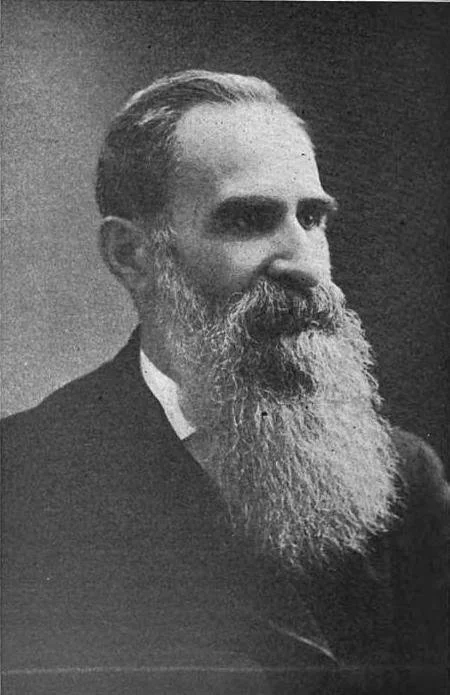
George Reynolds. Source: Public domain, Improvement Era, Volume 12, page 908, available here.
Early Life
George Reynolds was born in Marylebone, England, in 1842. Much of his childhood was spent in the care of his maternal grandmother, who employed a maid named Sarah White. When Reynolds was nine years old, White invited him to attend a service of The Church of Jesus Christ of Latter-day Saints, also known as the Mormons. After attending, he quickly became convinced that he wanted to join the church.
The church was founded by Joseph Smith in Fayette, New York, in 1830 and the British Mission was formally established in 1837. The opening of the mission coincided with the beginning of Queen Victoria's reign, a period during which Britain became increasingly receptive to religious diversity. Victoria presided over a society that had gradually become more tolerant of non-Anglican religious movements, allowing foreign missionaries greater freedom to preach. The message brought to England by foreign missionaries such as the Mormons, with its egalitarian worldview and promise of an afterlife, likely held considerable appeal for many among the poor of Victorian Britain. For individuals such as Sarah White, who may have struggled within a rigidly stratified society that offered limited opportunities for social mobility to those not born into privileged circumstances, such teachings could have presented a compelling alternative to the prevailing social order. Paddington, where Reynolds first attended church with Sarah White, would become an important center during the rapid expansion of the British Mission. This was largely due to the fact that the location was closely connected to London's growing railway network. Paddington Station, completed in 1838, served as a principal gateway into the capital and became the arrival point for missionaries from America as they expanded their efforts in London beginning in 1840.
It was against this backdrop that Reynolds's first encounter with the Mormons connected him to a movement that was transforming the religious landscape of Victorian Britain. After a short time of attending a few services, Reynolds quickly became convinced that he wanted to become a member. Among one of the first hurdles that Reynolds would have to overcome was his family. Suspicious of the fledgling religious movement, and staunch Anglicans, Reynold’s parents would not grant him permission to become a baptized member of the church. This did little to deter Reynold’s determination, and despite frequent admonishments against doing so, he would often disobey his parents to attend worship services in Paddington. In 1856, when Reynolds was 14 years old, he attended a church service in Somers Town, where he asked to be baptized. It is unclear as to why Reynolds sought to be baptized at that particular location, as opposed to in Paddington, which would have held more emotional significance, but it was most likely due to Reynolds’ fear of his parents discovering what he had done.
Immigration to the Utah Territory
In May 1865, Reynolds accepted an invitation to immigrate to the Utah Territory. He arrived in the Salt Lake Valley on July 5, 1865, and shortly thereafter Brigham Young, then president of the church, appointed him as his personal secretary. Young had likely learned of Reynolds's administrative abilities through reports of his service to the church in England. Soon after his baptism, Reynolds had become a missionary and later served as a clerk under George Q. Cannon and Daniel H. Wells. Both men were senior church leaders whose correspondence with Young likely commended Reynolds diligence and work ethic. Less than three weeks after his arrival in Salt Lake, Reynolds married Mary Ann Tuddenham, a fellow English convert, on July 22, 1865.
Reynolds' arrival in America coincided with one of the nation's most consequential periods of transition. The devastating Civil War had come to a close only months earlier with the Confederate surrender at Appomattox Court House, bringing an end to four years of unprecedented bloodshed. Reynolds’s arrival in Utah Territory thus occurred against the backdrop of a country wrestling with the consequences of its greatest internal crisis, even as the Latter-day Saints continued to shape their own distinctive society in the American West.
In 1847, Brigham Young first beheld the Great Salt Lake Valley, the destination that would become the new gathering place for the Latter-day Saints, as they had previously been forced out of Nauvoo, Illinois. Historian Leonard J. Arrington observed that the church leadership were already familiar with the region through trappers' journals, explorers' reports, and interviews with travelers who had traversed the area. After years of enduring persecution for their religious beliefs, the Saints viewed the remote valley as a place where they might finally secure a measure of peace. The vast, undeveloped landscape offered the prospect of establishing a refuge, far removed from the hostilities they had experienced elsewhere. Young believed that Utah's geographic isolation would provide the Saints with the freedom to practice their religion without interference. At the same time, Brigham Young recognized that the Saints could not "leave the political orbit of the United States," nor did they wish to do so. Church leaders moved to petition Congress for the admission of their settlements into the Union as the State of Deseret. The name “deseret” derived from a scriptural term meaning "honeybee," symbolizing industry, cooperation, and communal endeavor. The proposal and the name, therefore, reflected not only the Mormons’ ambition to establish a prosperous and expansive commonwealth, but also sought to avoid claims to territories already regarded as integral to neighboring regions, such as California and New Mexico. However, the proposal would be rejected by the federal government. Congress was reluctant to allow the creation of a state encompassing such a large area. Furthermore, Congress did not like the name “deseret” as it sounded too much like “desert”. It was thus proposed that the territory be reduced in size, and named Utah, for the Ute indigenous tribes that had settled there thousands of years prior.
Plural Marriage
In August, 1874, while still lawfully married to his first wife, Reynolds took his second wife, Amelia Jane Schofield. Like many early Latter-day Saints, Reynolds practiced polygamy, or plural marriage. The practice of plural marriage was alleged to have been based on a revelation received by Joseph Smith, and had been practiced as early as the 1840s. It has been speculated that half of those living in Utah Territory in the mid-1800s had experienced life in a polygamous family firsthand as a husband, wife, or as a child. While plural marriage was considered an important religious principle by the members of the church, it was an affront to the sensibilities of mainstream Protestants in the nineteenth century. The writer Mark Twain once travelled to Salt Lake City intending to expose the practice as religious fraud, however, after much observation, he claimed his heart "warmed toward these poor, ungainly and pathetically homely creatures". In his view, a man taking multiple wives was performing an act of self-sacrifice and "Christian charity" rather than something to be censured. In contrast to this rather humorous and sympathetic view, the Republican Party took a more hardline approach, viewing polygamy on par with slavery, referring to both as the “twin relics of barbarism” as part of the official party platform in 1856, and popular novels of the day linked polygamy to a variety of social ills. This widespread condemnation against the practice was soon reflected in congressional action.
In 1862, Congress passed the Morrill Act for the Suppression of Polygamy, better known as the Morrill Anti-Bigamy Act, named for its sponsor, Justin S. Morrill of Vermont. Raised in a devoutly Protestant New England environment shaped by traditional Congregationalist beliefs, Morrill regarded plural marriage as "grossest immorality and debauchery" and an affront to the principles and values of American democracy. The act not only outlawed bigamy and imposed penalties for its practice but also revoked the incorporation granted to the Mormon Church by the Utah territorial legislature and restricted the Church's property holdings. Despite its sweeping provisions, the law remained unenforced. By 1862, the nation was two years into the Civil War, and the Union government was compelled to devote its resources to defeating the Confederacy rather than confronting the Mormon Church in Utah Territory. President Abraham Lincoln captured this pragmatic approach when he reportedly remarked that if the Mormons left him alone, he would leave them alone. His policy of nonintervention spared the federal government a second domestic conflict, allowing it to concentrate on the war instead of enforcing the Morrill Anti-Bigamy Act.
Reynolds v. United States
Although the law had not been rigorously enforced during the 1860s, by 1874 federal authorities had begun making concerted efforts to prosecute individuals who practiced polygamy. This renewed enforcement transformed what had long been a largely theoretical constitutional question into an immediate legal challenge, forcing courts to consider the extent to which the First Amendment protected religiously motivated conduct. The Free Exercise Clause of the First Amendment was intended to protect individuals from government interference in the practice of their religion. It guarantees the liberty to hold any belief, practice any faith, or adhere to no religion at all without government coercion or hostility. In his 1802 letter to the Danbury Baptist Association, Thomas Jefferson argued that the First Amendment's prohibition that Congress should “make no law respecting an establishment of religion, or prohibiting the free exercise thereof” had erected a “wall of separation between Church & State.” Believing the Constitution to be divinely inspired, leaders of the Mormon Church were therefore confident that anti-polygamy legislation would ultimately be declared an unconstitutional violation of the First Amendment. To that end, Brigham Young asked Reynolds if he would be willing to serve as the test defendant. Reynolds, out of respect and loyalty to Young, as well as the church, agreed, and was indicted for bigamy by a grand jury on June 23, 1874. Because this was a test case the church wished to pursue before the United States Supreme Court, Reynolds cooperated with investigators and the trial court, supplying the witnesses and testimony to support that he was, indeed, married to two women at the same time.
Reynolds was found guilty by a jury in April 1875 and was sentenced to one year's imprisonment, as well as issued a fine of $300 USD (the equivalent of $9,139.72 USD in 2026). On appeal, the indictment was overturned on a technicality by the Utah Territory's Supreme Court. However, Reynolds would be retried and convicted again, and this time, he would be sentenced to two years of prison and hard labor. He was also fined a sum of $500 (the equivalent of $15,232.86 USD in 2026). On yet another round of appeals in 1876, the Utah Territorial Supreme Court upheld the sentence. Seeking to appeal the conviction, Reynolds' case was brought before the United States Supreme Court in November of 1878.
The Supreme Court had dealt with religious liberty in only a handful of earlier cases up to this point, such as Vidal v. Girard's Executors, Permoli v. New Orleans, and Watson v. Jones. Of these earlier decisions, Watson would be of particular importance because it articulated principles that would later inform the Court's treatment of the legal question at the center of the Reynolds case. In the majority opinion given by Justice Samuel Miller in Watson, Miller observed that the protection of religious liberty was not absolute because people were not entitled to "violate the laws of morality and property" or to infringe upon the personal rights of others. Reynolds' attorneys argued that his conviction for bigamy should be overturned on the issue of religious obligation. In their view, it was Reynolds’ religious duty, as directed by his ecclesiastical leaders, to marry multiple women. The First Amendment, they added, protected this practice as a fundamental duty of his religion. On 6 January 1879, the Supreme Court issued its unanimous decision affirming Reynolds's conviction and rejecting Reynolds's argument that the Latter-day Saint practice of plural marriage was protected by the Free Exercise Clause of the First Amendment to the Constitution. The conviction was upheld, as was the constitutionality of the Morrill Anti-Bigamy Act.
Aftermath and Legacy
George Reynolds was released from prison on January 20, 1881. In 1885, Reynolds would marry his third and final wife, Mary Gould. His first wife, Mary Ann, died in December, following the birth of a child. Reynolds would continue in his service to the church, often serving in positions of ecclesiastical authority, until his death in 1909. The historian Barbara W. Tuchman once wrote of the long view of history and the difficulty of discerning the true significance of a single individual or event within the broader sweep of time. Such was the case with Reynolds, as his enduring legacy lies not in his personal biography, but in the legal precedent established by his case—a precedent whose influence continues to shape debates over religious liberty to the present day. In writing the majority opinion in Reynolds v. United States, Chief Justice Morrison R. Waite made a constitutional argument that would prove remarkably durable: while the government may not prohibit religious belief, it may regulate religiously motivated conduct deemed contrary to the good order of society.
In 1890, Wilford Woodruff, fourth president of The Church of Jesus Christ of Latter-day Saints, issued what became known as the 1890 Manifesto (also known as the Woodruff Manifesto or the Anti-Polygamy Manifesto of 1890), declaring an end to the practice of plural marriage. A second manifesto, issued by Joseph F. Smith in 1904, unequivocally prohibited all plural marriages and established excommunication as the penalty for members who continued the practice. While Reynolds’ case and the issue of polygamy held some degree of fascination with Americans at the time, it would quickly be forgotten in the subsequent decades. However, more than a century later, the constitutional questions raised in Reynolds v. United States remains at the center of the ongoing national conversation to define the boundaries of freedom of religion, serving as a reminder that, as often is the case, history's most consequential turning points are not always recognized as such in their own time.
Did you enjoy the piece? Join us on X here to receive regular updates: @HistoryIsNowMag
References
Gordon, Sarah B. The Mormon Question: Polygamy and Constitutional Conflict in Nineteenth Century America. The University of North Carolina Press, 2003.
Paulsen, Michael Stokes, and Luke Paulsen. The Constitution: An Introduction. Basic Books, 2017.
Rasmussen, Matthew L. Mormonism and the Making of a British Zion. University of Utah Press, 2016.
Rehnquist, William H. The Supreme Court. Vintage Books, 2011.
Van Orden, Bruce A. Prisoner for Conscience' Sake: The Life of George Reynolds. Deseret Book Company, 1992.
.JPG)