Among the many figures who aided the American Revolution, few are as intriguing—or as overlooked—as Francis Vigo. An immigrant from what is now northern Italy, a former soldier in the Spanish army, a fur trader, financier, intelligence gatherer, and supporter of the Patriot cause, Vigo played a critical function in helping secure the Old Northwest for the emerging United States. Yet despite his contributions, he spent much of his later life seeking reimbursement for money and services he provided during the war.
Brian D’Ambrosio explains.
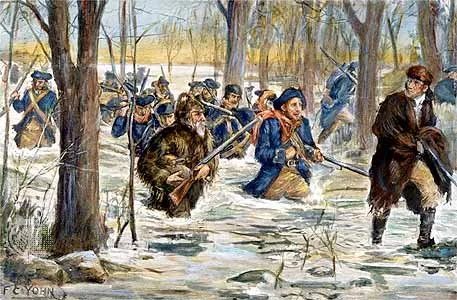
As depiction of the March to Vincennes. Source: Public domain, Frederick Coffay Yohn, available here.
What is known about Vigo's life comes from a relatively limited documentary record. Historians agree on the broad outlines of his career, though many details of his youth remain obscure.
Francis Vigo was born in Mondovì, in the Kingdom of Sardinia, in 1747. Most modern sources place his birth on December 3 of that year. His birth name was Giuseppe Maria Francesco Vigo. Little is known about his family background or childhood. At some point as a young man, he enlisted in the Spanish army and was sent first to the Caribbean and later to New Orleans, which was then under Spanish control.
After completing his military service, Vigo remained in North America and entered the fur trade. By the early 1770s, he had established himself as a merchant and trader in St. Louis, then part of Spanish Louisiana. He became familiar with the labyrinthine frontier world of French settlers, Native American nations, Spanish officials, and British interests. His business success gave him extensive knowledge of the Mississippi and Wabash river regions and brought him into contact with influential political and military leaders.
When the American Revolution spread westward, Vigo found himself in a position to influence events. Although he was not an American by birth and remained technically a Spanish subject during much of the war, he became sympathetic to the Patriot cause. His support emerged at a crucial moment in the struggle for control of the trans-Appalachian frontier.
The key figure in Vigo's Revolutionary War story was George Rogers Clark (1752-1818), the Virginia officer whose western campaign sought to weaken British influence in the Illinois Country and the Ohio Valley. Clark's capture of Kaskaskia and other British posts in 1778 threatened British authority across the region. His success, however, depended heavily upon information, supplies, and local support.
Vigo became one of Clark's most valuable allies.
In late 1778, after British Lieutenant Governor Henry Hamilton (1734-1796) reoccupied Fort Sackville at Vincennes, Vigo traveled into the area to gather information. Unaware that British forces had regained control, he was captured and detained. Hamilton eventually released him after securing his promise not to undertake actions harmful to British interests while leaving the region. Once clear of British control, Vigo immediately traveled to report what he had learned to Clark. The information he carried proved of great consequence.
Vigo informed Clark about British troop strength, defensive preparations, and Hamilton's plans for future operations. Armed with this information, Clark launched his celebrated winter march through flooded wilderness to Vincennes in February 1779. The campaign culminated in the recapture of Fort Sackville, one of the most significant American victories on the western frontier. Historians generally agree that Vigo's intelligence helped make the operation possible. Clark himself later praised Vigo's efforts, writing that he provided virtually all the information his force needed.
Vigo's contributions extended beyond intelligence gathering. He also provided financial assistance when Clark's operations faced chronic shortages of money and supplies. Frontier warfare often depended on personal credit, and Vigo used his own resources to support American efforts. Those advances became a lasting source of frustration because repayment proved elusive. Indeed, the financial risks he assumed on behalf of the revolutionary cause followed him for much of his remaining life.
After the Revolution, Vigo settled permanently in Vincennes (now southwestern Indiana), one of the oldest European settlements in the Old Northwest. He continued his commercial activities and became a respected member of the community. He also served in local militia organizations and participated in civic affairs during the formative years of the Indiana Territory.
Education became another area of his public service. Vigo supported the establishment of Jefferson Academy, which eventually evolved into Vincennes University, one of the oldest institutions of higher learning in the region. His role reflected a commitment not only to frontier commerce but also to the long-term development of communities emerging from a region that had only recently been contested ground.
Despite his earlier prosperity, Vigo's later years were marked by financial difficulties. Claims he submitted for wartime expenditures languished for decades. Perhaps no aspect of his life better illustrates the uncertain rewards of Revolutionary service. He died in Vincennes on March 22, 1836, at the age of eighty-eight. By then, much of his fortune had disappeared.
Ironically, recognition arrived after his death. Congress eventually authorized payment of a portion of Vigo's long-standing claims, along with accumulated interest. By the time reimbursement finally reached his estate in 1875, Vigo had been dead for nearly four decades.
Today, Vigo's name survives in places such as Vigo County and in monuments honoring his service. Still his larger legacy rests on his actions during one of the most precarious periods of the American Revolution. Like many traders operating along the Mississippi and Wabash rivers, Vigo moved comfortably among French settlements, Spanish officials, Native communities, and Americaan military leaders. Born in Italy, trained under the Spanish flag, and active in French communities along the Mississippi Valley, he nevertheless committed his resources and influence to the American cause.
Francis Vigo never commanded an army, drafted a constitution, or held high political office. What he did possess was a detailed knowledge of the western country, a network of commercial relationships, and a willingness to place his own finances at risk when Clark's campaign needed support. Clark supplied the daring; Vigo supplied information, credit, and local knowledge. Together, those contributions helped secure the Illinois Country and strengthen the American position in the Northwest. Indeed, while his name is less familiar than many Revolutionary figures, his contributions remain among the most consequential on the western frontier. Perhaps that is why historians continue to regard Francis Vigo as one of the indispensable, if often overlooked, architects of the American victory in the West.
Enjoyed the piece?
Join thousands of history readers getting occasional updates on new blog posts, books, and video releases — plus a free history book to get you started.
References
National Park Service: https://www.nps.gov/people/francis-vigo.htm
George Rogers Clark National Historic Site
American Battlefield Trust biographies: https://www.battlefields.org/learn/biographies/francis-vigo
Indiana Magazine of History, digital: https://www.jstor.org/stable/27786094?seq=1