Today Noor Inayat Khan is commemorated in films, books and memorials. And even though there is more recognition of her role as a Special Operations Executive (SOE) agent during World War Two, she still struggles to be included in popular histories of the war. Who was Noor Inayat Khan, and why did the life of this brave British wartime agents become hidden?
Sophie Riley explains.
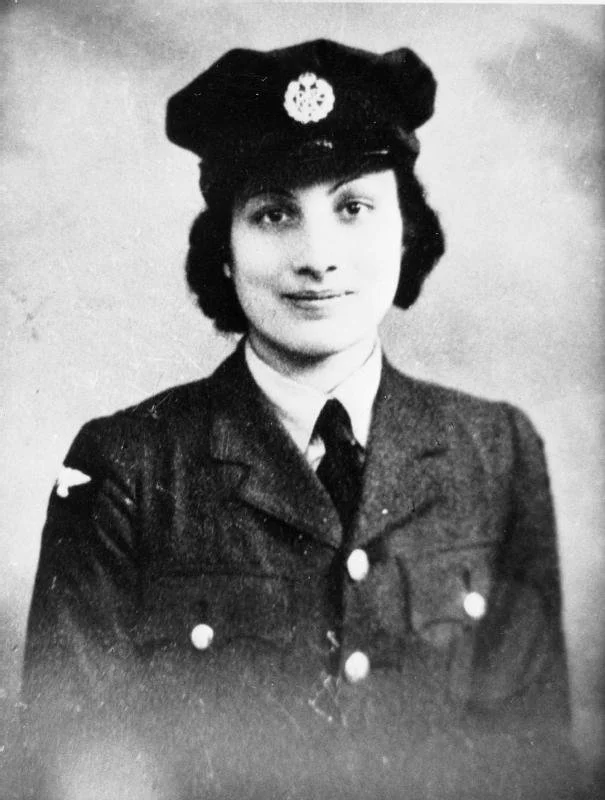
Noor-un-Nisa Inayat Khan. Source: Public domain, HU 74868 from the collection of the Imperial War Museums, available here.
Raised in the shadow of peace
Noor Inayat Khan was a young woman whose life revolved around music, storytelling and poetry. She was born to Sufi teacher Hazrat Inayat Khan and American poet Ora Baker in Moscow on January 1, 1914. However, the outbreak of the First World War forced the family to leave Russia, first settling in London before making their home in Paris after the war when Noor was still a child.
The family settled in the Parisian suburb of Suresnes, in a house Noor affectionately called Fazal Manzil – or House of Blessing. There she was raised with her siblings in an environment surrounded by music, spirituality, non-violence, and a deep appreciation for cultural diversity.
In 1927, tragedy struck the Khan household when her father died from pneumonia. Noor assumed responsibilities well beyond her years. As her mother turned inwards with grief, Noor assumed a maternal role for her siblings alongside domestic chores. Amid these responsibilities she developed her passion for writing poetry and short stories – some of which were later published in the Sunday literary supplement of the prominent French newspaper Le Figaro.
Nothing in Noor’s childhood suggested that she would one day become one of Britain’s most courageous wartime agents. Raised with a philosophy of peace and compassion, her upbringing stood in stark contrast to the dangerous world of wartime espionage. It is precisely this contrast that makes her story, and its subsequent disappearance from popular memory, so compelling.
Just as Noor stood on the threshold of becoming a children’s author, her life was disrupted again as Europe descended into war. The German invasion of France in May 1940 forced Noor and her family to flee to England. It was here that Noor and her brother Vilayat made the crucial decision to support the war effort and fight the fascists, a decision that would change the course of Noor’s life forever.
Choosing resistance
In November 1940, Noor joined the Women’s Auxiliary Air Force (WAAF) as an Aircraftwoman 2nd Class and trained as a wireless radio operator. Her fluency in French, knowledge of occupied France, and her aptitude for Morse code soon attracted the attention of recruiters from the Special Operations Executive (SOE), Britain's secret wartime organization. Established in July 1940 on the orders of Prime Minister Winston Churchill, the SOE was tasked with conducting espionage, sabotage and supporting resistance movements throughout Nazi-occupied Europe. Churchill famously instructed the organization to ‘set Europe ablaze’, and it was into this dangerous world that Noor was about to step.
In late 1942, she was summoned to the Victoria Hotel in London for an interview with Captain Selwyn Jepson, the recruiting officer for the SOE's French (F) Section. Conducted entirely in French, the interview assessed her language skills and her suitability for clandestine work. Jepson made the dangers explicitly clear: if captured, she would receive no protection under international law and she would be executed. Despite the risks, Noor accepted. On February 8, 1943, she joined the SOE under the codename Madeleine.
Ironically, the secrecy that made Noor an ideal SOE recruit also contributed to her post-war obscurity. Intelligence work depended upon silence, and after 1945 former agents rarely discussed their missions, while many official records remained classified. Unlike soldiers returning openly from the front, Noor's wartime service remained hidden from public view.
Decades later Captain Jepson reflected on Noor’s character, during an interview with the Imperial War Museum. He described her as ‘a woman with immense integrity, sincerity, and deep devotion to the cause of liberty.’ [1] His admiration also challenged prevailing views of women in espionage. Jepson believed that women had a ‘far greater capacity for cool and lonely courage than men’, [2] a conviction that saw him champion the recruitment of more women into the SOE's F Section.
From pacifism to espionage
Prior to her starting active duties Noor was sent to an SOE training school in Beaulieu, Hampshire, where she spent four months living and breathing her cover under the codename Madeleine. In addition to learning about her new identity as a children’s nurse, Jeanne-Marie Renier, Noor was also trained in physical combat, weaponry and how to resist during interrogations.
During her time at Beaulieu, she was continuously assessed physically and mentally while her instructors filled out written observations on her suitability as an SOE agent. Her reports (which can be seen in The National Archives) show that Noor was skilled as a radio operator, however there were mixed opinions on her ability. One officer noted that she ‘was not overburdened with brains,’[3] to which another responded ‘we don’t want them to be overburdened with brains.’[4] It is also noted that Noor had an unstable and temperamental personality, due to her pacifist beliefs and apparent anxiety around weapons.
Despite these mixed reviews, it was Vera Atkins, F Section's intelligence officer, who had the final word on Noor traveling to France. She summoned Noor for a meeting in a restaurant in Mayfair in May 1943, and offered her a chance to back out of the mission without any loss of honor. Noor adamantly refused, securing her final deployment clearance.
Before leaving England, every trace of Noor’s British identity had to disappear. She was issued with French-made clothes, forged identity papers, and ration cards. Alongside her B2 wireless radio and Webley pistol, she carried a small selection of pills, one for energy, one designed to induce a stomach disorder, and a cyanide capsule to use as a last resort if captured.
During the next full moon, on June 16, 1943, Noor boarded a Westland Lysander aircraft alongside three other SOE agents. As the aircraft disappeared into the night, Noor left England behind under the codename Madeleine. She would never return.
Behind Enemy Lines
Noor began her role as a wireless operator for the ‘Prosper’ network immediately after her arrival. Her job was to communicate with SOE back in Britain, to coordinate the arrival of agents and weaponry to aid the Resistance. However, the network soon collapsed due to infiltration from the Gestapo (Nazi secret police) and the work of double agents.
This collapse did not deter her as she continued to transmit messages back to London. In addition, she helped around thirty stranded Allied airmen escape occupied France. This work brought her into at least one shooting affray with German troops, forcing her to set aside her pacifist beliefs.
For the next three months Noor was constantly on the move as she transmitted messages back to London. Being the only operator in Paris during this time put her high up on the Gestapo’s most wanted list. This led to many close calls. On one occasion, she entered her home to find a Gestapo officer waiting for her, and through sheer luck and determination she managed to outwit him.
However, her luck would run out on October 13, 1943, when she was betrayed by a Frenchwoman for 100,000 francs. From there she was taken to 84 Avenue Foch in Paris for interrogation.
Once inside Avenue Foch, Noor refused to cooperate and remained silent despite being tortured. During her time there her fight did not waver as she attempted to escape twice, once through a window immediately after her arrival. For her second attempt, she escaped with two other prisoners by dismantling the bars on their skylights, but they were ultimately recaptured during an Allied air raid.
Because she was deemed highly dangerous and refused to sign a document promising not to attempt another escape, the Nazis moved her to Pforzheim prison in Germany where she remained in solitary confinement for ten months prior to her transfer to Dachau concentration camp in southern Germany.
Due to her sheer defiance, Noor was executed alongside three other SOE agents on September 13, 1944. Prior to her execution she shouted her final word ‘Liberté.’
A Legacy reimagined
Noor’s execution marked the end of her mission but not the beginning of her public recognition. Unlike many military heroes whose stories entered Britain’s wartime narrative almost immediately, Noor’s remained largely unknown outside intelligence circles for decades.
Yet secrecy, upbringing, and gender alone cannot explain Noor's absence from wartime history. History, however, has a habit of returning to unfinished stories. The young woman who once dreamed of writing children's stories never had the chance to finish her own. Instead, she became part of one of the twentieth century's most extraordinary stories, one that history was slow to tell. In recent decades, renewed scholarly interest has catalyzed biographies and memorials which have restored Noor among key heroes of the conflict.
In London, HRH the Princess Royal unveiled a bust of Noor in Gordon Square in November 2012, commenting that ‘the life of the spy princess, while truly remarkable in its own right, also has a real connection to our modern era.’ [5] Noor has also posthumously been honored with the George Cross from Britain alongside the French Croix de Guerre with Gold Star.
The story of Noor Inayat Khan reflects a wider shift in the way the Second World War is remembered. Rather than focusing solely on battlefield victories and military commanders, historians have increasingly explored the experiences of civilians, women, intelligence operatives and Britain's diverse wartime communities. This renewed interest has encouraged historians to reconsider the role of women within Britain's secret war, challenge traditional male narratives of military heroism, and recognize the contributions made by people from across the British Empire. In so doing, Noor's extraordinary service has become part of a much broader effort to recover histories that remained hidden for decades.
Despite all the glory and recognition, her story should end with the recollection of Captain Selwyn Jepson, the SOE’s chief recruiter who met her that fateful winter day just off Trafalgar Square when he recruited her:
‘I see her very clearly as she was that first afternoon, sitting in front of me in that dingy little room, in a hard kitchen chair on the other side of a bare wooden table. Indeed, of them all, and there were many who did not return, I find myself constantly remembering her with a curious and very personal vividness which outshines the rest … the small, still features, the dark quiet eyes, the soft voice, and the fine spirit glowing in her.’[6]
Enjoyed the piece?
Join thousands of history readers getting occasional updates on new blog posts, books, and video releases — plus a free history book to get you started.
Further Reading Material
Arthur J Magida, Code name Madeleine: A Sufi spy in Nazi-occupied Paris, (Recorded Books, 2020)
Noor Inayat Khan and Zia Inayat-Khan, Dream flowers: The collected works of Noor Inayat Khan, (Sulūk Press, 2020)
Shrabani Basu, Spy princess: The life of Noor Inayat Khan, (The History Press, 2025)
Shrabani Basu, Noor Inayat Khan – SOE | SWWEC, 20th June 2021.: https://war-experience.org/lives/noor-inayat-khan-soe/ (Accessed: 07 July 2026).
[1] Jepson, S. (n.d.). Interview with Selwyn Jepson [Oral History Interview]. Imperial War Museums Sound Archive, London, United Kingdom. Object Reference: 80009120. Retrieved from https://www.iwm.org.uk/collections/item/object/80009120
[2] Jepson, S. (n.d.). Interview with Selwyn Jepson [Oral History Interview]. Imperial War Museums Sound Archive, London, United Kingdom. Object Reference: 80009120. Retrieved from https://www.iwm.org.uk/collections/item/object/80009120
[3] Special Operations Executive (1943). Noor Inayat Khan’s SOE Finishing Report (Form T. 4). London: The National Archives. Reference: HS 9/836/5.
[4] Special Operations Executive (1943). Noor Inayat Khan’s SOE Finishing Report (Form T. 4). London: The National Archives. Reference: HS 9/836/5.
[5] Princess Anne, 2012. Speech at the Unveiling of the Noor Inayat Khan Memorial Bust. [Speech] Gordon Square Gardens, London, 8 November 2012.
[6] Fuller, J.O. and Jepson, S. (1952) ‘Foreword’, in Madeleine: The Story of Noor Inayat Khan, George Cross, MBE, Croix de Guerre. London, UK: Victor Gollancz Ltd, pp. 7–8.