Modern Americans can recite the three branches so easily that the arrangement feels almost natural: legislature, executive, judiciary. School diagrams reinforce the impression. Three boxes sit beside one another, arrows show checks and balances, and the structure appears to have arrived fully formed in 1787. Historically, however, the three-branch model was neither obvious nor inevitable. It emerged from a much longer argument about how political power should be divided, balanced, and restrained.
The deeper history matters because older writers were often solving a different problem. Some divided government by social class rather than by function. Some distinguished lawmaking from law enforcement but gave no independent place to courts. Others treated monarchy, aristocracy, and democracy as competing constitutional forms that could be mixed together. The familiar American trio grew out of these older experiments, but it did not simply copy any one of them.
Charles Edward Andrew Lincoln IV explains. He is author of Gods, Judges, and Presidents (Bloomsbury Academic, 2026)
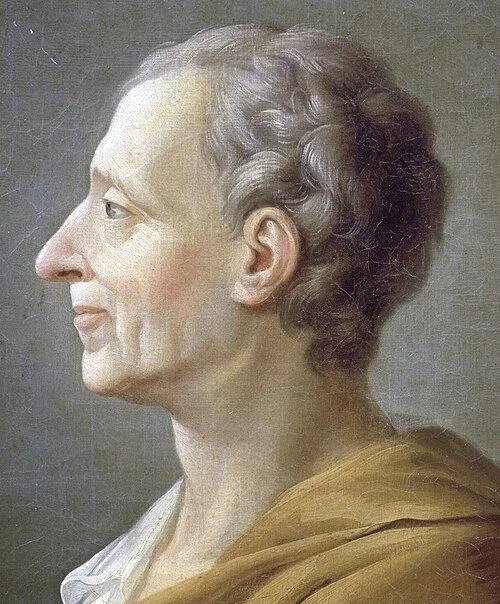
Portrait of Montesquieu. Source: Public domain, Musée de l'Histoire de France (Versailles), available here.
From mixed government to divided power
One major ancient tradition asked who should rule. Polybius, writing about Rome in the second century BCE, famously described a mixed constitution in which consuls, Senate, and people each possessed powers that could check the others. The point was not that Rome had a legislative branch, an executive branch, and a judicial branch in the modern sense. Polybius was interested in the combination of monarchical, aristocratic, and democratic elements.
That distinction is important. Mixed government distributes political standing among social or constitutional forces. Separation of powers distributes kinds of governmental activity. The two ideas can overlap, and later constitutional thinkers often used both, but they are not identical. The Roman example helped keep alive the idea that liberty might depend on institutions capable of resisting one another. It did not yet produce the three boxes familiar from a modern civics textbook.
The same caution applies to Greek philosophy. Plato divided the soul into reason, spirit, and appetite and built an account of the city around differentiated human capacities. Aristotle catalogued offices and constitutional forms with extraordinary precision. These works supplied later thinkers with languages for order and balance, but they were not preliminary drafts of the United States Constitution. Ancient materials mattered because they preserved questions that later writers would ask again under different conditions.
Locke did not give us the modern trio
By the seventeenth century, European political thought increasingly focused on functions of government. John Locke's Second Treatise is especially revealing because his categories are close to the later separation of powers but not the same. Locke gave pride of place to legislative power, distinguished it from executive power, and also identified a federative power concerned with war, peace, alliances, and relations outside the commonwealth.
A modern reader may be tempted to convert Locke automatically into legislature, executive, judiciary. That move would erase the historical difference. Courts did not yet occupy the conceptual position they would later acquire in American constitutionalism. Locke's scheme shows that once political writers began separating functions, several arrangements remained possible. There was no law of political nature requiring exactly three modern branches.
Montesquieu changes the vocabulary
Montesquieu's Spirit of the Laws, published in 1748, supplied the vocabulary that would become especially important to Anglo-American constitutional thought. In his famous discussion of the English constitution, Montesquieu distinguished legislative power, executive power concerning matters dependent on the law of nations, and executive power concerning matters dependent on civil law. The last category included judging and punishment and became associated with judicial power.
Montesquieu's achievement was not simply to invent three labels. He tied institutional differentiation to liberty. If the power to make law, execute law, and judge disputes were concentrated in the same hands, political freedom was endangered. Yet Montesquieu's own account was more complicated than the clean diagram later generations often drew from it. He wrote about social orders, monarchy, intermediary bodies, and institutional relations as well as functional separation.
The power of his formulation lay partly in translation. It could travel. Eighteenth-century readers could take a complex account of English political liberty and turn it into a more portable principle: different forms of public power should not be allowed to collapse into one another.
Philadelphia turns a theory into offices
The American Constitution gave that principle unusually visible textual form. Article I vests legislative powers in Congress. Article II vests executive power in a President. Article III vests judicial power in federal courts. The sequence encourages the familiar tripartite reading, but the Constitution immediately complicates it. The President participates in legislation through the veto. The Senate shares in appointments and treaties. Congress creates lower federal courts and controls much of their jurisdiction. The branches are distinct, but they are not sealed compartments.
The Federalist therefore defended both separation and connection. Madison warned against accumulation of legislative, executive, and judicial powers in the same hands, while also arguing that constitutional liberty did not require complete isolation. The practical problem was to create institutions with enough independence to resist encroachment and enough interdependence to govern.
This is one reason the phrase checks and balances can be misleading when treated as a synonym for separation of powers. A check is a relationship. A power is a function. The American system does both. It identifies characteristic kinds of authority and then deliberately gives institutions limited ways to interfere with one another.
Why the three became common sense
Once the Constitution endured, the American arrangement acquired the authority of familiarity. Political practice, judicial doctrine, textbooks, court cases, and civic education all reinforced the three-part map. Later constitutions around the world borrowed, modified, or rejected elements of it. Administrative government then made the map harder to draw, because agencies can make rules, execute statutes, and adjudicate disputes within the same institutional setting.
That modern complication helps us see the historical achievement more clearly. The three branches were never merely a count of government offices. They expressed a judgment that different forms of authority possess different dangers and different claims to legitimacy. Legislatures deliberate and represent. Executives act, administer, and take responsibility. Courts decide disputes through legal judgment and reasoned explanation. Real institutions overlap, but the distinctions still shape what citizens expect from them.
The long history therefore changes the question. Instead of asking why every government naturally comes in threes, we should ask why so many political traditions have found it useful to distinguish kinds of authority and why the eighteenth-century Anglo-American world crystallized those distinctions in this particular form. The answer runs through ancient mixed government, early modern functional division, Montesquieu's theory of liberty, and the American experiment. What looks inevitable from a schoolroom diagram was in fact the product of centuries of argument.
Charles Edward Andrew Lincoln IV is author of Gods, Judges, and Presidents.
References and Further Reading
Polybius, Histories, Book VI, especially 11-18, on the Roman mixed constitution.
John Locke, Second Treatise of Government, chs. XI-XII, on legislative, executive, and federative power.
Montesquieu, The Spirit of the Laws, Book XI, ch. 6, on the English constitution and separated powers.
The Constitution of the United States, arts. I-III.
The Federalist Nos. 47-51 (James Madison), on separation of powers, checks, and institutional dependence.
Charles Edward Andrew Lincoln IV, Gods, Judges, and Presidents: Trifunctional Archetypes in American Law and Government (Bloomsbury Academic, 2026).