The reign of King John entered its most dangerous phase not simply because he was unpopular, but because military failure began to undermine the very foundations of his authority. When John became king in 1199, he inherited one of the most extensive collections of territories ever assembled by an English monarch. The Angevin Empire stretched across large parts of modern-day France, from Normandy and Anjou to Aquitaine, while England itself provided the wealth and political base from which these possessions could be governed. Yet within little more than a decade, much of this vast inheritance had disappeared. The loss of these territories would have consequences far beyond the battlefield. It would damage John's reputation as a ruler, drain the English treasury, increase the financial demands placed upon his subjects and, ultimately, convince many of his most powerful nobles that the king himself had become a threat to the stability of the realm.
Terry Beiley explains.
You can read part 1 on the cruel King who made his own enemies here.
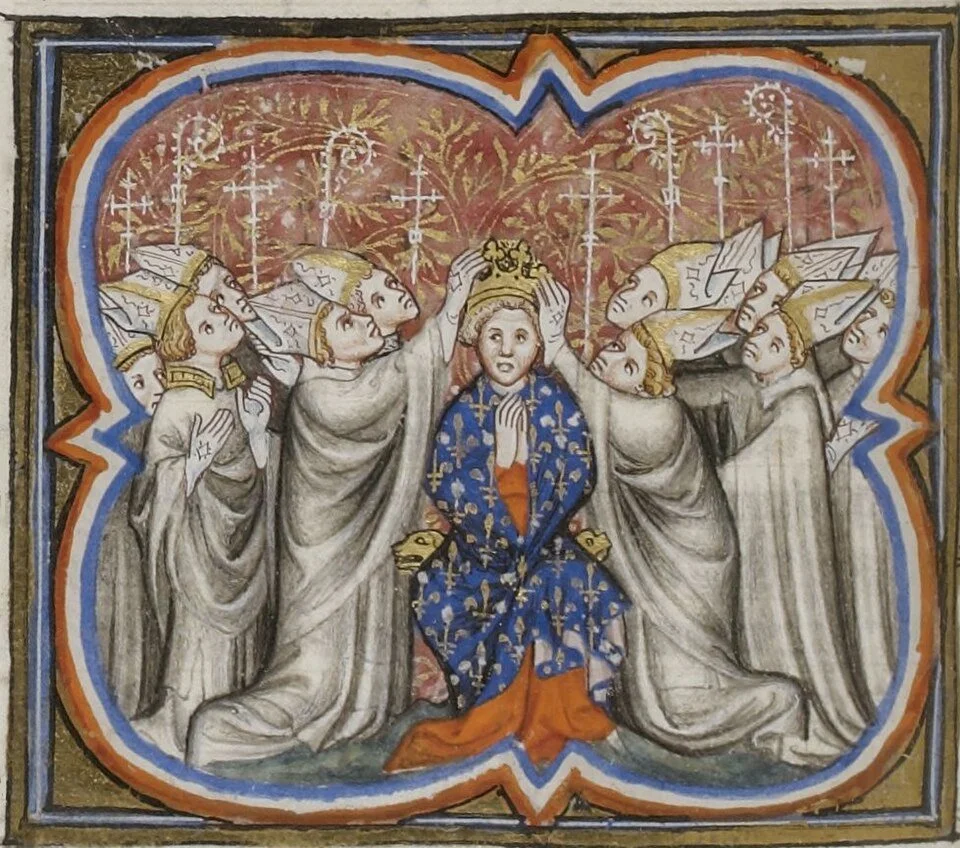
The coronation of Philip II of France. Source: Public domain, Bibliothèque nationale de France, available here.
John's difficulties began almost immediately after his accession. His claim to the French territories inherited from his brother Richard I was challenged by his nephew, Arthur of Brittany. Arthur was supported by Philip II of France, who saw an opportunity to weaken the Angevin territories that had long represented a formidable obstacle to Capetian expansion. John initially appeared capable of containing the threat, but his position deteriorated rapidly. His military response was undermined by political divisions within his French territories, and several important nobles began transferring their allegiance to Philip.
The decisive crisis came in 1203–1204 with the loss of Normandy. John had been unable to prevent Philip II from systematically attacking the duchy, while a combination of military pressure, defections and political miscalculation weakened the English position. The fall of Château Gaillard, the great fortress constructed by Richard I to guard Normandy, was particularly significant. When Château Gaillard fell in March 1204, the strategic position of Normandy became increasingly untenable. Rouen itself surrendered soon afterwards. By the end of 1204, Normandy, Anjou, Maine and Touraine had effectively been lost to the French crown.
The loss was catastrophic for John's prestige. Normandy had been under English royal control for generations and was not merely another possession across the Channel. It had been central to the political and economic power of the Norman and Angevin kings. Its loss meant that John had failed to defend one of the most important parts of his inheritance. Worse still, much of the defeat had occurred without the kind of spectacular final battle that could easily be blamed upon bad luck. Philip had gradually dismantled John's position through military pressure, diplomacy and the exploitation of John's political weaknesses.
The collapse of Normandy marked the beginning of the end of what historians commonly call the Angevin Empire. The term itself is somewhat misleading, because these territories were not a unified empire in the modern sense. They were a collection of duchies, counties and lordships held by the same ruling dynasty, each with its own traditions, laws and political relationships. Nevertheless, the territories together gave the English monarchy enormous prestige and resources. Their loss dramatically altered the balance of power between England and France.
John did not simply accept the loss. He spent much of the remainder of his reign attempting to recover the territories taken by Philip. This created a dilemma. To regain his continental possessions, John needed money. To obtain money, he had to place greater financial demands upon England. Yet the more money he extracted, the greater the resentment among the very people whose support he needed.
The king's strategy was ambitious. John attempted to build alliances against Philip and encouraged his nephew Otto IV, Holy Roman Emperor, to challenge French power. Other rulers and nobles were drawn into a broad coalition that sought to contain Philip II. In 1214, John launched a major campaign in France while his allies attacked from the north. If successful, the operation could have reversed years of French expansion and restored much of John's lost position. Instead, the campaign ended in disaster.
The crucial confrontation took place at the Battle of Bouvines in July 1214. John had already suffered a setback at La Roche-aux-Moines, where his advance into Anjou collapsed after resistance from local forces and the approach of enemy troops. Meanwhile, the allied army led by Otto IV met Philip II at Bouvines. The French king achieved a decisive victory. The defeat destroyed the coalition's immediate hopes of reversing French expansion and left John in an increasingly desperate position.
For John, Bouvines was far more than a military defeat. It represented the failure of years of diplomacy, taxation and military preparation. The enormous sums raised for the campaign had produced no corresponding victory. England had paid heavily for a war that had failed to restore the lost territories. The political consequences were therefore particularly severe.
John's attempts to finance his wars had already placed considerable pressure upon the English nobility. Medieval kings did not possess a modern taxation system capable of providing a predictable national income. The crown depended upon a mixture of traditional revenues, feudal payments, customs duties, fines, land income and extraordinary demands imposed when circumstances required additional money.
One of the most important mechanisms available to John was scutage, a payment traditionally made by knights or their lords in place of military service. In principle, scutage allowed the king to hire soldiers rather than requiring every knight owing military service to serve personally. It could therefore be a practical method of financing warfare. Under John, however, its repeated use and increasing financial burden contributed to the growing perception that the king was exploiting his feudal rights to extract as much money as possible from his subjects.
Scutage was not the only source of resentment. John imposed a range of extraordinary financial demands, fines and levies, and his administration became increasingly aggressive in collecting royal revenues. The issue was not simply that taxation existed; medieval kings had always demanded money. The problem was the scale and frequency of John's demands, particularly when the money appeared to be financing unsuccessful military campaigns.
For the barons, this produced a deeply troubling situation. They were expected to provide money to a king who had already lost enormous territories and then demanded still more resources to recover them. The argument could easily be turned against John: if his wars had repeatedly failed, why should the barons continue paying for them?
There was also a fundamental political issue beneath the financial dispute. Feudal government depended upon relationships of obligation and loyalty. A king expected service and money from his nobles, while nobles expected the king to protect their interests, respect established customs and administer justice. When either side believed the other was failing in its obligations, the relationship could begin to fracture.
John's reputation made the problem considerably worse. His military failures reinforced existing suspicions about his judgement, while his methods of government created fear and hostility among many of his subjects. His dealings with powerful nobles were frequently confrontational, and his use of financial penalties could leave wealthy men vulnerable to the king's demands. A monarch who was already distrusted could not easily impose extraordinary taxation without provoking resistance.
The Church also became increasingly hostile towards John. The dispute over the appointment of the Archbishop of Canterbury, Stephen Langton, had already brought John into conflict with Pope Innocent III. When John refused to accept the papal choice, England was placed under an interdict in 1208, suspending many public religious services. John himself was eventually excommunicated in 1209.
The dispute eventually became another source of political isolation. Although John ultimately submitted to the papacy and made substantial concessions, the episode damaged his relationship with important Church leaders. His willingness to confront the Church demonstrated the extraordinary extent to which he was prepared to resist opposition, but it also meant that he had alienated an institution possessing enormous political and social influence.
By the time John returned from his failed campaign in France in 1214, his position had become increasingly precarious. He had lost Normandy and most of the Angevin territories that had once formed the foundation of his family's continental power. His attempt to recover them had ended in failure. His treasury had been depleted by years of warfare, while the financial burden placed upon the English nobility had become increasingly difficult to justify.
The barons' dissatisfaction therefore cannot be explained simply as opposition to taxation. Their grievances were connected to a much larger question: could John still be trusted to govern effectively? A king could demand extraordinary sacrifices from his nobles if those sacrifices produced security, victory and prosperity. John was increasingly asking them to pay for failure.
This distinction was crucial. Had John won a spectacular victory over Philip II, many of his financial demands might have been remembered as the necessary price of restoring the kingdom's continental possessions. Instead, the defeat at Bouvines left the barons with little to show for the enormous resources they had provided. The king had not restored his lost empire. He had merely spent more money attempting to recover it.
John was therefore becoming politically isolated. His relationship with the barons was deteriorating, his relationship with the Church had been severely damaged, and his reputation as a military leader had suffered repeated blows. Even his eventual reconciliation with the papacy could not repair the deeper problem: too many powerful men had begun to question whether John's rule served the interests of the kingdom.
The loss of Normandy had begun as a military and territorial disaster. By 1214, however, it had developed into a constitutional and political crisis. John's inability to defend the inheritance of his dynasty had damaged his prestige; his determination to recover it had exhausted resources; and his methods of raising money had turned financial necessity into political resentment.
For an increasing number of barons, the issue was no longer simply whether John was an unpleasant or unpopular king. They were beginning to believe that his judgement, policies and methods of government were actively endangering the kingdom itself. If John could not win his wars, protect the realm, respect established political relationships or restrain his demands for money, then the traditional bonds between king and subjects were in danger of collapsing.
The stage was therefore set for open confrontation. The next crisis would not be fought primarily on the battlefields of France, but in the political heart of England, where John's opponents would attempt to force the king to accept limits upon his authority.
And it was there, in 1215, that the struggle would produce one of the most famous documents in English history: Magna Carta.
The story of John's failures in France was not simply one of lost castles, defeated armies and disappearing territories. It was the story of how military failure transformed the relationship between a medieval king and the people upon whom his authority depended.
When John inherited the throne in 1199, he inherited the vast territorial legacy of Henry II and Richard I. Within a few years, however, Normandy, Anjou, Maine and Touraine had been lost to Philip II. The fall of Château Gaillard and Rouen became powerful symbols of a king unable to defend his inheritance, fundamentally weakening his prestige.
John's response was to attempt to recover what he had lost. But war required enormous financial resources, creating the central contradiction of his reign: he needed the support of his kingdom to finance his wars, yet the taxes, scutage, fines and feudal payments used to raise that money increasingly destroyed that support.
The defeat at Bouvines in 1214 brought this contradiction into sharp focus. Despite years of taxation, preparation and alliance-building, John failed to recover his territories. His subjects were being asked to make greater sacrifices without receiving the military success that might have justified them.
The growing opposition was therefore not simply personal dislike of John. It was a crisis of trust. Medieval kingship depended upon reciprocal obligations: the king expected loyalty, military service and financial support, while his subjects expected protection, justice and respect for established customs. John was increasingly failing to uphold his side of that bargain.
Military defeat, financial demands, disputes with the nobility and conflict with the Church combined to produce a dangerous accumulation of grievances. By 1214, these problems had become interconnected: military failure required more money; more money created resentment; resentment weakened loyalty; and weakened loyalty made effective government increasingly difficult.
The question was no longer simply whether John was unpopular, but whether he could be trusted to govern within the accepted customs of the realm.
This was the crisis that led towards Magna Carta. It did not emerge suddenly because the barons disliked John, nor was it originally a declaration of democracy or modern human rights. It was a medieval attempt to resolve a political crisis by reaffirming established rights and limiting the king's ability to act beyond accepted custom.
By the end of 1214, John had lost much of his continental inheritance, failed to recover it, spent heavily attempting to do so and alienated many of the men whose cooperation was essential to his rule. The battlefield had effectively moved from France to England. The next confrontation would be fought not with siege engines and cavalry, but through political pressure, negotiation and eventually rebellion.
In 1215, John's opponents would force him to confront the consequences of years of military failure, financial demands and political miscalculation. The road to Magna Carta had begun with the loss of an empire. It would culminate in one of the first great confrontations over the limits of the English Crown.
Now read part 3 on rebellion and Magna Carta here.