
Like today, a Roman bakery started very early and provided essential delicious food to the populace. Here, William McGrath describes how a Roman bakery operated in the early hours of the morning
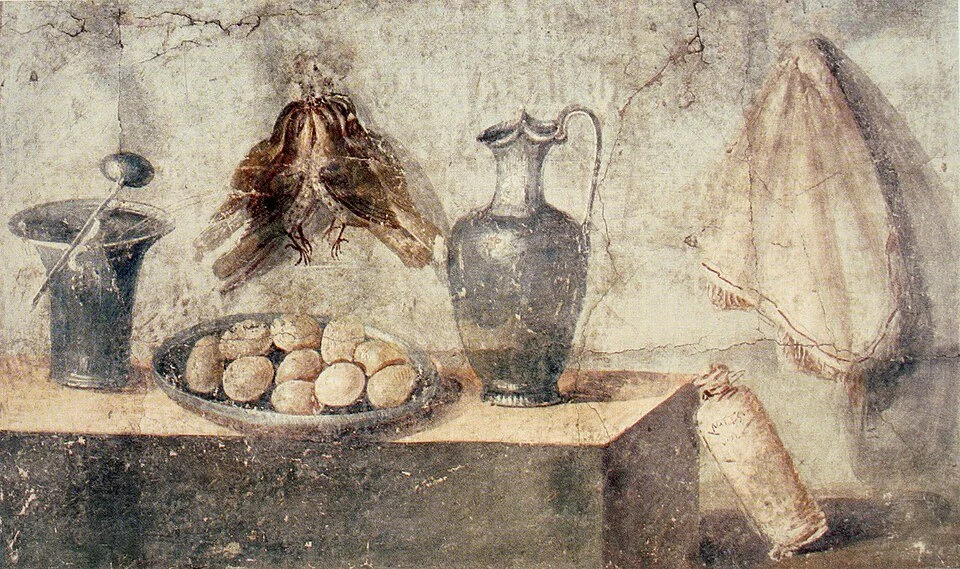
Still life with eggs, birds and bronze dishes. Source: Public domain, Naples National Archaeological Museum, available here.
Before sunrise, the bakery is already awake.
The streets outside still lie in darkness, their stone surfaces cool beneath the night air, but warm light spills through the open doorway of the pistrinum, stretching across the street in uneven bands of gold. Before the first customer appears, before the markets begin to stir, the smell arrives first.
Fresh bread.
Warm flour.
Wood smoke.
Even those passing by know where it comes from.
Inside, the heat is immediate.
At the heart of the bakery stands the furnus, the great domed oven upon which everything depends. Built from brick and stone, its rounded walls have absorbed years of heat, smoke, and ash until they have become almost black around the mouth. The opening appears surprisingly small compared with the chamber hidden behind it, just large enough for long wooden paddles to slide loaves deep inside.
The fire itself is already dying.
It has done its work.
Hours earlier, bundles of seasoned wood were fed into the oven until the stone glowed with stored heat. Now the embers are raked away, leaving the floor clean enough for bread to bake directly upon the hot stone. The warmth radiates from the oven in slow waves, reaching every corner of the room.
The bakery never truly cools.
Every surface seems touched by warmth. Flour rests in a fine white dust across benches, shelves, and the shoulders of those who work here. It hangs faintly in the air, catching the light as workers pass through it.
The sounds are constant.
Wooden paddles scrape against stone. Dough lands heavily upon worn workbenches with a soft, rhythmic thud. Sacks of grain are lowered onto the floor. Someone coughs as another cloud of flour rises into the air. Quiet conversation blends with laughter before disappearing beneath the crackle of the oven and the steady knock of wooden bowls against the tables.
Outside, the deep grinding of millstones turns without pause.
Many bakeries ground their own flour using large volcanic stone mills, often powered by donkeys walking patiently in endless circles. Wheat disappears beneath the heavy stones before emerging as fresh flour, ready to become the day's bread.
Nothing inside the bakery remains still for long.
A broad-shouldered baker leans his full weight into a mound of dough, folding it again and again until it becomes smooth beneath his hands. Nearby, another worker rolls smaller portions across the bench with quick, practiced movements, scarcely looking as years of experience guide each motion. A younger apprentice hurries between them carrying baskets almost too large for him, drawing amused smiles from the older bakers as flour clings to his hair and eyelashes.
No one speaks of rushing.
Yet everyone moves quickly.
Each person understands their place within the rhythm of the bakery.
Roman bakeries employed a mixture of skilled bakers, apprentices, slaves, and freedmen. Every loaf depended upon their combined labor, each task passing seamlessly to the next. While one worker kneads, another shapes. While one loads the oven, another prepares the next batch. Long before sunrise, an entire day's work is already unfolding.
The dough itself changes beneath their hands.
At first it feels rough, uneven, reluctant to hold together. Gradually it softens, becoming elastic beneath steady pressure until it stretches without tearing. The smell changes too. Dry grain gives way to the gentle scent of rising bread, subtle at first before slowly filling the room.
Not every loaf is the same.
Some are large, round wheels intended to feed entire households. Others are smaller, carried home beneath an arm while still warm. Many are carefully scored before baking into eight equal sections, creating the familiar wheel-shaped loaves discovered preserved beneath the ash of Pompeii. The cuts make them easier to divide, whether shared among a family or sold in individual portions.
The color tells its own story.
The finest loaves emerge pale golden, made from carefully sifted wheat flour affordable only to wealthier households. Others bake darker, using barley or coarser grains more commonly found on ordinary Roman tables. Both nourish, though not every Roman eats equally.
Bread is only part of the day's work.
Honey cakes sweetened with thick golden honey cool upon wooden boards. Small buns flavored with poppy seeds or scented with anise wait beside fruit-filled pastries containing chopped dates or dried figs. Their sweetness is gentle rather than rich, but enough to tempt those passing the doorway as the first warmth of morning reaches the street.
The smell grows stronger.
Warm crust.
Roasted grain.
Honey.
Olive oil.
Smoke from the oven drifts beyond the doorway and settles into the cool morning air. Before anyone sees the bakery itself, they know exactly where it is.
Customers begin to arrive.
Some carry baskets from home. Others simply wait their turn, exchanging greetings with neighbors while watching fresh loaves disappear from the oven. Children stand on their toes trying to glimpse the shelves beyond the counter. One man cannot resist tearing away a corner of a loaf before he has even left the doorway, quickly passing it from one hand to the other as the heat catches his fingers.
No one seems surprised.
This happens every morning.
For Romans, bread was more than food. It formed the foundation of daily life, eaten by rich and poor alike. Entire neighborhoods depended upon bakeries like this one, where skilled workers transformed grain into the food that sustained the city. The smell drifting through the streets each morning was as familiar to ancient Rome as church bells or morning traffic are today.
Outside, daylight finally begins to spread across the rooftops.
The city awakens.
Merchants unlock their shops. Market stalls fill the streets. Voices rise from every direction as Rome begins another day.
Inside the bakery, little has changed.
The oven still glows with stored heat. Flour still hangs in the air. Fresh loaves continue to emerge one after another, their crusts crackling softly as they cool upon wooden shelves.
Long before the city is fully awake, Rome already knows where breakfast is waiting.
It simply follows the smell.
Did you enjoy the piece? Join us on X here to receive regular updates: @HistoryIsNowMag
Now read about what happened in Ancient Rome after dark here.